

B2B Intent Data for ISPs should help revenue teams find accounts that are both interested and reachable. The commercial stakes are simple: an ISP can waste money chasing demand outside the footprint, or it can focus sales time on buyers that fit the network, the offer, and the next-best action.
Percepture’s point of view is that this is not generic marketing. It is serviceability-aware market conditioning: ISP marketing starts with the network, then adds trust, search visibility, AI retrievability, sales routing, and measurable business outcomes.





What is serviceable account intelligence?
B2B Intent Data for ISPs is the process of connecting buyer signals, serviceable markets, proof, search visibility, and sales follow-up into a pipeline system. The strongest programs do not start with channels. They start with where the ISP can sell, who is likely to buy, what proof the buyer needs, and how fast sales can respond.
Executive summary for ISP leadership
Start with footprint
In B2B Intent Data for ISPs, intent outside the network may be interesting, but it is not a near-term revenue opportunity unless expansion is part of the plan.
Score fit before channel
Good programs rank accounts by serviceability, company fit, need, timing, and sales capacity before media spend increases.
Proof before pitch
Business buyers want confidence that the ISP can serve their address, support their use case, and communicate clearly.
Route fast
Buyer intent loses value when address checks, CRM routing, and sales ownership are slow or unclear.
Measure pipeline
Clicks matter less than qualified leads, address checks, meetings, install conversion, pipeline value, and response time.
Run an address-level demand intelligence review
If your team has buyer signals but does not know which accounts are serviceable, B2B Intent Data for ISPs should map the gap between interest and reachable revenue.
Run an address-level demand intelligence reviewWho this guide is for
CEO and CRO
You need to know whether intent spend can connect to revenue, market expansion, trust, and sales execution.
VP Sales and enterprise sales
You need better account priority, cleaner handoffs, and a reason to call that is stronger than a cold list.
VP Marketing and demand generation
You need search, GEO, digital PR, landing pages, CTAs, and proof assets that support the sales motion.
Revenue operations
You need clean fields, routing rules, lead source discipline, and reporting that separates activity from opportunity.
This guide is for teams that need B2B Intent Data for ISPs to reflect network reality, not just broad market interest. It is not for teams looking for broad untargeted media buying, generic social posts, or a channel-first campaign that ignores network reality. If the ISP cannot sell everywhere, the strategy cannot market everywhere.
What B2B Intent Data for ISPs means
At a basic level, intent data shows that a company or person may be researching a topic, vendor, problem, or buying category. For broadband and enterprise connectivity, that can include public buying signals, search behavior, firmographic clues, hiring activity, technology needs, location data, and engagement with ISP content.
The ISP version is different because the account must be matched to footprint. A national software company can sell almost anywhere. A broadband provider cannot. That is why ISP marketing agency strategy has to respect serviceability, availability, construction constraints, sales territory, and install readiness.
Useful B2B Intent Data for ISPs answers five practical questions: who appears to be in-market, can we serve them, do they fit the offer, what proof do they need, and what should sales do next? If the data cannot answer those questions, it is research, not revenue intelligence.
Why generic intent data breaks without serviceability
Generic intent programs often start with a list of accounts researching a topic. That can help software, consulting, or national B2B services. For ISPs, it can create noise if the list is not filtered against footprint and offer fit.
B2B Intent Data for ISPs fails when serviceability is treated as an afterthought. A business may show interest in dedicated internet access, Metro Ethernet, cloud connectivity, backup circuits, or fiber upgrades, but the opportunity depends on whether the ISP can serve the address and support the buyer’s timeline.
Marketing where the network cannot sell wastes spend and breaks trust. A buyer who clicks, fills out a form, and later learns that service is not available may not give the brand a second chance. Fiber passings are not revenue. Search visibility only matters when it turns into address checks, qualified leads, meetings, installs, subscribers, or retention.
Percepture connects this work with telecom marketing, organic SEO services, generative engine optimization services, and digital PR because visibility, credibility, and action have to work together.
The Intent-to-Serviceability Model
The Intent-to-Serviceability Model is Percepture’s practical framework for turning B2B Intent Data for ISPs into a sales-ready workflow. It filters demand through network reality, buyer fit, proof, visibility, and follow-up instead of treating every signal as equal.
1. Footprint filter
Owner: network, sales ops, marketing. Confirm whether the account, address, building, or market can be served now or should be tagged for future expansion.
2. Buyer-fit score
Owner: sales and marketing. Check industry, size, locations, likely bandwidth needs, technology use, and buyer committee complexity.
3. Intent and timing layer
Owner: demand generation. Separate active research, event triggers, search engagement, competitor comparison, and content engagement.
4. Proof and trust layer
Owner: marketing, PR, leadership. Build Trust Tokens such as case studies, service-area pages, expert content, testimonials, and clear availability language.
5. Routing and next action
Owner: revenue operations. Pass the right account to the right seller with address notes, context, source, urgency, and recommended outreach.

Example: a regional healthcare group searches for redundant business internet and engages with an enterprise fiber page. A weak program adds the company to a generic nurture list. A strong program checks the facilities, confirms serviceable locations, scores the account, routes the best match to enterprise sales, and supports outreach with proof, availability language, and a clear CTA.
“The mistake is treating ISP marketing like normal demand generation. It is not. The first question is not what channel to use. The first question is where the network can sell, what the market already believes, and what proof is needed before a buyer takes the next step.”
Bob Generale, President, Percepture
What signals matter for ISP sales teams
Not every signal deserves the same response. A high-value business researching multi-site connectivity in a serviceable area is different from a student searching for home internet plans. The signal has to match the business offer.
For B2B Intent Data for ISPs, strong programs watch for searches around dedicated internet, enterprise fiber, business broadband, Metro Ethernet, backup connectivity, construction timelines, network reliability, price comparisons, and carrier alternatives. They also watch public clues such as office moves, new locations, hiring for IT roles, vendor changes, expansion announcements, and conference engagement.
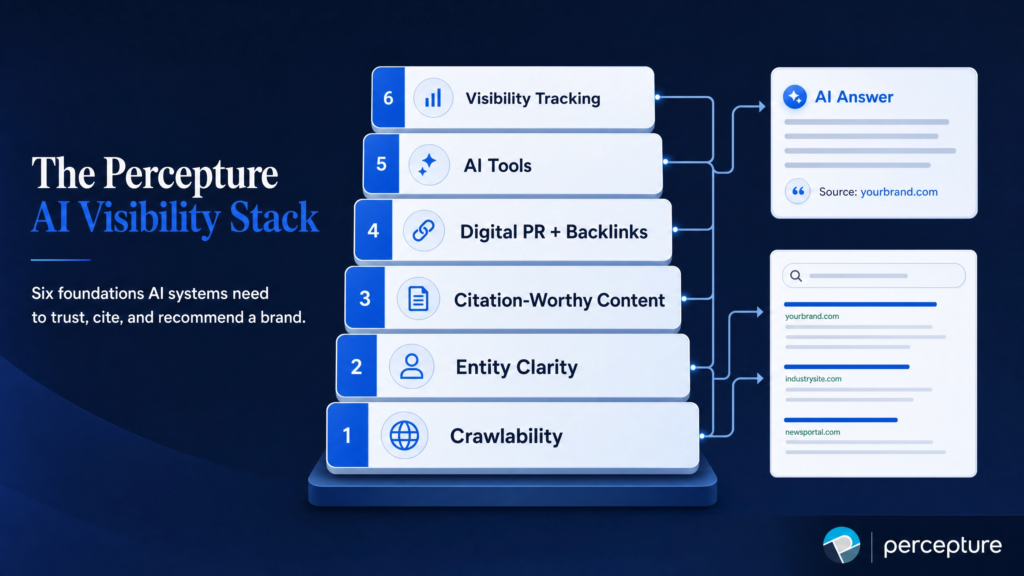
Search and AI-answer visibility matter because buyers now ask detailed questions before they contact sales. Percepture uses the Golden Triangle to connect organic search, AI answers, and third-party proof. AI visibility is not a replacement for SEO, PR, or proof. It is the compounding result of all three.
How to score accounts by fit, timing, and footprint
B2B Intent Data for ISPs should be scored with a simple rule: an account is only high priority when it shows need, fit, serviceability, and a clear sales path. A buyer who is not serviceable may still matter for expansion planning, but the sales response should be different.
A practical ISP account score can include: serviceable address match, market priority, company size, location count, likely product fit, current provider clues, search behavior, content engagement, buying urgency, CRM history, and sales owner capacity. The score does not have to be perfect. It has to be consistent enough to prevent sales leakage.
This is where Metro Ethernet lead generation, fiber internet PPC strategy, local SEO for fiber internet providers, and broadband offer strategy should work together. Demand capture, local discoverability, and offer clarity all support the same pipeline.
Intent data scorecard
Use this scorecard to test whether your current B2B Intent Data for ISPs program is ready for sales execution.
| Readiness question | Yes or no | Why it matters |
|---|---|---|
| Do you match intent signals to serviceable addresses or markets? | Yes / No | Prevents spend on accounts the network cannot serve. |
| Do you separate near-term sales targets from expansion intelligence? | Yes / No | Keeps sales focused while preserving planning value. |
| Do you score firmographics and technographics before outreach? | Yes / No | Improves fit and reduces low-quality follow-up. |
| Do landing pages explain availability, proof, and next steps clearly? | Yes / No | Improves buyer confidence before the form fill. |
| Do you have Trust Tokens for enterprise buyers? | Yes / No | Proof supports conversion and AI retrievability. |
| Do you route leads by product, territory, and urgency? | Yes / No | Reduces missed opportunities and response delays. |
| Do sales reps receive context, not just contact records? | Yes / No | Improves the quality of the first conversation. |
| Do reports connect intent to address checks, meetings, and pipeline? | Yes / No | Moves leadership beyond traffic and raw leads. |
| Do you check branded and non-branded search visibility? | Yes / No | Shows whether the market can find and trust the ISP. |
| Do you review AI-answer visibility without promising inclusion? | Yes / No | Supports answer-engine readiness while keeping expectations honest. |
LeadSeeker and AI-assisted account research workflow
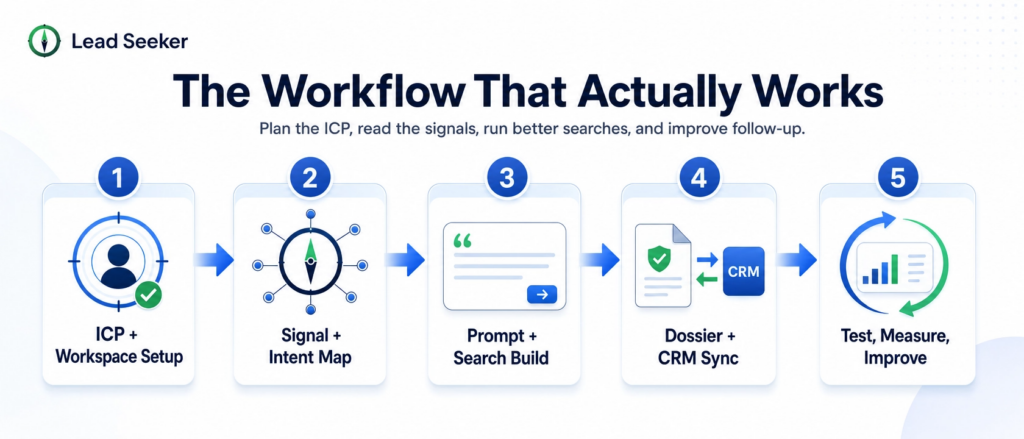
LeadSeeker supports source-backed prospect research and buyer-intelligence workflows. For ISP teams, the value is not only finding names. The value is building a cleaner dossier that helps sales understand why an account may matter, what signal triggered the review, and what the next step should be.
In a B2B Intent Data for ISPs workflow, practical research begins with serviceable markets, pulls in public signals, adds buyer and company context, maps likely needs, and creates an outreach-ready brief. It should also note what is unknown so sales does not overstate availability or fit.
Percepture can connect LeadSeeker with lead generation, omnichannel marketing, conversion rate optimization, and attribution and analytics so intent signals do not die in a spreadsheet.

Get 5 free B2B leads
Test the workflow with five free leads and see how source-backed prospect research can turn intent signals into cleaner account context, outreach lists, and sales-ready next steps.
Review LeadSeeker and B2B search visibility proof
If your team is comparing platforms, data sources, and agency partners for B2B Intent Data for ISPs, review how Percepture thinks about buyer intelligence, search visibility, and qualified lead generation before choosing a channel plan.
Review LeadSeeker Read the Broadstaff case studySales handoff and CRM routing
The handoff is where many intent programs lose money. Marketing may identify a signal, but sales receives a thin record with no serviceability notes, no product fit, no buyer context, and no clear next action.
B2B Intent Data for ISPs needs a stronger workflow that passes the address, market, product interest, source, account score, known buyer context, recommended talk track, and owner. Sales should know whether to call, email, invite the buyer to check availability, send proof, or hold the account for future market development.
For teams exploring automation, ISP sales automation and AI sales agents can support speed and consistency. Automation should not replace judgment on serviceability, compliance, or buyer fit. It should help the team respond faster and document what happened.
Decision matrix: weak programs vs strong ISP programs
This comparison shows where B2B Intent Data for ISPs moves from list buying to accountable revenue operations.
| What weak programs do | What strong ISP programs do | What Percepture would check |
|---|---|---|
| Buy a broad list of companies showing topic interest. | Filter accounts by serviceability, fit, and market priority. | Footprint logic, address fields, exclusion rules, and expansion tags. |
| Send every signal to the same nurture path. | Route by product, urgency, territory, and next-best action. | CRM ownership, handoff speed, and sales enablement notes. |
| Measure clicks and form fills only. | Measure qualified leads, address checks, meetings, pipeline, and response time. | Reporting fields, attribution rules, and leadership dashboards. |
| Use generic landing pages with weak proof. | Use service-area content, availability language, Trust Tokens, and proof before pitch. | Conversion pages, case-study links, proof modules, and buyer objections. |
| Treat SEO, GEO, PR, and paid media as separate efforts. | Use the Golden Triangle so organic search, AI answers, and third-party proof reinforce each other. | Entity clarity, schema, internal links, digital PR, and AI-search visibility checks. |
What should B2B Intent Data for ISPs cost, and how should it be measured?
The right budget depends on footprint size, target accounts, data sources, sales capacity, content gaps, CRM complexity, and how much proof already exists. A smaller regional ISP may need a focused pilot. A larger provider may need a multi-market intelligence and routing system.
Leadership should measure B2B Intent Data for ISPs beyond traffic. Useful metrics include qualified leads, address checks, pre-registrations, meetings booked, cost per qualified lead, install conversion, pipeline value, retention or churn reduction when relevant, sales response time, branded search visibility, non-branded search visibility, and AI-answer visibility checks.
For pricing context around search and AI visibility programs, Percepture provides AI search SEO pricing. For broader category comparison, readers can also review Percepture’s guide to B2B intent data providers.
Mistakes to avoid
With B2B Intent Data for ISPs, the first mistake is treating intent as a substitute for strategy. A signal does not decide whether the buyer is profitable, serviceable, or ready. It only starts the question.
The second mistake is sending sales too little context. If the representative cannot see why the account was flagged, which location matters, and what proof should support the conversation, the data will feel like noise.
The third mistake is making the page sound smarter than the operation can support. Technical buyers will ask about availability, uptime, install timelines, failover, construction realities, and account support. The article should answer what can be answered and route the rest to a qualified conversation.
The fourth mistake is separating AI visibility from the rest of marketing. A page built for answer systems still needs useful content, crawlable text, clear entities, internal links, proof, and a reason for the buyer to act.
Proof before pitch
In B2B Intent Data for ISPs, proof has to support the buyer’s next question, not distract from serviceability. Percepture was founded in 2004 and has experience across B2B, telecom, infrastructure, PR, SEO, GEO, digital marketing, AI-search visibility, AI-agent workflows, and qualified lead-generation programs. For a visible example, see how Percepture connected search visibility, B2B credibility, and qualified lead generation in the Broadstaff Global search visibility and qualified leads case study.

FAQs
What is B2B Intent Data for ISPs?
B2B Intent Data for ISPs is buyer intelligence filtered through serviceability, fit, timing, proof, and sales action. It helps an ISP identify which businesses may be researching connectivity and which of those accounts are worth a qualified outreach path.
Why does ISP intent data need to start with serviceability?
Serviceability protects budget and trust. If the account cannot be served, the lead may be useful for expansion planning, but it should not be treated the same as a near-term sales opportunity.
How should an ISP use buyer intent signals?
An ISP should use B2B Intent Data for ISPs to match signals to footprint, score the account, add buyer context, route the record to the right owner, and support outreach with proof. The goal is a better conversation, not a larger spreadsheet.
What proof should an ISP show before asking for a conversation?
Useful proof includes service-area clarity, business use cases, case studies when approved, testimonials, leadership visibility, technical explanations, and clear next steps. Trust before take-rate.
Which internal links should support an ISP intent article?
The article should link to the ISP pillar, lead generation services, related Metro Ethernet and fiber content, telecom marketing, SEO, GEO, LeadSeeker, pricing, and proof pages so buyers and search systems see the full topic cluster.
What CTA should be used for B2B intent data for ISPs?
The best CTA for B2B Intent Data for ISPs is diagnostic first: review serviceable accounts that show buying signals. Warm readers can review proof or LeadSeeker. High-intent buyers can request an intent-to-pipeline strategy conversation.
How should keyword density be handled?
Use the exact phrase where it helps search clarity, but do not stuff it. The page should also use related terms such as serviceable account intent, telecom sales intelligence, public buying signals, and address-level demand intelligence.
How does this support LLM visibility without sounding robotic?
Use plain definitions, short answers, tables, FAQs, named frameworks, schema, internal links, and visible proof. The writing should answer real buyer questions clearly instead of repeating keywords or using generic AI phrasing.
Talk with Percepture about intent-to-pipeline strategy
If your team is investing in B2B Intent Data for ISPs, Percepture can help review whether your signals, serviceability logic, proof assets, search visibility, and CRM routing are ready to support pipeline.
Talk with Percepture about intent-to-pipeline strategy