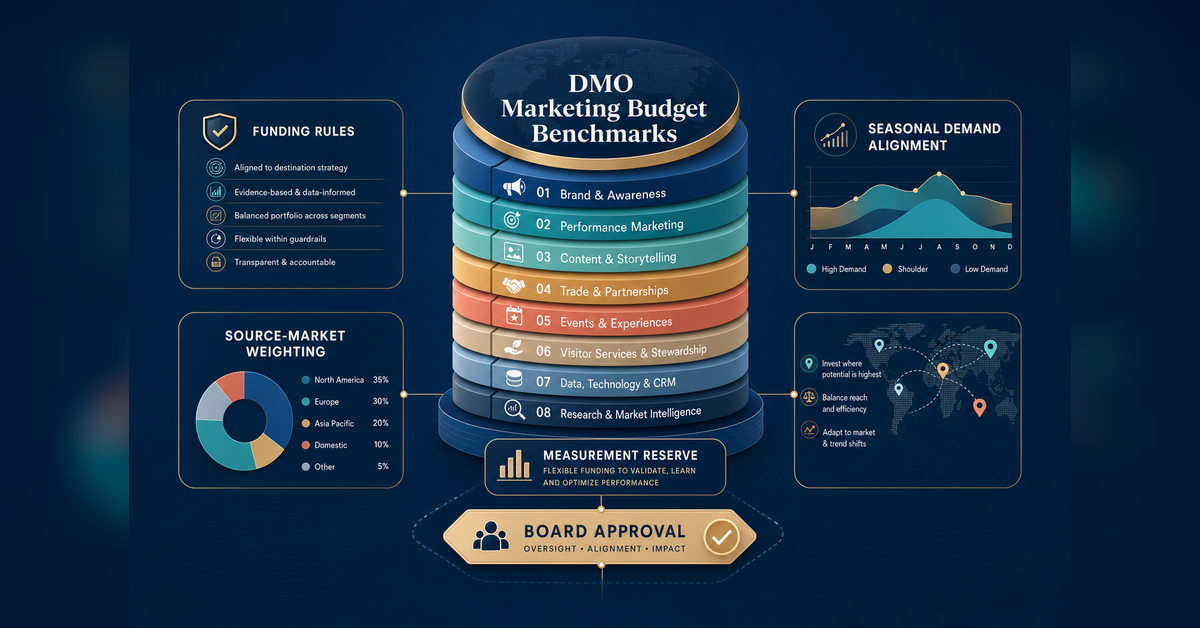

Build a DMO marketing budget in layers: protect essential operations, research, measurement and owned infrastructure first, then fund demand creation, demand capture, sales, partner activation and reserve according to priorities and minimum effective spend.
The right allocation depends on mandate, funding restrictions, market costs, seasonality, partner readiness and measurement. Benchmarks should improve decisions, not invite copy-and-paste budgeting.
Travel experience, independent recognition and ranking proof
A defensible budget should fund outcomes the organization can see, explain and improve. Percepture combines destination strategy, search, paid demand, public relations, AI visibility and measurement in one operating model.





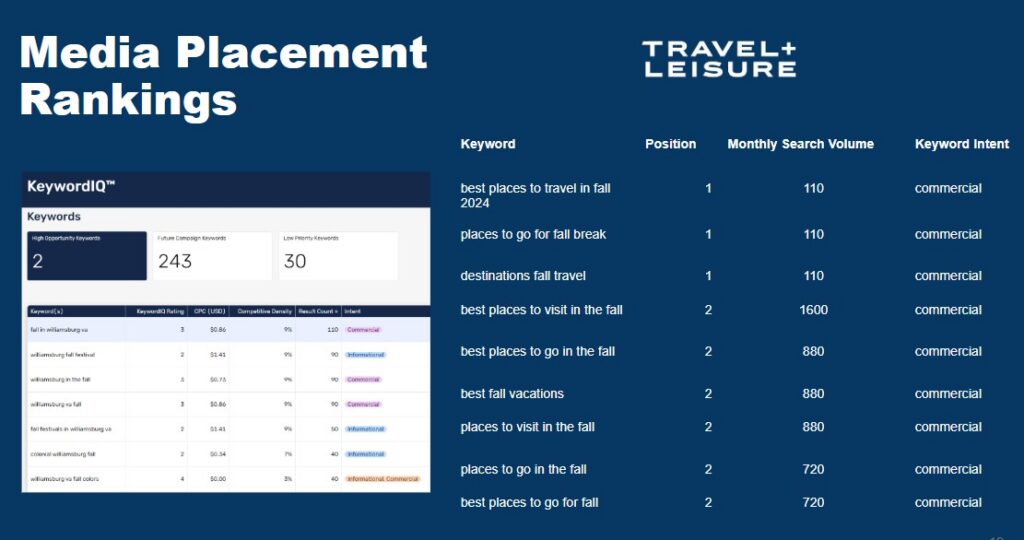
Search, content and earned authority can reinforce the same destination themes long after a paid flight ends.
How much should a DMO spend on marketing?
There is no responsible universal percentage for a DMO marketing budget. Identify restricted and fixed costs, protect owned infrastructure and measurement, then allocate the remaining investment across demand creation, demand capture, sales, partner activation and reserve based on effective scale and measurable priorities.
Start with the decisions the budget must support
Defend eligibility
Document which funds may pay for media, administration, research, sales, events, partner programs or reserves before assigning them to specific budget lines.
Fund effective scale
Give each selected market and channel enough time, creative and distribution to perform. Thin coverage is not diversification.
Protect learning
Measurement must be funded before the campaign starts. Every major line should have a KPI, owner and decision date.
Prepare scenarios
Show what the organization will protect, focus or grow as revenue, conditions and destination priorities change.
A budget is a strategy expressed in dollars. A useful destination budget therefore explains what the destination will fund, why those investments matter and what leaders will do when evidence changes.
Who should use this guide?
This guide supports teams that create, approve, procure or evaluate destination marketing investment.
DMO and CVB executives
Connect the budget to destination priorities, source markets, need periods and public value.
Finance leaders and boards
Separate operating, enabling, direct activation, measurement and reserve costs.
Marketing and sales teams
Balance leisure demand with meetings, sports, group sales and partner activation.
Agencies and procurement teams
Define viable scope, cost ownership, reporting rules and the consequences of reduced funding.
What counts as a DMO budget?
A DMO marketing budget is not the same as the organization’s total operating budget. It is the portion legally and operationally available for marketing work after leaders account for restrictions, committed costs and organizational responsibilities.
- Total operating budget
- All organizational revenue and spending, including staff, administration, facilities, programs and marketing.
- Legally available marketing funds
- Revenue that funding rules permit the organization to use for approved marketing purposes.
- Working media
- Money paid for placements and distribution, such as search, social, broadcast, print, out-of-home or sponsorship inventory.
- Enabling investment
- Research, strategy, creative, content, technology and optimization that allow activation to work and be measured.
- Operating investment
- Staff, governance, procurement, legal, accessibility, vendor management and partner support.
- Reserve investment
- Funds held for disruption, stewardship, emerging opportunities and controlled tests.
Creative, content, research and measurement are not “nonworking” waste; they make direct activation effective and accountable. Leaders can use Percepture’s strategy and planning approach to connect budget categories to objectives before channel selection begins.
When funding falls, narrow the battlefield
In a Branson/Lakes Area CVB media proposal, investment was tied to a defined number of markets and campaign weeks. The guidance warned that a lower spend would require fewer markets or a shorter flight.
That is responsible DMO budget management: preserve effective weight rather than shrinking every market until the campaign cannot produce a useful result. When funding falls, reduce the number of markets, campaign weeks or tactics before shrinking every line until nothing can work.
Build the first DMO marketing budget line by line
Document each objective, market, funding restriction, minimum viable investment, KPI, owner and reallocation date before the board reviews the budget. The worksheet turns competing requests into an auditable portfolio.
The DMO Funding-to-Demand Portfolio
The DMO Funding-to-Demand Portfolio is a layered budget system that protects essential destination infrastructure, funds measurable demand creation and capture, and preserves flexibility for seasonality, opportunity, stewardship and risk. It gives the budget eight distinct investment jobs.
1. Governance and operating floor
Staff, finance, procurement, legal, accessibility, partner support, data governance, board reporting and vendor management.
2. Destination intelligence
Visitor research, resident sentiment, brand tracking, lodging data, source-market analysis, product inventory and attribution design. A destination that does not fund intelligence eventually buys media against assumptions.
3. Owned demand infrastructure
Website, search visibility, destination content, CRM, analytics, partner data, structured information and conversion pathways.
4. Demand creation
Brand media, public relations, creators, video, events, partnerships and destination storytelling.
5. Demand capture
Paid search, organic search, retargeting, email, offer pages, local visibility and booking or partner handoffs.
6. Sales and partner activation
Meetings, sports, travel trade, co-op programs, partner toolkits, familiarization trips, sales missions and RFP systems.
7. Measurement and optimization
Dashboards, media verification, conversion tracking, studies, testing and board reporting supported by attribution and analytics.
8. Reserve, stewardship and opportunity
Crisis response, reputation, disruption, resident communication, demand distribution, market tests and cooperative matches.
Using these jobs keeps the budget tied to operating needs, traveler demand and accountable decisions rather than isolated channel requests.
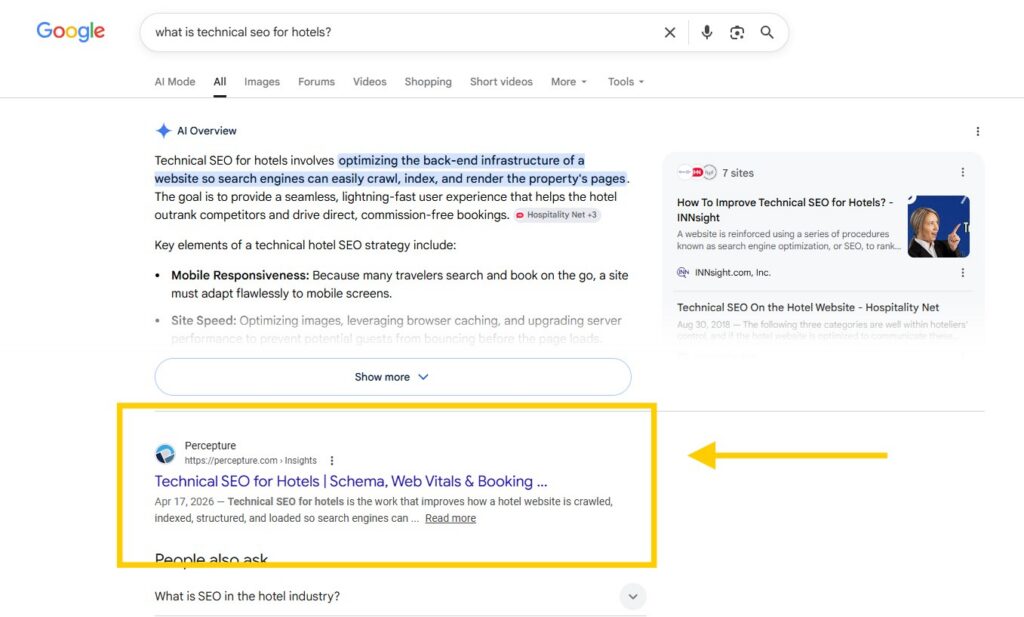
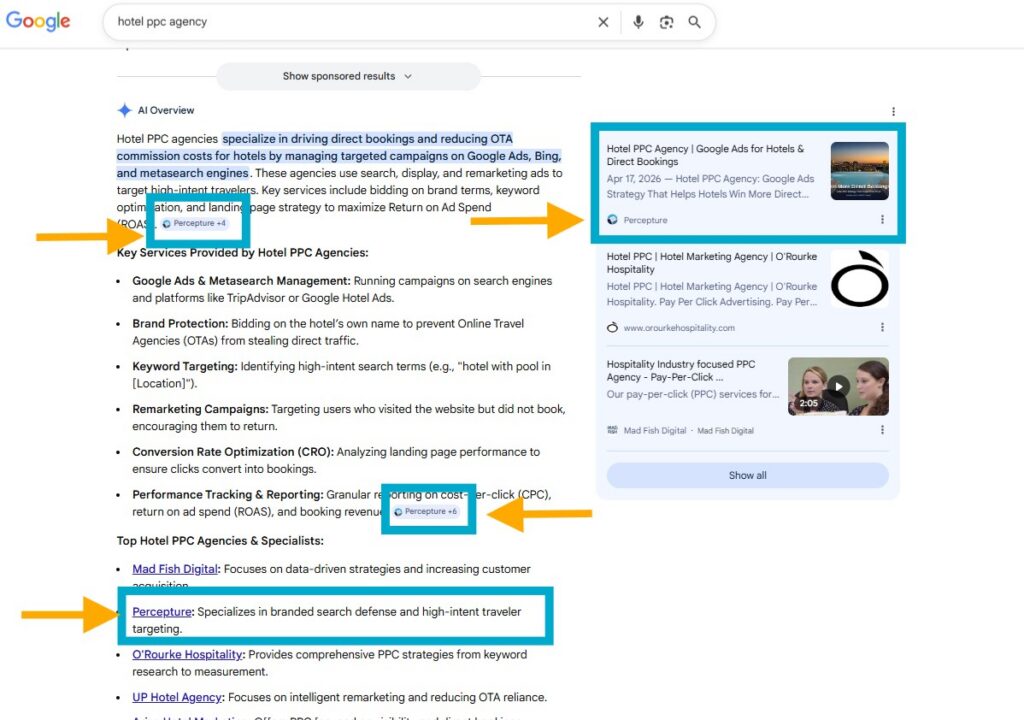
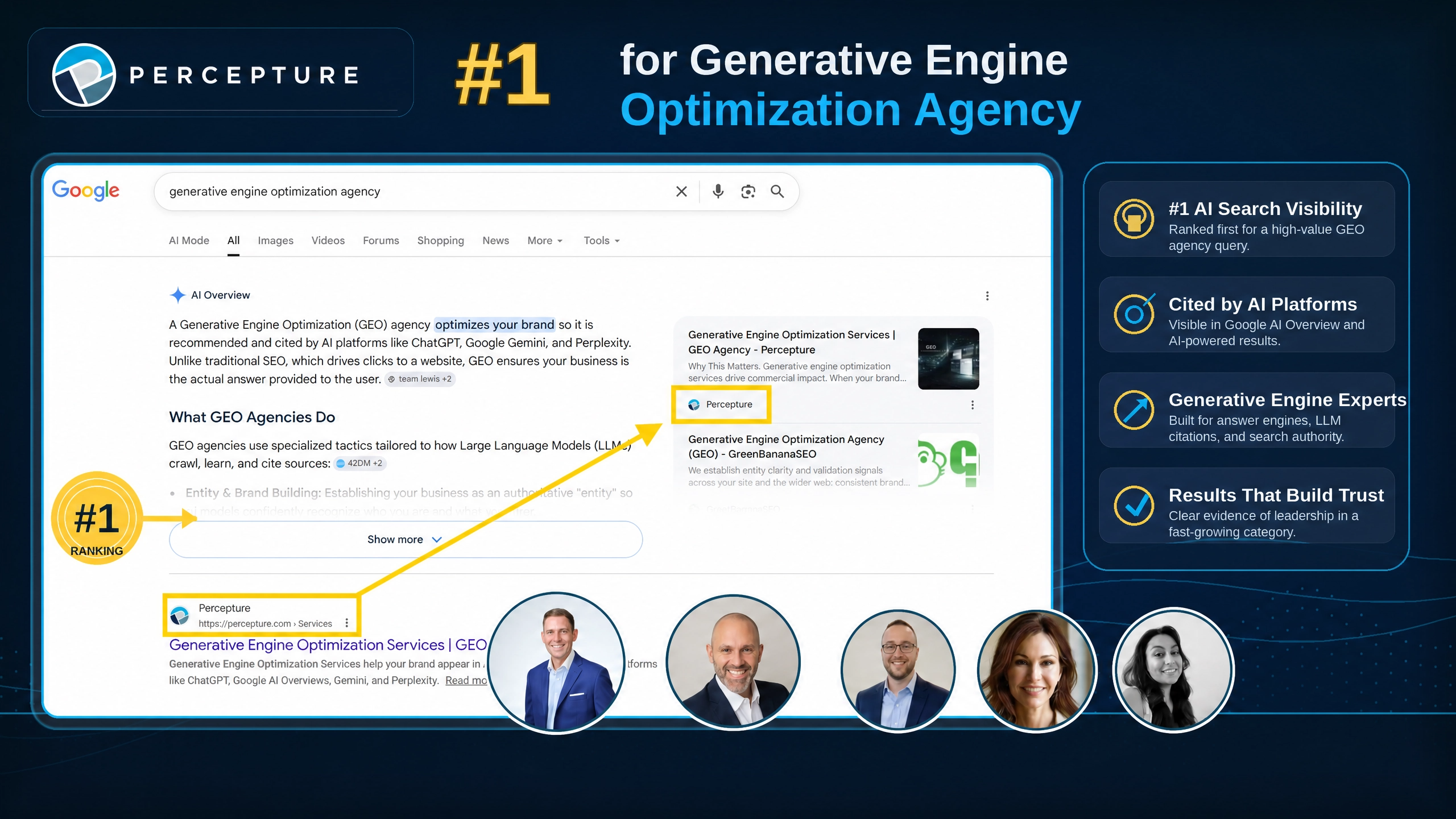
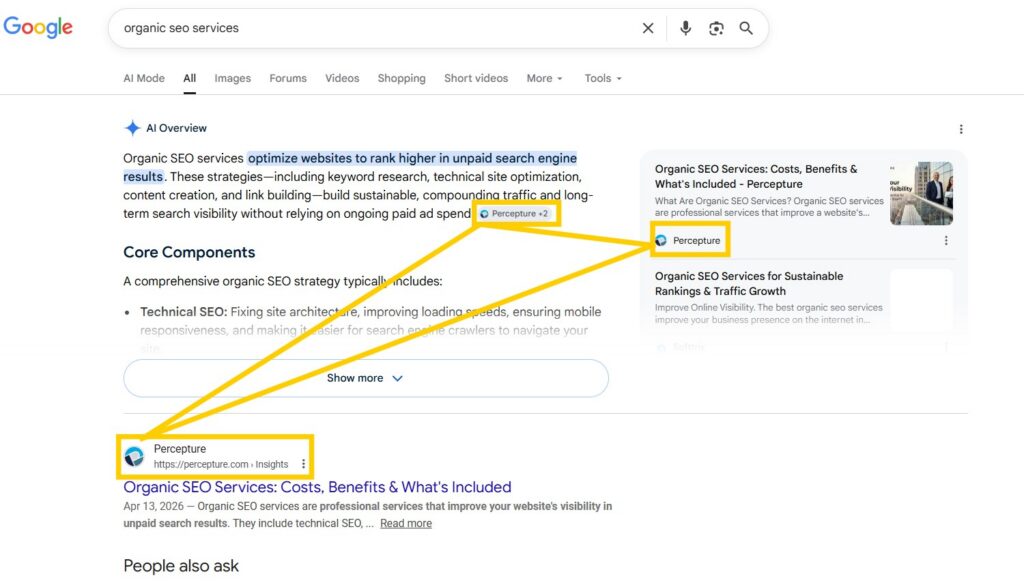
What funded search, paid demand and AI visibility can produce
These ranking examples are not presented as DMO budget case studies. They show the execution standard behind the budget categories in this guide: technical search infrastructure, high-intent paid demand, organic market ownership and AI-search visibility.
Illustrative DMO marketing budget planning ranges
Illustrative Percepture planning range. Adjust each planning range for mandate, funding restrictions, staffing, destination maturity, market costs, seasonality and objective. These bands apply to marketing investment, not total operating budget, and they are not external survey averages.
| Investment job | Planning band | Increase when | Reduce when |
|---|---|---|---|
| Research and intelligence | 4%–10% | Entering markets, repositioning or working with weak data | Strategy and data systems are mature |
| Website, SEO, content and CRM | 15%–28% | Owned assets are weak or traveler search demand is high | Infrastructure and content coverage are mature |
| Paid media and distribution | 25%–45% | Demand is clear and funding can reach effective scale | Available funding cannot support viable weight |
| PR, creators and earned authority | 8%–18% | The destination has a strong story or reputation need | Product or story readiness is weak |
| Meetings, sports and trade | 5%–20% | Group business is part of the mandate | The organization has a leisure-only mandate |
| Partner and co-op activation | 4%–12% | Partners can participate, convert and report results | Participation or tracking is weak |
| Measurement and optimization | 5%–10% | The mix is complex or public scrutiny is high | Do not reduce this category to zero |
| Contingency and stewardship | 3%–8% | Volatility, crowding or disruption risk is high | A separate funded reserve already exists |
The rows are not meant to add neatly to one preset funding model. Select ranges after defining the destination’s jobs, then reconcile the portfolio to available funds. Equal allocation is not the same as fair allocation.
Why one percentage is not enough
Comparing one destination marketing budget with another can mislead a board because organizations count responsibilities differently. Staffing may sit inside or outside marketing. One organization may operate visitor centers or convention facilities, while another may focus on leisure promotion.
| Organization context | Typical challenge | Budget response |
|---|---|---|
| Lean or local | Limited staff and funding | Protect the website, content, measurement and one or two effective channels |
| Emerging or regional | Brand development and partner growth | Add research, integrated campaigns and controlled market tests |
| Established or metropolitan | Leisure, meetings and geographic complexity | Separate business units, markets, goals and measurement plans |
| State or national | Large geography and many source markets | Use portfolio management, regional weighting, trade support and robust attribution |
A public tourism marketing budget needs a decision narrative, not only a spreadsheet. That narrative should explain the mandate, available funds, assumptions, priorities, risks and thresholds behind every major allocation.
Funding source determines eligible use
Funding source determines eligible use before strategy determines allocation. Hotel occupancy taxes, tourism assessment districts, appropriations, memberships, grants, co-op programs, sponsorships, event revenue and restricted project funds can each carry different conditions.
| Funding source | Main risk | Budget response |
|---|---|---|
| Occupancy tax | Revenue can be cyclical or politically exposed | Maintain reserve capacity and diversify demand |
| Assessment | Boundaries and stakeholder expectations shape use | Provide clear partner reporting and geographic accountability |
| Public appropriation | Funding can face annual pressure | Prepare commissioner-ready evidence and scenarios |
| Membership | Participation and benefit may be unequal | Define member value and service boundaries |
| Grant | Funding is temporary or restricted | Build an exit, ownership and maintenance plan |
| Co-op or sponsorship | Approvals, fit and tracking vary | Standardize packages, controls and reporting |
Do not mix restricted and unrestricted money in one tactical pool. Show the restriction beside the affected budget line so finance, procurement and marketing teams can make the same decision from the same facts.
Allocate by objective before allocating by channel
A sound allocation plan starts with the traveler or stakeholder outcome. Channels follow the objective; they do not define it.
Brand repositioning
Fund research, strategy, creative, PR, destination assets, partner rollout and brand measurement. Use content marketing to turn the positioning into useful traveler information.
Need-period visitation
Prioritize offers, partner inventory, conversion pages, email, paid search and short-window tracking. Paid search can capture existing intent when inventory and landing paths are ready.
New source market
Test access, current visitation, audience potential, media economics, awareness and conversion readiness before funding a broad launch.
Meetings and conventions
Support planner content, CRM, RFP tools, trade activity, site visits, venue coordination and pipeline reporting.
Search and AI visibility
Combine structured destination information, technical quality, expert sources, digital authority and monitoring. Percepture’s GEO services address how destination information is understood across AI-assisted discovery.
Stewardship and demand distribution
Fund resident communication, alternative itineraries, geographic dispersion, seasonal distribution and capacity information.
Objective-first allocation gives each budget line a defined job before teams debate channels or vendors.
Allocate by market and effective scale
Score candidate markets before assigning DMO funds. Use a 1-to-5 scale with this formula: Opportunity × Strategic Fit × Accessibility × Conversion Readiness × Measurement Confidence ÷ Cost to Reach Effective Scale.
| Factor | What to evaluate | Warning sign |
|---|---|---|
| Opportunity | Traveler volume, spending, current visitation and competitive space | Large audience with little evidence of destination fit |
| Strategic fit | Trip type, brand, need period, inventory and capacity | Demand arrives when the destination cannot serve it |
| Accessibility | Drive time, airlift, rail, weather and travel friction | Media reach is strong but access is weak |
| Conversion readiness | Offers, lodging, partner participation and landing pages | No clear traveler or partner handoff |
| Measurement confidence | Baseline, origin data, tracking and controls | No practical way to judge the test |
| Cost to scale | Media costs, production, market count, frequency and duration | The allocation cannot support viable exposure or learning |
A large market can still be a poor DMO budget choice when access, inventory or media cost prevents efficient conversion. If a channel cannot meet its threshold, reduce markets or weeks, narrow the audience, sequence the channel later, use co-op funds or remove it.
Cuts, growth and volatility
Zero-based DMO budget planning asks what each line must accomplish now rather than protecting it because it appeared last year. For every line, identify the objective, audience, market, minimum viable investment, required asset, KPI, decision threshold and consequence of not funding it.
| Scenario | Budget condition | Recommended action |
|---|---|---|
| Protect | 10%–15% reduction | Preserve measurement, high-performing capture, owned infrastructure and crisis capability. Reduce low-confidence markets and delay experiments. |
| Focus | 20%–30% reduction | Select fewer markets and need periods, concentrate distribution, simplify creative and reset expected outcomes. |
| Grow | Additional funding | Buy new capability, new reach or stronger evidence through research, controlled market tests, creative variation and partner support. |
Incremental budget should buy new capability, new reach or stronger evidence—not simply more of every existing line. When a budget contracts, protect viable work rather than imposing an equal percentage cut on every activity.
What to cut first and protect longest
Cut first
- Duplicative subscriptions and low-use platforms
- Unmeasured sponsorships
- Too many thin markets
- Channels below effective scale
- Repetitive content with no traveler job
- Co-op programs without participation or tracking
- Reports that produce no decision
- Legacy tactics preserved by habit
Protect longest
- Analytics and measurement
- Website reliability and accessibility
- Conversion and partner pathways
- Proven need-period activity
- High-intent demand capture
- Destination content
- Crisis and reputation capability
- Partner communication and data privacy
Do not cut measurement, website maintenance, crisis capacity, partner communication or data privacy to zero. Weakening these budget foundations makes every remaining activation harder to operate and defend.
Separate agency, media, creative and technology costs
The budget should make cost ownership visible. A board cannot compare options if strategy, media, production, technology and pass-through expenses are hidden inside one number.
| Cost | Examples | Budget purpose |
|---|---|---|
| Agency | Strategy, account leadership and reporting | Expertise and management |
| Media | Placements, sponsorship inventory and distribution | Direct activation |
| Creative | Concept, design and copy | Brand and performance communication |
| Production | Photography, video, editing and adaptation | Reusable campaign assets |
| Technology | CRM, analytics, CMS and approved tools | Owned infrastructure |
| Research | Surveys, panels, brand studies and market analysis | Decision quality |
| Measurement | Tracking, studies, dashboards and verification | Accountability and learning |
| Travel and hosting | Media, creators, trade and familiarization activity | Experience execution |
| Partner activation | Co-op, toolkits and training | Local participation and conversion |
| Contingency | Disruption, opportunity and approved overruns | Resilience |
Agency scopes should state fixed fees, out-of-scope rates, commissions, markups, pass-through expenses, media reconciliation, data costs, travel, production ownership, cancellation liability, payment schedules and treatment of unused funding model funds. Percepture’s media buying service is one relevant resource when evaluating placement management and effective media weight.
Fund measurement and contingency before launch
A campaign without a measurement reserve is a budget with no learning mechanism. The destination marketing budget should cover baselines, conversion tracking, partner links, media verification, dashboards, studies, quality checks and reporting before activation begins.
Illustrative Percepture planning ranges: 3%–6% for simple direct-response programs, 5%–10% for integrated regional programs and 7%–12% for complex multi-market programs with public accountability. Adjust these ranges for the questions being asked, available data, study design and reporting burden.
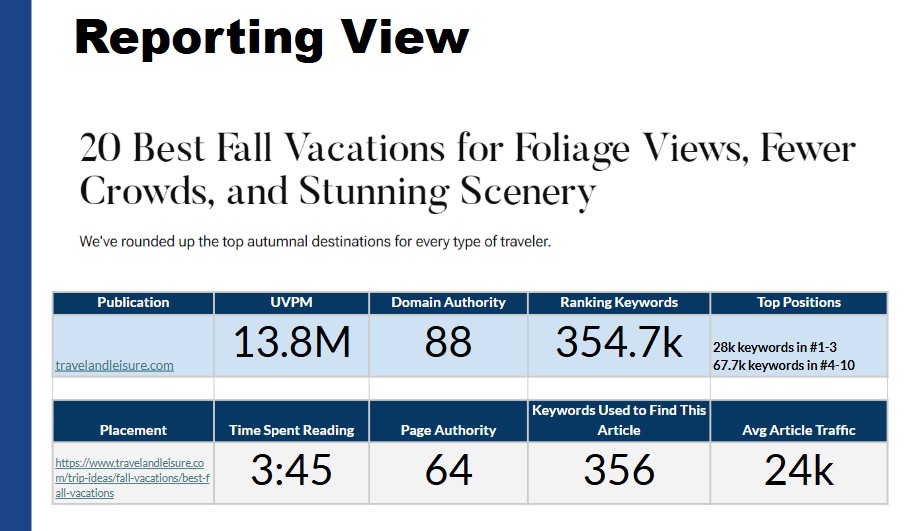
Build the tourism marketing budget with measurement in mind, then use attribution evidence to decide what should scale, change or stop. Data visualization can also make pacing, outcomes and risks easier for boards to interpret.
Build a board-ready budget worksheet
A board worksheet should reveal the logic behind the budget portfolio without forcing directors to decode a media plan. Use one row per investment and include the fields required to approve, monitor and reconsider it.
Purpose
Objective, audience, market, season or need period, channel job and expected output.
Money
Requested amount, fixed or variable status, investment category and minimum viable spend.
Evidence
KPI, attribution method, confidence level, baseline and scale, optimize or stop threshold.
Control
Owner, partner dependency, legal restriction, scenario, reallocation date and notes.
The board summary should show total budget, marketing share, direct activation, enabling investment, people and operations, measurement, reserve, top objectives, source markets, major risks and decision dates. A public allocation plan needs a decision narrative, not only a spreadsheet.
A 90-day budget build
A 90-day schedule can move the destination budget from audit through modeling and approval without separating strategy from implementation.
- Days 1–30 — Audit. Map funding restrictions, reconcile definitions, inventory committed costs, review performance, identify channels below effective scale, document seasonality and define the decisions the board must make.
- Days 31–60 — Model. Score markets, build portfolio allocations, set minimum viable investment, create Protect, Focus and Grow scenarios, reserve measurement and contingency, map production requirements and identify practical co-op opportunities.
- Days 61–90 — Approve. Finalize the narrative, map procurement, issue scopes, implement tracking, publish owners and pacing rules, establish reallocation dates, align partners and prepare the public summary.
The budget process should also map the traveler path from inspiration through partner handoff. Percepture’s customer journey work helps expose where media, content and conversion investment must connect.
Common budget mistakes
- Copying another organization’s percentage without comparing mandates or accounting definitions
- Calling paid media the entire marketing investment
- Spreading money across too many markets to reach effective scale
- Buying distribution before content, offers or partner pathways are ready
- Cutting measurement first
- Ignoring staff, agency, creative, production and technology costs
- Operating without contingency, stewardship or scenario plans
- Treating PR, SEO or owned media as free
- Mixing restricted and unrestricted funds
- Ignoring meetings, sports, sales or partner conversion responsibilities
- Renewing sponsorships without evidence or a defined traveler job
- Omitting cancellation liability and unused-fund treatment from scopes
- Reporting spending without setting a decision threshold
The strongest plan replaces “What percentage should we spend?” with “Which demand jobs must be funded, at what effective level, with what evidence and decision threshold?”
Travel and destination experience
Ranking screenshots show search execution. The travel case studies below show how destination positioning, public relations, content and measurement work together in the field.
Destination transformation
Greater Williamsburg used an integrated mix of public relations, content, search and destination positioning.
Regional tourism activation
Explore Hunterdon connected brand activation, destination traffic, partner distribution, reporting and tourism recognition.
Award-winning travel storytelling
Amazon and Xanterra at Phantom Ranch generated 378 stories, reached more than 70 million viewers and received an HSMAI Silver award.

Build a budget around the demand your destination can actually win
Percepture can review the funding rules, fixed costs, source markets, need periods, partner pathways, media thresholds and measurement plan behind the next DMO budget cycle.
Request a Destination Budget Review · Explore Percepture’s travel and tourism experience

Connect strategy, visibility, paid demand and measurement
Percepture can help separate the budget jobs that build durable visibility from the channels that rent attention. Compare service scope against the destination’s objectives, effective-spend thresholds and reporting requirements.
DMO budget FAQs
What is a typical DMO marketing budget?
There is no single typical DMO marketing budget that applies across destinations. Available investment changes with funding rules, destination size, staffing, sales responsibilities, visitor services, seasonality and market costs. Use peer data as context, then build the budget from the organization’s mandate, fixed commitments, effective channel thresholds and measurement requirements.
What percentage of a DMO budget should go to marketing?
The marketing percentage should follow the organization’s legal funding structure and operating model. First separate restricted funds, staffing, administration, sales, visitor services and committed costs. Then determine what remains available for direct activation, enabling work, measurement and reserve. A percentage without shared accounting definitions is not a reliable benchmark.
How much should a tourism board spend on paid media?
Paid media should receive enough funding to reach a defined audience with viable frequency, creative variation, campaign duration and measurement. If the available amount cannot support those conditions, reduce the number of markets or weeks, narrow the audience, choose a less costly channel or sequence the campaign later.
What is working versus nonworking spend?
Working spend usually refers to placements and distribution. Nonworking spend often refers to strategy, research, creative, content, technology and measurement. That label can be misleading because enabling investments make media usable and accountable. A clearer budget separates direct activation, enabling investment, operating costs and reserve.
How much should be reserved for measurement?
Illustrative Percepture planning ranges are 3%–6% for simple direct response, 5%–10% for integrated regional work and 7%–12% for complex multi-market programs with public accountability. The final budget amount should match the study questions, available data, attribution design, verification requirements and reporting burden.
How should a small DMO allocate a limited budget?
A small DMO should protect the website, useful destination content, basic measurement, partner communication and one or two channels that can reach effective scale. Do not divide a small budget evenly across every available tactic. A focused plan with clear source markets and need periods is more defensible than broad activity that cannot generate enough exposure or learning.
What should a DMO cut first?
Start with duplicative tools, low-use platforms, unmeasured sponsorships, thin markets, channels below effective scale and reports that lead to no decision. Preserve website reliability, measurement, conversion pathways, partner communication, proven demand capture and crisis capability for as long as possible.
How should leisure and meetings budgets be divided?
Divide them according to the destination mandate, inventory, need periods, sales pipeline and economic objectives. Meetings work may require planner content, CRM, trade activity, site visits, RFP systems and venue support that leisure marketing does not. Keep the goals and reporting for each business line visible.
Are PR, SEO and content part of media spend?
They are part of the DMO marketing investment but should not automatically be recorded as paid media. PR builds earned authority, SEO improves organic discovery and content creates owned assets. Each still requires strategy, labor, production and measurement, so none should be treated as free distribution.
How often should a DMO reallocate its budget?
Set budget review dates before launch and use a cadence that matches campaign length, revenue conditions and available evidence. Monthly pacing reviews and quarterly portfolio decisions are practical for many programs, while short need-period campaigns may require faster checks. Reallocation should follow defined scale, optimize, hold or stop thresholds.
Turn the next DMO marketing budget cycle into a defensible growth portfolio
Percepture can review your DMO marketing budget across funding restrictions, fixed costs, market weighting, channel thresholds, content and media requirements, measurement reserve and board presentation.
The review connects each budget decision to an objective, viable operating level and evidence standard.