

How Data Center Developers Can Address Community Opposition Before Permitting starts with a simple operating decision: define the project before the public defines it for you. Leaders need one approved set of facts, clear decision boundaries, accountable speakers and real local relationships before a zoning vote or hearing.
The hearing is not the beginning of engagement. It is where earlier choices become visible. A developer that waits for opposition to organize must correct confusion while also answering valid questions about power, water, noise, traffic, land use, jobs, taxes and expansion.
Credibility should be visible before the first ask
Enterprise proof in seconds, not another sales paragraph.




What should a developer do before permitting?
How Data Center Developers Can Address Community Opposition Before Permitting is answered by seven actions: protect the business decision, establish project truth, define the facility, map stakeholders, state what can change, publish verified evidence and track every issue through accountable stage gates. Communication should begin before an announcement, not before the microphone turns on.
The executive view
Define the project
Separate verified facts from estimates, proposed designs, pending studies, regulator decisions and unknowns.
Define public influence
Tell residents what can change, what can be mitigated, who controls each decision and when input closes.
Prepare evidence owners
Engineering, utility, legal, tax, construction and communications leaders should approve the answers they own.
Build a local operating rhythm
Listening, response speed, commitment tracking and continued presence after the vote matter as much as the meeting itself.
For development, permitting, legal, government affairs and communications leaders who share responsibility for a data center project before a public decision.
Start with a pre-permit risk check
Use the scorecard to test the pre-permit engagement plan across project truth, facility clarity, stakeholder coverage, evidence ownership, public influence and hearing readiness before adding more messages.
Use the 30-Day Opposition Risk ScorecardHow Data Center Developers Can Address Community Opposition Before Permitting in the first 30 days
The first month should not begin with a campaign. It should begin with an internal fact review. The executive sponsor must identify the business asset at risk, the next formal decision and the questions the team cannot yet answer.
the pre-permit operating model becomes an operating plan when every action has an owner and gate. The sequence below keeps the team from publishing claims faster than engineering, utility, legal or permitting leaders can support them.
1–10
Establish project truth
Create one controlled record of what the team knows, proposes, estimates and still needs to verify.
- List every public claim about the facility, site, phases and schedule.
- Classify each claim as verified, estimated, proposed, pending, external, unknown or restricted.
- Name the approver and source for each answer.
- Compare public materials with permit filings and executive statements.
11–20
Map people and issues
Separate direct effects, decision authority, trusted relationships and organized influence.
- Map nearby residents, landowners, officials, planners, utilities, schools, emergency services, businesses, labor, media and digital organizers.
- Separate affected stakeholders from influential stakeholders.
- Record each concern without dismissing it as opposition.
- Choose local listening channels and a response path.
21–30
Prepare the decision
Make sure approved evidence, qualified speakers and follow-up ownership are ready for public scrutiny.
- Publish only answers supported by approved evidence.
- Assign hearing questions to people qualified to answer them.
- Open a commitment register with owners and deadlines.
- Rehearse difficult questions, incomplete facts and escalation rules.
30-day opposition risk scorecard
Use this scorecard to determine whether the pre-permit community strategy is supported by operating controls rather than unverified messaging.
| Area | Ready | At risk | Immediate gate |
|---|---|---|---|
| Project truth | Claims have sources and approvers | Teams use different figures or terms | Freeze unsupported wording |
| Facility clarity | Type, scale, phases and function are plain | Everything is described only as a data center | Approve a facility definition |
| Stakeholders | Affected and trusted groups are mapped | Outreach begins with elected officials only | Complete the local map |
| Evidence | Technical owners can explain key claims | Communications is asked to infer answers | Assign subject owners |
| Influence | Flexible and fixed decisions are stated | Input is invited without boundaries | Publish decision limits |
| Hearing | Questions, speakers and backups are assigned | One spokesperson must answer everything | Run a hostile-question rehearsal |
| Commitments | Promises have owners and dates | Meeting statements are not logged | Open the register |
A team planning the pre-permit engagement plan should treat any red row as a management issue, not a copywriting problem.
Define the facility before advocating for it
The term “data center” can describe facilities with different functions, footprints, users and operating designs. If a company does not explain what it proposes, residents may attach assumptions from a much larger or different project.
Entity clarity is therefore the first public communications test. the community-opposition plan requires a plain description of facility type, buildings, phases, network function, cooling approach, backup generation and the facts still under study. Technical claims still require review by the qualified project owner.
A precise facility definition anchors the pre-permit operating model by giving residents and decision makers the same project scope used by development, engineering and permitting teams.
Facility type and the first question to answer
| Facility description | What should be explained | Likely first concern |
|---|---|---|
| Hyperscale or large campus | Phases, buildings, utility planning and expansion boundaries | Cumulative power, water, land and infrastructure effects |
| Colocation facility | Shared customer model, building plan and operating systems | Scale, generators, traffic and future growth |
| Carrier hotel or interconnection facility | Network function, tenant activity and physical footprint | Why the site is described as a data center |
| Edge or regional site | Local service role, footprint and equipment | Whether larger phases will follow |
| Modular facility | Module count, phase plan and site limits | How quickly capacity could expand |

Separate opposition, advocacy, permit objections and crisis conditions
Not every hard question is organized opposition. Residents may be seeking basic facts, advocating for a condition, challenging a permit finding or responding to an incident. Treating every critic as an enemy can turn an answerable issue into a trust problem.
Accurate classification strengthens the pre-permit community strategy because the response owner and decision path differ for an information gap, policy request, formal objection, organized campaign or crisis.
| Condition | What it means | Primary owner | Response |
|---|---|---|---|
| Information gap | People cannot find a clear project answer | Project and communications leads | Verify and publish the missing fact |
| Policy advocacy | A group seeks a rule, benefit or design change | Government affairs and project leadership | State authority, constraints and decision path |
| Permit objection | A formal filing or hearing argument challenges approval | Legal and permitting teams | Follow process and support claims with the record |
| Organized opposition | A coordinated group seeks to delay, reshape or stop the project | Executive, local and public affairs leads | Listen, correct factual errors and address valid concerns |
| Crisis condition | An incident, legal event or fast-moving narrative threatens trust or operations | Executive crisis team | Activate escalation, monitoring and response governance |
Percepture’s guide to what a crisis communications agency does explains how escalation differs from routine issue management.
The “Before the Permit. Before the Protest.” framework
A seven-part operating system for project decisions, local relationships, evidence, public information and executive accountability before opposition hardens.
Build a project-truth system
A fact bank should prevent a spokesperson from turning an estimate into a promise. It should also reveal where the team lacks evidence. That is useful: saying a study is pending is safer than filling the gap with an unsupported conclusion.
For the pre-permit engagement plan, the fact bank should show the status, evidence, approver and safe wording for every material project claim.
| Fact status | Evidence | Approver | Safe wording pattern |
|---|---|---|---|
| Verified fact | Approved filing, plan, study or agreement | Responsible technical or legal owner | State the fact and its scope |
| Current estimate | Dated working model | Project owner | State that it is an estimate and give the date |
| Proposed design | Current design document | Engineering or development lead | Describe it as proposed |
| Pending study | Defined study scope | Study owner | Explain what is being tested and when results enter the process |
| External decision | Utility, regulator or elected-body process | Relevant external authority | Do not speak for the decision maker |
| Unknown | No reliable evidence yet | Assigned investigator | Say what is unknown and how it will be resolved |
Map stakeholders by relationship, risk and responsibility
A mailing list is not a stakeholder map. The map should show who is affected, who is trusted, who controls a decision, who has unanswered questions and who can reach people the developer cannot.
the community-opposition plan also depends on lifecycle ownership. Pre-construction work may include local listening, project information and advisory relationships. Construction adds workforce, traffic and incident communication. Operations requires continued participation and reporting on commitments. The broader data center community engagement guide covers that lifecycle.
- Closest neighbors: direct effects, access, noise, lighting, traffic and construction questions.
- Planning staff and elected officials: application facts, policy fit, conditions and public process.
- Utilities and regulators: infrastructure responsibilities, studies and decision authority.
- Schools, labor and businesses: workforce, procurement, tax and community claims.
- Emergency services: access, coordination and response planning.
- Media and digital organizers: public claims, corrections and information gaps.
Connect every concern to an answer and proof owner
Communications teams should not create technical conclusions. Their job is to turn approved evidence into clear answers while preserving limits and context. The concern-to-evidence matrix makes that division visible.
This ownership model makes the pre-permit operating model operational by routing each concern to the person or entity qualified to support the answer.
| Concern | Answer must cover | Proof owner |
|---|---|---|
| Power and rates | Project demand, infrastructure responsibility, study status and who controls rate decisions | Utility and project energy leads |
| Water and cooling | Proposed system, use assumptions, source, operating conditions and pending studies | Engineering and water authority |
| Noise and generators | Equipment, operating cases, measurement method, mitigation and applicable review | Acoustical, engineering and permitting owners |
| Traffic and light | Construction phases, routes, operating traffic, lighting design and mitigation | Construction, traffic and design leads |
| Jobs and taxes | Job categories, timing, assumptions, incentives, tax treatment and source | Finance, economic development and workforce owners |
| Expansion | Current application, future phases, site limits and additional approvals | Development and legal leads |
Ratepayer questions often require more context than a hearing slide can provide. See Percepture’s analysis of who pays for data center growth.
State what the public can influence
Inviting input without explaining its limits creates false expectations. Before each meeting, list what is fixed, flexible, subject to mitigation, controlled by another party or still under study.
A clear boundary does not make the process less open. It lets people spend time on decisions where their input can matter. It also helps the developer document how a question, recommendation or design change moved through review.
Clear influence boundaries are essential to the pre-permit community strategy because they separate meaningful participation from decisions the developer or jurisdiction cannot change.
Minimum commitment register
A commitment register supports the pre-permit engagement plan by preventing meeting statements and promised follow-ups from losing their owners, deadlines or public closure paths.
| Field | Purpose |
|---|---|
| Issue or request | Record the stakeholder’s point in plain language |
| Status and evidence | Separate facts, estimates, studies and unresolved questions |
| Decision owner | Name the person or entity with authority |
| Commitment | Record exactly what was promised |
| Deadline | Set the response or completion date |
| Public update | Show how closure will be reported |
Prepare the hearing before preparing the slides
A polished deck cannot repair weak answer ownership. the community-opposition plan requires a speaker matrix, source packet, correction process and clear rules for questions that cannot be answered at the microphone.
| Question | Lead speaker | Backup |
|---|---|---|
| What is being approved? | Development or permitting lead | Land-use counsel |
| How will power be supplied? | Utility or approved energy lead | Project engineer |
| What cooling system is proposed? | Engineering lead | Environmental or permitting specialist |
| How will noise be assessed? | Qualified technical specialist | Design lead |
| What can the community change? | Executive or public affairs lead | Permitting lead |
| What happens after approval? | Local relationship owner | Construction or operations lead |
Rehearsal should include an incomplete study, an incorrect online claim, an emotional question and a request outside the developer’s authority. The goal is not to win an argument. It is to answer accurately, preserve respect and define the next step. That discipline is central to the pre-permit operating model when the public record is being formed in real time.
Handle zoning changes and moratoriums as policy decisions
A moratorium or zoning revision changes the operating environment. The response should begin with the actual jurisdictional text, decision calendar and stated policy purpose. Do not treat one city’s process as a national rule.
In jurisdictions considering new restrictions, the pre-permit community strategy must remain grounded in the current local text, responsible authority and formal review calendar.
For example, the City of St. Louis publishes a page describing its local data center zoning law and review topics. Developers working there should use the current official record rather than a general industry summary. The City of St. Louis data center zoning resource is specific to that jurisdiction.
Public participation also needs structure. The EPA Public Participation Guide provides a general public-participation reference, but the applicable local process and project record still govern a permit decision.
Make accurate information findable in search and AI answers
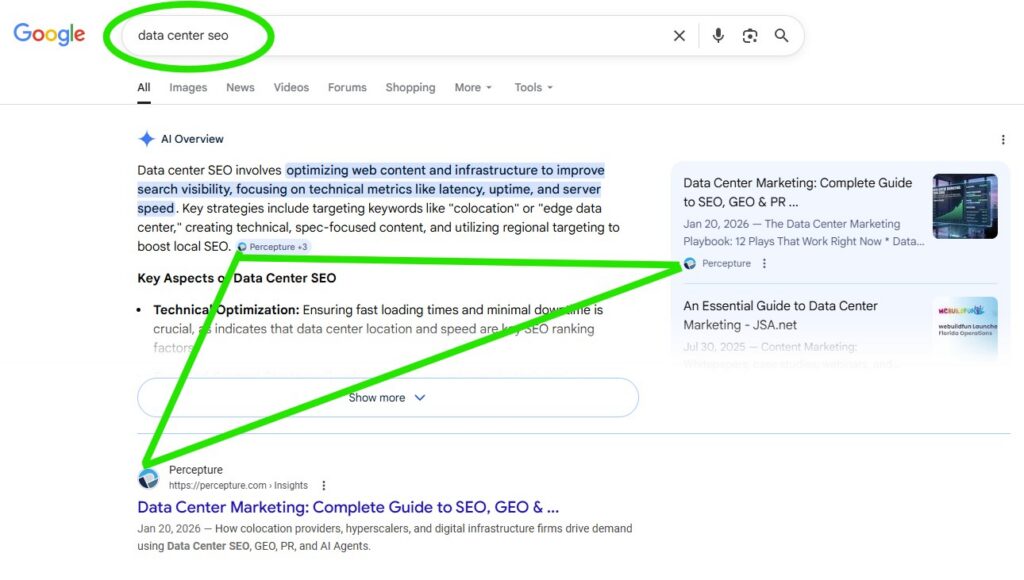
SEO cannot replace trust or erase legitimate concern. It can make accurate information findable and reduce the vacuum in which misinformation grows.
the pre-permit engagement plan includes a project fact page that names the facility, location, current phase, pending approvals, evidence status, contact path and update date. Structured headings, short answers and visible tables help people and retrieval systems understand the same project.
Search results are viewed by residents, officials, utilities, investors, customers, journalists and employees. A coordinated generative engine optimization strategy, supported by enterprise SEO, should distribute approved facts without claiming that visibility determines a permit outcome.
Media and project communications must use the same definitions. Percepture’s digital infrastructure PR strategy explains how infrastructure narratives connect with technical evidence and buyer confidence.
The evidence-to-answer loop
The search component of the community-opposition plan should begin with approved evidence and route new public questions back to accountable project owners.
- Approve the project fact and its limits.
- Publish the answer in clear, accessible HTML.
- Use the same definition in meetings, media and executive remarks.
- Monitor search results, AI answers, local coverage and stakeholder questions.
- Correct material errors with evidence.
- Route new questions back into the fact bank and project decision process.
Use human judgment and AI for different jobs
AI can help organize issue logs, compare approved language, monitor public narratives and route updates. It should not become the source for legal judgment, engineering evidence or community relationships.
Humans establish strategy, facts, guardrails and approvals. Automation supports monitoring and reporting. Humans then review context, make decisions and conduct the conversations. That division supports the pre-permit operating model without turning an efficiency tool into an unqualified expert.
Govern the work through project stage gates
Stage gates keep the pre-permit community strategy connected to site screening, announcement, application, hearing, construction and operations decisions.
| Stage | Required action | Primary risk | Gate |
|---|---|---|---|
| Site screening | Assess local issues, public records and facility fit | Risk is discovered after commitment | Community-risk review |
| Pre-announcement | Approve facts, definitions, influence boundaries and stakeholder plan | Rumor fills the information gap | Executive fact signoff |
| Application | Align filing, website, meetings and media answers | Conflicting claims enter the record | Cross-functional review |
| Public hearing | Assign speakers, evidence and follow-up ownership | Unsupported promises are made | Hearing readiness test |
| Construction | Track traffic, workforce, incidents and commitments | Approval-era trust is lost | Construction communications review |
| Operations | Maintain local relationships and close commitments | The company disappears after opening | Operating-community review |
A fast-scaling operator described in Percepture’s internal research identified the need to connect site selection, contracting, engagement, construction and operations through stage gates. The organization remains anonymous, and no project outcome is attributed to this process.
the pre-permit engagement plan: team, consultant, local lead or software
The right model depends on local trust, internal capacity, decision speed and issue severity. the community-opposition plan usually requires shared ownership rather than a complete handoff to one vendor.
| Option | Best fit | Strength | Limit |
|---|---|---|---|
| Internal team | Stable project with experienced public affairs, legal and technical owners | Direct access to decisions and confidential facts | May lack local capacity or independent diagnosis |
| External consultant | High-risk, compressed or cross-functional situation | Structured risk review, facilitation, communications and escalation support | Cannot replace project evidence or executive authority |
| Local relationship lead | Project requiring sustained in-market presence | Continuity, listening and community access | Needs integration with corporate and technical teams |
| Monitoring software | Large issue volume across media, search and stakeholder channels | Faster collection, routing and reporting | Cannot judge intent, make commitments or build trust |
When selecting support for the pre-permit operating model, retain technical evidence, legal judgment, commitments and final decision authority inside the accountable project organization.
Percepture’s community engagement consulting connects local planning with executive accountability. When issues accelerate, crisis communications services can support escalation. Broader public relations services and omnichannel communications help keep approved information consistent across channels.
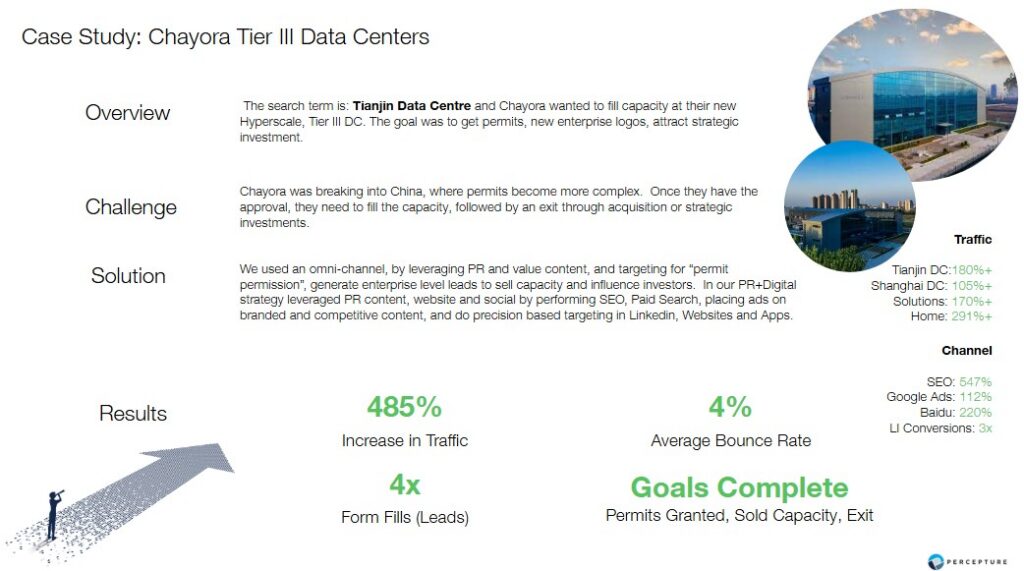
Data center experience in practice
Sector experience matters, but it should not be overstated. This example supports Percepture’s work in the data-center market; it is not evidence that communications caused a permit outcome.
Review the community engagement model
If the project already has a permit milestone, stakeholder tension or conflicting public information, review the operating model before adding more outreach.
Review Community Engagement ConsultingScope the work around risk, not a generic package
There is no single responsible price for pre-permit engagement without the project location, facility type, stage, permit calendar, stakeholder environment and evidence gaps. A confidential review should determine the scope before a proposal is built.
The scope for the pre-permit community strategy should reflect the project’s actual decision risk, evidence needs, local capacity and permit timing.
| Scope level | Typical work included | Use when |
|---|---|---|
| Diagnostic review | Fact inventory, public narrative scan, risk scorecard and first-step plan | The team needs an independent baseline |
| Pre-permit program | Stakeholder mapping, evidence governance, local communications, content and hearing preparation | A formal decision is approaching |
| Escalated response | Executive coordination, rapid monitoring, media response, corrections and crisis readiness | Opposition, litigation, negative coverage or a policy event is moving quickly |
| Lifecycle support | Construction communication, commitment reporting and continued local participation | The project needs continuity after approval |
Mistakes that harden opposition
Teams evaluating the pre-permit engagement plan should correct these operating failures before increasing outreach volume.
- Calling every concern misinformation or NIMBYism.
- Publishing benefit claims before assumptions and owners are approved.
- Using one “data center” description for facilities with different functions and impacts.
- Inviting public input without saying what can change.
- Letting communications staff infer power, water, noise or rate conclusions.
- Treating a town hall as the whole engagement program.
- Debating residents through corporate social accounts.
- Making a promise at a hearing without entering it in a commitment register.
- Ignoring search and AI answers until an incorrect narrative spreads.
- Disappearing after the permit decision.
A strong strategy and planning process connects these communications choices to the business decision. The data center marketing guide provides broader commercial context, while community engagement for construction projects addresses the construction setting.
Frequently asked questions
Why do communities oppose data centers?
Communities may raise questions about power, water, noise, generators, traffic, land use, taxes, jobs, incentives, construction and future expansion. Some concerns are factual, some are policy choices and some reflect missing information. the community-opposition plan begins by identifying the concern, determining who owns the answer and responding with approved evidence rather than dismissing the question.
When should community engagement begin?
Engagement should begin while the team can still define project facts, map stakeholders and explain decision boundaries. The exact timing depends on confidentiality, site control and local process. the pre-permit operating model requires enough lead time to correct definitions, complete studies, build relationships and show how public input entered the decision.
How Data Center Developers Can Address Community Opposition Before Permitting?
the pre-permit engagement plan requires a verified fact bank, a clear facility definition, a stakeholder map, evidence owners, stated influence boundaries, a hearing speaker matrix and a commitment register. The developer should publish accurate information early while preserving legal, technical and jurisdictional limits.
Can SEO reduce data center opposition?
SEO cannot replace trust or erase legitimate concern. Within the community-opposition plan, it can make accurate information findable and reduce the information vacuum in which errors spread. A useful project page should define the facility, show the current phase, identify pending decisions, answer supported questions and provide a clear route for updates.
Who should speak at a public hearing?
the pre-permit operating model requires assigning each question to the person qualified and authorized to answer it. Development or permitting leaders can explain the application. Utility and engineering owners should address supported technical topics. A local relationship owner should explain engagement and follow-up. Every speaker needs approved evidence, limits and a backup.
When should a developer hire an outside consultant?
Consider outside support for the pre-permit community strategy when the project faces compressed deadlines, organized opposition, inconsistent facts, negative coverage, limited local capacity or weak cross-functional governance. A consultant can diagnose gaps, coordinate the process and support communications. The developer still owns technical evidence, legal decisions, commitments and executive authority.
What should a pre-permit consultant deliver?
For the pre-permit engagement plan, useful deliverables include a project-truth inventory, facility definition, stakeholder map, issue and evidence matrix, decision-boundary plan, public narrative audit, hearing preparation, commitment register and stage-gate dashboard. Deliverables should identify owners and deadlines rather than ending with a general communications calendar.
How long does a pre-permit risk review take?
Timing depends on the project record, jurisdiction, permit calendar, number of stakeholders and availability of technical owners. A developer planning the community-opposition plan should begin with the decision date and work backward. If a hearing is close, the review should prioritize unsupported claims, speaker ownership, evidence gaps and urgent corrections.
Request a confidential data center risk review
the pre-permit operating model starts with the project decision, not a canned town-hall package. Percepture can review the facility, public narrative, evidence gaps, stakeholder environment and next permit milestone before recommending a scope.
Book a Confidential Strategy Conversation
About Bob Generale
Bob Generale is President of Percepture. He works across digital marketing, public relations, SEO, AI-search visibility and executive strategy. His operating approach connects verified evidence, clear public information, search visibility and business decisions rather than treating each channel as a separate campaign.