
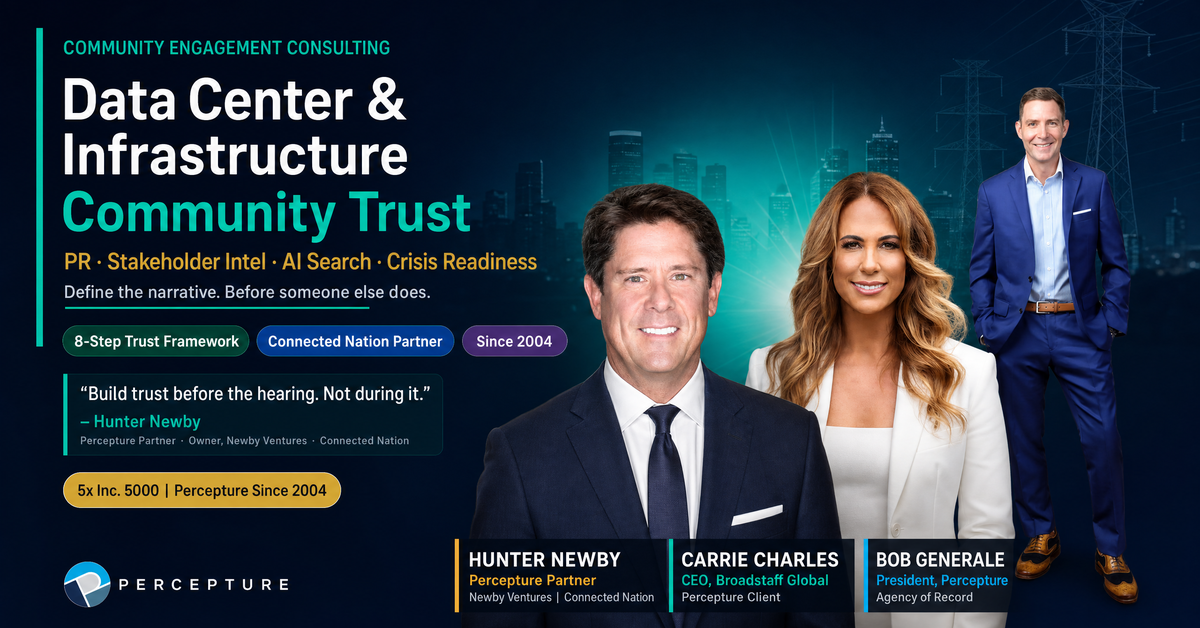

Community Engagement Consulting helps data center, energy and infrastructure leaders build a clear public record before confusion, opposition or a public deadline starts driving the story. Percepture connects stakeholder intelligence, approved project facts, public relations, content, search visibility and crisis readiness.
The work starts with the decisions ahead, not a generic awareness campaign. Every engagement is built around the project stage, affected communities, known questions, internal review requirements and commitments the company can actually keep.
What does an infrastructure community engagement consultant do?
Community Engagement Consulting organizes how a project team listens, explains technical facts, prepares for public questions, records commitments and updates stakeholders. For complex commercial projects, it also connects local engagement with media relations, digital content, search visibility, social communication, issue response and executive decision-making.
What executives need to know
Start before the deadline
A hearing, announcement or construction start should not be the first time the organization aligns its facts, owners and response paths.
Build one evidence base
Legal, engineering, operations, public affairs and communications should work from one approved set of project facts.
Make questions visible
Track recurring questions, information gaps, commitments and unresolved issues so leaders can act before small concerns spread.
Measure useful signals
The program should report what people are asking, which content they use, what remains unclear and who owns the next action.
Who this service is built for
This service is built for organizations that need technical, legal, operational and communications teams to work from a shared public-information plan.
Data center developers and operators
The work supports projects facing questions about construction, utilities, traffic, land use, local benefits, operating practices or future expansion.
Energy and utility teams
For generation, storage, transmission, substation and related projects that require clear technical explanations and disciplined stakeholder communication.
Infrastructure and construction leaders
For projects where prolonged disruption, multiple jurisdictions, contractor activity or changing schedules can create avoidable confusion.
Executive buyer committees
For CEOs, development leaders, finance teams, legal counsel, engineers, public affairs teams and communications leaders who need a shared operating plan.
Why Community Engagement Consulting starts with project risk
Public pressure rarely arrives as one clean communications problem. A technical question may become a social post, a reporter inquiry, a meeting comment and an executive escalation within days. Treating each channel as a separate task creates inconsistent answers and unnecessary rework.
Percepture’s process begins by identifying the decisions, dates and information gaps that can change the project’s communications risk. That includes the current project stage, relevant jurisdictions, planned announcements, public meetings, construction milestones, known opposition, technical reviewers and existing legal or regulatory processes.
The engagement does not promise to win every opinion. The practical goal is to answer reasonable questions, correct avoidable confusion, document commitments and give internal leaders a reliable view of what comes next.
A communications layer for the full project team
The work functions best when it supports the specialists already accountable for the project. Percepture does not replace legal, engineering, environmental, lobbying, regulatory or permitting counsel. Those professionals retain ownership of their work and conclusions.
Percepture organizes approved information and makes it understandable across public channels. Technical experts own the facts. Communications leaders determine how those facts should be explained, distributed, updated and measured.
This operating structure protects against a common failure: one team answering a question in public while another team is still reviewing the underlying information. A shared evidence base, review path and issue log reduce those contradictions.
See how data center engagement fits together
Review the practical questions, trust signals and communication steps that shape local understanding of digital infrastructure projects.
What the engagement scope can include
No two projects need the same mix of research, messaging, content and activation. A Community Engagement Consulting scope should be based on project conditions rather than a preset list of publicity tactics.
Stakeholder and issue intelligence
The work can begin with stakeholder categories, public records, local media, search behavior, public comments, social discussion and information already published by the project. The purpose is to create a working map of who needs information, what they are asking and where uncertainty is forming.
Within the engagement, this is not a static contact list. A useful map connects each stakeholder group to relevant issues, project milestones, information sources, internal owners and an appropriate communication path.
Approved evidence and message architecture
Project teams often have the information they need, but it sits across technical reports, legal reviews, presentations, emails and executive notes. Percepture helps turn approved material into a structured evidence base with plain-English answers, definitions, supporting documents and review ownership.
The evidence base supports executive talking points, public information, media responses, meeting preparation and digital content. Percepture’s strategic public relations capabilities can connect this work to media strategy without turning engagement into a publicity campaign.
Issue and crisis readiness
Some questions can be answered through routine content. Others require technical review, executive attention or a defined escalation path. An issue matrix separates those categories before pressure rises.
Percepture can connect the plan with issues and crisis readiness, including response roles, approval paths, holding materials and monitoring. The team should know who decides, who speaks and which facts are cleared for use.
Public information content
Plain-English project pages, question-and-answer resources, milestone updates, meeting materials, fact sheets and issue explainers give people a stable place to check information. Good content states what is known, distinguishes proposals from commitments and provides a path for updates.
Percepture’s project education content capability supports the planning, writing and maintenance of these resources. For construction-focused context, PR for construction companies explains how communications supports complex project visibility.
Search and AI-answer visibility
Your first public meeting is rarely the community’s first impression. People search the project name, location, developer, technology, resource questions and local coverage before they attend a formal event.
Enterprise SEO services can organize project information around the language people use. Generative engine optimization services can strengthen entity clarity, direct answers and evidence structure so AI systems have better source material to retrieve.
This does not allow a company to control search engines or AI answers. It gives those systems clearer, more consistent and more useful published information from the project itself.
Digital distribution and amplification
Important information should not depend on one meeting or one web page. Channel planning identifies where updates belong and which audiences need a direct path to them.
Integrated digital PR can connect authoritative content with relevant online coverage. Targeted social amplification can extend approved information to defined audiences when organic distribution alone is not enough.
How the approach changes by industry
Data centers
Data center projects can combine technical infrastructure, land use, construction, utilities and long-term operating questions. The engagement plan gives the project team one system for explaining what is proposed, what has been decided, what remains under review and where updates will appear.
Public information should be specific enough to answer real questions without moving beyond approved facts. The related data center PR strategy resource shows how reputation, media and stakeholder communication fit the larger digital infrastructure story.
Energy projects
Energy projects often involve technical, environmental, property, construction and jurisdictional questions at the same time. The engagement plan should map each issue to a qualified internal owner and a clear review path.
The consulting team helps translate approved technical material into understandable answers while preserving the distinction between communications support and formal regulatory participation.
Infrastructure construction
Construction creates visible change. Traffic, access, noise, schedules, contractor activity and restoration can shape trust even when the long-term project case is well understood.
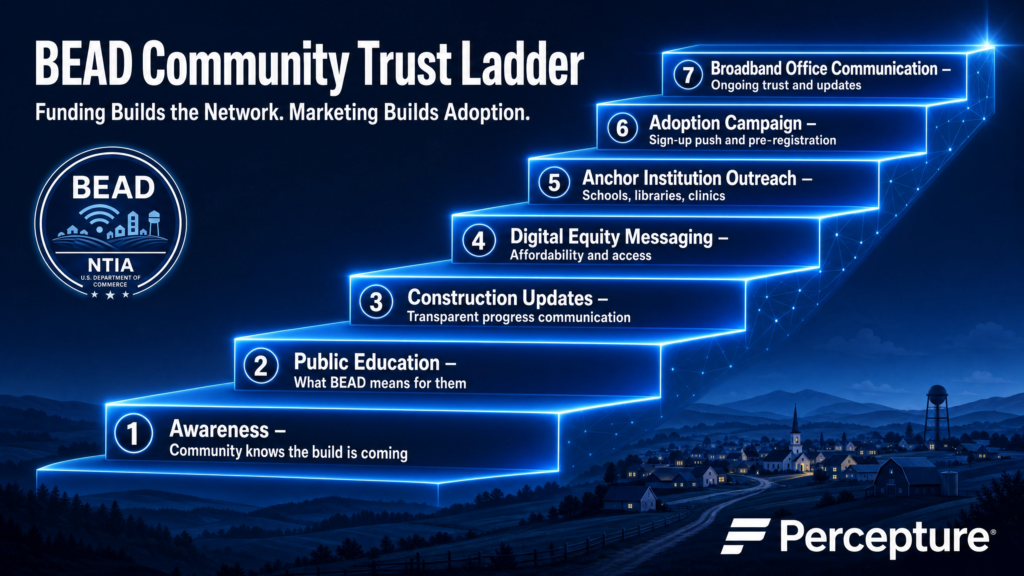
The work can establish update rhythms, issue ownership and public information paths before construction starts. Percepture’s guide to community trust before broadband construction provides a practical example of preparing communities for disruptive field activity.

The Percepture Project Trust Framework
The Percepture Project Trust Framework is an eight-step communications methodology that connects project facts, stakeholder input, public information, commitments and measurement from planning through operations.
- Discover: Review the project stage, decisions, deadlines, published information and known communication risks.
- Map: Connect stakeholder groups, issues, channels, jurisdictions and internal owners.
- Listen: Capture recurring questions, local context, misunderstandings and useful feedback.
- Explain: Turn approved technical information into direct, plain-English answers and supporting content.
- Participate: Prepare project representatives for appropriate meetings, interviews, updates and stakeholder conversations.
- Commit: Record public commitments, responsible owners, limits and expected update dates.
- Update: Keep information current as project facts, schedules and decisions change.
- Measure: Report questions, content use, issue movement, response status and unresolved information gaps.
The framework gives the service a repeatable operating structure without forcing every project into the same campaign. It also connects PR, search, AI visibility, conversion paths and crisis response to the same evidence.
Community Engagement Consulting compared with adjacent services
Which partner owns which part of the work?
The scorecard shows where the engagement discipline leads, where specialist review remains essential and which responsibilities should not be combined.
| Partner or capability | Primary role | What it should not replace | Best use |
|---|---|---|---|
| Community Engagement Consulting | Stakeholder intelligence, public information, message systems, channel coordination and issue readiness | Legal, engineering, environmental, permitting or lobbying advice | Creating an integrated communications operating plan |
| Public relations agency | Media strategy, announcements, executive visibility and reputation support | Technical ownership or formal public process | Managing earned-media opportunities and inquiries |
| Engineering or environmental consultant | Technical analysis, designs, studies and professional conclusions | Full communications strategy and channel execution | Establishing and defending technical facts |
| Legal or permitting counsel | Legal interpretation, filings, disclosure and process guidance | Ongoing public education across every channel | Protecting compliance and formal process integrity |
| Engagement software | Contact records, notices, surveys, comments and workflow support | Strategy, judgment, writing or executive alignment | Managing data and repeatable engagement tasks |
The strongest model is usually coordinated, not competitive. Communications should use technical and legal review rather than work around it. Technical and legal teams should also know how approved information will appear in public.
What buyers should expect from the process
1. Diagnose the project
Percepture reviews the project type, location, stage, jurisdictions, deadlines, existing research, communication channels and known concerns.
2. Build the operating plan
The operating plan defines stakeholders, issue owners, approved evidence, content priorities, review roles, update rhythms and escalation paths.
3. Activate and measure
Approved materials move into the right channels while questions, commitments, information gaps and next actions are tracked.
An engagement should have named client owners and clear review expectations. Communications cannot remain current if technical changes, permit milestones or operational decisions do not reach the people responsible for public information.
Typical working deliverables
- Project communications risk review
- Stakeholder and issue map
- Approved evidence and message architecture
- Question-and-answer content plan
- Meeting, media and spokesperson preparation materials
- Issue escalation and crisis-readiness matrix
- Search, AI-answer and digital-channel recommendations
- Commitment and update tracker
- Measurement dashboard and executive reporting rhythm
The final scope depends on what the project already has. A team with strong public affairs coverage may need evidence architecture and digital visibility. Another may need broader coordination across PR, content, search, paid distribution and analytics.
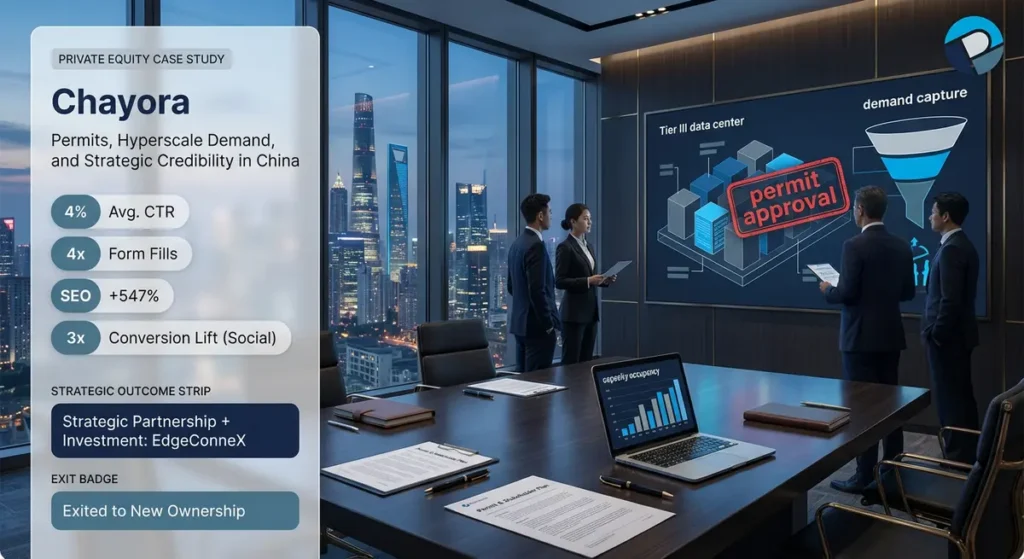
Data center permitting and industry credibility
Community engagement needs sector context. Percepture works across digital infrastructure, telecom, construction and complex B2B markets where project facts must survive executive review, local questions, media attention and online search.
Review the investment approach
Compare how Percepture structures services before requesting a project-specific recommendation.
Community Engagement Consulting pricing and scope
Pricing depends on the project stage, geographic scope, number of jurisdictions, stakeholder complexity, research requirements, content volume, channel mix, meeting calendar, reporting needs and level of issue readiness required. Publishing a flat fee without those inputs would give buyers a weak planning number.
Percepture defines each scope, team, deliverable set, assumption, client responsibility and reporting approach before work begins. Buyers should ask every firm which activities are included, which depend on partner support and how changes in project conditions affect scope.
What changes the investment?
| Scope factor | Lower-complexity condition | Higher-complexity condition | Planning implication |
|---|---|---|---|
| Project stage | Early planning with flexible timing | Active controversy or near-term public deadline | Compressed timelines require faster review and response cycles |
| Geography | One defined community | Multiple jurisdictions or project corridors | More local research, content and coordination may be required |
| Evidence readiness | Approved facts are organized | Information is dispersed or still changing | Evidence architecture becomes a larger workstream |
| Channel mix | Core web content and preparation | PR, search, social, paid media and ongoing updates | More specialists and measurement inputs are involved |
| Issue conditions | Routine questions and planned milestones | Persistent misinformation, organized opposition or crisis exposure | Monitoring, escalation and senior counsel become more prominent |
How to evaluate a consulting partner
The right consulting firm should understand that engagement is an operating discipline, not a collection of meetings. Ask how the team will connect stakeholder input to approved facts, executive decisions, content, media, search results and issue response.
Buyer evaluation checklist
- Can the firm explain its method in plain language?
- Will it define deliverables, assumptions, owners and reporting before launch?
- Can it work alongside legal, technical, environmental and permitting teams?
- Does it distinguish listening and public information from promotion?
- Can it prepare content for web, media, social, search and AI retrieval?
- Does it have an escalation method for fast-moving issues?
- Will it record commitments and assign update ownership?
- Can it show leaders what questions remain unanswered?
Percepture was founded in 2004 and provides public relations, digital PR, crisis communications, content marketing, enterprise SEO, GEO, paid media and analytics. That integrated capability lets the engagement plan extend from local questions to the digital sources that executives, reporters and community members may encounter.
For a broader view of coordinated channel planning, use an omnichannel marketing approach. The point is not to use every channel. It is to make sure each active channel uses the same approved evidence and supports the project’s actual communication needs.
Common mistakes that weaken project trust
Waiting for a public event
If the first coordinated effort begins just before a hearing or construction notice, the team has little time to find conflicting facts, fill content gaps or prepare spokespeople. Start with the next decision and work backward.
Treating engagement as promotion
People can tell when a meeting is designed only to deliver talking points. Useful engagement makes room for questions, explains limits and records what requires follow-up.
Publishing answers without ownership
A frequently asked questions page becomes a liability when no one owns updates. Every public commitment, schedule statement and technical answer should have an internal source and review path.
Separating local engagement from digital visibility
Residents, reporters, officials and employees may encounter search results before official materials. The plan should account for what appears online, not just what is said in a room.
Making promises communications cannot control
A communications team should not invent operational commitments or speak beyond technical review. Clear language about what is proposed, approved, expected or still being studied is more credible than overstatement.
Frequently asked questions
What is Community Engagement Consulting?
It is the structured work of identifying stakeholders, listening to questions, organizing approved project facts, preparing public information, recording commitments and measuring unresolved issues. For infrastructure projects, it should coordinate with legal, engineering, permitting, operations, public affairs and communications teams without replacing their professional responsibilities.
When should a project hire a community engagement consultant?
The work should start while the project still has time to organize facts and prepare for foreseeable questions. Useful trigger points include site planning, a public announcement, a permit milestone, construction preparation, a major schedule change or growing local attention. Waiting for a controversy limits the team’s options.
How is community engagement different from public relations?
Community engagement focuses on stakeholders, questions, participation, commitments and ongoing project information. Public relations focuses more heavily on media, reputation and public narratives. They often work together, but engagement should not be reduced to publicity or press coverage.
Does Percepture replace legal, engineering or permitting counsel?
No. Legal, engineering, environmental, regulatory and permitting professionals retain ownership of their advice, analysis and formal processes. Percepture helps organize approved facts, translate technical information, coordinate communications and prepare project representatives to communicate consistently.
How much does an engagement cost?
Cost depends on the project stage, geography, jurisdictions, stakeholder complexity, evidence readiness, content needs, channel mix, meeting calendar and issue conditions. Percepture defines the scope, team, deliverables, assumptions, client responsibilities and reporting approach before work begins rather than presenting an unsupported flat fee.
How long does the work take?
The schedule follows the project’s decisions and deadlines. A focused risk review can be narrower than an ongoing program covering construction and operations. The initial plan should identify immediate deadlines, foundational work, review dependencies and the update rhythm required after launch.
Can community engagement improve search and AI visibility?
The work can improve the quality and structure of the information available to search engines and AI systems. Direct answers, consistent project entities, useful definitions and maintained source content make public facts easier to retrieve. No consultant can guarantee rankings, citations or the wording of an AI-generated answer.
What information should we prepare for an initial review?
Bring the project type, location, jurisdictions, current stage, next public deadline, known concerns, existing opposition, published materials, legal and technical team structure, desired start date and current communication channels. Those inputs help define the first risk questions and a realistic scope.
Request a Community Engagement Consulting risk review
For a project risk review, bring the project type, location, current stage, next permit or hearing date, known concerns, existing opposition, legal and technical team structure, and desired start date. Percepture will use that context to frame a project-specific discussion rather than a generic sales call.