

Fiber Broadband in Montana is not just a construction challenge. Long routes, lower customer density, funding rules, middle-mile access and local trust all affect whether a network can move from a plan to a durable service.
The operating goal is also bigger than passing addresses. Leaders must connect capital, build conditions, community communication, serviceability, installation and retention so public and private investment produces lasting community and economic value.
Built for broadband decisions, not generic marketing
Percepture works across telecom, fiber, interconnection, data centers, technology, public-sector communication and complex B2B growth. The goal is to connect infrastructure truth with market demand, public trust and measurable follow-through.




Selected industry relationships and experience. Logos are shown for context and do not imply endorsement of this article.



What Is the State of Fiber Broadband in Montana in 2026?
Fiber Broadband in Montana is expanding through state, federal, local and private investment, while deployment remains shaped by distance, density, transport access, permitting, workforce capacity and subscriber economics. Construction alone does not settle the outcome. Networks must also earn community trust, capture address-level demand and convert completed passings into active, retained subscribers.
Program information last reviewed July 14, 2026 against the official ConnectMT program page. Funding and project status can change.
Executive Summary
Build from network truth
Separate planned routes, funded routes, active infrastructure and serviceable addresses when evaluating Fiber Broadband in Montana. Each status calls for different public communication and demand capture.
Distinguish funding from completion
An award or allocation can support a project, but it does not mean construction, activation or adoption has occurred.
Plan beyond the last mile
Access, middle-mile transport, physical route diversity and interconnection affect performance, resilience and long-term economics.
Treat adoption as an operating system
For Fiber Broadband in Montana, awareness, address checks, offers, installation readiness, onboarding and retention must work as one measurable funnel.
Who This Guide Is For
Network and construction leaders
Use the guide to connect Montana fiber route planning, build stages and serviceability with market communication.
Executives and finance teams
Use it to distinguish infrastructure milestones from the adoption and revenue work that follows.
Marketing and community teams
Use it to coordinate broadband education, search visibility, address checks and subscriber follow-up.
Public and institutional stakeholders
Use it to ask better questions about access, transport, resilience, adoption and measurable outcomes.
Montana Broadband Quick Facts
The supplied state program brief identifies ConnectMT as the Montana Department of Administration program responsible for broadband infrastructure deployment and related funding work. Its cited Fiber Broadband in Montana program history includes a $629 million BEAD award, 61 ARPA projects and 61,887 serviceable locations associated with that history.
Program facts and the operating question behind each one
| Item | Supplied program fact | What operators should ask |
|---|---|---|
| ConnectMT | State broadband infrastructure and funding program | Which current rules, milestones and reporting duties apply to this project? |
| BEAD | The state page cited in the brief states that Montana was awarded $629 million | What portion is allocated, obligated, under construction or active? |
| ARPA history | 61 projects | Which project areas are now serviceable, and how is that status communicated? |
| Program history | 61,887 serviceable locations | How are serviceable addresses reconciled with provider systems and resident checks? |
Current Fiber Broadband in Montana program rules and project status should be checked on the ConnectMT Broadband Program page before a funding, construction or public statement is made.
Why Fiber Deployment Is Different in Montana
Fiber Broadband in Montana must be designed around the number of customers a route can serve, the distance between communities and the physical path available to reach them. A route that looks simple on a statewide map can cross different rights of way, terrain, utility systems and permitting authorities.
Distance and Population Density
Longer routes increase the construction, maintenance and field coordination required to reach each customer. Lower density can also spread capital recovery across fewer subscribers. That does not make a project unworkable, but it makes accurate serviceability, cost and adoption assumptions more important.
Middle-Mile Access and Route Economics
Last-mile fiber connects an address. Middle-mile and long-haul networks carry Montana broadband traffic from the community toward larger network hubs, content platforms and cloud services. A strong access plan can still face high transport costs or concentration risk when the supporting routes are limited.
Permitting, Rights of Way and Workforce
Montana fiber projects can involve roads, rail corridors, utility paths, private property and public land. Operators need a shared view of approvals, construction dependencies and field resources. Marketing should follow confirmed build stages rather than announcing service before operations can support it.
Construction Risk and Capital Recovery
Weather, materials, field conditions and route changes can alter schedules. Financial planning should therefore separate homes passed, addresses serviceable, installations completed and subscribers retained. Each metric represents a different operating result.
Hunter AI: Montana Must Solve Access, Transport and Interconnection
About this analysis: The following framework is grounded in Hunter Newby’s published work on interconnection and digital infrastructure. Bob Generale helped shape the concept of having AI interview Hunter for his book and related thought-leadership assets, so this section is presented as a structured synthesis of that work rather than a new one-on-one interview.



- Broadband access Last-mile connectivity answers a basic question: can a specific home, business, school or healthcare location connect?
- Network transport Middle-mile and long-haul capacity determine how traffic leaves the community and whether the route is resilient and cost-effective.
- Interconnection The physical place where networks meet determines whether Montana traffic can exchange locally instead of taking longer, more expensive paths.
- Local digital opportunity Data centers, cloud on-ramps, AI workloads and future services tend to follow regions where access, transport, power and interconnection align.
Provider count does not by itself prove physical route diversity. Different providers may depend on a shared corridor, conduit or facility. Fiber Broadband in Montana planning should map physical paths and operational dependencies, not just brand names.
Score the Project Before Expanding the Campaign
Rate the Fiber Broadband in Montana project from one to five across network truth, funding status, community communication, address-level demand and subscriber follow-up. A low score identifies the next operating gap without requiring a gated download.
Review the Omnichannel Growth ApproachHow Montana Broadband Projects Are Funded
Montana broadband projects can involve federal programs, state administration, local participation, private equity, provider capital, debt or bond structures. The mix affects timing, reporting, ownership, risk and the revenue needed after activation.
ConnectMT and ARPA Funding
ConnectMT administers Fiber Broadband in Montana infrastructure and funding work for the state. ARPA-supported project history provides one view of public investment, but each project should be discussed by its current phase. An announced project is not the same as an active service area.
Montana BEAD Funding
The supplied ConnectMT brief states that Montana was awarded $629 million through BEAD. An award establishes available program funding. It does not prove that every dollar has been obligated, that every route has been built or that every listed address can order service.
Operators should connect BEAD marketing and subscriber adoption to verified build stages. Early messages can explain the program and collect interest. Later messages should use address-level serviceability and realistic installation steps.
Public-Private and Bond Financing
Public-private structures can divide Fiber Broadband in Montana capital, construction, ownership, operations and market responsibilities among different organizations. Bond financing can also support infrastructure where repayment assumptions and governance are clear. Leaders should define who owns the asset, who operates it, who serves customers and who carries adoption risk.
What ConnectMT and BroadbandMT Do
ConnectMT is the state program described above. BroadbandMT is identified in the supplied brief as Montana’s rural broadband association representing locally owned, community-based providers. They serve different functions, so public copy should not treat the program and association as interchangeable.
The distinction matters for Fiber Broadband in Montana because funding administration, industry representation, provider operations and customer service require different sources of authority. Clear entity naming also helps residents and AI-assisted search systems understand who is responsible for each action.
How Open-Access Fiber Works in Montana
Open access separates shared network infrastructure from at least part of the retail service layer. Multiple internet service providers may use the infrastructure under the network’s governance and commercial rules. The model can create provider choice, but results depend on operating terms, wholesale economics, service coordination and customer experience.
Yellowstone Fiber as a Montana Example
The supplied brief identifies Yellowstone Fiber as a nonprofit open-access network serving Bozeman and parts of Gallatin County with multiple ISP choices. It is a useful model for understanding the roles of infrastructure owner and retail provider, but it should not be treated as the only structure available for Fiber Broadband in Montana.
Benefits and Risks of Open Access
Shared infrastructure can reduce duplicated Fiber Broadband in Montana construction and provide a platform for retail choice. It can also create handoffs between network and service organizations. Customers need clear answers about availability, pricing, installation, support and which organization handles a problem.
Fiber Broadband in Montana Network Model Comparison
| Model | Infrastructure role | Retail role | Buyer question |
|---|---|---|---|
| Vertically integrated provider | Provider builds or controls the network | The same provider generally sells service | Can one organization support construction, installation and retention? |
| Open-access network | Shared infrastructure is governed separately | Multiple retail providers may participate | Are wholesale terms, handoffs and customer responsibilities clear? |
| Public-private structure | Roles are divided by agreement | A private or contracted operator may serve customers | Who owns adoption, service quality and long-term economics? |
| Institutional or regional network | Infrastructure connects defined institutions or participants | Retail service may be outside the core purpose | How does the network connect to transport, carriers and local demand? |
Fiber in Big Sky Country: Myths and Realities
| Myth | Operating reality | Better decision |
|---|---|---|
| Montana is simply too remote | Distance changes Fiber Broadband in Montana route economics and operating design. It does not replace project-level analysis. | Model routes, density, transport and address demand together. |
| Fiber is always too expensive | Cost depends on construction conditions, network design, financing and subscriber economics. | Compare full lifecycle cost and measurable demand. |
| There is no demand | Broad interest is not the same as address-level intent or completed orders. | Collect pre-registrations and reconcile them with serviceability. |
| Only grants make projects work | Projects may combine public and private capital, debt, bonds and operating revenue. | Define capital sources and long-term obligations separately. |
| Construction guarantees adoption | A passing becomes revenue only after ordering, installation, onboarding and retention. | Fund adoption work as part of network operations. |
How Fiber Supports Montana Communities
Fiber Broadband in Montana can support institutions, businesses and public services when the network reaches the required sites and those organizations can adopt it. The responsible case is based on specific uses, not broad promises that every project will produce the same result.
Education and Anchor Institutions
Schools, libraries and other anchor institutions can be important Fiber Broadband in Montana demand centers and community information channels. Planning should identify their connection needs, installation constraints, internal networks and continuity requirements.
Healthcare and Public Safety
Healthcare and public-safety organizations using Fiber Broadband in Montana may require dependable transport, route diversity, backup systems and clear escalation paths. A fiber connection is one layer of that design, not a complete resilience plan by itself.
Small Business, Agriculture and Economic Development
Businesses may use reliable connectivity for payments, cloud systems, customer support, remote work and coordination across locations. Agriculture and field operations can have different coverage and application needs, so planners should avoid treating every address as an identical use case.
Data Centers, Photonics and Future Infrastructure
Future infrastructure connected to Fiber Broadband in Montana depends on more than local access. Power, facilities, transport, interconnection, route diversity and recurring demand affect whether advanced digital services can operate in a region. These conditions should be mapped before promotional claims are made.
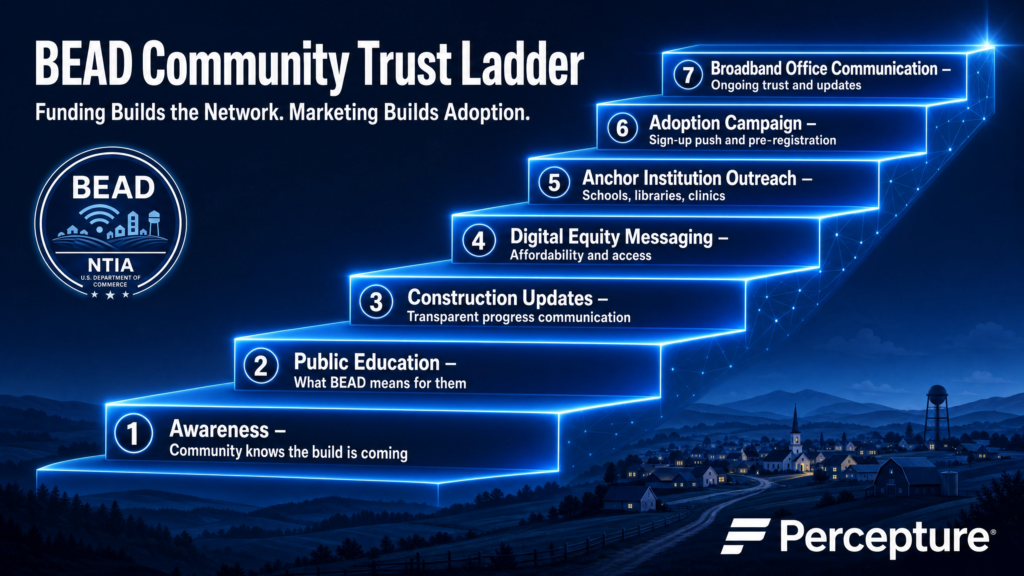
Operators can use the dedicated playbook on how to build community trust before broadband construction for the tactical outreach steps. This guide keeps the focus on the statewide operating system.
Western infrastructure only works when people understand the story
Percepture’s work includes the State of Wyoming and an award-winning Amazon remote-delivery campaign. These are not fiber deployment case studies. They demonstrate how remote geography, public-sector priorities, logistics and community relevance can be translated into clear, credible communication.
That same discipline matters in Montana. Residents and institutions need to understand what is funded, what is being built, when an address becomes serviceable and what action comes next.
The Montana Fiber Growth Map
The Montana Fiber Growth Map is Percepture’s five-part method for connecting infrastructure decisions to visibility, conversion and subscriber economics. It gives leaders one shared view of Fiber Broadband in Montana without collapsing policy, construction and adoption into one number.
- 1
Infrastructure truth
Question: What exists now for Fiber Broadband in Montana? Evidence: routes, build phases and serviceable addresses. Action: reconcile operations, maps and public messages.
- 2
Capital and policy
Question: What funds the project and under which rules? Evidence: awards, agreements, obligations and milestones. Action: separate funding status from completion.
- 3
Community coalition
Question: Who must understand and support the work? Evidence: stakeholder questions, meetings and local communication. Action: publish clear stage-specific answers.
- 4
Address-level demand
Question: Which locations can order or want future service? Evidence: validated address checks and pre-registrations. Action: connect demand records to construction and sales systems.
- 5
Subscriber and economic outcomes
Question: Does Fiber Broadband in Montana convert and retain users? Evidence: orders, installs, activations and retention. Action: remove friction at the weakest funnel stage.
SEO organizes the questions residents and buyers search. GEO makes entities, service areas and answers easier for AI systems to retrieve. CRO simplifies address checks and next steps. Pipeline defines routing, follow-up and human ownership after interest is captured.

How Montana Networks Convert Passings Into Subscribers
A passing means a route reaches an address or its vicinity under the operator’s definition. It does not automatically mean the address can order immediately, that installation is ready or that the resident understands the offer. Fiber Broadband in Montana needs a shared definition for each funnel stage.
The sequence is serviceability, awareness, address check, offer selection, installation readiness, activation, onboarding and retention. Teams can use the guide to convert fiber passings into subscribers and the supporting fiber take-rate marketing framework to diagnose adoption gaps.
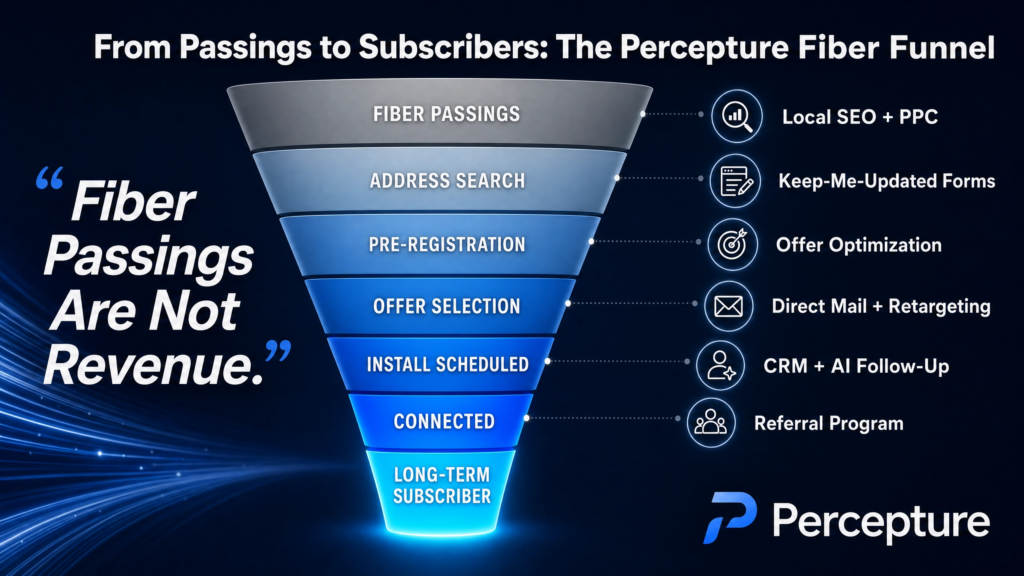
Paid search can capture active local demand when campaigns use confirmed service areas. Conversion rate optimization services can reduce friction in address checks, offer pages and registration paths. AI sales agents can support routing and qualification when the workflow includes clear human handoff and privacy controls.
Search, PR and AI Visibility for Montana Broadband Providers
Residents may search for Montana fiber service by town, provider, construction status, service address, funding program or network model. A provider’s website should clearly state who operates the service, where it is available, how availability is checked and what happens after registration.
Organic SEO services help organize durable service-area and question-based content. Generative engine optimization services strengthen entity clarity and answer structure. Digital PR services can distribute accurate infrastructure explanations and expert context without overstating a project’s status.
Google’s position: foundational SEO still applies to AI Overviews and AI Mode. Google does not require special GEO markup or artificial “chunking.” The practical advantage comes from crawlable pages, useful first-party information, clear entities, strong images and a satisfying page experience. See Google Search Central’s guidance for AI features.
The best AI visibility SEO tool for a regional operator should track whether the company is cited for service areas, community impact, open-access models, funding questions and local broadband comparisons.
Regional awareness can also use media buying services when geography, timing and serviceability are tightly controlled. The broader telecom marketing strategy should keep search, public communication, paid demand and sales follow-up on the same operating data.
Montana Fiber and Broadband Case Examples
Yellowstone Fiber provides the named Fiber Broadband in Montana example of an open-access structure in the supplied brief. Its value here is architectural: it helps explain the difference between shared network infrastructure and retail ISP choice. This article does not use it as proof that every community should select the same model.
Percepture’s supplied Broadstaff Global proof addresses a different question: whether specialized infrastructure expertise can become easier to find and convert into qualified demand. The approved case material reports that 90% of tracked keywords reached page one and qualified leads increased three times within 12 months.
Telecom visibility has to support real business outcomes
Montana broadband leaders do not need generic traffic. They need visibility that reaches investors, partners, institutions, local stakeholders and qualified buyers. The examples below show how Percepture connects technical-market authority with discoverability and pipeline.


Connect the Framework to an Investment Plan
Compare the work required for Fiber Broadband in Montana across strategy, search, GEO, public communication, paid demand and conversion before selecting a channel budget.
Review Percepture Pricing OptionsA 90-Day Montana Fiber Growth Plan
The first 90 days should produce a cleaner operating picture, not a larger pile of disconnected campaigns. The plan below aligns Fiber Broadband in Montana with serviceability, community communication and subscriber conversion.
Days 1–30: Diagnose
- Document the difference between planned, funded, under-construction, serviceable and active areas.
- Reconcile address records across engineering, operations, marketing and sales.
- List the questions residents, institutions, businesses and public stakeholders ask at each build stage.
- Map middle-mile dependencies, route concentration and interconnection assumptions.
- Audit address checks, forms, call routing and follow-up ownership.
Days 31–60: Build
- Create Fiber Broadband in Montana service-area pages and community FAQs using confirmed operating data.
- Publish construction messages that explain current status and the next resident action.
- Connect pre-registration records to address status and campaign eligibility.
- Build separate paths for unavailable, future-serviceable and immediately serviceable addresses.
- Coordinate search, PR, email and paid media through an omnichannel marketing system.
Days 61–90: Optimize
- Measure address checks, qualified registrations, scheduled installations, activations and retention.
- Compare performance by service area, message, audience and funnel stage.
- Fix the highest-friction step before increasing media spend.
- Use B2B lead generation services for institutional and business opportunities that require longer sales cycles.
- Publish updated answers when construction or service status changes.

Fiber Broadband in Montana FAQs
How much BEAD funding did Montana receive?
The ConnectMT state page cited in the supplied brief states that Montana was awarded $629 million through BEAD. An award is not the same as completed Fiber Broadband in Montana deployment. Current allocations, obligations, project milestones and service status should be reviewed on the state program page before the figure is used in a funding or construction decision.
What is the ConnectMT Broadband Program?
ConnectMT is the Montana Department of Administration program responsible for Fiber Broadband in Montana infrastructure deployment and related state and federal funding work. Operators and public stakeholders should use its current materials for program rules, project information and funding status rather than relying on summaries that may not reflect later changes.
Why is rural broadband difficult to build in Montana?
Fiber Broadband in Montana must account for long distances, lower customer density, middle-mile access, rights of way, permitting, field workforce and capital recovery. Terrain and route constraints can also affect construction and resilience. Each proposed route needs project-level engineering, financial and demand analysis rather than a blanket statewide assumption.
What is open-access fiber?
Open-access fiber is a network structure in which shared infrastructure can support multiple retail service providers under defined governance and commercial terms. The infrastructure owner and customer-facing ISP may have different duties. Clear wholesale rules, service handoffs, installation processes and support responsibilities are central to the customer experience.
What is Yellowstone Fiber?
The supplied brief identifies Yellowstone Fiber as a nonprofit open-access fiber network serving Bozeman and parts of Gallatin County with multiple ISP choices. It illustrates how shared infrastructure and retail internet service can be separated. It is one Montana example, not the only network structure available to communities or operators.
Does building Fiber Broadband in Montana guarantee subscriber adoption?
No. Fiber construction creates the ability to serve locations, but adoption still depends on accurate serviceability, awareness, local trust, clear offers, simple address checks, installation coordination, onboarding and retention. Operators should measure each stage separately so a low take rate is not mistaken for a construction problem.
How can Montana fiber providers improve take rate?
Fiber Broadband in Montana providers can align campaigns with confirmed serviceability, communicate before and during construction, collect address-level demand, simplify availability checks and follow up quickly after a qualified registration. They should also track installation readiness, activation and retention instead of treating all website leads or homes passed as subscribers.
How does AI search affect Montana broadband providers?
Residents, businesses, public officials and partners can use AI-assisted search to compare Fiber Broadband in Montana providers, understand programs and ask local service questions. Providers need clear organization names, service areas, network roles, availability instructions and factual FAQs. These elements help search and AI systems retrieve answers without confusing a state program, network owner and retail ISP.
Meet Alex in Montana. Amanda will make it easy.
Bring us the Montana fiber, market visibility or subscriber-growth challenge that matters most. Alex Mannine will prepare the strategic conversation, while Amanda Pacheco coordinates the meeting and keeps every next step organized.
Leads the discussion around market positioning, AI discovery, community communication, address-level demand and subscriber growth.
Coordinates schedules, gathers the right background information and keeps the meeting, follow-up and next steps moving.
What happens next
-
1
Share the priority
Tell us the deployment, demand, visibility or growth issue you want to address.
-
2
Amanda coordinates the details
Amanda confirms timing, collects useful context and makes sure the right people are included.
-
3
Alex arrives prepared
The conversation begins with your operating reality rather than a generic agency presentation.
Percepture is an independent attendee and publisher. Percepture is not the Fiber Broadband Association or the event organizer.