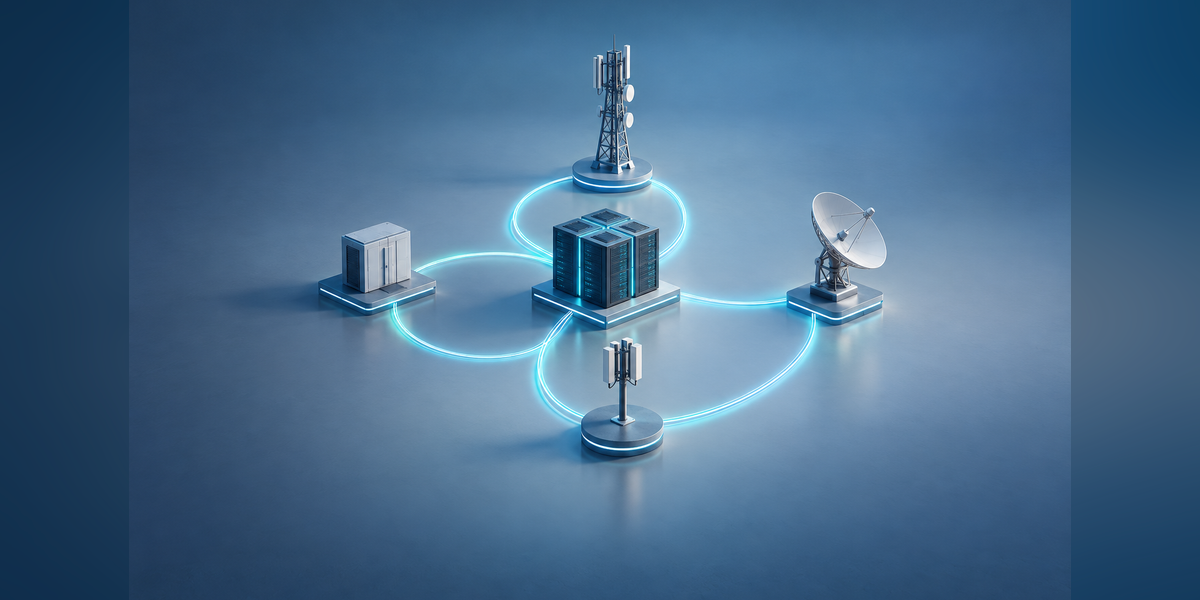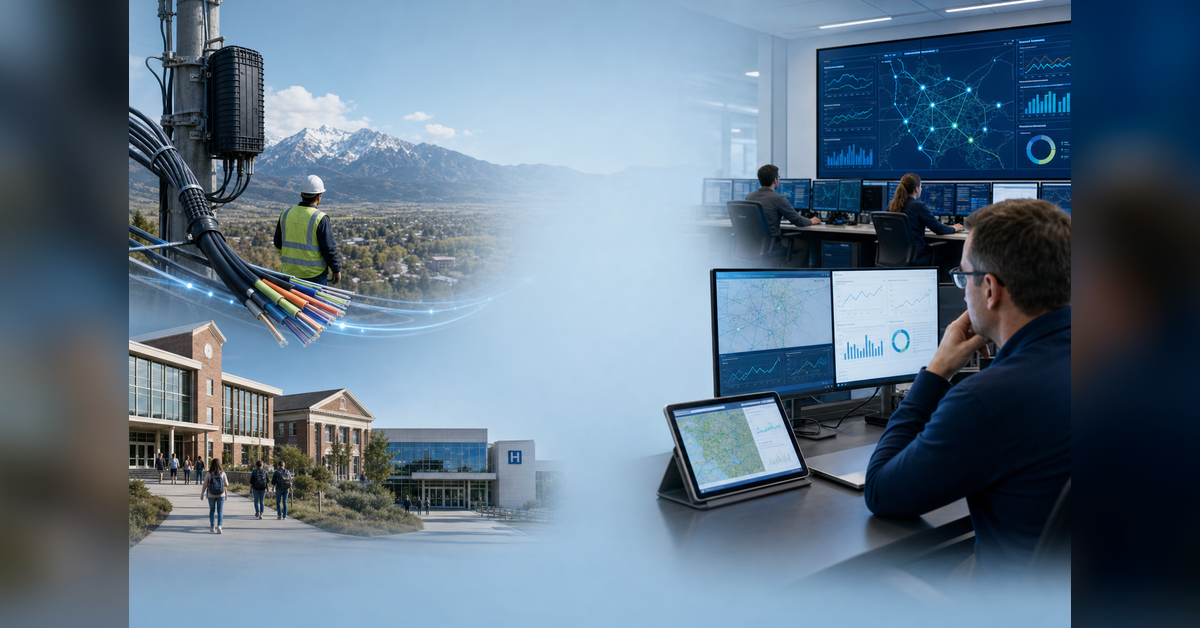

AI experiences may look like software, but their value depends on physical networks, reliable data and accountable people. AI and fiber infrastructure meet where data must move quickly and reliably between users, field systems, edge sites, data centers and cloud platforms.
This guide frames the questions business and marketing leaders should bring to Regional Fiber Connect Bozeman. It also shows how Alex Mannine, Percepture’s AI and Technical Automation Strategist, connects network capability with practical workflows, governance and measurable follow-up.
Infrastructure strategy needs operating proof
AI and fiber infrastructure buyers are not looking for another technology slogan. They need evidence that physical networks, expert positioning, AI visibility and accountable follow-up can work as one commercial system.




How are AI and fiber infrastructure connected?
AI and fiber infrastructure are connected because AI systems need reliable, high-capacity networks to move data among users, edge sites, data centers and cloud platforms. Fiber provides transport and resilience. AI helps operators interpret data, support decisions and automate defined workflows when governance and human review are built into the system.
Executive summary
Fiber creates reach
In AI and fiber infrastructure, fiber carries large volumes of data between communities, businesses, network facilities and compute resources.
Data creates context
AI is only as useful as the serviceability, network, ticket, CRM and knowledge data it can access lawfully and accurately.
Workflows create value
Start with a defined task, an accountable owner, an approved data path and a clear handoff to a person.
Measurement creates discipline
Judge AI and fiber infrastructure by operating outcomes, not by the number of tools deployed.
Why AI systems need fiber networks
AI does not remove the physical limits of a network. A model may process information in a data center or cloud region, but users still need a dependable path to send requests and receive results. Fiber is not the only access technology, yet it is an important part of the transport layer that links access networks, facilities and compute. Any AI and fiber infrastructure plan should account for that complete physical path.
Capacity and data movement
Network operations, video, sensors, customer systems and business applications can produce large and continuous data flows. An AI workflow may need only a small prompt at the user interface, while the supporting system retrieves records, compares histories and exchanges data with several platforms.
That distinction matters. The visible request can be small while the supporting data movement is much larger. Leaders evaluating AI and fiber infrastructure should map the full path from source system to model, integration, employee and customer.
Latency, edge computing and cloud access
Latency is the time required for information to travel and return. Some workloads can tolerate delay. Interactive support, live video, industrial controls and other time-sensitive applications may require compute or interconnection closer to the user.
Placing compute closer does not solve every problem. The operator must still examine route design, upstream connectivity, integrations and the response time of each system in the workflow. Local processing is useful only when the complete AI and fiber infrastructure service path supports it.
Reliability and resilience
A fast route that fails at the wrong moment is not an AI-ready route. Operators should examine physical diversity, upstream dependencies, power, backup systems, monitoring and escalation. Two commercial providers do not create route diversity if both use the same physical corridor.
AI can help organize alarms and histories, but it cannot repair weak architecture. Engineering teams should validate the network assumptions behind any service promise or automated recommendation.
Community access to AI-enabled services
Communities experience AI through services such as education platforms, healthcare applications, public systems and business tools. Access depends on more than the model. It also depends on AI and fiber infrastructure, suitable devices, usable applications, support and trust.
The fiber broadband in Montana resource provides state context without turning this page into a broadband deployment guide. Operators planning construction should also consider how to build community trust before broadband construction.
What “fiber fuels intelligence” means
The phrase is useful when it describes a chain of capability rather than a slogan. Fiber moves information. Compute processes it. Data gives it context. A governed workflow turns the result into an action that a person or system can evaluate.
For a municipality, that could mean faster access to approved records. For a business, it could mean better support or reporting. For an operator, it could mean a more organized investigation of alarms, tickets and service histories. The value does not come from AI alone.
Leaders should ask where intelligence enters the operating process. If an alert has no owner, a qualified lead has no follow-up path or a generated message has no approval rule, the workflow is incomplete. AI and fiber infrastructure create leverage only when the final action is designed as carefully as the network path.
Who should use this guide?
CEOs
Use it to separate a strategic AI and fiber infrastructure operating system from a collection of AI tools.
Marketing leaders
Use it to connect AI and fiber infrastructure expertise, market visibility and qualified demand.
Sales leaders
Use it to define qualification, routing and human follow-up before automating outreach.
Network and operations leaders
Use it to identify the data, controls and engineering review that AI and fiber infrastructure require for safe assistance.
Where broadband operators can use AI now
The best starting point for AI and fiber infrastructure is a narrow workflow with known inputs and an accountable owner. AI should organize evidence, draft a response or recommend the next step. It should not hide uncertainty or bypass the person responsible for the outcome.
AI and fiber infrastructure use-case scorecard
Use the scorecard to compare where AI and fiber infrastructure can support a defined task without weakening evidence or human control.
| Workflow | Useful AI role | Required evidence | Human control |
|---|---|---|---|
| Network troubleshooting | Organize alarms, histories and approved knowledge | Current network data, ticket history and runbooks | Engineer validates diagnosis and action |
| Serviceability | Retrieve records and flag conflicts | Address, footprint, product and construction data | Authorized employee confirms availability |
| Lead qualification | Collect requirements and route an opportunity | CRM fields, serviceability and qualification rules | Sales owner reviews fit and next step |
| Construction updates | Draft status messages from approved records | Project status, geography and approved language | Project or communications owner approves release |
| Outage communication | Prepare consistent drafts for approved channels | Incident status, affected area and message policy | Operations approves facts and timing |
| RFP support | Retrieve approved answers and draft sections | Product, security, legal and technical libraries | Subject experts approve the submission |
| Customer onboarding | Sequence tasks and answer routine questions | Order, installation, product and account data | Support handles exceptions and disputes |
| Retention signals | Surface patterns for review | Tickets, usage, billing and communication records | Account owner selects the response |
| Executive reporting | Summarize approved performance data | Defined metrics, source ownership and time periods | Executive owner checks context |
Network troubleshooting and knowledge retrieval
AI can bring together alarms, ticket histories and approved procedures so an engineer can investigate with better context. The system should cite the source record and show when information is stale or missing. It should never present a generated network answer as verified engineering judgment.
Serviceability and lead qualification
Serviceability is a high-value but high-risk AI and fiber infrastructure workflow because address, construction and product records may conflict. AI can retrieve evidence and identify gaps. A person or authoritative system should confirm the final promise.
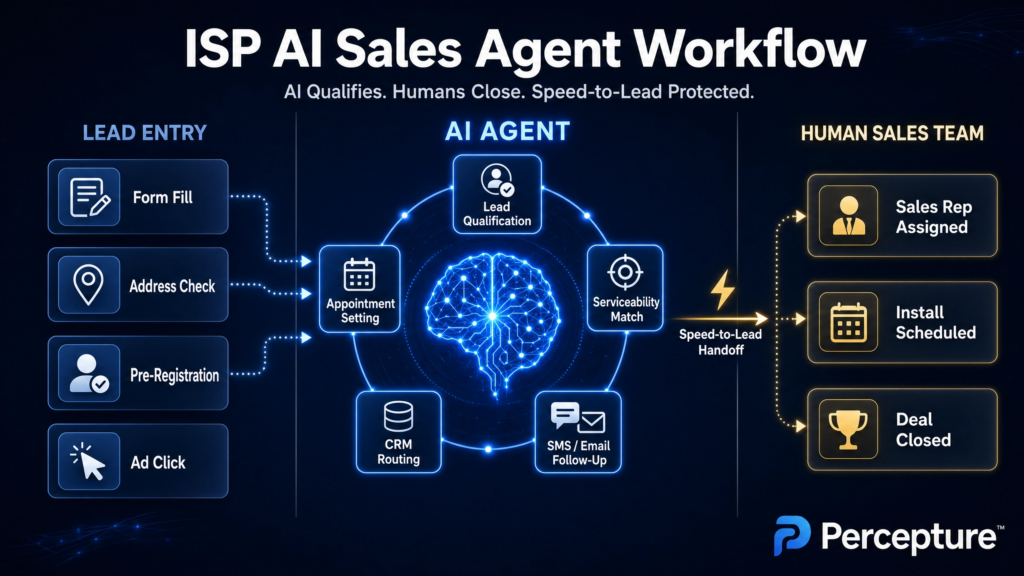
Percepture’s AI sales agents service focuses on structured qualification and handoff. The supporting guide to ISP sales automation and AI sales agents explains why speed must be paired with human accountability.
Construction and outage communication
AI can prepare drafts from approved project or incident data. The communications owner must confirm the affected area, status and timing before release. This protects customers from confident messages built on incomplete records.
RFPs, security questionnaires and sales support
A controlled knowledge base can retrieve approved answers and create a first draft. Legal, security, engineering and sales owners still approve the final submission. This is especially important when an answer changes a contractual or technical commitment.
Customer onboarding and retention signals
Onboarding workflows can sequence tasks, answer routine questions and route exceptions. Retention models can surface patterns, but teams should review the evidence before making an offer or changing an account treatment.
Executive reporting and competitive intelligence
AI can summarize defined metrics and compare approved periods. The report should preserve links to source data so leaders can challenge the summary and evaluate AI and fiber infrastructure against operating results. Percepture’s attribution and analytics work supports that source-to-decision discipline.
Score one workflow before buying another tool
Use an AI-to-Fiber Workflow Scorecard to rate data readiness, workflow value, integration, human review and measurement. The purpose is to find one defensible starting point for AI and fiber infrastructure.
Run a Lead Quality DiagnosticThe Alex Mannine AI-to-Fiber Operating Model
The Alex Mannine AI-to-Fiber Operating Model organizes AI and fiber infrastructure decisions into five connected parts. Each part asks for evidence, ownership and a measurable next action. A weak part can limit the whole system.
Physical network and data foundation
Buyer question: Can the AI and fiber infrastructure foundation provide reliable, permitted data at the required time?
Evidence: Route and facility dependencies, system owners, data definitions, permissions and quality checks.
Next measure: Record completeness, retrieval success and unresolved data conflicts.
Operational intelligence
Buyer question: What specific decision or task will AI support?
Evidence: A documented workflow, approved knowledge, exception rules and an accountable owner.
Next measure: Investigation time, draft acceptance, error rate or another workflow-specific result.
Customer and sales workflows
Buyer question: What happens after a customer asks a question or a lead shows intent?
Evidence: Qualification rules, serviceability sources, CRM fields, routing logic and follow-up ownership.
Next measure: Qualified handoffs, completed next steps and corrected routing errors.
Human governance and escalation
Buyer question: Which AI and fiber infrastructure decisions require approval, and who can stop the workflow?
Evidence: Access controls, audit records, prohibited actions, review points and escalation paths.
Next measure: Escalation quality, policy exceptions and unauthorized-action prevention.
Measurement and continuous learning
Buyer question: How will the team know whether the workflow is useful and safe?
Evidence: A baseline, outcome definition, review cadence and owner for corrections.
Next measure: Business outcome, quality, adoption and documented changes.
The model also supports market execution. Clear subtopics help organic SEO services. Atomic definitions and named expertise support generative engine optimization services. Better forms and handoffs connect to conversion rate optimization services. Qualified routing supports B2B lead generation services.
Build, pilot or pause?
| Decision | Best fit | Required next step |
|---|---|---|
| Pilot | One bounded workflow has usable data, an owner and a human approval point. | Set a baseline and test with a limited group. |
| Build the foundation | The use case is useful, but records, permissions or integrations are inconsistent. | Fix the source system and ownership gaps first. |
| Pause | The workflow could create unsafe promises, hidden decisions or uncontrolled messages. | Define prohibited actions and escalation before deployment. |
What AI should not do in a fiber operation
AI and fiber infrastructure should not be used to make unsupervised service promises, conceal conflicting serviceability records or invent a network diagnosis. AI should not release outage or construction messages without an approved factual source. It should not replace engineering judgment in safety-sensitive or high-impact decisions.
Customer-facing systems need the same discipline. An agent should disclose its role where appropriate, respect access and communication rules, and provide a clear path to a person. The article on AI outbound calling agents explains why the communication channel must be evaluated along with the automation.
Minimum governance controls
- Approved use cases and prohibited actions
- Named owners for source data and workflow outcomes
- Role-based access to customer, network and business records
- Source citations or record links inside operational answers
- Human review for promises, exceptions and high-impact actions
- Audit records, quality checks and a correction process
- A tested escalation path when the system lacks enough evidence
AI visibility for telecom and fiber brands
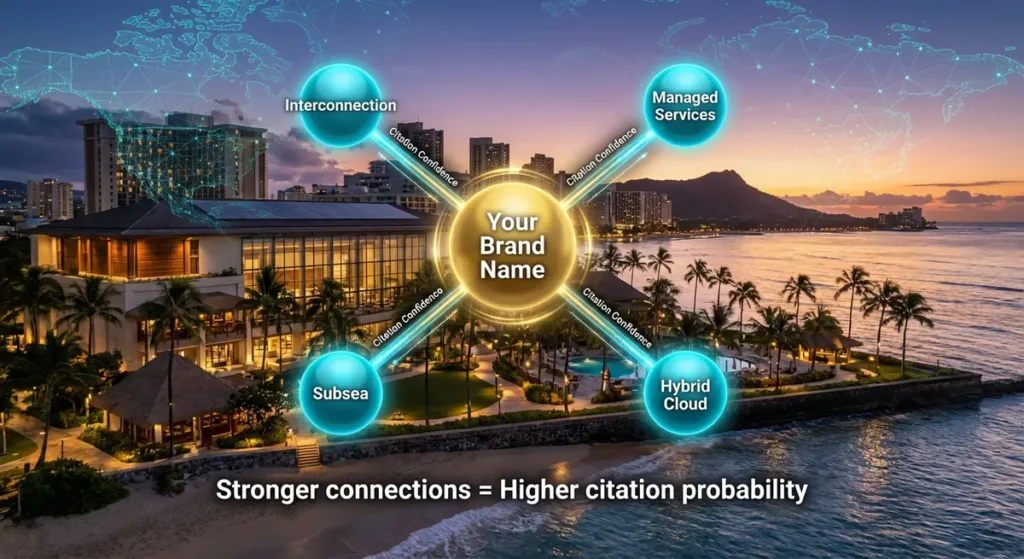
Operators also face a market problem. Their AI and fiber infrastructure expertise may be deep, but buyers and communities cannot use it if search engines and AI answer systems cannot identify the company, its experts, its service areas and the evidence behind its claims.
A practical visibility system combines technical crawlability, clear entities, expert-led content, useful internal links, third-party references and ongoing monitoring. Percepture connects digital PR services with search and expert content so a technical point can be found, understood and supported.
Telecom teams can use AI visibility software to measure whether their infrastructure expertise is being retrieved for the questions buyers, communities and partners ask in AI search.
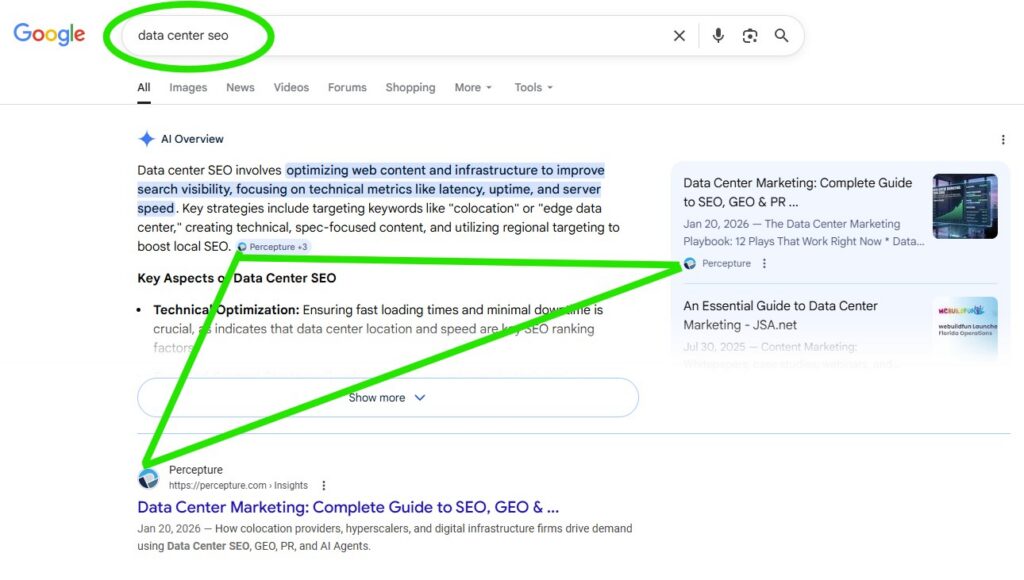
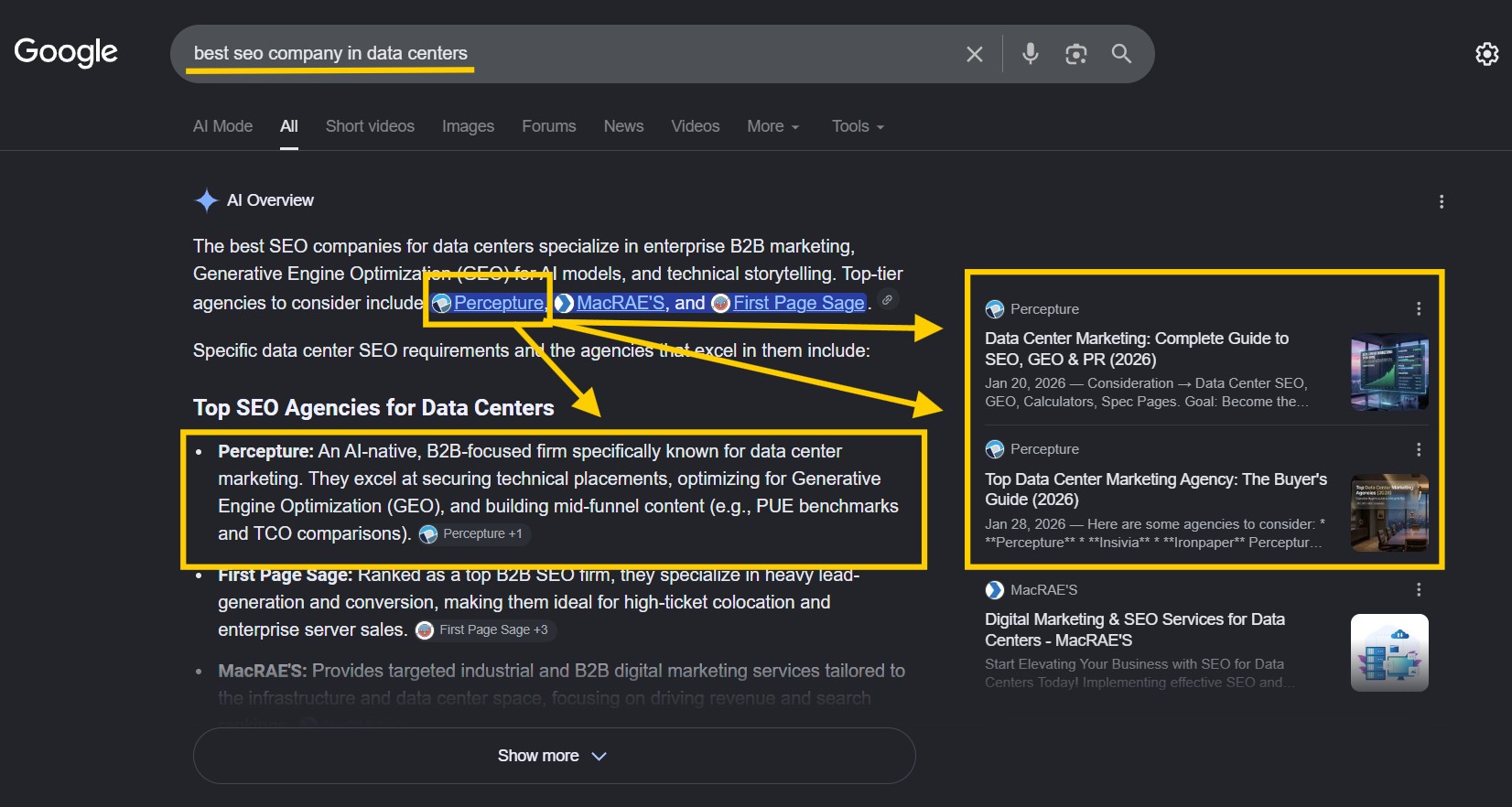

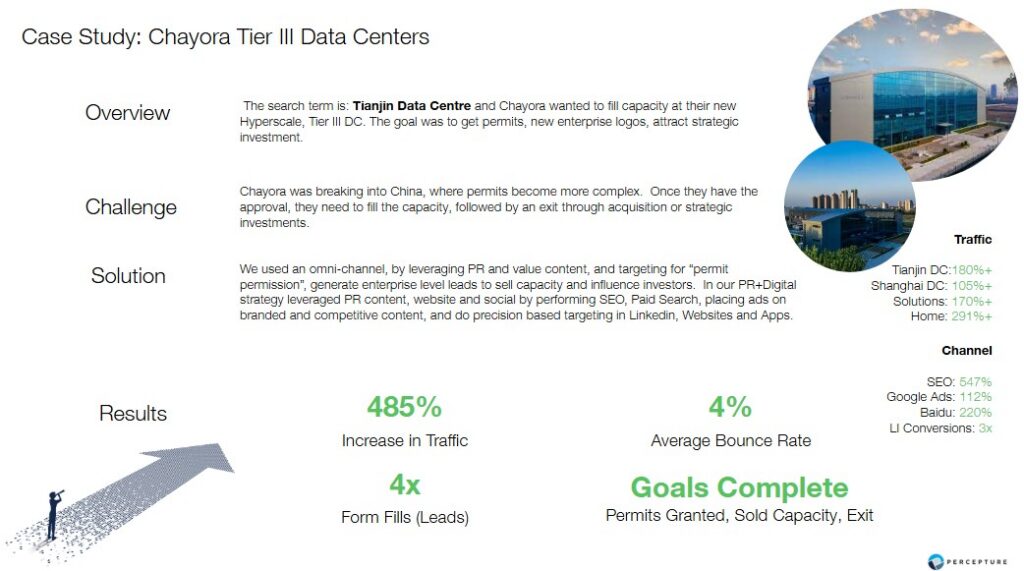
Why this matters: a 35-year-old infrastructure company can have deep real-world experience and still remain nearly invisible in AI search. Percepture’s case material reports that one such company moved from almost no daily mentions to thousands, while supporting qualified demand, in under three months.
A complete demand plan can also include paid search for active demand and media buying services for regional awareness. Those channels should support the same entity, offer and follow-up logic used in organic content.
Five questions Alex Mannine is taking to Bozeman
These five questions turn AI and fiber infrastructure from a broad theme into an operating discussion. They are useful whether the conversation happens at Regional Fiber Connect, inside a planning meeting or during a vendor review.
What data is ready?
List the systems required by the workflow. Identify who owns each field, how often it changes and what happens when two records disagree. A useful pilot begins with known data limits.
Which workflows create real leverage?
Choose AI and fiber infrastructure work that is repeated, measurable and expensive enough to matter. Avoid starting with a vague company-wide assistant. A narrow process makes quality and accountability easier to inspect.
How is community impact measured?
Separate network availability from service adoption and service usefulness. The measures should match the promised outcome rather than a generic AI adoption target.
Where does human approval sit?
Name the person responsible for promises, exceptions and high-impact decisions. Then show the point where that person receives the evidence required to act.
What happens after a lead or alert?
Automation often fails at the handoff. Define the owner, system update, response path and documented next step before increasing volume.
Readers planning the event can use Percepture’s Regional Fiber Connect Bozeman guide. The Fiber Broadband Association remains the source for current public event information on the official event page.
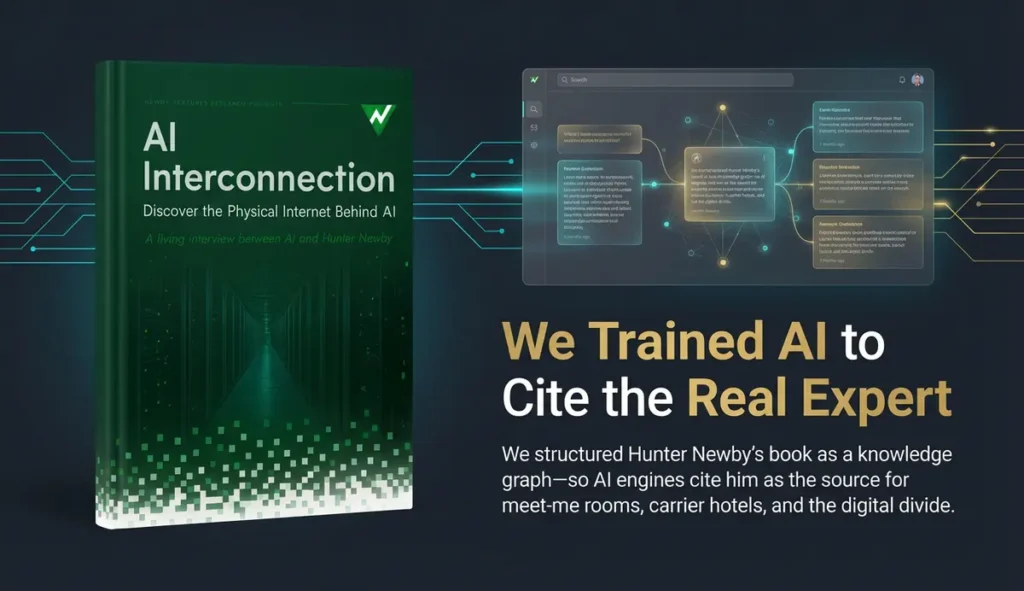
What Hunter AI reveals about AI-ready fiber infrastructure
About this material: Hunter AI is a knowledge system grounded in Hunter Newby’s published work, interviews and digital-infrastructure frameworks. It is designed to retrieve documented expertise, not imitate a new personal interview or replace qualified engineering judgment.

The AI infrastructure readiness stack
- Physical fiber
Routes reach users, institutions, businesses and interconnection facilities.
- Carrier-neutral colocation
Networks can install equipment and connect in a professionally operated environment.
- Power and cooling
Facilities can support the equipment and density required by the workload.
- Network diversity
Alternate routes do not silently depend on the same physical path or facility.
- Neutral interconnection
Networks, platforms and cloud services can exchange traffic without unnecessary distance.
- Local or regional compute
Processing is placed at a distance suitable for the application and user experience.
- Usable services
Data quality, governance and human execution turn physical capacity into an operating result.
Telecom thought leadership as a working AI system
An expert knowledge system should scale access to documented thinking without pretending to become the expert. It can organize published definitions, recorded case studies, technical patterns and previously answered questions. Strategic, financial, technical and public-risk decisions still require qualified human review.
A responsible knowledge agent answers from named material, distinguishes source content from inference and identifies gaps. It also preserves the expert’s terminology instead of inventing positions. For AI and fiber infrastructure, this creates a practical bridge between thought leadership, search visibility and human decision-making.
Mission Possible: turning industry conversations into action
This editorial video supports the discussion of future connectivity, expert knowledge and practical follow-up. It opens on the video provider only after the reader selects the link.
Watch Mission PossibleConference attention needs a pipeline system
Attendance creates access. Pipeline comes from owning the search window, arriving with a reason to meet, coordinating the handoff and documenting the next action after the conversation.
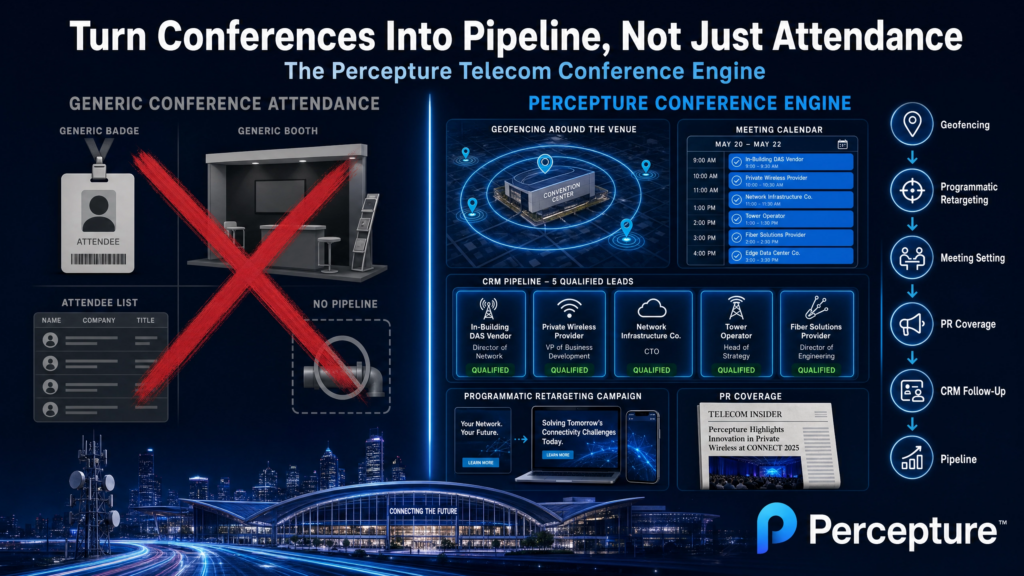
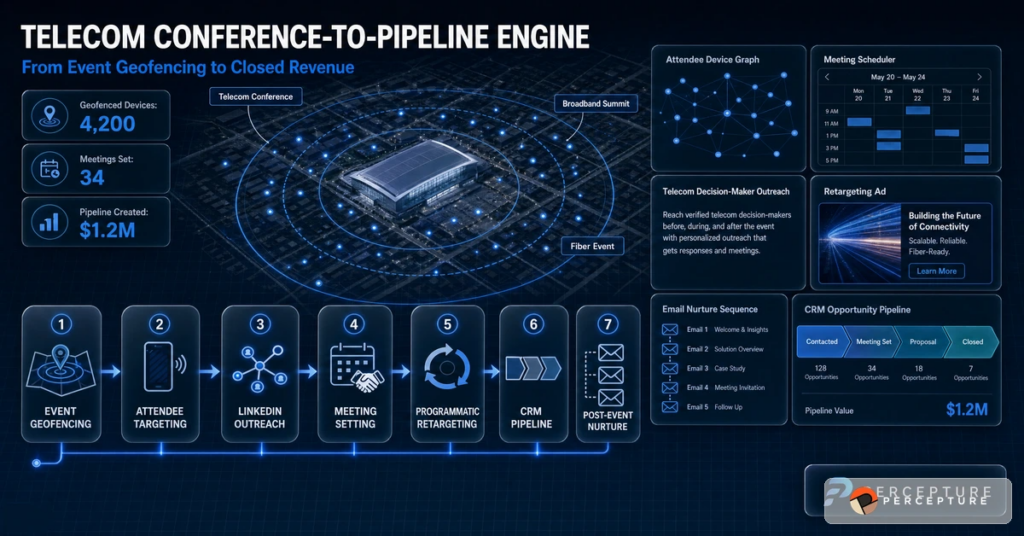
- Own the search window
Publish useful answers before attendees finalize meetings and travel plans.
- Create a reason to meet
Lead with one operating question, useful proof and a clear point of view.
- Coordinate the handoff
Give scheduling, preparation and follow-up to named people rather than a generic inbox.
- Capture the next action
Document what was learned, who owns the response and when it should happen.
- Measure commercial movement
Track qualified conversations, opportunities, influenced pipeline and closed revenue.
Compare the operating model with the investment
Review Percepture’s pricing options after scoring the AI and fiber infrastructure workflow, data foundation and human controls. This keeps the buying discussion tied to a defined operating need.
Review Pricing OptionsBroadstaff Global search and lead-generation proof

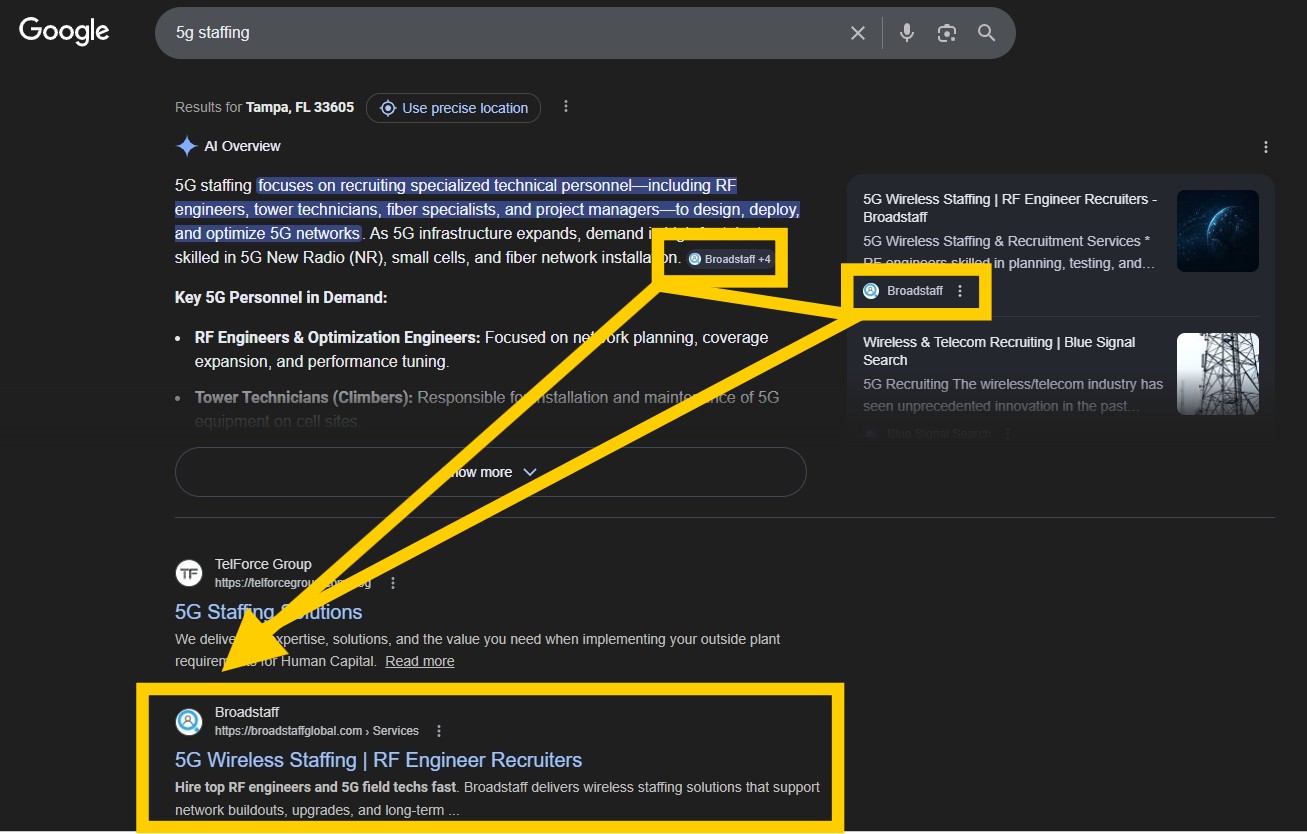
The approved Broadstaff Global case study reports that 90% of tracked keywords reached page one and qualified leads increased threefold within 12 months. This is search and lead-generation proof, not an AI-agent result.
“What they’ve done for Broadstaff has been really nothing short of miraculous.”
Carrie Charles, Broadstaff Global
Watch the Broadstaff testimonial
Carrie Charles describes Broadstaff Global’s experience with Percepture. The video opens on YouTube after selection and does not autoplay.
Watch the Broadstaff testimonialThe lesson for infrastructure brands is direct. Specialized knowledge must be translated into useful pages, clear claims and a measurable path to qualified demand. Percepture’s telecom marketing strategy guide expands that operating approach.
AI and fiber infrastructure FAQs
How are AI and fiber infrastructure connected?
Fiber moves data among users, devices, edge sites, data centers and cloud systems. AI analyzes that data and assists defined decisions or workflows. AI and fiber infrastructure are useful together when the network is reliable, source data is accurate and a person remains accountable for promises, exceptions and high-impact actions.
What is AI-ready fiber infrastructure?
AI-ready fiber infrastructure is a network and operating environment with dependable connectivity, usable data, suitable integrations, security controls, governance and measurable workflows. Bandwidth is one part of AI and fiber infrastructure readiness. Route design, interconnection, compute location, power, source ownership and human escalation can also affect whether an AI service works as intended.
How can broadband operators use AI?
Practical AI and fiber infrastructure starting points include troubleshooting support, knowledge retrieval, lead routing, serviceability assistance, customer-message drafts, RFP preparation, onboarding and reporting. Start with one bounded process that has approved data, an accountable owner, a review point and a metric tied to the operating outcome.
Can AI improve fiber network troubleshooting?
AI can organize alarms, histories, tickets and approved knowledge so engineers can investigate with better context. In an AI and fiber infrastructure workflow, the system should identify the source of each fact and disclose missing or stale information. Engineers should validate diagnoses, configuration changes and safety-sensitive actions before the operation proceeds.
Can AI replace ISP sales or support teams?
The recommended model supports people with faster retrieval, consistent drafts and better routing. It should not remove human escalation or accountability. Sales and support employees remain responsible for disputed records, unusual customer needs, service promises and decisions that require judgment beyond the approved workflow.
What data does an ISP need for AI?
An ISP may need serviceability, CRM, network, ticket, product, construction, billing, knowledge and communication data. The exact set depends on the workflow. Each source should have an owner, permissions, quality rules and a process for resolving conflicts before its data influences a customer or network decision.
How should telecom companies govern AI?
Define approved use cases, prohibited actions, human review, access controls, audit records, quality checks and escalation. AI and fiber infrastructure systems should show their evidence and stop when that evidence is insufficient. Governance should be tested with real exceptions, not documented only as a policy that employees never use.
What is AI visibility for telecom?
AI visibility for telecom describes how often and how accurately a telecom or fiber brand is retrieved, cited or recommended in AI-assisted search and answer systems. Strong visibility depends on clear entities, useful expert content, crawlable pages, supported claims, relevant third-party references and regular monitoring of target questions.
What is Alex Mannine watching at Regional Fiber Connect Bozeman?
This article focuses on five operating questions: which data is ready, which workflows create leverage, how community impact is measured, where human approval sits and what happens after a lead or alert. Together, those questions connect AI and fiber infrastructure with accountable business execution.
How can I schedule a conversation with Alex?
Submit a request through Percepture and identify the workflow or business question you want to discuss. Include the current systems, desired outcome and preferred meeting format. Amanda Pacheco reviews the request and coordinates the meeting details with the appropriate team members.
Bring one real AI and fiber question. Leave with a clearer next step.
Alex Mannine leads the strategic conversation. Amanda Pacheco coordinates the details, gathers the useful context and keeps the follow-up moving. The meeting starts with your operating reality, not a generic AI presentation.
What happens next
- Share the priorityDescribe the workflow, visibility problem or commercial decision.
- Amanda coordinatesSchedules the conversation and collects the right background.
- Alex preparesArrives ready to discuss the network, data, governance and market implications.
Percepture is an independent attendee and publisher. Percepture is not the Fiber Broadband Association or the event organizer.