
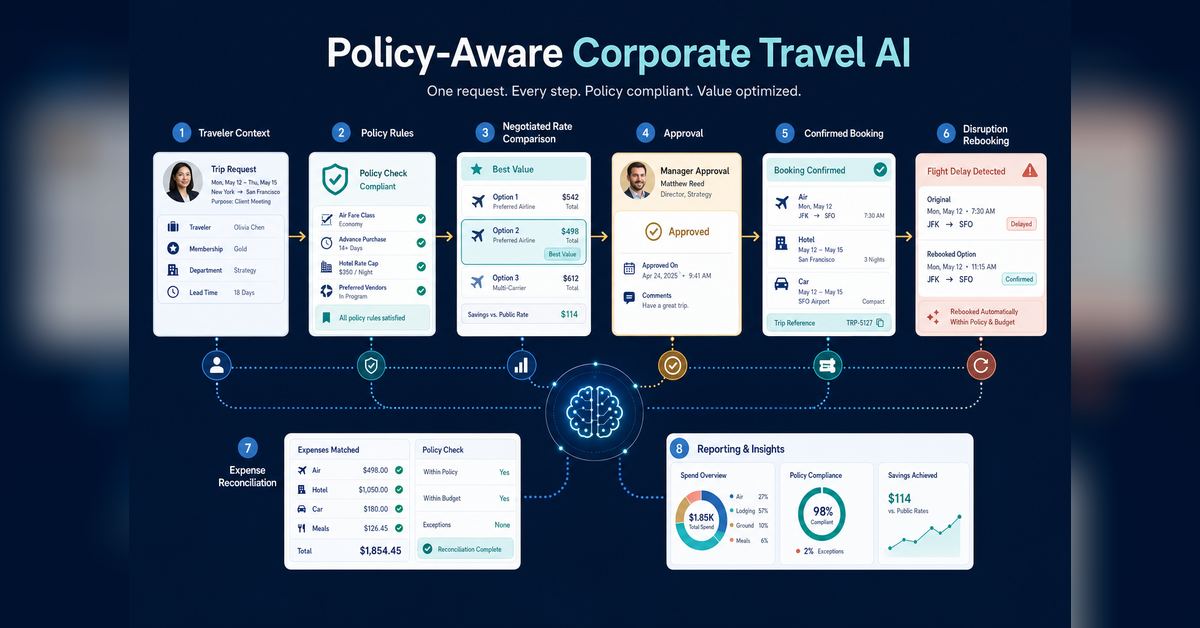

Understanding how generative ai improves corporate travel booking starts with the trip request, not the chatbot. The system must turn purpose, timing, preferences and constraints into policy-compliant options drawn from approved inventory and current rates.
The value appears when the assistant preserves context, explains trade-offs, routes approvals and supports the traveler when plans change. Generative AI should make corporate travel easier without making policy invisible.
Enterprise travel decisions require operating discipline and visible proof
Percepture has worked across travel, tourism, technology, public relations, search and AI visibility since 2004. The experience shown here supports market positioning and buyer education. It does not replace product-level evidence for policy compliance, savings or booking performance.





What makes a corporate travel AI assistant useful?
In direct terms, how generative ai improves corporate travel booking is by interpreting a business trip request, retrieving approved options, applying policy, explaining trade-offs and supporting permitted booking or rebooking actions. It can reduce repetitive work only when rates, rules, inventory, permissions, audit logs and human escalation are reliable.
Executive summary
Preserve trip purpose
Meeting time, location, accessibility, equipment and schedule flexibility should remain attached to the decision.
Keep policy deterministic
The generative layer may interpret policy, but approved rules, payment controls and approval limits should govern the action.
Compare equivalent rates
Taxes, fees, restrictions, benefits, cancellation terms and payment conditions belong in every rate comparison.
Explain recs
Employees and approvers should see why an option is compliant, preferred, blocked or routed as an exception.
Escalate risk
Ambiguous, high-cost, international, accessibility-related and high-risk trips need a clear path to trained people.
Measure outcomes separately
Savings, time reduction, compliance and traveler satisfaction are separate outcomes. One should not stand in for another.
For executives, how generative ai improves corporate travel booking is therefore an operating-system question: can the organization connect reliable sources, visible controls and accountable service around the traveler?
Who this guide is for
Travel and procurement
Evaluate policy adherence, supplier terms, rate assurance, leakage and service workflows.
Finance and expense
Define savings, reconciliation, payment controls, unused credits and evidence labels.
HR, privacy and risk
Set limits for employee data, accessibility, duty of care, retention and escalation.
Technology and platform leaders
Test retrieval, rules, integrations, write-back, auditability and failure recovery.
Each buyer should assess how generative ai improves corporate travel booking against the controls and outcomes that buyer owns, rather than relying on a single platform-level claim.
This guide focuses on the managed-booking workflow inside an enterprise travel program. Percepture’s omnichannel strategy work addresses connected decision journeys, while its generative engine optimization services address public AI-search visibility rather than booking-software architecture.

Generative AI is a decision layer, not the source of record
Generative AI in corporate travel booking is a conversational decision layer that interprets a trip request, retrieves approved inventory and rates, applies company policy, explains options, routes exceptions and supports authorized service actions.
This boundary clarifies how generative ai improves corporate travel booking: the model interprets and explains while governed systems retain authoritative policy, inventory and transaction records.
It is not a replacement for an online booking tool, travel management company, distribution system, expense platform or risk system. The booking assistant is only as reliable as the rates, rules and inventory behind it. The language model should not become the database of record.
| Capability | Main job | Control boundary |
|---|---|---|
| Generative AI | Interpret and explain | Cannot invent policy, rates or inventory |
| Machine learning | Predict and rank | Criteria and outcomes require monitoring |
| Rules engine | Enforce deterministic controls | Uses approved policy and approval logic |
| Retrieval | Access current information | Sources need ownership and timestamps |
| Agent workflow | Execute permitted actions | Confirmation, limits and reversal matter |
| Booking infrastructure | Confirm and service travel | Remains the transaction layer |
| Expense and risk systems | Reconcile spend and support duty of care | Require verified records and controlled access |
The safest architecture combines generative explanation with deterministic controls for policy, payment and approval. That distinction should also guide any broader strategy and planning process.
How generative ai improves corporate travel booking across the trip
Generative AI is most useful where several constraints must be balanced—not where a deterministic form already solves the task. The assistant can retain context as the request moves through search, approval, booking, service and expense. Evaluating how generative ai improves corporate travel booking therefore requires testing the complete trip workflow rather than an isolated response.
Benefit and control matrix
The matrix shows how generative ai improves corporate travel booking at each stage and identifies the control required before the potential improvement can be trusted.
| Booking stage | Potential improvement | Required control |
|---|---|---|
| Trip request | Converts natural language into structured requirements | Traveler confirms extracted details |
| Search | Combines schedule, policy and authorized preferences | Approved, current inventory |
| Comparison | Explains price, flexibility, time and trade-offs | Transparent terms and sources |
| Recommendation | Ranks options by traveler and program fit | Explainable criteria |
| Approval | Prepares exception rationale and routing | Named approver and preserved log |
| Booking | Reduces repeated entry and preserves context | Traveler confirmation and payment controls |
| Disruption | Finds alternatives without restarting the search | Permission limits and human escalation |
| Expense | Connects itinerary, card and receipt data | Reconciliation and review rights |
| Program review | Surfaces leakage and supplier patterns | Baseline, attribution and evidence labels |
Framework and comparison: how generative ai improves corporate travel booking
The Corporate Travel Policy-to-Trip AI System
Percepture’s nine-stage methodology maps an employee’s trip need to a compliant, serviceable and measurable booking. It gives buyers a practical way to test whether a polished assistant is connected to the operating controls behind it. Within this framework, how generative ai improves corporate travel booking can be evaluated through defined inputs, decisions and outputs rather than interface fluency alone.
- 1
Trip Need
Decision question: Why is the traveler going?
Required output: Trip Purpose Record
- 2
Traveler Context
Decision question: Which approved needs and preferences matter?
Required output: Context Profile
- 3
Policy Guardrails
Decision question: Which rules and approvals apply?
Required output: Policy Decision Map
- 4
Rate and Inventory Truth
Decision question: Which current options and terms apply?
Required output: Approved Offer Set
- 5
Recommendation
Decision question: Which options balance program and traveler needs?
Required output: Explainable Shortlist
- 6
Approval and Booking
Decision question: What may be confirmed, and by whom?
Required output: Auditable Booking
- 7
Trip Service
Decision question: How will changes and risk be handled?
Required output: Service and Escalation Plan
- 8
Expense and Reconciliation
Decision question: Does final spend match the trip?
Required output: Matched Transaction
- 9
Learning and Governance
Decision question: What should improve under control?
Required output: Program Decision Log
The generative layer may interpret and explain. It should not quietly override policy, negotiated terms, approval or safety controls. Organizations building connected customer and employee systems can apply the same discipline used in customer-journey analysis: preserve context, define handoffs and measure each decision point.
Test policy, data and permissions before automating booking
Use the framework as a readiness audit. Document the workflow, policy owner and version, rate sources, permissions, approvals, integrations, disruption rules, expense controls, privacy limits, baselines and pilot score. This audit establishes where and how generative ai improves corporate travel booking without bypassing operational ownership.
Plan a Corporate Travel AI Readiness ReviewA hypothetical policy-aware booking request
Consider this fictional request: “Book Newark to Chicago for a Tuesday 10 a.m. client meeting. Arrive Monday evening, stay near the meeting, remain within policy, use my preferred airline when practical and avoid a connection because I have presentation equipment.”
The assistant extracts the route, arrival deadline, meeting location, nonstop requirement, equipment, authorized airline preference, hotel geography, project code and approval status. It then retrieves current policy, approved inventory, applicable rates, fare and room terms, travel time and available risk information.
The shortlist should show compliance, total trip cost, schedule fit, flexibility, excluded alternatives, approval requirements and a timestamp. The traveler confirms all material details before ticketing. The model should not invent a negotiated rate, assume a meeting location or hide a restrictive fare to look cheaper.
This example shows how generative ai improves corporate travel booking without granting the model unrestricted authority. It structures and explains the decision while rules, source systems and people retain control.
Policy-aware booking must explain the rule
Policy compliance should be explained, not hidden behind a score. The canonical policy needs an owner, version, effective date, employee and region scope, deterministic rules, approvals, exceptions and emergency handling.
Policy personalization is not policy invention. Traveler preference is context—not permission to ignore policy. Employees should see which rule applies, whether an exception exists, who approves it, what the consequence is and which compliant alternative is closest.
A generated summary is not the policy’s system of record. Policy versions must be preserved for audit. These controls are part of how generative ai improves corporate travel booking for finance and risk teams, not just for the traveler.
Rates, savings and how generative ai improves corporate travel booking
Negotiated-rate auditing must compare equivalent terms. For hotels, that includes property, dates, occupancy, taxes, fees, cancellation terms, inclusions, loyalty eligibility and payment conditions. Air comparisons should account for schedule, fare restrictions, change terms, baggage and relevant trip constraints.
Reliable rate equivalence is fundamental to how generative ai improves corporate travel booking because recommendations are only useful when price and terms are compared on the same basis.
A lower fare is not a saving if it creates leakage, fees, lost productivity or traveler risk. The lowest line-item price is not always the lowest trip cost.
| Value category | What it means | Evidence needed |
|---|---|---|
| Displayed price | Difference between visible options | Equivalent search conditions |
| Negotiated-rate value | Contracted price plus included benefits | Current contract and eligible booking |
| Avoided fee | A change, cancellation or service fee not incurred | Applicable fee and recorded action |
| Productivity | Traveler or counselor time reduced | Role-specific baseline |
| Leakage reduction | Booking moved into a managed channel | Channel and booking records |
| Unused credit | Eligible credit applied or recovered | Matched credit and transaction |
| Total-trip value | Air, hotel, ground, time and risk considered together | Complete cost definition |
Label savings as observed, contracted, avoided, modeled or estimated. Do not claim spend reduction without a baseline and complete cost. Percepture’s approach to attribution and analytics is relevant here because value must be tied to a defined source and decision.
Traveler experience improves when work falls away
The assistant can reduce repeated search, policy lookup, profile entry, option comparison, approval explanation, basic support and expense coding. Measure that time separately for travelers, approvers, counselors, finance teams and program managers.
Traveler satisfaction improves when the assistant removes work without removing agency. It should preserve choice, explain recommendations, use only authorized preferences, support accessibility, avoid manipulative urgency and make correction easy.
That is how generative ai improves corporate travel booking at the employee level: fewer repeated steps, clearer choices and a handoff that carries the trip context forward.
Disruption rebooking and duty of care
- Detect the disruption and verify the affected traveler and itinerary.
- Preserve meeting, connection, accessibility, equipment and safety constraints.
- Retrieve policy-compliant alternatives from current sources.
- Show price, schedule and term changes before action.
- Act only within established permissions and confirmation limits.
- Escalate ambiguous, high-risk or high-cost decisions.
- Update itinerary and risk systems, notify the traveler and preserve the log.
Disruption support is valuable when the system can act within permissions and show what changed. Fast rebooking is not safe rebooking when constraints are lost. Duty of care requires verified traveler, itinerary and risk data, and it cannot depend on an itinerary the organization cannot verify.
The system should know when to escalate to a human travel counselor. High-risk or ambiguous situations should move to trained people with the request, constraints, policy result, considered options and attempted actions intact. This controlled continuity is another way how generative ai improves corporate travel booking.
Data architecture, expense and governance
A production system may need controlled access to traveler profiles, corporate policy, supplier contracts, booking inventory, approval workflows, payment data, expense records, project codes, risk information and analytics. Each source needs an owner, access rule and conflict policy. Those source relationships determine how generative ai improves corporate travel booking under real operating conditions.
| Layer | Purpose | Buyer test |
|---|---|---|
| Source systems | Hold canonical facts and transactions | Which system wins when data conflicts? |
| Retrieval | Finds policy, rate and service data | Are results current and attributable? |
| Rules | Enforces deterministic controls | Can the model override them? |
| Generative interface | Interprets requests and explains options | Can users inspect and correct details? |
| Agent workflow | Executes permitted actions | Which actions require confirmation? |
| Audit layer | Records sources, decisions and changes | Can reviewers reconstruct the booking? |
| Human service | Resolves ambiguity and risk | Does the full context transfer? |
Expense automation may prepopulate fields, connect card and booking data, reconcile changed trips, flag duplicates and identify out-of-policy items. It should reduce review work without turning an opaque score into a disciplinary decision. Employees need explanation and review rights.
Corporate travel AI should be governed like an operational system, not a marketing experiment. Data minimization, role access, policy versioning, source logs, incident handling, accessibility testing, retention rules and vendor-change review belong in the operating model.
No platform should claim end-to-end optimization without defining data sources, permissions, exceptions and audit logs. In this layer, how generative ai improves corporate travel booking depends more on integration quality than conversational polish. Related disciplines include enterprise web development and technical audit methodology, where source integrity and testable system behavior also matter.
Corporate Travel AI Readiness Score
A polished interface should score poorly when policy, inventory, write-back and escalation are unreliable. Use this 100-point planning score to identify the controls that should be repaired before deployment. The score turns how generative ai improves corporate travel booking into a review of operational readiness rather than a feature checklist.
| Readiness category | Points |
|---|---|
| Policy clarity and versioning | 15 |
| Traveler and profile data quality | 10 |
| Rate and inventory reliability | 15 |
| Booking and approval integration | 15 |
| Explainability and audit logs | 10 |
| Disruption and duty-of-care readiness | 10 |
| Expense and payment integration | 10 |
| Privacy, security and access controls | 10 |
| Human service and escalation | 5 |
- 85–100: Consider a controlled multi-workflow deployment.
- 70–84: Pilot after closing named gaps.
- 55–69: Limit the pilot to read-only or narrow workflows.
- Below 55: Repair policy, data and integration foundations first.
These are planning bands, not performance guarantees. They make how generative ai improves corporate travel booking measurable before a buyer commits to broader automation.
The Corporate Travel AI Value Ledger
The Value Ledger separates program value, traveler value and risk. Time saved is not automatically money saved. Policy compliance is not automatically traveler satisfaction. A recommendation can be compliant and operationally poor.
| Outcome | Example measure |
|---|---|
| Booking efficiency | Request-to-confirmation time |
| Support efficiency | Contacts avoided and escalation quality |
| Compliance | Compliant bookings and justified exceptions |
| Spend | Total-trip cost and preferred-rate use |
| Rate assurance | Equivalent-rate differences |
| Traveler experience | Satisfaction, abandonment and correction |
| Disruption | Time to suitable rebooking |
| Duty of care | Verified itinerary and response completion |
| Expense | Match rate, review time and duplicate flags |
| Risk | Incorrect answers, failed actions and reversals |
Evidence can be labeled observed, contracted, transaction-matched, avoided, modeled, estimated, traveler-reported or unknown. Report program value, traveler value and risk separately. That separation is essential when leadership evaluates how generative ai improves corporate travel booking.
A controlled 90-day pilot
- 1
Days 1–30: define
Choose one workflow and traveler population. Document policy, approvals, systems, rate access, permissions, escalation, privacy requirements, baselines and test journeys.
- 2
Days 31–60: recommend
Deploy request capture and read-only recommendations. Show rationale, require confirmation, route exceptions to people and log sources, decisions, speed and corrections.
- 3
Days 61–90: act carefully
Enable limited booking or rebooking. Test write-back, duplicate prevention, rate equivalence, policy outcomes, reversibility and human handoff before deciding to scale.
The pilot should prove a controlled booking decision—not merely a fluent answer. A focused pilot is the clearest way to test how generative ai improves corporate travel booking inside one real operating environment.
Build, buy or partner
Buy a product for a defined workflow. Build only when control, integration or differentiation justifies the burden. The right sourcing model for how generative ai improves corporate travel booking depends on required integrations, internal ownership and acceptable vendor dependence.
| Option | Potential strength | Primary buyer risk |
|---|---|---|
| Existing TMC or booking-tool feature | Closer to current workflow and inventory | Limited transparency or configuration |
| Corporate-travel AI platform | Purpose-built experience | Vendor and data dependence |
| Enterprise assistant | Broad employee access | Integration and governance burden |
| Custom build | Control over workflow and differentiation | Cost, maintenance and operational ownership |
| Integrated partner model | Cross-system design and measurement | Requires clear technical ownership |
Ask which systems supply policy and rates, which decisions are rules versus generative output, how rates are validated, how logs are preserved, which actions require confirmation, how disruptions escalate and how duplicate bookings are prevented. Also ask what employee data is retained, how savings are defined and what the provider does not guarantee. These answers reveal whether the provider can substantiate how generative ai improves corporate travel booking within the buyer’s environment.
Public visibility for a travel technology provider is a separate workstream. Buyers addressing that need can review Percepture’s enterprise SEO services, content marketing services and digital PR services. Supporting guides include corporate SEO, organic SEO services, enterprise SEO ROI and SaaS content marketing.
Common implementation mistakes
- Using stale inventory or generated policy summaries as authoritative sources.
- Allowing model output to override deterministic policy or payment rules.
- Comparing rates with different restrictions, benefits, fees or cancellation terms.
- Optimizing a line-item price while ignoring total trip cost and traveler time.
- Hiding recommendation criteria or collecting more employee data than the workflow needs.
- Operating without policy history, source logs, write-back controls or duplicate prevention.
- Allowing autonomous high-risk rebooking without confirmation and escalation.
- Leaving itinerary changes outside the duty-of-care record.
- Reporting savings without a baseline or using opaque fraud scores for disciplinary action.
- Launching an overbroad pilot before accessibility, privacy and failure recovery are tested.
The most expensive failure is a confident recommendation built from stale rates, incomplete policy or missing traveler context. Avoiding that failure is central to how AI improves corporate travel booking responsibly.
Percepture ranks for the categories travel technology buyers use to find AI-search expertise
The screenshots below document Percepture’s search visibility when captured. They establish experience in generative engine optimization, AI-search positioning and authority building. They are not evidence that a corporate travel platform produces savings, compliance or better booking outcomes.
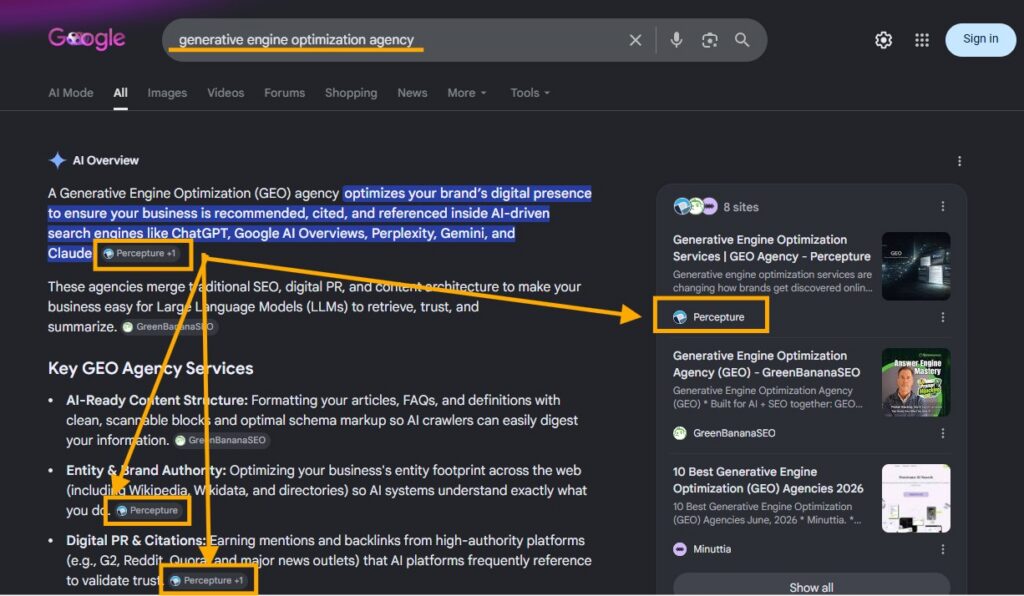
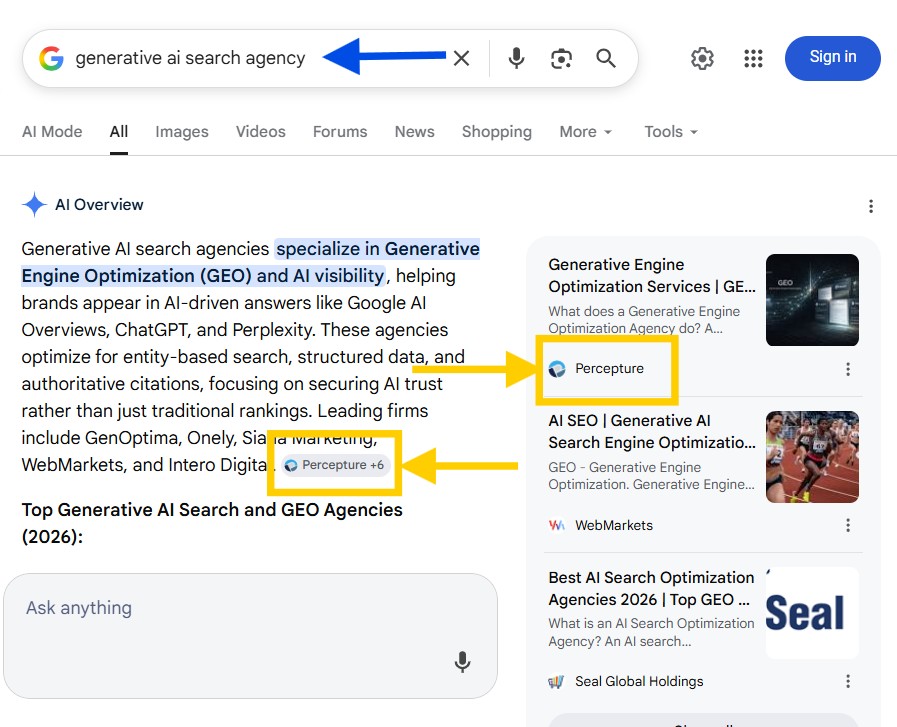
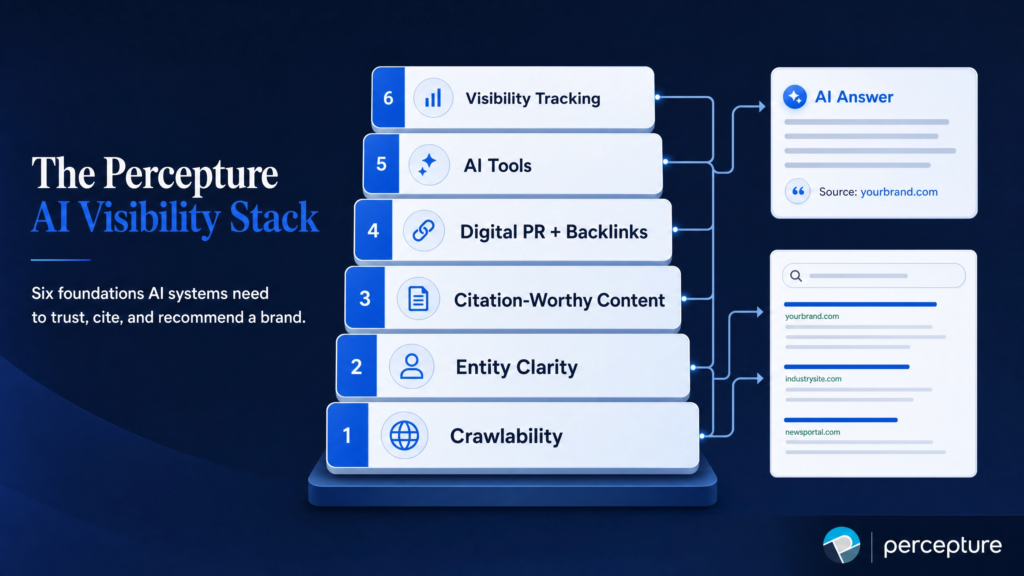
Why this matters: corporate travel technology providers still need buyers to discover, understand and trust the offer. Percepture’s ranking proof supports that public decision journey while the provider remains responsible for platform, policy and transaction evidence.
Travel authority is built through useful stories, third-party validation and measurable visibility
Percepture’s award-winning Amazon remote-delivery work shows how a complex travel story can become credible editorial coverage, search authority and sustained market attention. That campaign is not a corporate booking implementation, but it demonstrates the storytelling and distribution discipline required to make a travel technology offer understandable and memorable.

Frequently asked questions
How does generative AI improve corporate travel booking?
AI-enabled corporate travel booking is by turning a natural-language trip request into structured requirements, retrieving approved options, applying policy and explaining trade-offs. It can also prepare approvals, preserve context during disruption and connect booking data with expense workflows. The result depends on current inventory, deterministic controls, permission limits, audit logs and human escalation.
How can AI enforce corporate travel policy?
Within the managed-travel booking experience, AI should not invent or silently rewrite policy. A rules engine should apply the approved policy version, while the generative interface explains which rule applies, why an option is compliant or blocked, whether an exception is available and who can approve it. Policy ownership, effective dates and decision logs must remain visible.
Can AI find better negotiated rates?
Rate retrieval is one part of corporate travel AI when the system has authorized access to current rate and inventory sources. The comparison must use equivalent dates, terms, fees, restrictions, inclusions and payment conditions. A cheaper displayed price is not necessarily a better total-trip outcome.
How does AI reduce corporate travel booking time?
Reduced repetitive work is a practical example of how AI improves corporate travel booking. It can reduce repeated data entry, policy lookup, option comparison, exception explanations and basic support interactions. Measure time separately for travelers, approvers, counselors, finance teams and travel managers. Time saved should not automatically be reported as money saved.
Can generative AI rebook a disrupted business trip automatically?
Limited rebooking shows the corporate travel AI booking workflow only when the traveler is verified, the itinerary is current and permissions are explicit. The workflow should preserve meeting, accessibility, equipment and safety constraints; show price and term changes; prevent duplicate actions; and escalate ambiguous or high-risk decisions to a trained person.
How should corporate travel AI support duty of care?
Duty-of-care support is part of AI-enabled corporate travel booking, but it requires verified traveler and itinerary records, current risk information, controlled contact preferences, privacy safeguards and a human escalation path. The assistant should update connected itinerary and risk systems after permitted changes. A generated answer alone is not a verified duty-of-care record.
Will AI replace corporate travel counselors?
The managed-travel booking experience does not depend on replacing counselors. AI can handle structured requests, comparisons and routine service steps, but human counselors remain important for complex international, VIP, group, accessibility, disruption, dispute and high-risk trips. A strong handoff transfers the request, constraints, policy result, considered options and attempted actions instead of making the traveler start over.
What should buyers ask a corporate travel AI vendor?
To verify corporate travel AI, ask which systems supply policy, rates and inventory; which decisions are deterministic; how rate terms are validated; what actions require confirmation; how logs and policy versions are preserved; how duplicate bookings are prevented; how employee data is retained; how disruptions escalate; and how savings, compliance and errors are measured.
Make the corporate travel AI offer easier to find, understand and trust
Percepture can evaluate the public decision journey around a corporate travel AI product: search visibility, AI-answer presence, expert authority, proof architecture, conversion paths and measurement. The review does not replace platform due diligence. It makes the provider’s strongest evidence easier for the right buyers to discover and evaluate.
What the review covers
- Search and AI-answer visibility
- Entity, expert and proof clarity
- Content and digital PR opportunities
- Conversion and attribution gaps