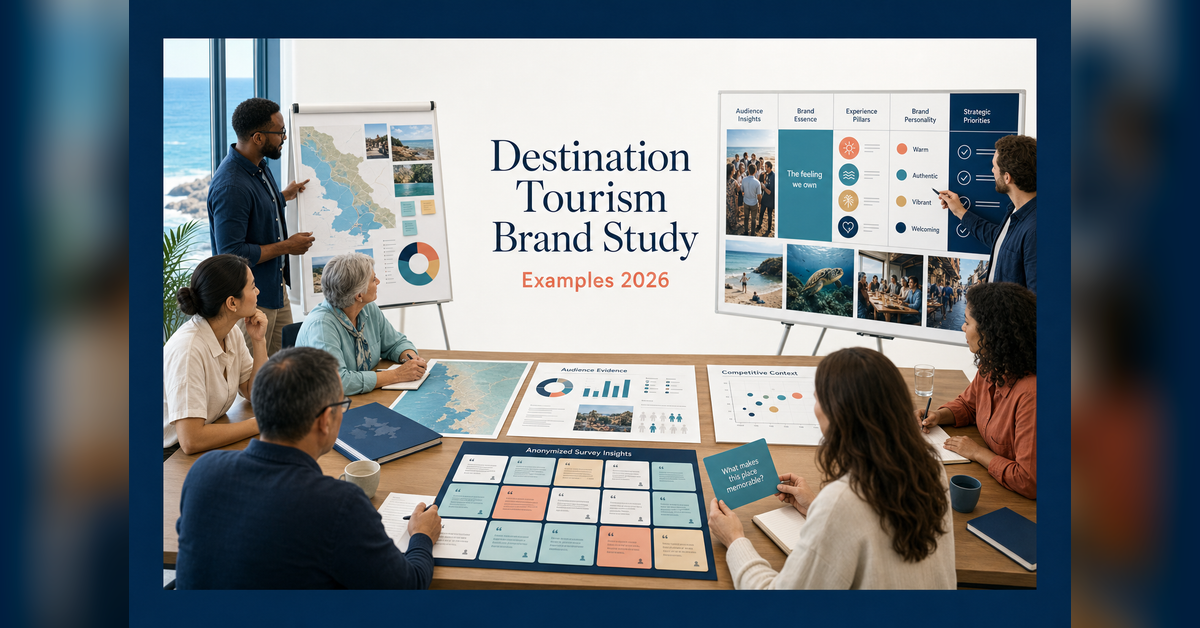

Destination tourism brand study examples 2026 show how destinations use resident, stakeholder, traveler and competitive research to define a credible place promise before developing a tagline or visual identity. Strong studies end with decisions, proof, partner tools, governance and a practical way to measure change.
Useful examples are not merely memorable slogans. They show how evidence became a positioning choice, how concepts were tested and how residents and partners could deliver the promise.



What is a destination tourism brand study?
A destination brand study uses resident, stakeholder, traveler, nonvisitor and competitive evidence to define what a place can credibly promise, which audiences it should prioritize and how the brand should be expressed, activated and measured.
In direct terms, destination tourism brand study examples 2026 should reveal the research decision behind the identity, not just the finished campaign. A destination brand study is not a logo project.
What a destination tourism brand study includes
Decision first
State why the study exists, which decisions it must support and who holds approval rights.
Audiences separated
Analyze residents, partners, visitors, nonvisitors and leaders as distinct groups rather than blending their views.
Place truth protected
Connect every proposed promise to experiences, assets, behaviors or operating capabilities the destination can demonstrate.
Strategy tested
Compare comprehension, credibility, differentiation, attribution, motivation and unintended meanings.
Partners equipped
Provide messages, proof, tools, applications and decision rights that tourism partners can use.
Change measured
Establish a baseline and track perception, adoption and behavior without overstating causality.
A campaign may express the brand, but it does not define the brand. A memorable tagline cannot repair weak place truth. That distinction keeps destination tourism brand study examples 2026 focused on strategic evidence rather than creative display.
Brand study vs. audit, perception study and rebrand
Use this comparison to interpret destination tourism brand study examples 2026 and prevent a visual-identity assignment from being mistaken for research.
| Work type | Main question | Primary output | Does not prove |
|---|---|---|---|
| Brand audit | Is the current system consistent? | Asset and message audit | Market relevance |
| Perception study | How is the place perceived? | Awareness and association findings | A complete brand platform |
| Destination brand study | What can the place credibly own? | Evidence, positioning and activation rules | Campaign performance |
| Rebrand | Should the identity change? | Refreshed verbal or visual system | Research quality |
| Concept test | Which expression communicates best? | Comparative concept evidence | Long-term behavior |
| Campaign test | Which activation performs? | Creative and media learning | Core-brand validity |
| Brand tracker | Are perceptions changing? | Repeated measures | Causality by itself |
A logo refresh can be part of a destination brand study, but a logo refresh is not the study. Buyers should classify destination tourism brand study examples 2026 by the decision and evidence each assignment actually contains.
Why destination branding is different
A destination is marketed centrally but delivered through residents, businesses, public space, service, access, infrastructure, media and reviews. A destination brand is a shared promise that no organization completely controls.
Residents are part of the destination product, not merely a focus group. Resident license is not unanimous resident approval, but the study must account for the people who experience tourism’s benefits and burdens.
Stakeholder agreement is useful, but forced consensus can erase distinction. Research should expose trade-offs, not average them away. The promise must survive the visitor experience, and the study should reveal where the destination is ready and where promotion would overpromise. Credible destination tourism brand study examples 2026 make those delivery constraints visible before identity development begins.
Explore Hunterdon: research to activation
Percepture’s internal case material documents marketplace evaluation, guided workshops, structured exercises and consensus building. The work developed an essence, promise, personality, values, mission, vision and brand book, then connected those decisions to identity, content and activation.
Discover
Evaluate the marketplace, conduct guided stakeholder work and identify evidence about the destination and its audiences.
Define
Translate the findings into the essence “Unplug & Reconnect,” the promise “Get away to it all!” and the tagline “The Other Side of Jersey.”
Activate
Apply the platform through a refreshed identity, audience-informed content strategy and integrated tourism marketing.
The example shows how discovery and platform decisions informed identity, content and activation. Reported campaign figures belong to the integrated campaign after the brand work. They do not prove that the research or tagline alone caused visitation or economic impact.
Do not call campaign impressions proof that the brand itself is correct. Applied to destination tourism brand study examples 2026, this rule keeps research evidence separate from downstream campaign reporting.
Tourism strategy and integrated marketing experience
Destination branding, tourism research and integrated travel marketing experience since 2004. Percepture connects the strategic decision to the channels, partners and proof required to activate it.
The Destination Truth-to-Brand Study System
The Destination Truth-to-Brand Study System is Percepture’s nine-stage method for moving from place truth to a destination promise residents, partners and travelers can use. It provides a decision framework for evaluating destination tourism brand study examples 2026 without reducing the work to creative preference.
| Stage | Decision | Output |
|---|---|---|
| 1. Mandate | Why is the study happening? | Decision Charter |
| 2. Place Truth | What is true and deliverable? | Place-Truth Inventory |
| 3. Resident and Partner Evidence | What has license and support? | Stakeholder Evidence Map |
| 4. Traveler and Market Evidence | What creates relevance? | Perception and Market Map |
| 5. Competitive Context | Which territory is available? | White-Space Map |
| 6. Brand Platform | What should the place stand for? | Positioning, Essence and Promise |
| 7. Concept Testing | Which expression works and why? | Validated Direction |
| 8. Activation and Governance | How will the shared brand be used? | Toolkit and Decision Rights |
| 9. Measurement and Refresh | What change will be tracked? | Tracker and Refresh Rules |
No destination brand platform should be approved without a place-truth inventory, respondent map, concept test, partner activation plan and measurement owner. The best study ends with decisions, owners, proof and activation rules. Use those outputs to distinguish complete destination tourism brand study examples 2026 from partial audits or campaign assignments.
Turn a rebrand request into a research and decision brief
Use the destination tourism brand study examples 2026 framework to document the decision charter, place truths, respondents, methods, questions, competitors, deliverables, testing, partner activation, governance and KPIs.
Build a Destination Brand Study BriefChoose the right research methods
Good tourism research combines methods because each answers a different question. Use qualitative work to understand meaning, quantitative work to estimate prevalence and behavioral evidence to test whether stated perceptions align with action. Method transparency is essential when destination tourism brand study examples 2026 are used to compare potential providers or scopes.
| Method | Best use | Main risk |
|---|---|---|
| Leadership interviews | Mandate, history and decision rights | Executive bias |
| Stakeholder interviews | Operational truth and partner needs | Loud voices dominate |
| Resident survey | License, impacts and place associations | Unrepresentative sample |
| Visitor survey | Experience, awareness and associations | Current-visitor bias |
| Nonvisitor research | Barriers, alternatives and weak awareness | Low familiarity |
| Focus groups | Language and emotional depth | Group conformity |
| Workshops | Alignment and structured decisions | Consensus mistaken for evidence |
| Review and social analysis | Natural language and experience friction | Platform bias |
| Search and AI analysis | Planning questions and visibility gaps | Demand mistaken for permission |
| Competitive audit | Sameness, claims and white space | Copying peers |
| Concept testing | Compare strategic expressions | Testing taste instead of fit |
| Brand tracking | Measure change over time | Attribution overclaim |
Score destination tourism brand study examples 2026 on whether each selected method answers a defined decision and whether its limitations are disclosed.
A minimum credible design includes leadership or stakeholder interviews, resident input, visitor or priority-market input, a competitive and communications audit, facilitated synthesis, concept validation and documented limitations. That mix makes destination tourism brand study examples 2026 more useful to procurement teams.
Decide who should participate
The respondent plan should represent the people who deliver, experience, benefit from and bear the costs of tourism. Include a decision group, experience-delivery partners and market respondents such as visitors, lapsed visitors, nonvisitors and planners.
Represent different geographies and community types. Include informed critics. Disclose recruitment, sampling and weighting, distinguish qualitative direction from population estimates, protect privacy and record which voices remain missing. Those disclosures let buyers judge whether destination tourism brand study examples 2026 reflect the audiences affected by the resulting promise.
Decision group
Board members, public leaders, DMO executives and the people with approval or funding authority.
Experience delivery
Residents, lodging, attractions, restaurants, transportation, events, accessibility stakeholders and frontline teams.
Market evidence
Visitors, lapsed visitors, nonvisitors, meeting planners and priority audience segments.
When comparing destination tourism brand study examples 2026, confirm that all three respondent groups have a defined role in evidence gathering, decision-making or validation.
Ask better destination-brand questions
Questions should uncover truth, distinction, barriers, trade-offs, promise and readiness. In destination tourism brand study examples 2026, the strongest question sets connect each audience to a decision rather than collecting broad opinions.
- Leadership: What decision must this study support? What has changed? Which outcomes matter? Who has final rights?
- Residents: Which experiences feel authentic? What tourism impacts matter? Which stereotypes are inaccurate? Which promise could the place responsibly make?
- Partners: Where does the current brand fit or fail? What capacity gaps create expectation risk? What proof and tools would help?
- Visitors and nonvisitors: What comes to mind? Which alternatives are considered? What creates a barrier? What feels distinct enough to motivate a visit?
- Concept-test participants: What does the idea mean? Which place does it suggest? Is it credible, motivating, usable and inclusive?
Do not ask only which logo or tagline people like. Preference is not strategic fit.
Map place truth and perception gaps
| Status | Meaning | Decision |
|---|---|---|
| True and recognized | An existing strength is already associated with the place. | Protect and amplify |
| True but underrecognized | The place can prove the attribute, but the market does not readily see it. | Prove and communicate |
| Desired but not yet true | The idea is appealing, but the experience cannot consistently deliver it. | Build before promoting |
| Perceived but inaccurate or undesirable | A reputation gap affects consideration or expectations. | Correct with evidence and experience |
The most valuable brand territory is often true but underrecognized. Preserve minority risks, distinguish frequency from importance, show contradictions and connect every platform recommendation to an evidence ledger. Destination tourism brand study examples 2026 should show how those gaps changed the positioning decision.
Define study deliverables
The platform must be usable by partners, not just admired by the board. Destination tourism brand study examples 2026 should state which deliverables are required and which depend on scope.
| Deliverable | Purpose | Typical scope status |
|---|---|---|
| Research report | Document methods, findings, limitations and decisions | Required |
| Perception-gap map | Separate truth, perception and opportunity | Required |
| Audience priorities | State whom the destination chooses to serve | Required |
| Positioning, essence and promise | Define central meaning and commitment | Required |
| Proof and message architecture | Connect claims to evidence and audiences | Required |
| Partner toolkit | Enable practical adoption | Required |
| Activation roadmap and governance | Sequence rollout and assign decision rights | Required |
| Measurement baseline | Establish brand and behavior indicators | Required |
| Name or tagline | Create verbal expression when the mandate requires it | Optional |
| Visual identity | Create or refresh the design system | Optional |
| Website implementation | Apply the platform to the digital experience | Optional |
A brand book without activation and governance is documentation, not adoption. Not every study requires a new name, tagline or visual identity. Complete destination tourism brand study examples 2026 connect required deliverables to owners, approvals and practical partner use.
Test positioning, messages and identity
Validate the research synthesis before testing expressions. Then compare positioning, promise, messages, verbal and visual concepts, partner usability and pilot activation with residents, visitors, nonvisitors, partners and accessibility reviewers. Destination tourism brand study examples 2026 should state what was tested, with whom and against which criteria.
The winning concept is not automatically the most liked concept. A concept can be distinctive and strategically wrong. Do not revise every edge out of the platform to maximize average preference.
Measure comprehension, credibility, differentiation, attribution, motivation, usability, resident license and unintended meanings. This testing discipline separates rigorous destination tourism brand study examples 2026 from galleries of attractive creative.
Review destination tourism brand study examples 2026
Examples are useful when they reveal a research or governance decision—not merely an attractive identity. The safest comparison separates completed platform work, campaign activation, operating proof and projects that have not produced mature outcomes. For that reason, destination tourism brand study examples 2026 should be categorized by evidence type before outcomes are compared.
| Example type | What buyers should inspect | Limitation to record |
|---|---|---|
| Explore Hunterdon | How marketplace evaluation and stakeholder work became essence, promise, identity, content and activation | Later campaign results do not isolate the effect of research or tagline choices |
| Completed destination platform | Research design, evidence ledger, positioning decision, partner tools and governance | A launch does not establish long-term outcomes |
| Concept-testing program | Comprehension, attribution, credibility, emotional response and comparative fit | A method example is not a complete brand study |
| Long-running platform | How a stable promise supports changing campaign expressions | Longevity alone does not prove optimality |
| Operational place proof | How accessibility, service, infrastructure or product delivery supports a promise | Operational proof is not necessarily a rebrand |
| Public procurement project | Scope, respondents, methods, website implications, approvals and ownership | An announced project is not a completed success |
This scorecard prevents destination tourism brand study examples 2026 from being ranked by visual appeal when their scopes and evidence differ.
Build partner adoption and governance
Partner adoption is a product requirement of the study, not a communications task added after launch. A destination platform may sit above towns, districts, lodging, attractions, events, culinary or outdoor initiatives, meetings, sports and state or national brands. Destination tourism brand study examples 2026 should therefore document brand architecture and decision rights, not only launch materials.
| Architecture | Use | Risk |
|---|---|---|
| Master brand | One primary identity | Local identities may feel erased |
| Endorsed brand | Local brands receive visible support | Endorsement may become inconsistent |
| Family of brands | Related identities serve distinct needs | Complexity increases |
| Campaign platform | Shared expression without identity replacement | The platform may have a short life |
| Thematic initiative | Food, outdoor, meetings or another focused offer | The initiative may be confused with the master brand |
Ask whether partners can explain and prove the promise, use the toolkit, preserve local identity, obtain approvals and build referrals or itineraries. Apply the same questions to destination tourism brand study examples 2026 before treating partner participation as adoption. Support activation through an integrated omnichannel marketing system, not a one-time launch.
Write a stronger destination-brand RFP
A proposal should explain how decisions will be made, not merely list workshops and deliverables. Procurement teams reviewing destination tourism brand study examples 2026 should require the mandate, existing evidence, respondents, markets, methods, sampling, accessibility, competition, testing, digital implications, governance, timeline, ownership and budget assumptions.
Ask providers how they separate truth from preference, resolve conflicting evidence, test concepts, report limitations and enable partner use. Evaluation should favor a defensible method over the largest workshop count. Relevant destination tourism brand study examples 2026 should support those method claims with visible outputs rather than unexplained creative.
Research design can be supported by Percepture’s strategy and planning services and customer journey work. The resulting message system can then connect to content marketing, public relations and digital PR. This sequence helps procurement teams interpret destination tourism brand study examples 2026 as connected research, strategy and activation assignments.
Estimate timeline, scope and investment drivers
Planning ranges are more useful than a universal promise. A focused diagnostic may take 8–12 weeks; a full destination brand study may take 4–6 months; study plus identity and partner tools may take 6–9 months; and a complex regional or international program may require 9–12 months or more.
These are illustrative planning ranges, not industry standards. Markets, recruitment, languages, public meetings, identity scope, website work, concept testing and approvals affect the schedule. A shorter schedule should reduce scope explicitly, not compress research and approval until the study becomes performative. Timeline comparisons across destination tourism brand study examples 2026 are meaningful only when those scope drivers are visible.
What drives destination brand-study cost?
| Cost driver | Why it matters | Procurement response |
|---|---|---|
| Markets and sample | More audiences and geographies increase recruitment and analysis | Define priority and comparison markets |
| Research methods | Surveys, interviews, groups and behavioral analysis require different resources | Price methods separately |
| Languages and accessibility | Translation, interpretation and accessible testing expand the work | State requirements in the RFP |
| Naming and identity | Creative development and legal screening extend scope | Separate strategy from creative pricing |
| Partner tools and website | Implementation can exceed the study itself | Define applications and technical dependencies |
| Tracking | A baseline and repeated measurement require ongoing design | Price the baseline and tracker separately |
Destination tourism brand study examples 2026 should disclose scope before buyers compare fees. Require separate pricing for research, strategy, creative, testing and activation.
Destination brand study readiness score
| Category | Points |
|---|---|
| Mandate and decision | 10 |
| Research design | 15 |
| Resident and stakeholder representation | 15 |
| Traveler and market evidence | 10 |
| Competitive and cultural context | 10 |
| Place truth and proof | 10 |
| Concept testing | 10 |
| Partner usability | 10 |
| Governance | 5 |
| Measurement and refresh | 5 |
- 85–100: Ready to commission or advance.
- 70–84: Proceed after resolving named gaps.
- 55–69: Conduct a focused diagnostic.
- Below 55: Clarify the mandate and evidence first.
These are planning bands, not industry standards. A destination is not ready for a rebrand merely because its visual identity feels dated. Use the score to compare destination tourism brand study examples 2026 on decision readiness, not design polish.
Measure brand change
Track awareness, associations, relevance, differentiation, credibility, consideration, attribution, resident license, partner adoption, qualified site use, referrals, branded search, visitor mix, seasonality and economic value where evidence is available.
Label evidence as observed, surveyed, platform-attributed, partner-reported, modeled, assisted, experimental or unknown. Brand tracking measures change; it does not automatically prove cause. Campaign performance can validate an expression without proving the entire platform. Measurement claims in destination tourism brand study examples 2026 should retain those evidence labels and attribution limits.
Collect a prelaunch baseline wherever possible. Connect the measurement design to attribution and analytics and use data visualization to make limitations visible. Refresh when truth, markets or strategy change—not because a calendar says five years.
Start the study in 90 days
Days 1–30
Create the decision charter, inventory research and assets, map respondents and approvals, choose methods, define privacy and ownership, and establish baseline measures.
Days 31–60
Conduct interviews and workshops, field resident and market research, analyze search, media and reviews, audit competitors, and map place truths and perception gaps.
Days 61–90
Develop evidence-backed positioning territories, identify proof gaps, test early directions and define partner, governance and tracking requirements.
Ninety days can create a defensible strategic direction; it should not bypass representative research, testing or public approval. Use destination tourism brand study examples 2026 to sequence the work, not to justify skipping a required stage.

Avoid common destination brand-study mistakes
The study fails when it produces attractive language the destination cannot consistently prove or use. Watch for these failures when evaluating destination tourism brand study examples 2026:
- Beginning with logo preference or copying a famous slogan.
- Asking only tourism partners and excluding residents, nonvisitors or informed critics.
- Treating workshops as market research or hiding survey recruitment and sample limits.
- Forcing consensus instead of documenting meaningful trade-offs.
- Choosing the most liked concept without testing credibility, attribution and usability.
- Overpromising destination attributes or ignoring accessibility and resident burden.
- Skipping competitive traveler-choice research and the perception-gap model.
- Failing to define a “not us” boundary, partner toolkit or approval system.
- Publishing private research or leaving data ownership unresolved.
- Using AI-generated concepts without place evidence.
- Calling an announced rebrand a successful case.
- Confusing campaign performance with proof that the underlying brand is correct.
Reject destination tourism brand study examples 2026 that conceal these weaknesses behind polished identity applications or unsupported outcome language.
Why Percepture has a point of view
Destination work must connect brand decisions to the visitor economy. Percepture approaches the assignment through destination branding and stakeholder alignment, tourism visibility and content activation, and measurement across search and partner pathways. That operating view shapes how Percepture assesses destination tourism brand study examples 2026.
Brand and alignment
Define the place truth, audience priorities, promise, proof and decision rights.
Visibility and activation
Connect the platform to content, PR, digital channels and partner use.
Measurement pathways
Separate brand tracking, channel performance and reported outcomes.
Explore Percepture’s travel and tourism experience, enterprise SEO and GEO services for the systems that support discovery after the platform is defined. These systems help translate lessons from destination tourism brand study examples 2026 into governed activation and measurable pathways.
Connect the study to destination activation
This guide explains the evidence and decisions behind a destination brand. Use destination tourism brand study examples 2026 to define that platform before selecting channel tactics. For channel-specific planning, review Percepture’s guides to hotel SEO agency selection, hotel PPC agency evaluation, technical SEO for hotels and hotel SEO strategy.
Destination brand study FAQs
What is a destination tourism brand study?
A destination brand study identifies the credible promise, market relevance and activation rules behind a destination identity. It combines place evidence with resident, partner, visitor, nonvisitor and competitive research, then converts the findings into positioning, proof, messages, tools, governance and a measurement baseline. Destination tourism brand study examples 2026 should make that full chain of evidence and decisions visible.
How is a destination brand study different from a rebrand?
A study determines what the destination can credibly own and how that conclusion is supported. A rebrand changes verbal or visual expression. A rebrand may follow the study, but it does not demonstrate that the research was representative or that the resulting promise is deliverable. When reviewing destination tourism brand study examples 2026, confirm whether the assignment established strategy or only changed its expression.
Which research methods should a DMO use?
Combine qualitative, quantitative and behavioral evidence. A credible design generally includes interviews, resident input, visitor or market input, competitive analysis, facilitated synthesis and concept validation. The exact mix should follow the decision, audience and geographic scope rather than a fixed method count. Compare destination tourism brand study examples 2026 by method fit and disclosed limitations, not by the number of research activities.
Who should participate in destination brand research?
Include residents, tourism partners, public leaders, visitors, lapsed visitors, nonvisitors and people who deliver the experience. The sample should account for geography, community type and informed critics while clearly disclosing recruitment, weighting, privacy protections and missing voices.
Should nonvisitors be included?
Yes, when the study must understand weak awareness, travel barriers or competing choices. Current visitors can explain the delivered experience, but they may not reveal why priority audiences reject or overlook the destination. Nonvisitor findings should still be interpreted in light of their familiarity with the place.
What deliverables should result from the study?
Core deliverables should include findings, a perception-gap map, audience priorities, positioning, promise, proof, messages, partner tools, governance, activation rules and a measurement baseline. Naming, tagline development, identity and website implementation are optional components that depend on the approved scope. Destination tourism brand study examples 2026 should clarify which of those outputs were included and who owns their implementation.
How long does a destination brand study take?
A focused diagnostic may take 8–12 weeks, while a full study may take 4–6 months. Study, identity and partner-toolkit work may take 6–9 months, with complex regional programs taking longer. These are planning ranges; recruitment, languages, testing and approvals materially affect timing.
How should destination tourism brand study examples 2026 be evaluated?
Evaluate destination tourism brand study examples 2026 by inspecting the mandate, respondent map, research methods, perception gaps, positioning decision, concept testing, partner tools, governance and measurement plan. Separate completed work from announcements, campaign results from brand validity and long-running platforms from evidence of optimality.
What affects destination brand-study cost?
Cost depends on the number of markets, sample design, recruitment, methods, languages, accessibility work, concept testing, naming, identity, partner tools, website scope and tracking. Ask providers to price research, strategy, creative, testing and activation separately instead of presenting one unexplained total.
How should a DMO measure the brand?
Track awareness, associations, relevance, differentiation, credibility, consideration, resident license, partner adoption and selected behaviors against a baseline. Label whether evidence is observed, surveyed, attributed, partner-reported or modeled. Tracking shows change over time but does not automatically establish cause.
Build a Destination Brand Study You Can Defend
Use the destination tourism brand study examples 2026 framework to bring the mandate, evidence, respondent plan, testing approach and activation requirements into one review. Percepture can identify where the scope is ready, where it is unclear and where the proposed promise still lacks proof.
Request a Destination Brand Study Review
About Bob Generale
Bob Generale is President of Percepture. He develops evidence-led destination marketing systems that connect place truth, stakeholder alignment, traveler demand, search visibility, public relations, content, paid media and measurement. His work focuses on turning strategy into a platform that boards, partners and travelers can understand and use.