

Telecom Conference Marketing is expensive when the team treats the event as a booth, a badge scanner, and a stack of disconnected follow-up emails. The commercial stakes are simple: if the right accounts are not targeted before the show, captured during the show, and routed after the show, the event becomes activity instead of pipeline.
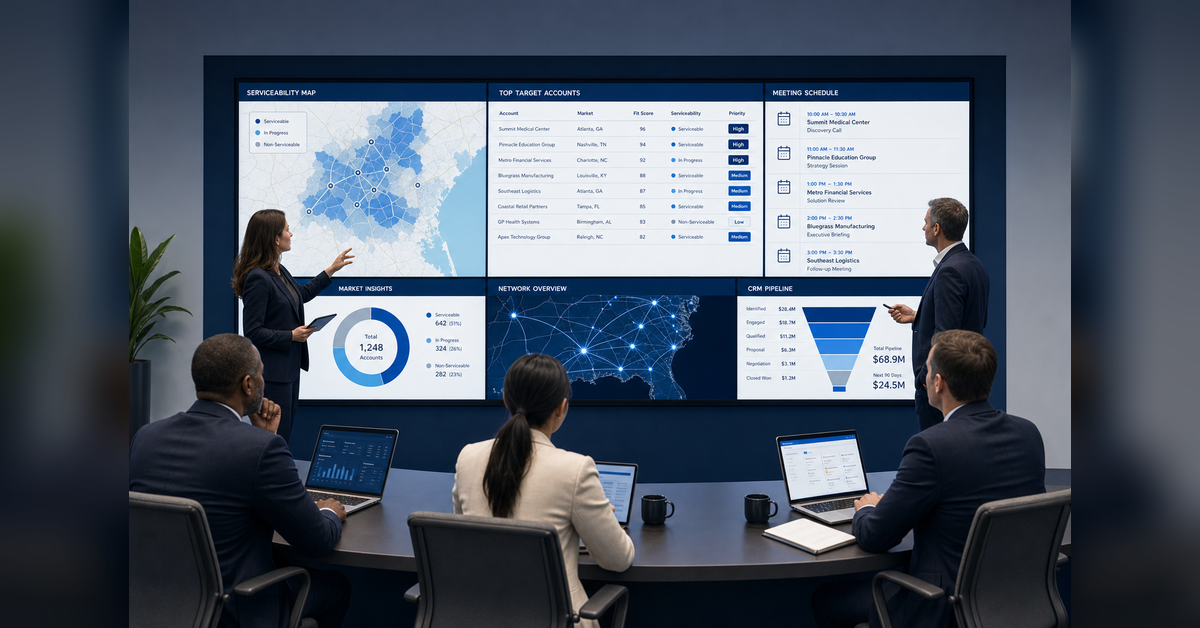
Percepture views this work differently. This is not generic event promotion; it is serviceability-aware market conditioning, where ISP marketing starts with the network, proof comes before pitch, and every campaign respects where the company can actually sell.




What is Telecom Conference Marketing?
Telecom Conference Marketing is the process of connecting serviceable markets, buyer intent, proof, search visibility, and sales follow-up into a measurable pipeline system. Strong programs do not start with channels. They start with where the ISP can serve, who is most likely to buy, what proof the buyer needs, and how fast sales can respond.
Executive summary for leadership
Start before the event
For Telecom Conference Marketing, build a named-account list, score it by serviceability and fit, then run meeting-setting, search, LinkedIn, email, and PR support before the floor opens.
Capture useful intent
Badge scans are not enough. Capture role, account, location, need, urgency, product fit, and consent path so sales can route the lead.
Use proof assets
Trust Tokens such as case studies, explainers, executive quotes, and credible search results make the conversation easier for sales.
Follow up by priority
Route hot meetings quickly, nurture research-stage contacts, and retarget accounts that showed intent but did not book time.
Measure business outcomes
Track qualified leads, meetings booked, address checks, pipeline value, speed-to-lead, install conversion, and AI-answer visibility checks.
Who this guide is for
CEO and CRO
Use this guide if the event budget must connect to market expansion, enterprise pipeline, partner conversations, or retention.
VP Marketing
Use it to align Telecom Conference Marketing with omnichannel marketing, PR, SEO, paid media, retargeting, and conversion paths around the same account list.
Sales and business development
Use it to define what qualifies as a meeting, what data must enter the CRM, and what sales should say after the event.
Sponsor and event teams
Use it to make the booth, landing page, QR path, speaking activity, and post-show follow-up work as one system.
This page is not for companies looking for broad untargeted media buying, generic social posts, or channel-first activity that ignores serviceable markets. An ISP cannot sell everywhere. Marketing where the network cannot sell wastes spend and can break trust.
Audit your next event-to-pipeline plan
If your next Telecom Conference Marketing plan already has a sponsor package, meeting list, or booth plan, Percepture can review the path from account targeting to follow-up. The goal is to find leakage before the team is on-site.
Audit your next event-to-pipeline planWhat Telecom Conference Marketing should do
Telecom Conference Marketing should build demand before the event, capture intent during the event, and convert conversations into traceable post-event action. A good program answers five direct questions: who should we meet, why should they trust us, what should they do next, who owns follow-up, and how will leadership know if the spend worked?
For an ISP, the answer begins with the network. Fiber passings are not revenue. A conference lead only matters if the account, location, buying need, and route-to-sale make sense. That is why ISP marketing agency strategy has to respect serviceability, product fit, and operational reality.
The strongest Telecom Conference Marketing pages and campaigns do not just say the company will be at ITW, PTC, or Metro Connect. They condition the market before the show with search visibility, executive positioning, proof assets, and clear meeting paths. Then they keep that demand warm after the event with email, LinkedIn, paid search, retargeting, and sales routing.
Why booth traffic is not the same as pipeline
Booth traffic can look busy and still fail. A badge scan may tell the team that someone stopped by. It usually does not tell the team whether the buyer is in a serviceable market, has budget, has urgency, or has authority.
The weak program counts scans, giveaway entries, and generic email opens. The strong Telecom Conference Marketing program connects each conversation to an account, business problem, serviceable location, buying committee, content path, and CRM owner. That is the difference between event lead generation and a conference-to-pipeline strategy.
Leadership should ask a practical question before approving spend: what will happen to the account list after the lights come down? If the answer is a newsletter blast and a sales spreadsheet, the event plan is not ready.
“The mistake is treating ISP marketing like normal demand generation. It is not. The first question is not what channel to use. The first question is where the network can sell, what the market already believes, and what proof is needed before a buyer takes the next step.”
Bob Generale, President, Percepture
The Telecom Conference-to-Pipeline Engine
The Telecom Conference-to-Pipeline Engine is Percepture’s framework for turning a telecom event into targeted demand, captured intent, trusted follow-up, and measurable sales movement. It connects network reality, buyer research, Trust Tokens, the Golden Triangle of organic search, AI answers, and third-party proof, then routes every serious conversation to the right next step.
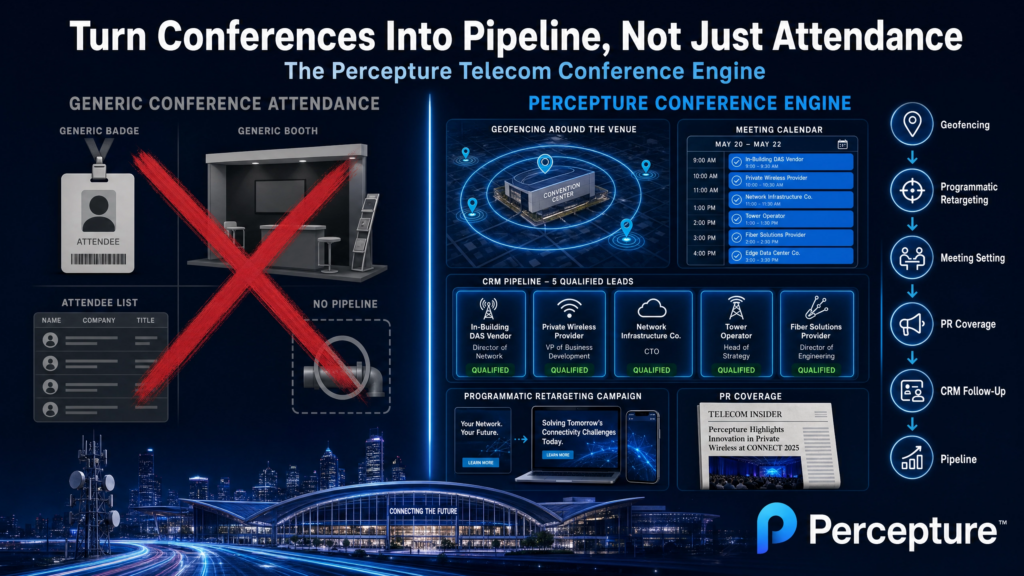
How the engine works
1. Serviceability map
Owned by leadership and operations. In Telecom Conference Marketing, define where the company can sell, what products fit, and which locations should not receive spend.
2. Account targeting
Owned by marketing and sales. Build the named-account list using fit, intent, event attendance, partner value, and revenue potential.
3. Trust Token buildout
Owned by marketing, PR, and subject matter experts. Prepare proof assets, landing pages, media angles, explainers, case links, and executive talking points.
4. Meeting-setting and activation
Owned by sales, sponsor teams, and marketing operations. Use email, LinkedIn, search, retargeting, and event pages to book the right meetings.
5. On-site capture
Owned by the booth and business development team. Capture account details, buying need, service area, urgency, and the promised next step.
6. Post-event routing
Owned by sales operations. Push data into CRM, segment by priority, trigger follow-up, and report on meetings, leads, address checks, and pipeline.
Example: a fiber or enterprise connectivity team heading to ITW 2026 should not start with booth graphics. It should start with the accounts the network can serve, the buyers likely to be at the event, the proof those buyers need, and the follow-up path for enterprise DIA, Metro Ethernet, transport, or partnership discussions.
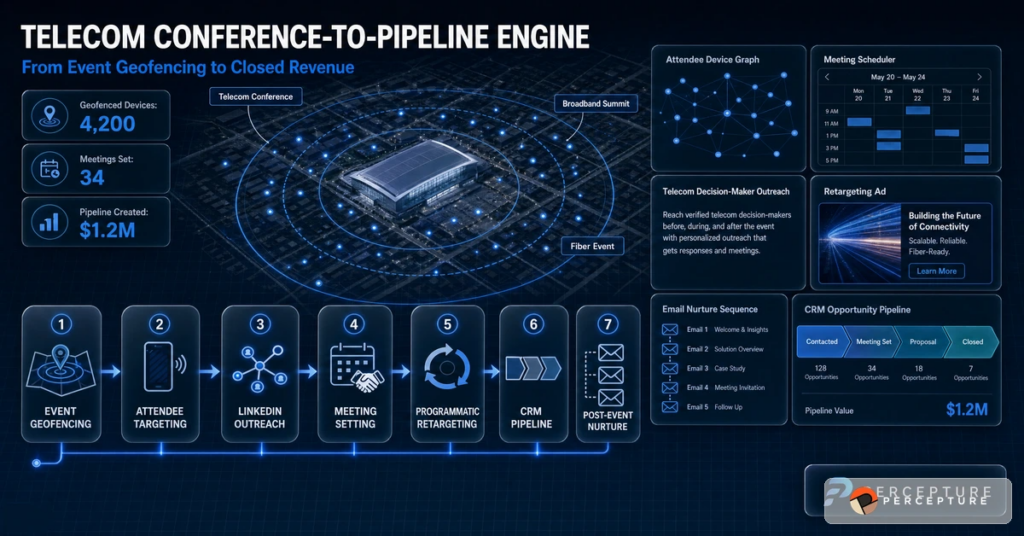
Pre-event account targeting and meeting-setting
Pre-event work should answer: how do you market before a telecom conference? For Telecom Conference Marketing, start with the serviceable universe, then narrow to accounts that match geography, product, vertical, buying need, and conference attendance. After that, build outreach that gives the buyer a reason to meet.
The content path should include a focused event landing page, a practical offer, proof assets, and sales language. If the event supports enterprise connectivity conversations, link the path to resources such as DIA lead generation for ISPs, Metro Ethernet lead generation, and B2B intent data for ISPs.
Meeting-setting should not rely on one channel. A practical sequence may include account research, LinkedIn touches, executive email, paid search for branded and event queries, retargeting, sales calls, partner introductions, and PR support. Lead generation and email marketing work better when the message is tied to a specific buyer problem instead of a generic booth invitation.
What should a telecom conference campaign include?
- Before the event: serviceability map, named-account list, meeting targets, event landing page, proof assets, retargeting audiences, and sales talk tracks.
- During the event: QR paths, badge capture, meeting notes, buyer need, location, urgency, proof shared, and next-step commitment.
- After the event: CRM routing, segmented follow-up, retargeting, PR recap, sales response tracking, and pipeline reporting.
On-site capture, QR, AI assistant, and proof assets
In Telecom Conference Marketing, on-site capture should reduce friction. A QR code can send visitors to a focused page with meeting options, proof assets, product fit, and a short intake path. The form should ask for enough information to route the lead without creating a barrier that kills the conversation.
An AI assistant can help prepare prospect dossiers, summarize public account signals, organize meeting notes, and support follow-up workflows. It should not replace judgment. It should make the sales team faster, cleaner, and more consistent.
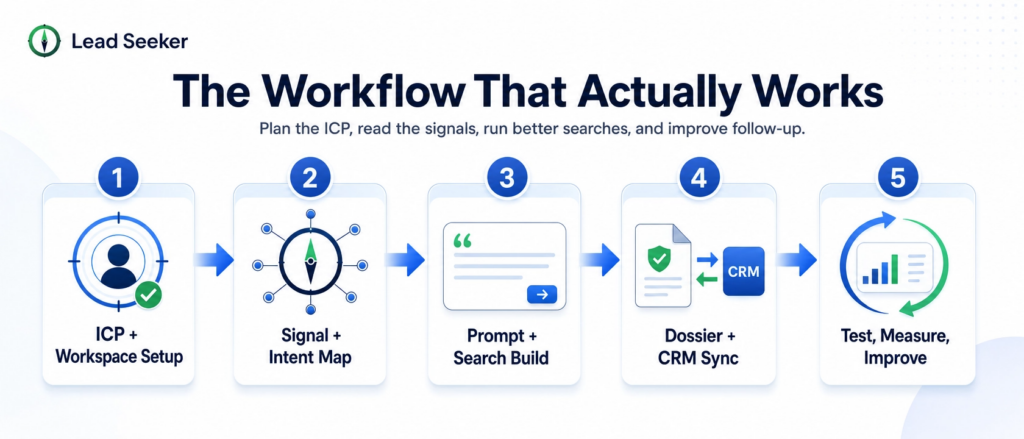
LeadSeeker fits this part of the system because intent data without serviceability is expensive curiosity. A buyer-intelligence workflow should help the team decide which accounts deserve fast human follow-up, which accounts need nurture, and which accounts should be excluded because the network cannot serve them.
The proof stack matters on-site. Good proof assets answer the questions a technical buyer, CFO, or CRO will ask before agreeing to a next step. What do you serve? Where can you serve? Why should we trust you? Who else has believed the story? What is the next low-risk action?
Paid search, retargeting, and PR support
Paid media should not chase broad event traffic. It should support named-account awareness, branded demand, competitor-adjacent research, and post-event retargeting. Paid search can help capture high-intent queries around the event, the brand, and the service category when the buyer starts researching after a conversation.
Retargeting keeps the conversation alive after the buyer leaves the booth or clicks the event page. Use it to reinforce proof, promote a recap, invite a follow-up review, and bring buyers back to a focused conversion path. The creative should match the sales motion, not just repeat the sponsor graphic.
PR can increase trust before and after the show. A useful program may include executive visibility, industry commentary, conference preview angles, partner announcements, and proof content. Digital PR and telecom PR support the Golden Triangle when organic search, AI answers, and third-party proof reinforce the same market message.
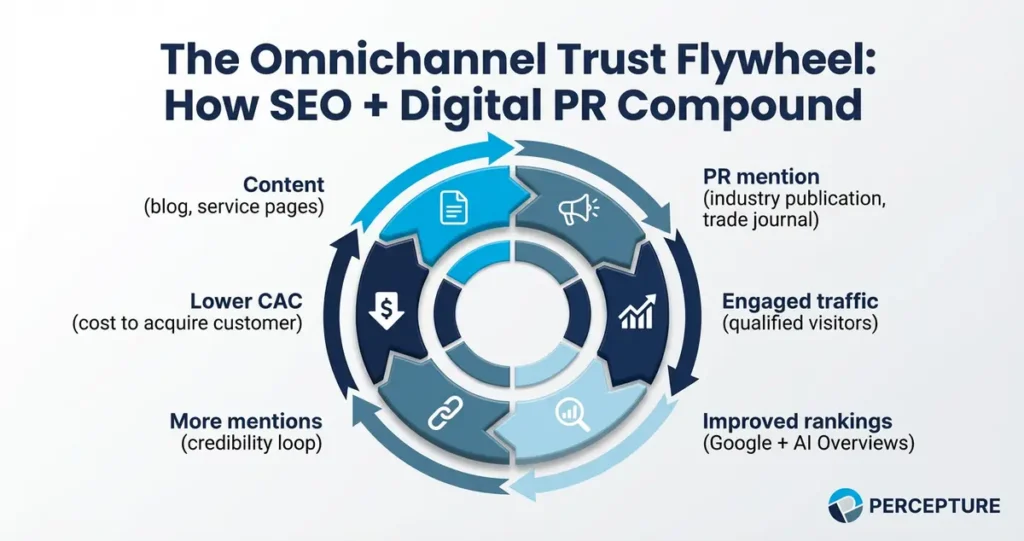
AI visibility is not a replacement for SEO, PR, or proof. It is the compounding result of all three. Percepture’s GEO services and organic SEO work best when the content has clear entities, useful answers, credible proof, and a route to conversion.
Post-event follow-up and sales routing
A Telecom Conference Marketing follow-up plan should begin before the event ends. Every hot meeting should leave with an owner, next step, deadline, and CRM note. Every research-stage account should enter a nurture path based on interest, product fit, and serviceability.
Sales and marketing should agree on routing rules. A CFO may care about cost per qualified lead and pipeline value. A VP Sales may care about meeting quality, response time, and conversion. A technical buyer may care about availability, route diversity, SLA fit, and operational constraints. A CEO may care about whether the event supports expansion, trust, and revenue focus.
Attribution and analytics should connect spend to outcomes without pretending every buyer journey is perfectly linear. Useful signals include meetings booked, qualified leads, address checks, proposals, pipeline value, response time, branded search lift, non-branded search visibility, and AI-answer visibility checks.
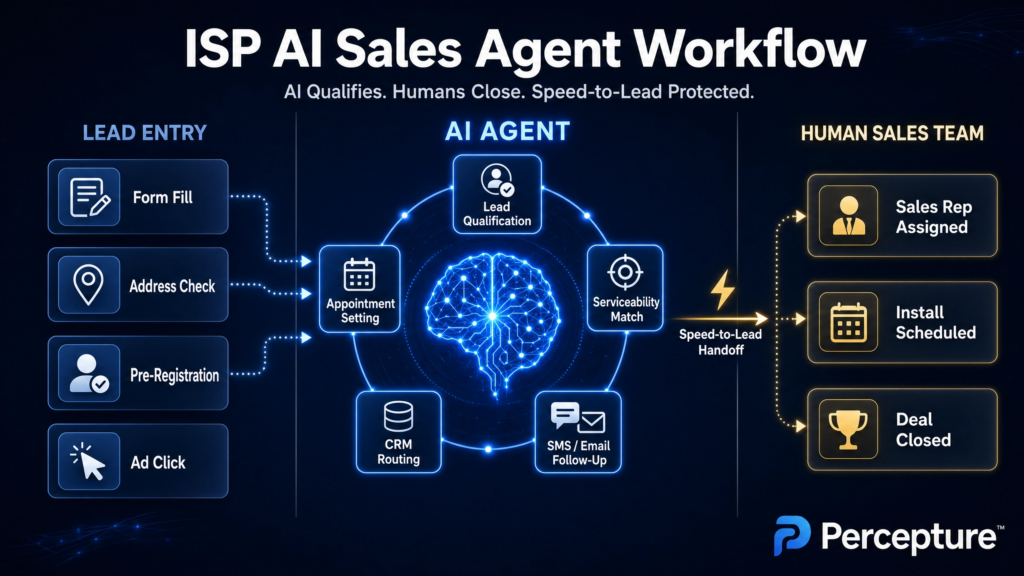
Review ITW, Metro Connect, and LeadSeeker support assets
If your team is planning ITW marketing, Metro Connect marketing, or another Telecom Conference Marketing program, review the event path, AI workflow, and proof stack before committing more spend. Start with the resources that support account selection and follow-up.
Telecom Conference Marketing comparison and decision matrix
| What weak programs do | What strong ISP programs do | What Percepture would check |
|---|---|---|
| Start with booth design and sponsor deliverables. | Start with network, serviceability, account fit, and sales goals. | Can the company sell to the accounts being targeted? |
| Count badge scans as success. | Score leads by role, location, urgency, service fit, and next step. | Does the CRM capture what sales needs? |
| Send one generic follow-up email. | Segment hot meetings, nurture accounts, and retarget research-stage buyers. | Is follow-up fast, specific, and owned? |
| Use generic event posts. | Use proof assets, PR, search, and AI visibility to build trust. | Are Trust Tokens visible before and after the event? |
| Report clicks and impressions only. | Report qualified leads, meetings, address checks, pipeline, and response time. | Can leadership see business movement? |
| Ignore technical constraints. | Explain availability, route fit, product limits, and buyer-specific next steps. | Does the campaign avoid oversimplifying network reality? |
What should this cost, and how should it be measured?
The cost depends on event size, sponsor level, target-account volume, creative needs, paid media budget, PR support, content depth, landing page work, sales enablement, and follow-up automation. A team going to one regional event may need a smaller activation. A team using ITW, PTC, and Metro Connect 2026 as a pipeline program needs a larger operating plan.
Budget should be judged against the revenue motion, not vanity metrics. For Telecom Conference Marketing, leadership should measure qualified leads, meetings booked, address checks, cost per qualified lead, install conversion, pipeline value, retention or churn reduction where relevant, sales response time, branded search visibility, non-branded search visibility, and AI-answer visibility checks.
For PR budget context, Percepture publishes public relations pricing packages. For conversion paths, conversion rate optimization can help turn event demand into forms, meetings, address checks, and qualified sales conversations.
Conference ROI scorecard
Use this Telecom Conference Marketing yes/no scorecard before the next show. If several answers are no, the event plan is likely leaking budget.
| Readiness question | Yes or no | Why it matters |
|---|---|---|
| Do we know which accounts are serviceable? | Yes / No | Prevents spend in markets where the network cannot sell. |
| Do we have a named-account list before outreach starts? | Yes / No | Keeps marketing and sales focused on fit. |
| Do we know which products each account may need? | Yes / No | Improves meeting quality and follow-up relevance. |
| Do we have proof assets ready for each buyer type? | Yes / No | Builds trust before the ask. |
| Does the landing page explain service area and next steps? | Yes / No | Reduces confusion and improves conversion quality. |
| Does on-site capture feed the CRM cleanly? | Yes / No | Prevents sales leakage after the event. |
| Are hot leads assigned within a defined response window? | Yes / No | Protects momentum after a live conversation. |
| Do we have nurture paths for research-stage buyers? | Yes / No | Keeps future pipeline warm without pressuring the wrong buyer. |
| Do we track search and AI visibility after the event? | Yes / No | Shows whether the market is continuing to research the brand. |
| Can leadership see meetings, leads, address checks, and pipeline? | Yes / No | Connects event spend to business outcomes. |
Mistakes to avoid
The first mistake is starting with channels before the target account list is clear. A media plan cannot fix an account list that ignores serviceability. Trust before take-rate is not a slogan; it is how buyers behave when the offer involves infrastructure, cost, and operational risk.
The second mistake is treating AI follow-up as a magic layer. AI outbound calling agents and automation can support speed and structure, but the message, consent path, compliance posture, and human handoff still matter.
The third mistake is letting event pages sit outside the broader search strategy. A conference page should support telecom marketing, PR, SEO, GEO, retargeting, and sales enablement. Search visibility only matters when it turns into address checks, qualified leads, meetings, installs, subscribers, or retention.
The fourth mistake is skipping proof. If a buyer met five providers at the same event, the provider with clearer proof, better follow-up, and stronger digital presence is easier to remember. Percepture’s Broadstaff Global search visibility and qualified leads case study shows how search visibility, B2B credibility, and qualified lead generation can work together.
How Telecom Conference Marketing supports AI search visibility
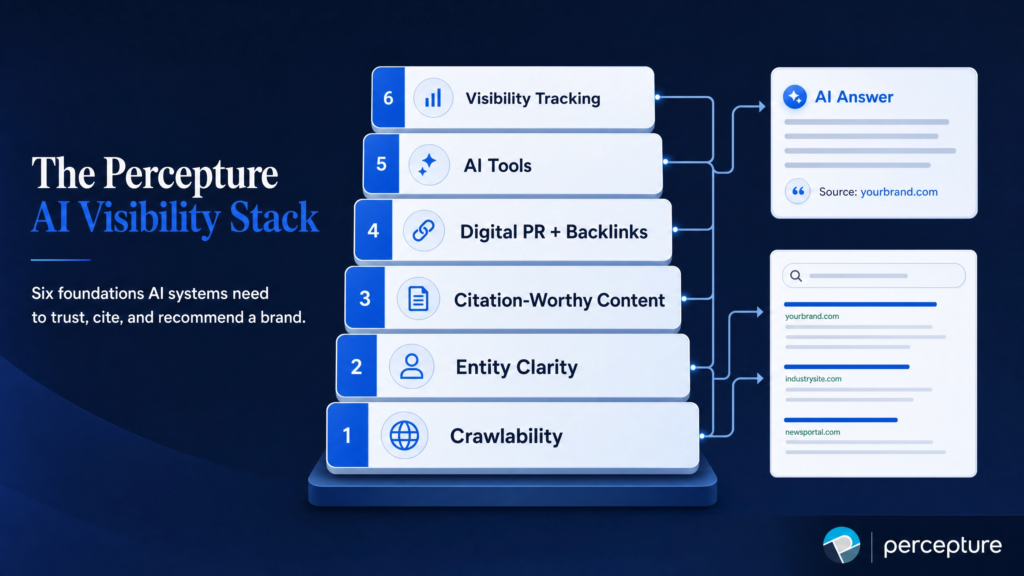
Telecom Conference Marketing should be written and structured so humans and answer systems can understand it. That means clear definitions, direct answers, named entities, FAQs, tables, internal links, and visible proof. The page should answer the CEO, CFO, VP Marketing, VP Sales, technical buyer, and sales-ops versions of the topic without sounding mechanical.
Percepture uses the AI Visibility Stack to connect search visibility, entity clarity, third-party proof, structured content, internal links, and conversion paths. For related AI-search strategy, see Percepture’s guide on brand visibility in AI answers. For digital infrastructure context, the data center marketing guide is a useful authority bridge.
FAQs
What is Telecom Conference Marketing?
Telecom Conference Marketing is the planning, promotion, capture, and follow-up system that turns a telecom event into qualified pipeline. It includes account targeting, meeting-setting, proof assets, event landing pages, on-site capture, retargeting, PR, CRM routing, and post-event nurture.
Why does it need to start with serviceability?
In Telecom Conference Marketing, serviceability comes first because an ISP cannot sell everywhere. If marketing targets accounts outside the network footprint or product fit, spend rises, sales wastes time, and buyers lose trust. Serviceability keeps the campaign tied to real revenue opportunity.
How should Percepture structure a page about Telecom Conference Marketing for AI search visibility?
The page should use a direct answer, clear definitions, entity-rich headings, internal links, proof assets, FAQ schema, tables, scorecards, and visible text. The content should answer executive, sales, marketing, CFO, and technical questions in concise sections.
What proof should an ISP show before asking for a conversation?
An ISP should show service-area clarity, product fit, technical credibility, customer or partner proof where approved, executive authority, relevant case studies, and a clear next step. The buyer should understand why the provider is credible before being asked for a meeting.
Which internal links should support this article?
Internal links should connect the article to the ISP marketing pillar, related telecom lead-generation articles, GEO services, digital PR, paid search, omnichannel marketing, conversion optimization, LeadSeeker, relevant telecom event pages, and proof such as the Broadstaff case study.
What CTA should be used for Telecom Conference Marketing?
The best CTA for Telecom Conference Marketing depends on buyer readiness. Early readers should get a diagnostic audit. Evaluating buyers should see event, proof, and AI workflow assets. Ready buyers should be invited to map a serviceability-aware event-to-pipeline plan with Percepture.
How should keyword density be handled?
Use the primary phrase where it helps the reader: title, intro, direct answer, one heading, image alt text, FAQ, comparison section, and final CTA. Do not repeat it in filler sentences. The article should read naturally while still making the topic clear.
What mistakes should ISPs avoid?
ISPs should avoid targeting outside serviceable markets, counting badge scans as pipeline, skipping proof assets, sending generic follow-up, ignoring CRM routing, separating PR from search, and measuring only clicks or impressions instead of qualified business movement.
How should this article help sales, marketing, and leadership?
Marketing gets a Telecom Conference Marketing campaign structure, sales gets routing and follow-up rules, and leadership gets a way to measure event spend against meetings, qualified leads, address checks, pipeline value, and market trust. The shared system reduces waste and improves accountability.
Turn your next Telecom Conference Marketing plan into pipeline
If your next Telecom Conference Marketing effort needs to produce more than booth activity, Percepture can help map the serviceability-aware account list, proof stack, event landing page, retargeting plan, AI follow-up path, and CRM routing.
Talk with Percepture about telecom event pipeline