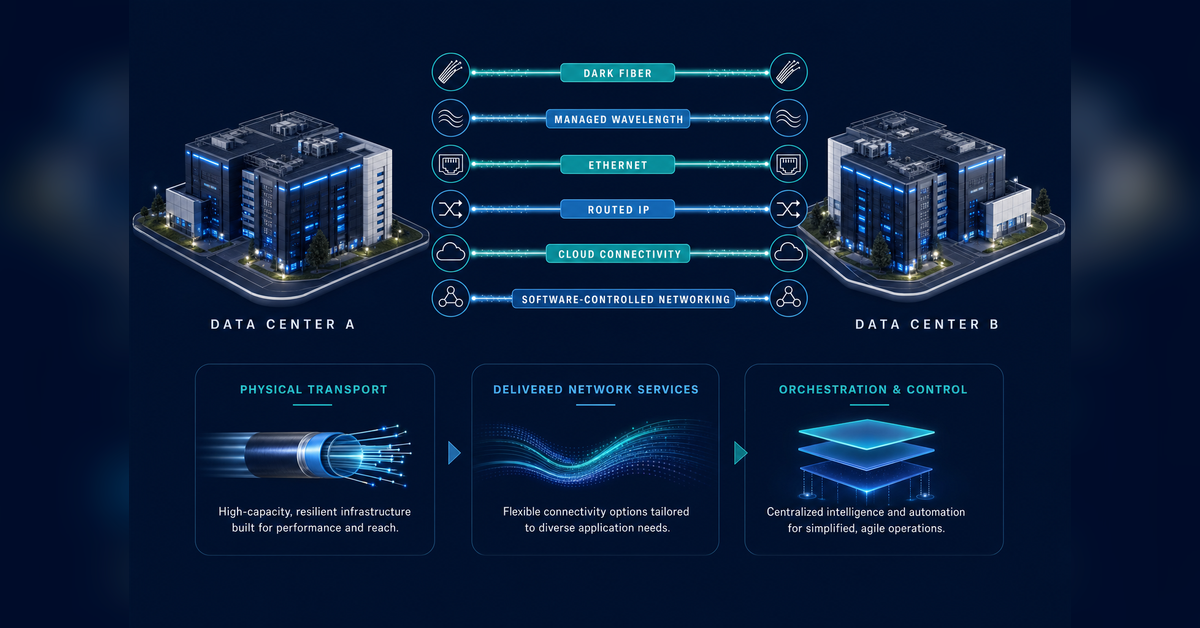

The main data center interconnect options are dark fiber, managed wavelengths, Ethernet private line, Ethernet virtual private line, MPLS or IP VPN, encrypted internet, cloud on-ramps and software-defined NaaS. Dark fiber gives the most control, managed services reduce operational burden, and NaaS adds portal or API provisioning. The best choice depends on distance, bandwidth, latency, resilience, staffing and ownership preference.
Most comparisons mix fiber, network services and overlay protocols as if they were interchangeable. They are not. This guide separates the physical path, delivered service and control layer so buyers can compare cost, responsibility, speed and risk without comparing a hammer to a blueprint.





Who this guide is for
This guide is built for teams that must compare technical control, provider responsibility and commercial risk before choosing a DCI model.
Network and infrastructure leaders
Use the comparison to separate physical transport, delivered services and overlay controls before approving an architecture.
Data center and colocation operators
Clarify which facilities, cross-connects, routes and handoffs are required to make the proposed service usable.
Cloud and enterprise architects
Match workload, recovery, latency and security requirements to the right mix of private, routed and cloud connectivity.
Commercial and procurement teams
Compare five-year cost, ownership boundaries, contract terms and exit conditions instead of comparing monthly circuit prices alone.
What most DCI comparisons get wrong
Most lists place dark fiber, Ethernet services, routing protocols and software portals in one category. That produces a false comparison because each item solves a different layer of the architecture.
They compare unlike products
A physical fiber route is not interchangeable with EPL, EVPN/VXLAN or a provisioning portal.
They hide ownership boundaries
The lowest quoted price can leave the buyer responsible for optics, local access, monitoring, security or recovery.
They assume route diversity
Two providers can still share a conduit, entrance, meet-me room, bridge or other physical failure domain.
They ignore lifecycle cost
Installation, cross-connects, cloud charges, equipment refresh, staffing and failover capacity change the real economic result.
Score the options before you shortlist providers
Use the Percepture Six-Factor DCI Option Test to document control, capacity, performance, operations, economics, resilience and security before requesting final designs.
Use the Six-Factor Test
Dark fiber
Dark fiber is unlit optical fiber leased or owned by the customer. The customer supplies and operates the optics and network equipment needed to carry traffic. Among DCI options, it gives the buyer the most direct control over equipment choices, capacity planning and the optical design.
The buyer is purchasing a physical path, not merely a bandwidth number. Route maps, building entrances, meet-me-room termination, maintenance responsibility and shared failure domains therefore matter. A second contract does not create resilience if both services follow the same conduit or building entrance.
Dark-fiber capacity is not infinite. It depends on the fiber, usable spectrum, optics, modulation, distance, line design and the team operating it. The commercial model must include optical equipment, spares, monitoring, maintenance, rack space, power, support and refresh cycles.
Best fit: steady, high-capacity traffic where the organization has optical expertise and values long-term control. Main risk: underestimating route exposure or the operating burden.
Managed wavelength and DWDM
A managed wavelength gives the buyer a lit optical channel with a defined handoff while the provider operates the underlying line system. Among managed DCI options, it can support predictable, high-volume point-to-point traffic without requiring the buyer to manage the complete optical transport layer.
Buyers should compare bandwidth increments, upgrade procedures, latency commitments, monitoring, demarcation, encryption availability, contract term and route evidence. A wavelength is not automatically a dedicated fiber strand, and a second wavelength is not automatically a diverse path.
Best fit: replication and other stable high-volume flows. Main risk: provider dependence, capacity step costs or an unverified physical route.
Ethernet Private Line, EVPL and Carrier Ethernet
Ethernet Private Line
EPL is a point-to-point Layer 2 Ethernet service. It is often easier to operate than customer-lit fiber because the provider manages the transport while the buyer receives an Ethernet handoff. When assessing EPL against other DCI options, the technical review should cover committed capacity, VLAN behavior, MTU, quality of service, latency, monitoring, failover, demarcation and term.
Best fit: straightforward private Ethernet between two sites. Main risk: assuming logical privacy proves physical diversity. PacketFabric describes its related service on its point-to-point networking page.
Ethernet Virtual Private Line and Carrier Ethernet
EVPL lets a buyer use a shared port for multiple isolated virtual Ethernet services. That can make it practical to connect several data centers, clouds, exchanges or partners from one interface. To compare these DCI options accurately, buyers must distinguish the physical port size from the committed capacity and performance of each virtual connection.
Best fit: networks that need several flexible Layer 2 connections. Main risk: overlooking VLAN mapping, service multiplexing, oversubscription, per-connection limits or the physical paths beneath the virtual services.
MPLS or routed IP VPN
MPLS and managed IP VPN services provide routed private connectivity across a provider backbone. Within DCI options, they can support many-site topologies, Layer 3 isolation, quality-of-service policies, route exchange and managed convergence.
MPLS is not inherently encrypted. Security teams must establish whether encryption is required, where it starts and ends, who controls keys and how logs support audits. Buyers should also review BGP policy, route control, segmentation, cloud integration, recovery behavior and contract complexity.
Best fit: distributed networks that prefer managed routing. Main risk: less direct control and a service model that can become hard to change.
Internet with IPsec
IPsec creates encrypted tunnels over internet access. Among DCI options, it can provide a lower-entry-cost route for backup, development, tertiary recovery and workloads that tolerate variable latency, jitter and loss. Dual internet providers can improve access resilience only when their physical paths and upstream dependencies are understood.
Encryption does not create dedicated bandwidth, predictable performance or a private-service SLA. Account for tunnel overhead, device throughput, DDoS exposure, monitoring, failover and the operational work required to diagnose problems across multiple parties.
Direct cloud connectivity and cloud on-ramps
A cloud on-ramp provides private access to a cloud environment. It may be one component of broader DCI options, but it does not automatically connect two data centers. Buyers still need the data-center-side port, cross-connect or local loop, routing design, redundant cloud connections and recovery plan.
Compare hosted and dedicated access models, cloud ports, routing limits, redundancy, transfer economics and ownership at each demarcation. PacketFabric presents its offering as hybrid cloud connectivity. Facility choice can also shape available cross-connects, as illustrated by Percepture’s guide to Chicago colocation.
Software-defined DCI and NaaS
Software-defined DCI uses a portal, API or infrastructure automation to order, provision, modify and monitor network services delivered over physical infrastructure. It can make DCI options easier to change, but it does not remove local loops, cross-connects, facilities, carrier routes or failure domains.
Evaluate the complete lifecycle rather than the ordering screen when comparing software-defined DCI options. Ask which functions are available through an API, whether changes are reversible, how capacity is billed, what telemetry is exposed, how support works and which facilities can be reached. Confirm whether the desired topology, service type, term and redundancy model are available for the required locations.
Best fit: fast-changing multi-location or multi-cloud networks. Main risk: mistaking a portal for complete automation or ignoring the physical path beneath the service.

PacketFabric as a software-defined option
PacketFabric is best evaluated as a software-controlled EPL, EVPL, cloud-connectivity and customizable NaaS option, not as a dark-fiber or optical-equipment substitute. Its published materials describe portal and API control for private connectivity.
A buyer comparing these DCI options should still confirm facility availability, local-loop requirements, route, handoff, capacity, service commitments, term, billing, monitoring, support and the API lifecycle. The right question is not whether ordering is digital. It is whether the complete service can be provisioned, observed, changed and recovered in the way the operating team requires.
Where EVPN/VXLAN, OTV, BGP, MACsec and IPsec fit
Use this scorecard to keep overlay, control and security technologies in the correct layer while evaluating DCI options.
| Technology | Role | Stack layer | Solves | Does not replace |
|---|---|---|---|---|
| EVPN/VXLAN | Overlay and control-plane architecture | Layer 3 | Scalable segmentation and L2/L3 reachability | Fiber, wavelength or Ethernet transport |
| OTV | Layer 2 extension technology | Layer 3 | Specific data-center extension use cases | A default DCI transport or route |
| BGP | Routing control plane | Layer 3 | Route exchange and policy | A physical path |
| MACsec | Supported Ethernet-link encryption | Layer 3 | Link-layer confidentiality and integrity | Route diversity |
| IPsec | Routed tunnel encryption | Layer 3 | Encrypted IP traffic across an underlying network | Predictable bandwidth or dedicated transport |
Coherent optics and IPoDWDM
Coherent pluggables and IP over DWDM are architecture choices, not universal managed-service categories. When considering them alongside DCI options, the buyer must still evaluate reach, fiber characteristics, interoperability, power, space, ownership and troubleshooting responsibilities.
No architecture is the universal cost winner. The result depends on distance, capacity, equipment, operating skill, support model and refresh requirements. Ciena provides additional background on optical DCI architectures.
Build, buy or combine?
| Model | Typical choices | Buyer control | Buyer burden | Good fit |
|---|---|---|---|---|
| Build | Dark fiber and customer optics | Highest | Highest | Stable high demand and strong optical operations |
| Buy managed | Wavelength, EPL, EVPL, MPLS | Defined at the handoff | Moderate | Teams that value a defined service and support model |
| Combine | Managed or NaaS primary plus diverse backup and cloud paths | Shared across layers | Requires clear governance | Enterprises balancing agility, control and resilience |
Whichever DCI options are combined, create a RACI that covers the buyer, facility, local carrier, transport provider, cloud provider and NaaS platform. Every installation, monitoring and recovery task should have one accountable owner.
How much do data center interconnect options cost?
There is no responsible universal price because the result depends on locations, distance, capacity, facilities, route, term and operating model. A usable comparison includes ports, cross-connects, local loops, transport, routers, switches, optics, licenses, installation, colocation, monitoring, support, cloud ports, data transfer, redundant paths, staff and equipment refresh.
Across DCI options, dark fiber tends to shift more equipment and operating responsibility to the buyer. Managed services tend to shift more cost into recurring service charges. NaaS can change ordering and commercial flexibility, but the underlying access and facility costs still matter.
Model five-year TCO under normal growth, faster growth and primary-path failure. The least expensive circuit can be the most expensive architecture when it lacks route diversity, growth capacity, monitoring or an accountable recovery process. Broader capital planning context is available in Percepture’s data center financing structures comparison.
How should buyers choose?
- Define each workload and its recovery objective.
- List every data center, cloud, partner and exchange endpoint.
- Set measurable latency, jitter and loss requirements.
- Model normal, peak, growth and failover capacity.
- Decide which infrastructure and operations the buyer wants to own.
- Verify routes, entrances, meet-me rooms and shared failure domains.
- Select the required topology, handoff and network service.
- Define encryption, key ownership, segmentation and logging.
- Compare five-year TCO, contract term and exit conditions.
- Test provisioning, failover, monitoring and support escalation.
This sequence makes DCI options comparable without turning general guidance into site-specific engineering approval.
Common DCI buying mistakes
- Mixing physical transport, delivered services and overlays in one price comparison.
- Comparing DCI options without normalizing topology, route, capacity and operating responsibility.
- Calling dark-fiber capacity unlimited.
- Assuming two providers use physically diverse routes.
- Stretching Layer 2 where routed separation would reduce the failure domain.
- Calling MPLS inherently encrypted.
- Treating IPsec encryption as a bandwidth or latency commitment.
- Ignoring cloud transfer, cross-connect, local-loop and support costs.
- Buying only on price per unit of bandwidth.
- Sizing without growth and failover demand.
- Assuming a portal provides complete lifecycle automation.
- Leaving the demarcation and recovery owner unclear.
- Skipping a documented recovery test.
The physical layer buyers still need to verify
One of the strongest lessons from Percepture’s AI-assisted interview with interconnection pioneer Hunter Newby is simple: a virtual service still follows a physical path. Facilities, entrances, meet-me rooms, conduit, fiber, power and handoffs determine whether a backup is truly independent.
Bob Generale helped develop the concept of using AI to interview Hunter and organize his published expertise into a searchable knowledge asset. For this guide, that perspective is applied to the buying questions teams should ask before treating a portal listing or second carrier name as proof of resilience.

For every data center interconnect option, request route evidence, termination details, carrier overlap, available growth and the recovery sequence. Presence on a provider list does not prove that the required cross-connect, port or physical path is installed, diverse and ready.
How Percepture turns technical expertise into demand
A technically accurate page about DCI options still needs a clear search role, connected supporting pages and a conversion path. Percepture combines organic SEO services, generative engine optimization services, technical SEO audit services and digital PR to package specialist knowledge for buyers, search engines and AI answer systems.
For data-center organizations, that system connects technical education with data center marketing, data center lead generation and AI search optimization for telecom.
Choose in layers, then verify the path
The best DCI options are not selected from one flat product list. First choose the physical path or managed transport. Then choose the delivered Ethernet, IP or cloud service. Finally define routing, segmentation, encryption, orchestration and operational ownership.
Use the Three-Layer Stack and Six-Factor Test to compare DCI options by responsibility, capacity, performance, agility, security and five-year economics. Before signing, verify the physical route and test what happens when the primary path fails.

About Bob Generale
Bob Generale is President of Percepture. He leads executive strategy for SEO, generative engine optimization and integrated digital programs serving complex B2B markets, including telecom and data-center organizations.