
A strong CDMO business development strategy starts before the conference badge is printed and keeps working long after the booth comes down. Most CDMOs invest heavily in trade shows like CPHI and DCAT. They book booths, send teams, and collect business cards. Then the event ends. Follow-up slows. Momentum fades. Pipeline stalls.
This is not a lead generation problem. It is a systems problem.
Modern CDMO business development is not booth traffic plus hope. It is a system that starts before the conference, compounds during the conference, and keeps working after the conference through search, AI visibility, retargeting, and disciplined follow-up.
This guide shows sales leaders, commercial leaders, heads of BD, heads of marketing, and executives at CDMOs how to build that system. It covers conference activation, AI search, content strategy, role ownership, and the metrics that actually matter for qualified pipeline.
What is a CDMO business development strategy?
A CDMO business development strategy is the system a contract manufacturer uses to create visibility, build trust, and turn buyer interest into qualified meetings, proposals, and long-term pipeline.
Quick Summary
- Conferences alone are not enough to build consistent pipeline
- Buyers search before and after events to validate what they heard
- AI visibility supports trust and shapes early shortlists
- Nurture matters more than one follow-up email
- Pipeline comes from systems, not isolated tactics
What Is a CDMO Business Development Strategy?
A CDMO business development strategy is the system a contract development and manufacturing organization uses to create visibility, build trust, and turn buyer interest into qualified meetings, proposals, and long-term pipeline.
It is not just a sales plan or a marketing plan; it’s the connection between the two, supported by proof, content, search visibility, and disciplined follow-up.
For CDMOs, business development includes:
- Conference activation at events like CPHI, DCAT, and BIO
- Search visibility so buyers find you when they research
- AI search optimization so AI tools cite you in early discovery
- Content that builds trust and answers buyer questions
- Nurture sequences that keep momentum after the first meeting
- Metrics that connect activity to pipeline and revenue
A strong CDMO business development strategy does not rely on one channel. It builds a system where each channel supports the others.
Why CDMO Lead Generation Breaks After the Conference
Most CDMOs treat conferences as the main event. They invest in booths, travel, and meetings. But the real work starts after the badge comes off.
The booth is not the strategy
A booth creates visibility. It does not create pipeline. Buyers meet dozens of CDMOs at a single event. They collect cards, take notes, and move on. Without follow-up, your booth visit becomes a blur.
Why one follow-up email is not enough
Most CDMOs send one or two emails after a conference. That is not enough. Buyers are busy. They are fielding follow-ups from every vendor they met. One email gets lost. Two emails get ignored.
Research from Salesforce shows that it takes an average of 8 to 12 touchpoints to convert a B2B lead into a meeting. One email is not a strategy. It is a hope.
Why most post-event energy disappears
After a conference, teams return to their regular work. Follow-up becomes a side task. Leads sit in spreadsheets. Momentum fades. By the time someone follows up, the buyer has moved on.
This is why CDMO lead generation breaks. It is not a lead problem. It is a systems problem.
2 Touchpoints
- Trade show booth interaction
- One follow-up email
- Momentum fades quickly
- Little signal after the event
12+ Touchpoints
- Pre-show search and AI visibility
- Conference targeting and remarketing
- Case studies, emails, and follow-up content
- More momentum toward qualified meetings
How Buyers Move From Search to Shortlist to Meeting
Understanding how buyers move through the decision process is essential for any CDMO commercial strategy. Buyers do not make decisions at the booth. They make decisions over weeks and months, using search, content, and peer input.
Search behavior before outreach
Before a buyer reaches out, they search. They look for CDMOs with the right capabilities, the right scale, and the right proof. Read capability pages, case studies, and buyer guides may be part of their customer journey as they compare options.
If your CDMO does not appear in search results, you are not on the shortlist. This is why CDMO SEO matters. It puts you in front of buyers when they are actively researching.
What buyers look for after seeing your booth
After a conference, buyers validate what they heard. They search your company name, look for evidence that you can deliver. As they read your content and check if your claims to see if they match your online presence.
If your website is thin, your proof is weak, or your content is outdated, buyers lose trust. The booth visit becomes a dead end.
Why proof and structure shape trust
Buyers trust CDMOs that show proof. Case studies, client results, and clear capability pages build confidence. Structure matters too. A well-organized website signals a well-organized company.
For a deeper look at how search supports CDMO visibility, see the life science SEO guide.
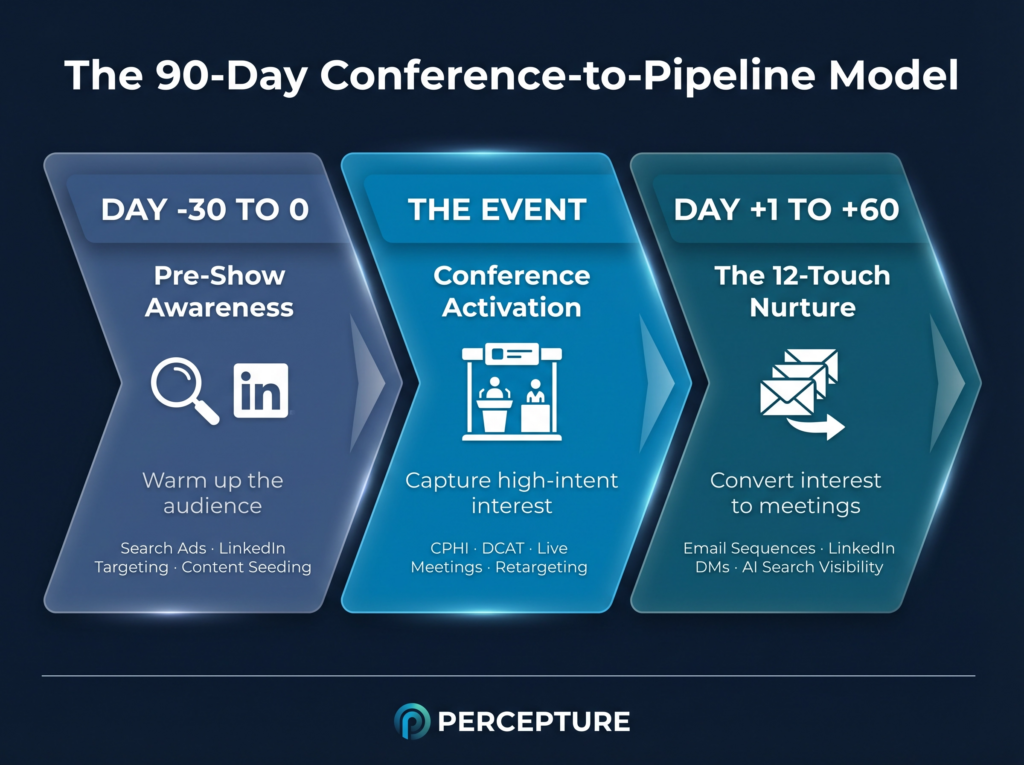
The 90-Day Conference-to-Pipeline Model
The most effective CDMO business development strategies use a 90-day model. This model starts 30 days before the event, intensifies during the event, and extends 60 days after.
The 90-Day Conference-to-Pipeline Model
Launch search, LinkedIn, and retargeting support. Publish conference-ready pages, proof, and buyer-focused content.
Stay visible with live updates, remarketing, booth messaging, and meeting-focused CTAs while interest is highest.
Extend conference momentum through follow-up sequences, proof content, AI visibility, and role-based nurture.
30 days before the event
Before the conference, your CDMO should:
- Launch search campaigns targeting conference-related keywords
- Publish or refresh capability pages and case studies
- Set up retargeting to reach buyers who visit your site
- Prepare LinkedIn content and outreach sequences
- Build a conference landing page with meeting booking options
This pre-show work ensures buyers see your CDMO before they arrive at the event.
During the event
During the conference, your CDMO should:
- Run remarketing ads to attendees
- Post live updates on LinkedIn
- Use booth messaging that drives to your landing page
- Capture leads with clear next steps
- Schedule follow-up meetings before the event ends
The goal is to maximize visibility while buyer attention is highest.
60 days after the event
After the conference, your CDMO should:
- Launch a multi-touch follow-up sequence (8-12+ touchpoints)
- Send role-based content to different buyer personas
- Use retargeting to stay visible to engaged leads
- Share proof content like case studies and buyer guides
- Track engagement and prioritize high-intent leads
This post-show system is where most CDMOs fail. It is also where the best CDMOs win.
How AI Search Changes the First Stage of CDMO Business Development
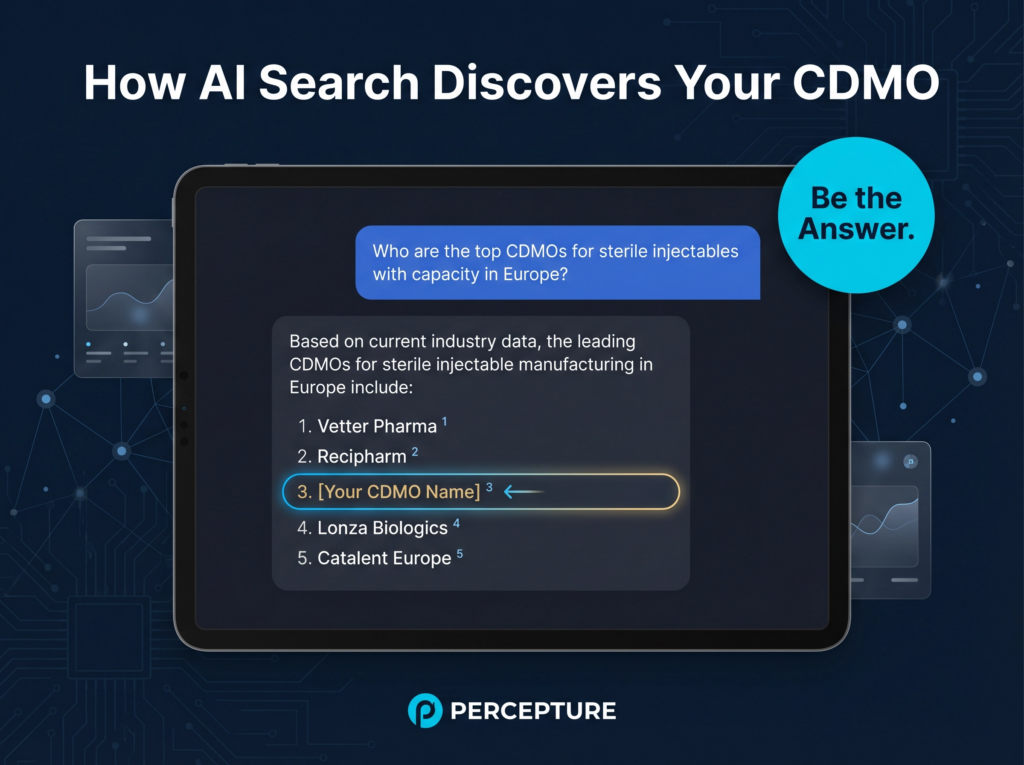
AI search is changing how buyers discover CDMOs. Tools like ChatGPT, Perplexity, and Google AI Overviews now answer buyer questions directly. If your CDMO is not cited in these answers, you are invisible in early discovery.
Why AI answers shape early trust
When a buyer asks an AI tool, “What are the best CDMOs for sterile injectables?” the AI provides a list. That list shapes the buyer’s shortlist before they ever visit a website.
AI systems pull from structured, authoritative content. If your CDMO has clear capability pages, strong proof, and well-organized content, AI tools are more likely to cite you.
For more on this topic, see CDMO AI Search.
How AI visibility supports conference follow-up
After a conference, buyers often use AI tools to research the CDMOs they met. If your CDMO appears in AI answers, it reinforces the trust built at the booth.
AI visibility and conference activation work together. The booth creates awareness. AI visibility sustains it.
What content AI systems are likely to cite
AI systems favor content that is:
- Structured with clear headings and definitions
- Authoritative with proof and citations
- Comprehensive but easy to scan
- Updated regularly
This is why GEO services matter for CDMOs. They help you create content that AI tools trust and cite.
What Sales, Marketing, and Executives Each Need to Own
A CDMO business development strategy only works when sales, marketing, and executive leadership each own their part. Misalignment is the most common reason pipeline stalls.
Sales ownership
Sales owns:
- Meeting booking and follow-up
- Lead qualification and prioritization
- CRM hygiene and pipeline updates
- Feedback on lead quality and content needs
When splitting responsibilities, sales shouldn’t own content creation or campaign strategy. That leads to inconsistency and burnout.
Marketing ownership
Marketing owns:
- Search and AI visibility
- Content creation and distribution
- Conference landing pages and campaigns
- Retargeting and nurture sequences
- Lead scoring and handoff criteria
As you know, Marketing should not own meeting booking or deal closing. That leads to confusion and dropped leads.
Executive ownership
Executives own:
- Budget allocation and resource prioritization
- Alignment between sales and marketing
- Pipeline review and accountability
- Strategic direction and target account selection
Executives should not micromanage campaigns or content. That slows execution and frustrates teams.
Where alignment usually breaks
Alignment breaks when:
- Sales blames marketing for lead quality
- Marketing blames sales for poor follow-up
- Executives change priorities mid-campaign
- No one owns the handoff between marketing and sales
The fix is clear ownership, shared metrics, and regular pipeline reviews.
- Meeting booking
- Lead qualification
- CRM updates
- Quality feedback
- Search visibility
- Content creation
- Nurture sequences
- Lead scoring
- Budget allocation
- Team alignment
- Pipeline review
- Strategic direction
- Process design
- Tool management
- Reporting
- Handoff coordination
How to Turn Content Into Qualified Pipeline Instead of Noise
Content is the fuel for CDMO business development. But not all content drives pipeline. The right content answers buyer questions, builds trust, and moves leads toward meetings.
Capability pages
Capability pages show what your CDMO can do. They should be specific, structured, and easy to scan. Include:
- Service descriptions
- Scale and capacity details
- Regulatory certifications
- Geographic locations
Conference landing pages
Conference landing pages capture interest before, during, and after events. They should include:
- Meeting booking options
- Key capabilities relevant to the event
- Proof and case studies
- Clear CTAs
Case studies
Case studies show proof. They answer the question, “Can this CDMO deliver?” A strong case study includes:
- The challenge
- The solution
- The results (with numbers)
For an example of how proof drives results, see the pharma CDMO case study.
Buyer guides
Buyer guides help prospects evaluate options. They position your CDMO as a trusted advisor. Topics might include:
- How to choose a CDMO
- What to look for in a sterile fill-finish partner
- Questions to ask during CDMO due diligence
Retargeting and nurture content
Retargeting keeps your CDMO visible to engaged leads. Nurture content moves them toward meetings. This includes:
- Email sequences
- LinkedIn content
- Downloadable guides
- Webinar invitations
For support with authority-building content, explore digital PR services and enterprise SEO services.
Heading to CPHI, DCAT, or planning your next push after the event?
Percepture helps CDMOs stay visible before, during, and after conferences through search, AI visibility, retargeting, and smarter follow-up systems.
The Metrics That Actually Matter for CDMO Business Development
Vanity metrics like booth traffic and email opens do not predict pipeline. The metrics that matter connect activity to revenue.
Meetings booked
Meetings booked is the clearest signal of pipeline progress. Track meetings by source (conference, search, referral) to understand what works.
Target-account engagement
Track engagement from your target accounts. Are they visiting your site? Opening emails? Clicking ads? Engagement signals intent.
Days to first meeting
How long does it take to convert a lead into a meeting? Shorter timelines mean stronger systems.
Influenced pipeline
Influenced pipeline tracks deals where marketing touchpoints played a role. This shows the value of content, search, and nurture.
Proposal velocity
How quickly do leads move from meeting to proposal? Faster velocity means better qualification and stronger trust.
Search-assisted conversions
Track conversions where search played a role. This shows the value of SEO and AI visibility in the buyer journey.
| Metric | What It Measures | Why It Matters |
|---|---|---|
| Meetings Booked | Pipeline entry points | Direct signal of BD effectiveness |
| Target-Account Engagement | Activity from priority accounts | Shows intent from ideal buyers |
| Days to First Meeting | Speed of lead conversion | Indicates system efficiency |
| Influenced Pipeline | Marketing contribution to deals | Connects content to revenue |
| Proposal Velocity | Time from meeting to proposal | Measures qualification quality |
| Search-Assisted Conversions | SEO/AI role in conversions | Shows search value in pipeline |
Comparison Table: Traditional CDMO BD vs Modern CDMO BD Strategy
| Area | Traditional CDMO BD | Modern CDMO BD Strategy |
|---|---|---|
| Conferences | Booth traffic | Pre-show, during-show, post-show system |
| Follow-up | 1–2 emails | 8–12+ touchpoints |
| Search | Passive website | Active search and AI-search visibility |
| Proof | Brochure-level | Case studies, buyer guides, proof pages |
| Measurement | Meetings counted | Pipeline, velocity, attribution, engagement |
- “Modern CDMO business development is not booth traffic plus hope. It is a system.”
- “One follow-up email is not a strategy. It is a hope.”
- “The booth creates awareness. AI visibility sustains it.”
- “Pipeline comes from systems, not isolated tactics.”
- “Alignment breaks when no one owns the handoff between marketing and sales.”
Frequently Asked Questions About CDMO Business Development Strategy
What is a CDMO business development strategy?
A CDMO business development strategy is the system a contract manufacturer uses to create visibility, build trust, and turn buyer interest into qualified meetings, proposals, and long-term pipeline. It combines conference activation, search visibility, AI search optimization, multi-touch nurture, and disciplined follow-up.
Why is conference follow-up weak for many CDMOs?
Most CDMOs send only one or two follow-up emails after a conference. Research shows it takes 8 to 12 touchpoints to convert a B2B lead. Without a multi-touch system, momentum fades and leads go cold.
How do CDMOs generate qualified leads beyond trade shows?
CDMOs generate qualified leads through search visibility, AI search optimization, content marketing, retargeting, and multi-touch nurture sequences. These channels work together to reach buyers before, during, and after conferences.
What role does AI search play in CDMO business development?
AI search tools like ChatGPT and Perplexity now answer buyer questions directly. If your CDMO is cited in these answers, you shape early shortlists. AI visibility supports conference follow-up by reinforcing trust after the booth visit.
How should sales and marketing work together at a CDMO?
Sales should own meeting booking, lead qualification, and CRM updates. Marketing should own search visibility, content creation, and nurture sequences. Both should share metrics and hold regular pipeline reviews to stay aligned.
What content helps a CDMO generate better pipeline?
Capability pages, conference landing pages, case studies, buyer guides, and nurture content all drive pipeline. The best content answers buyer questions, builds trust, and moves leads toward meetings.
What metrics matter most for CDMO lead generation?
The metrics that matter are meetings booked, target-account engagement, days to first meeting, influenced pipeline, proposal velocity, and search-assisted conversions. These connect activity to revenue.
How can a CDMO improve post-conference pipeline conversion?
Use a 90-day model: 30 days before the event for pre-show activation, during the event for maximum visibility, and 60 days after for multi-touch follow-up. This system keeps momentum alive and converts more leads.
What is the difference between CDMO marketing and CDMO business development?
CDMO marketing creates visibility and generates leads. CDMO business development converts those leads into meetings, proposals, and pipeline. The two must work together for consistent results.
How long does it take for search and AI visibility to influence pipeline?
Search and AI visibility typically take 3 to 6 months to show measurable pipeline impact. The investment compounds over time as content ranks, AI tools cite your pages, and buyers find you during research.
Build a CDMO pipeline system that keeps working after the conference ends
Search, AI visibility, proof, and multi-touch follow-up can work together to create better meetings, stronger trust, and more qualified pipeline.