
Are you learning how to apply CDMO generative engine optimization services to drive sales leads? Your next pharma partner might not find you through a Google search. They might ask ChatGPT. So if you are doing traditional CDMO SEO services, you have a head start and are well-positioned for AI Search or Generative Engine Optimization.
That’s the shift happening right now. Buyers at pharmaceutical companies are typing questions into AI tools before they ever click a link. They ask things like “Who are the best CDMOs for sterile injectables?” or “Which contract manufacturers have capacity in Europe?”
If your CDMO isn’t showing up in those AI answers, you’re invisible at the exact moment a buyer is building their shortlist.
This guide explains how CDMO GEO search works. You’ll learn what makes AI systems cite one source over another. And you’ll see how to structure your content so ChatGPT, Google AI Overviews, and other AI tools trust your company enough to mention it by name.
This isn’t about replacing your CDMO marketing strategy. It’s about adding a new layer of visibility that meets buyers where they’re already looking.
AI VISIBILITY CHECK
Want to know whether your CDMO is visible in AI answers?
What Is CDMO Generative Engine Optimization?
DEFINITION
CDMO AI search is the practice of optimizing contract development and manufacturing organization content so it gets cited in AI-generated answers. This includes ChatGPT responses, Google AI Overviews, Perplexity summaries, and other generative AI tools that synthesize information instead of listing links.
Traditional SEO helps you rank in search results. CDMO GEO search helps you get mentioned in AI answers.
The difference matters. When a buyer asks an AI tool for CDMO recommendations, the AI doesn’t show a list of ten blue links. It gives a direct answer, names specific companies, and explains why those companies fit the buyer’s needs.
If your content is structured the right way, your CDMO becomes part of that answer.
AI search, AEO, and AIO are sometimes summed up as generative engine optimization services, or GEO. It’s the next evolution of search visibility. And for CDMOs competing for pharma partnerships, it’s becoming essential.
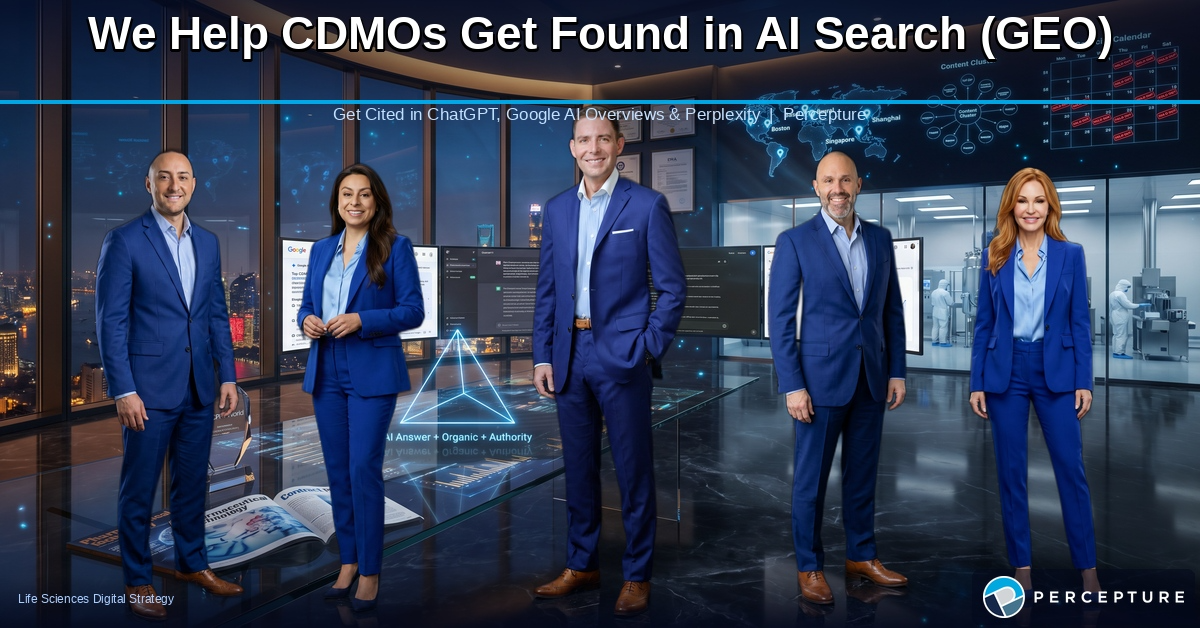
Is your CDMO showing up when pharma buyers ask ChatGPT for recommendations? If not, you are missing out on the new discovery layer of B2B procurement. In this video, Bob Generale and his team break down Generative Engine Optimization (GEO) and the “Golden Triangle” strategy.
Why AI Visibility Matters Before a Buyer Clicks
Pharma buyers don’t start with your website. They start with questions.
At industry events like CPHI, buyers meet dozens of potential partners. They collect brochures, exchange business cards, and sit through the same capability presentations.
Then they go back to their offices and do research.
That research increasingly happens through AI tools. A procurement lead might ask ChatGPT: “What should I look for when choosing a CDMO for biologics?” A BD director might ask Perplexity: “Which CDMOs have FDA-approved facilities in Germany?”
The AI gives an answer. It cites sources. It names companies.
If your CDMO isn’t in that answer, you’re not on the shortlist. The buyer never visits your website. They never see your capabilities deck. They never fill out your contact form.
This is why working with a life sciences marketing agency that understands AI visibility is becoming critical. The discovery layer has changed. Your content strategy needs to change with it.

How ChatGPT and Google AI Overviews Choose What to Cite
AI systems don’t cite content randomly. They follow patterns.
A 2025 audit of over 2 million ChatGPT sessions found that 72.4% of cited posts used what researchers call “answer capsules.” These are self-contained blocks of 120 to 150 characters that directly answer a question right after a heading.
The same study found that 52.2% of cited content included original data or proprietary research. Content with links inside the answer capsule was cited less often—91% of cited content was link-free in the capsule itself.
Google’s AI Overviews work similarly. According to Google Search Central documentation, AI features use “query fan-out” techniques. They issue multiple related searches across subtopics to build comprehensive responses. Then they identify supporting web pages to cite.
The key insight: AI systems prefer content that’s easy to extract, verify, and attribute.
For CDMOs, this means your content needs to be structured for machines, not just humans. Clear definitions. Specific capabilities. Verifiable proof points. All organized in a way that AI can parse and summarize.
This is where AI search optimization services become valuable. The technical requirements are specific, and the stakes are high.
What Makes CDMO Content Easy for AI to Trust
AI systems evaluate content the same way a careful researcher would. They look for signals that indicate expertise, accuracy, and reliability.
Clear Definitions
Define terms in plain language. AI extracts definitions verbatim.
Proof in Plain Text
State results as text, not just graphics. AI can’t read images.
Entity Clarity
Consistent company name, location, and capabilities across all pages.
Structured Comparisons
Tables and lists that AI can parse for direct answers.
Corroborated Authority
Third-party mentions, press coverage, and industry recognition.
For CDMOs specifically, this means:
State your capabilities in concrete terms. Don’t say “world-class manufacturing.” Say “FDA-inspected facility with 50,000L bioreactor capacity for monoclonal antibodies.”
Include regulatory approvals as text. AI systems can verify FDA, EMA, and PMDA approvals. List them clearly on your capability pages.
Publish original data. If you’ve improved batch success rates or reduced cycle times, state the numbers. Original data gets cited more often than generic claims.
Use consistent naming. If your company is “ABC Pharma Services” on your website but “ABC Pharmaceutical Manufacturing” in press releases, AI systems may not connect the dots.
A comprehensive life science SEO guide covers these fundamentals in detail. The principles apply whether you’re optimizing for traditional search or AI citations.
The Golden Triangle for CDMO AI Visibility
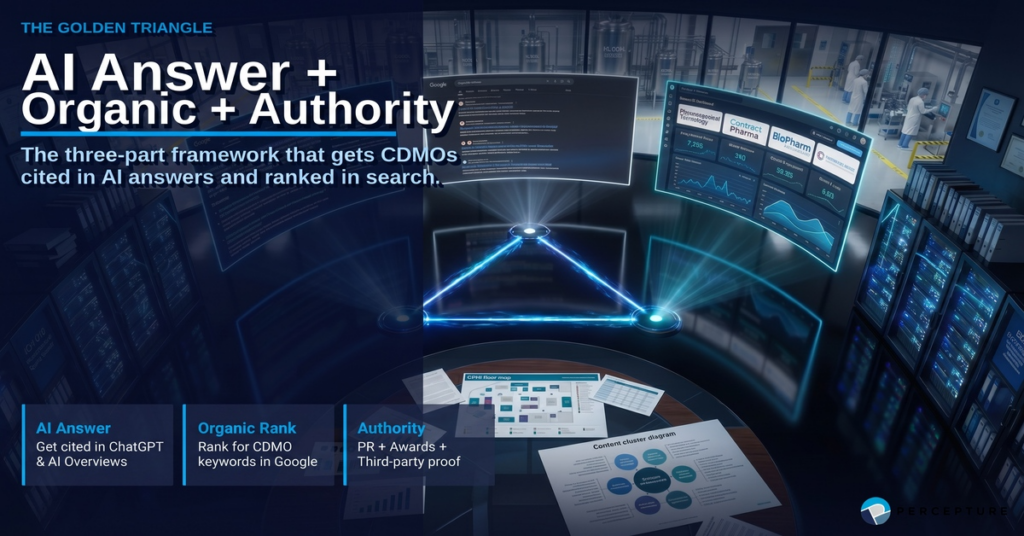
THE GOLDEN TRIANGLE
AI Answer
Get cited in ChatGPT, Google AI Overviews, and Perplexity responses
Organic Ranking
Rank for CDMO keywords in traditional search results
Authority Reinforcement
Build credibility through PR, awards, and third-party coverage
AI visibility doesn’t exist in isolation. It works best when combined with traditional SEO and authority-building activities.
AI Answer: This is the new discovery layer. When buyers ask AI tools about CDMOs, your company appears in the response. This requires structured content, clear entity signals, and verifiable proof.
Organic Ranking: Traditional search still matters. Many buyers click through AI citations to learn more. If your pages rank well for CDMO keywords, you capture traffic from both AI and traditional search.
Authority Reinforcement: AI systems trust sources that other credible sources trust. Press coverage, industry awards, and mentions in trade publications all signal authority. This is where PR and content marketing intersect with AI visibility.
The most effective CDMO marketing strategies address all three. You can’t just optimize for AI and ignore organic search. You can’t just rank in Google and ignore AI citations. And you can’t do either without building genuine authority in your space.
The Content Formats AI Systems Prefer to Reference
Not all content gets cited equally. AI systems have preferences.
| Format | Traditional SEO Value | AI Citation Value |
|---|---|---|
| Definitions & Glossaries | Medium — featured snippets | High — directly extractable |
| Comparison Tables | High — scannable | High — structured data |
| Step-by-Step Guides | High — long-form value | High — process answers |
| Case Studies with Metrics | Medium — conversion focus | High — proof signals |
| Generic Capability Pages | Low — thin content | Low — no unique value |
The pattern is clear: AI systems prefer content that answers specific questions with verifiable information.
For CDMOs, this means investing in:
- Capability comparisons that help buyers understand differences between service offerings
- Process explanations that walk through how you handle tech transfer, scale-up, or regulatory submissions
- Case studies with real metrics that demonstrate outcomes (see our pharma CDMO case study for an example)
- FAQ content that directly answers the questions buyers ask
Generic “About Us” pages and vague capability statements don’t get cited. Specific, structured, verifiable content does.
How PR, Proof, and Entity Clarity Increase Citations
AI systems don’t just evaluate your website. They evaluate your presence across the entire web.
When ChatGPT or Google AI Overviews generate a response, they’re drawing from multiple sources. If your CDMO is mentioned consistently across trade publications, press releases, industry directories, and your own website, AI systems recognize you as a credible entity.
This is where digital PR services become part of your AI visibility strategy.
Press coverage creates corroboration. When a trade publication mentions your facility expansion or regulatory approval, that’s a third-party signal that AI systems can verify.
Consistent entity signals build recognition. Your company name, headquarters location, key capabilities, and leadership should appear consistently across all sources. Inconsistencies confuse AI systems.
Awards and certifications add authority. Industry recognition signals expertise. AI systems weight authoritative sources more heavily.
In our work with CDMO clients, we’ve seen how PR and content work together. A press release about a new capability gets picked up by trade media. That coverage gets indexed. AI systems see multiple sources confirming the same information. The CDMO becomes more likely to be cited in relevant AI answers.
How to Build an AI-Ready CDMO Content Cluster
AI visibility requires more than individual pages. It requires a connected content ecosystem.
Think of your content as a cluster. At the center is your main capability page. Surrounding it are supporting pages that answer related questions, explain processes, and provide proof.
For a CDMO focused on biologics manufacturing, the cluster might include:
- Pillar page: Biologics CDMO services overview
- Supporting pages:
- What is a CDMO? (definition content)
- How to choose a CDMO for biologics (buyer guide)
- Biologics manufacturing process explained (educational)
- Case study: Scaling monoclonal antibody production (proof)
- FAQ: Common questions about biologics CDMOs (direct answers)
Each page links to the others. Each page targets different questions buyers might ask. Together, they create a comprehensive resource that AI systems recognize as authoritative.
This is the foundation of CDMO GEO SEO. The same structure that helps you rank in traditional search also helps you get cited in AI answers.
The key is consistency. Every page should reinforce the same entity signals, use the same terminology, and every page should link to related content in your cluster.
CONFERENCE SEASON
Preparing for CPHI or another industry event?
Make sure buyers find you in AI search after they leave the booth.
How to Measure CDMO AI Search Performance
Measuring AI visibility is different from measuring traditional SEO.
You can’t just check rankings. AI answers don’t have positions the way search results do. Instead, you need to track whether your CDMO is being cited—and how often.
Manual monitoring: Regularly ask AI tools questions that your buyers would ask. “Who are the top CDMOs for oral solid dose?” “Which contract manufacturers have capacity in Ireland?” Track whether your company appears in the responses.
Search Console data: Google Search Console now includes data from AI Overviews in its Performance reports. Monitor clicks and impressions from AI-generated results.
Citation tracking: Use tools that monitor brand mentions across AI platforms. Some SEO platforms now offer AI citation tracking as a feature.
Conversion attribution: Track whether leads mention AI tools in their discovery process. Add a “How did you hear about us?” field to your contact forms with AI options.
The metrics that matter most:
- Citation frequency: How often does your CDMO appear in AI answers?
- Citation context: Are you cited for the right capabilities?
- Click-through from citations: Do AI citations drive traffic to your site?
- Lead quality from AI sources: Do AI-sourced leads convert at higher rates?
In our experience, leads that come through AI citations tend to be more qualified. They’ve already received a recommendation. They’re further along in their decision process.
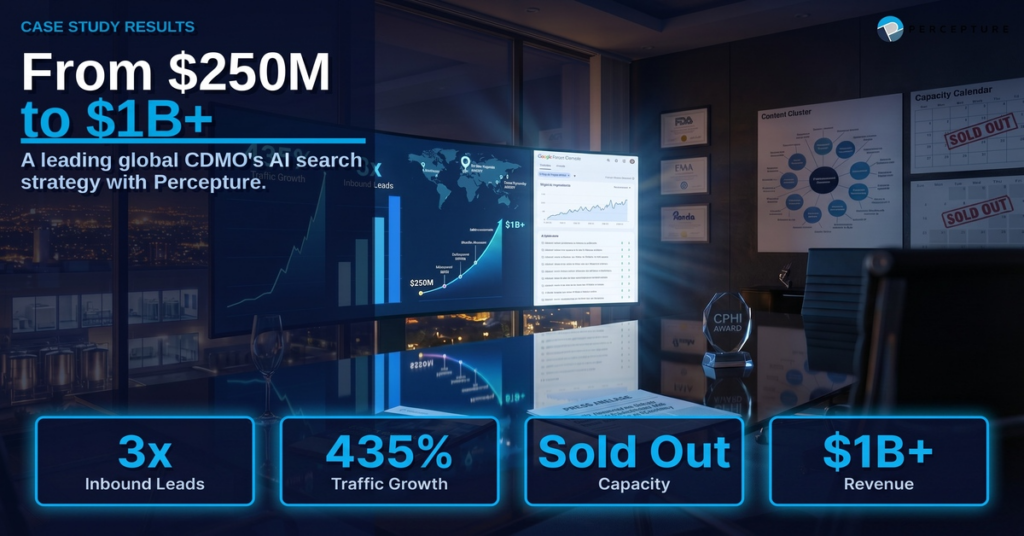
RESULTS FROM A LEADING GLOBAL PHARMA CDMO
3×
Inbound Leads
435%
Traffic Growth
Sold Out
Promoted Capacity
+Germany
Added Capacity
$1B+
From ~$250M
Frequently Asked Questions About CDMO AI Search
What is CDMO AI search?
CDMO AI search is the practice of optimizing contract manufacturing content so it gets cited in AI-generated answers from tools like ChatGPT, Google AI Overviews, and Perplexity. It focuses on structure, proof, and entity clarity rather than traditional keyword rankings.
How is CDMO AI search different from traditional SEO?
Traditional SEO helps you rank in search results. CDMO AI search helps you get mentioned in AI answers. Both matter, but AI search requires more emphasis on structured content, verifiable proof, and consistent entity signals across the web.
Why do AI systems cite some CDMOs and not others?
AI systems prefer content that’s easy to extract, verify, and attribute. CDMOs with clear definitions, specific capabilities, original data, and consistent entity signals across multiple sources are more likely to be cited.
How do I know if my CDMO is being cited in AI answers?
Monitor AI tools manually by asking questions your buyers would ask. Check Google Search Console for AI Overview data. Use brand monitoring tools that track AI citations. Add “AI tool” options to your lead source tracking.
What content formats work best for AI citations?
Definitions, comparison tables, step-by-step guides, and case studies with metrics perform best. Generic capability pages and vague marketing language rarely get cited.
How long does it take to improve AI visibility?
AI visibility depends on content quality, entity clarity, and authority signals. Most CDMOs see improvements within 3-6 months of implementing structured content and consistent entity signals.
Does AI visibility replace traditional SEO?
No. AI visibility works alongside traditional SEO. Many buyers click through AI citations to learn more. Strong organic rankings support AI visibility, and AI citations can drive traffic to your ranked pages.
What role does PR play in AI visibility?
PR creates third-party corroboration that AI systems use to verify information. Press coverage, industry awards, and trade publication mentions all signal authority and increase citation likelihood.
How do I structure content for AI citations?
Use clear headings, include definitions after H2s, state proof as text (not just graphics), maintain consistent entity signals, and organize content in a logical cluster structure.
Can small CDMOs compete with large ones in AI search?
Yes. AI systems prioritize content quality and relevance over company size. A smaller CDMO with well-structured, specific content can outperform a larger competitor with generic marketing pages.
QUOTABLE INSIGHTS
- “CDMO AI search is about getting cited, not just ranked.”
- “AI systems prefer content that’s easy to extract, verify, and attribute.”
- “If your CDMO isn’t in the AI answer, you’re not on the shortlist.”
- “72.4% of ChatGPT citations come from content with answer capsules.”
- “The Golden Triangle: AI Answer + Organic Ranking + Authority Reinforcement.”
- “Generic capability pages don’t get cited. Specific, structured content does.”
- “PR creates the third-party corroboration that AI systems trust.”
- “Leads from AI citations tend to be more qualified—they’ve already received a recommendation.”
Ready to improve your CDMO’s AI visibility?
Let’s build a strategy that gets you cited where buyers are looking.