
Direct Answer
Chicago data centers are facilities that provide colocation, interconnection, cloud access, and compute infrastructure across the Chicago metropolitan area. The market includes downtown carrier hotels like 350 E. Cermak and 600 S. Federal, suburban campuses in Elk Grove Village and Northlake, and AI-ready sites designed for high-density workloads. Chicago ranks among the top U.S. data center markets because of its fiber density, financial services demand, low natural-disaster risk, and legacy as a network crossroads.
Who This Guide Is For

This guide is for:
- Data center buyers evaluating Chicago colocation, cloud, or interconnection options
- Infrastructure investors assessing Chicago data center acquisitions or development
- Data center operators and marketers seeking visibility in Google, AI search, and buyer shortlists
- Economic development teams recruiting or supporting data center projects
- Enterprise IT leaders planning hybrid cloud, disaster recovery, or edge deployments
If you need to understand why Chicago is a major data center market—not just who operates there—this guide is for you.
Definition Box
| Term | Definition |
|---|---|
| Data center | A facility that houses servers, storage, and networking equipment with power, cooling, and physical security. |
| Colocation facility | A data center where multiple tenants lease space, power, and connectivity. |
| Carrier hotel | A colocation facility with dense carrier presence, Meet-Me Rooms, and Internet Exchanges—where networks exchange traffic. |
| Interconnection hub | A facility where networks, cloud platforms, and enterprises connect through cross-connects, peering, and cloud on-ramps. |
What You’ll Learn
- Why Chicago became a major data center and interconnection market
- The difference between downtown carrier hotels and suburban campuses
- Which addresses define the Chicago data center ecosystem
- How AI and power constraints are changing the market
- What data center companies can do to become visible in Google and AI search
Want to see how your data center appears in Google and AI search?
Percepture helps data center, telecom, and digital infrastructure companies turn complex infrastructure stories into search visibility, AI visibility, and qualified demand.
Request a Data Center SEO + GEO Visibility AuditWhy Chicago Is a Major Data Center Market
Chicago became a data center hub because of geography, history, and infrastructure.
Geography: Chicago sits at the intersection of major long-haul fiber routes from the East Coast, West Coast, and South. Railroads, highways, and fiber corridors converge here. That made Chicago a natural regeneration and exchange point for telecommunications traffic.
History: In the 1990s and 2000s, buildings like 350 E. Cermak and 600 S. Federal became carrier hotels—facilities where dozens of carriers, ISPs, and enterprises could interconnect. Once networks started aggregating, more networks followed. That is network gravity.
Demand: Chicago is home to major financial services firms, exchanges, cloud providers, enterprise headquarters, and content companies. The Chicago Mercantile Exchange, Board of Trade, and related financial infrastructure created demand for low-latency, high-reliability connectivity.
Low natural-disaster risk: Compared to coastal markets, Chicago faces lower hurricane, earthquake, and flood risk. That makes it attractive for disaster recovery and business continuity.
According to Baxtel, Chicago has approximately 208 data centers operated by 67 providers, ranking as the 7th largest data center market in the U.S. and Americas. DataCenterMap lists 155 facilities from 23 operators. Directory counts vary, but the scale is clear: Chicago is a major market.
Chicago Data Center Market Snapshot
| Metric | Estimate |
|---|---|
| Total facilities | 155–208 (varies by source) |
| Providers | 23–67 (varies by source) |
| Key downtown addresses | 350 E. Cermak, 600 S. Federal, 427 S. LaSalle, 717 S. Wells |
| Key suburban areas | Elk Grove Village, Northlake, Franklin Park, Itasca, Aurora |
| Market capacity (projected 2026) | ~2.03 GW |
| Market capacity (projected 2031) | ~2.81 GW |
Source: Baxtel, DataCenterMap, Mordor Intelligence estimates. Facility counts are directional; directories differ in methodology.
The Four Chicago Addresses That Explain the Market
Understanding Chicago data centers starts with four addresses.
350 E. Cermak Road
350 E. Cermak is the most important interconnection hub in Chicago. Originally a printing plant for R.R. Donnelley, the building was converted into a carrier hotel in the late 1990s. Today, Digital Realty operates the facility.
350 E. Cermak hosts 13 Internet Exchanges, hundreds of carriers, cloud on-ramps, and thousands of cross-connects. It is where the Chicago internet happens. The building’s value is not just square footage—it is decades of accumulated network gravity.
600 S. Federal Street
600 S. Federal is another major Digital Realty facility in downtown Chicago. It offers proximity to 350 E. Cermak, access to 85+ network providers, and connectivity to financial services, enterprise, and cloud ecosystems.
427 S. LaSalle Street
427 S. LaSalle is CoreSite’s flagship Chicago facility (CH1). It provides access to 60+ networks, 25+ cloud offerings, and direct connectivity to financial exchanges. CoreSite positions the building as a hub for enterprise, cloud, and AI-ready workloads.
717 S. Wells Street
717 S. Wells is operated by Netrality and serves as a carrier-neutral interconnection hub. It offers Meet-Me Room access, diverse fiber entrances, and connectivity to major carriers and cloud providers.
These four addresses are not interchangeable. Each has a different carrier mix, cross-connect model, and tenant ecosystem. Buyers should verify which networks are lit, which IXs are present, and what the actual interconnection options are—not just what the marketing says.
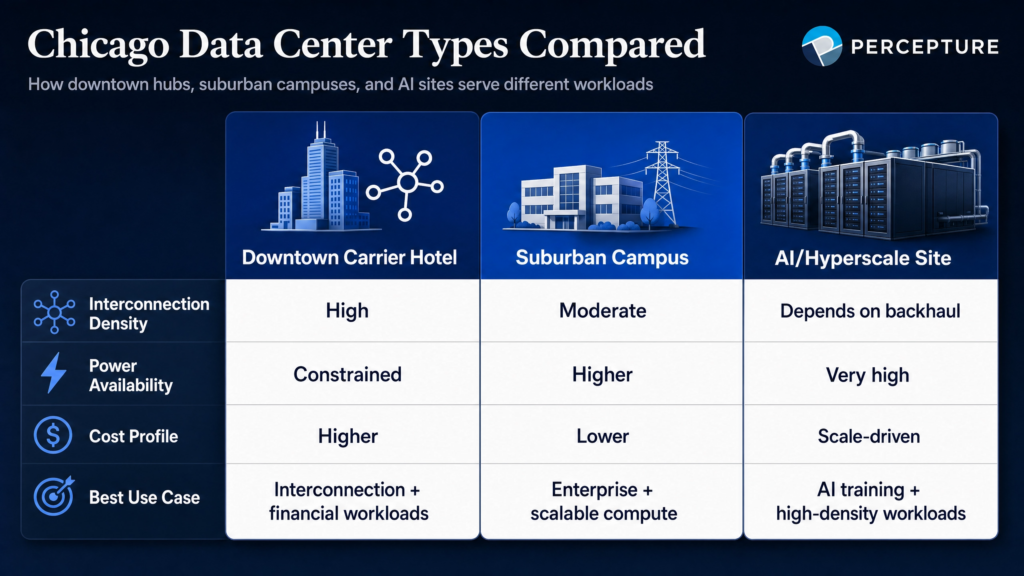
Chicago Data Center Types
Not all Chicago data centers serve the same purpose.
| Type | Description | Example Locations |
|---|---|---|
| Carrier hotel | Dense carrier presence, IXs, Meet-Me Rooms, peering | 350 E. Cermak, 600 S. Federal, 427 S. LaSalle |
| Downtown colocation | Enterprise colocation with cloud access, financial proximity | CoreSite CH1/CH2, Equinix CH1–CH4 |
| Suburban campus | Large-scale colocation, hyperscale, enterprise compute | Elk Grove Village, Northlake, Franklin Park |
| AI/hyperscale campus | High-density power, liquid cooling, large footprints | Emerging suburban and exurban sites |
| Edge/inference node | Low-latency, distributed compute for real-time AI | Emerging across metro Chicago |
Comparison Table: Downtown Carrier Hotel vs. Suburban Campus
| Factor | Downtown Carrier Hotel | Suburban Campus |
|---|---|---|
| Interconnection density | High (IXs, carriers, cloud on-ramps) | Lower (backhaul to downtown hubs) |
| Latency to financial exchanges | Sub-millisecond | Higher (depends on backhaul) |
| Power availability | Constrained (older buildings, urban grid) | More available (greenfield, utility access) |
| Expansion room | Limited | Large footprints possible |
| Cost per kW | Higher | Lower |
| Best for | Interconnection, financial services, cloud access | Hyperscale, AI training, enterprise compute |
Provider and Facility Landscape
Chicago’s data center market includes national operators, regional specialists, and carrier-neutral hubs.
Major providers operating in Chicago:
- Digital Realty (350 E. Cermak, 600 S. Federal, suburban sites)
- Equinix (CH1–CH4, enterprise and cloud focus)
- CoreSite (CH1, CH2, downtown interconnection)
- DataBank (suburban and downtown colocation)
- Netrality (717 S. Wells, carrier-neutral hub)
- Aligned (high-density, AI-ready suburban sites)
- Stream Data Centers (enterprise colocation)
- Iron Mountain (secure colocation)
- QTS (suburban campus)
- TierPoint (enterprise colocation)
- NTT (global enterprise connectivity)
- Prime Data Centers (suburban colocation)
- Stack Infrastructure (hyperscale and enterprise)
- CyrusOne (enterprise and cloud)
For a detailed comparison of Chicago colocation providers, see our companion guide. To be considered for this list, please reach out to Bob Generale.
AI and Power: Why the Market Is Changing
Is AI is reshaping the Chicago data center market?
AI training vs. AI inference:
- AI training requires massive compute, high power density, and large-scale cooling. Training workloads can tolerate distance from users because latency is less critical during model development.
- AI inference is the real-time use of AI models. Inference workloads need proximity to users, networks, and cloud platforms. Latency matters.
Chicago can serve both roles, but not always in the same building. Suburban campuses may support training and large-scale enterprise compute. Downtown interconnection hubs may matter more for inference, financial applications, and traffic-sensitive workloads.
Power constraints:
Power availability is becoming a limiting factor. According to JLL’s 2024 Global Data Center Outlook, nearly 100 GW of new data center capacity may be added globally from 2026–2030, but power grid constraints are slowing development in many markets. Chicago faces similar pressures: downtown sites have limited power headroom, and suburban sites depend on utility expansion.
Interconnection still matters:
Power gets the headline. Interconnection determines long-term value. A site with power but no carrier density, cloud access, or IX access may struggle to attract the workloads that justify the investment.
Percepture Proof
Percepture has helped data center, fiber, and telecom companies increase organic traffic, improve AI search visibility, and generate qualified leads.
- Telstra colocation: 414% increase in organic traffic in 90 days
- FiberLight: SEO + Google Ads integration driving qualified leads
- ZenFi Networks: Lead generation and content strategy
The Chicago Data Center Gravity Map™
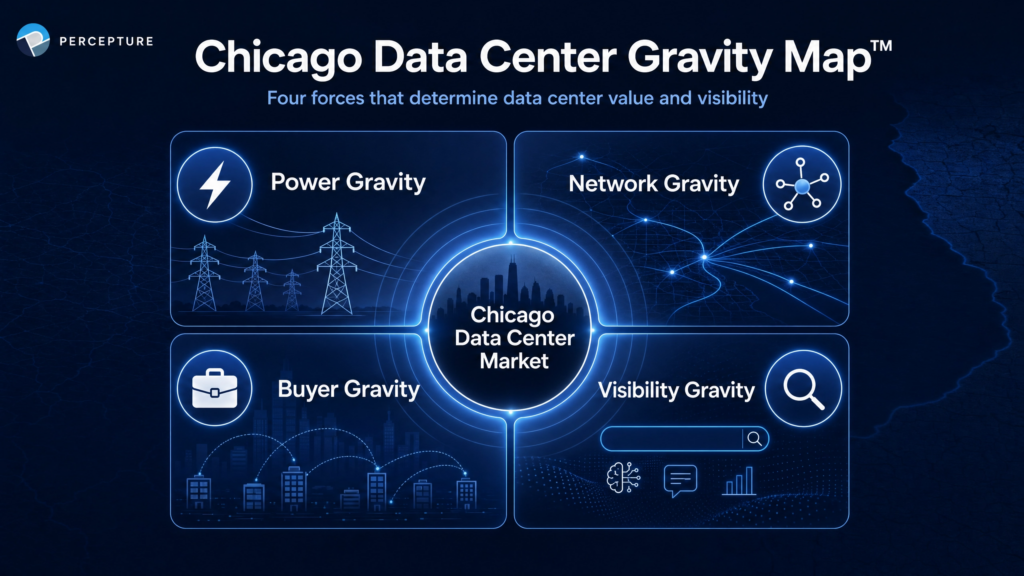
Percepture uses the Chicago Data Center Gravity Map™ to explain how Chicago data centers earn value through four forces.
| Force | What It Means | Why It Matters |
|---|---|---|
| Power gravity | Available, deliverable, reliable power | AI and hyperscale demand depend on it |
| Network gravity | Carriers, IXs, ASNs, Meet-Me Rooms | Determines actual interconnection value |
| Buyer gravity | Financial services, cloud, enterprise, telecom, AI | Explains demand and pricing |
| Visibility gravity | SEO, GEO, PR, content, trust signals | Determines which operators get found and shortlisted |
A data center can have power, location, and interconnection—but if buyers and AI search engines do not understand where it fits, it may never make the shortlist.
Mistakes to Avoid When Evaluating Chicago Data Centers
- Assuming “fiber nearby” means interconnection. A site can sit near long-haul fiber and still lack lit carriers, IXs, or useful cross-connect options.
- Treating downtown and suburban sites as interchangeable. They solve different problems.
- Ignoring cross-connect economics. High recurring fees, unclear rules, or operator conflicts can slow adoption.
- Confusing a powered building with an interconnection hub. An IX is the heartbeat of a hub. Without one, a facility is just a powered warehouse.
- Overlooking visibility. If your data center is real but invisible in Google and AI search, buyers may not find you.
Pricing, ROI, and Buyer Risk
Chicago data center pricing varies by location, power density, and interconnection options.
| Factor | Downtown Carrier Hotel | Suburban Campus |
|---|---|---|
| Colocation cost per kW | Higher | Lower |
| Cross-connect fees | Varies (one-time, recurring, or both) | Varies |
| Power availability | Constrained | More available |
| Expansion flexibility | Limited | High |
| Risk of stranded capacity | Lower (established demand) | Higher (depends on backhaul and demand) |
Buyer risk: The biggest risk is choosing a site that does not match your workload. A financial services firm needing sub-millisecond latency should not deploy in a suburban campus without verifying backhaul. An AI training operation needing 50 MW should not expect downtown carrier hotels to deliver that power.
Percepture Proof: Data Center SEO, GEO, and Digital PR
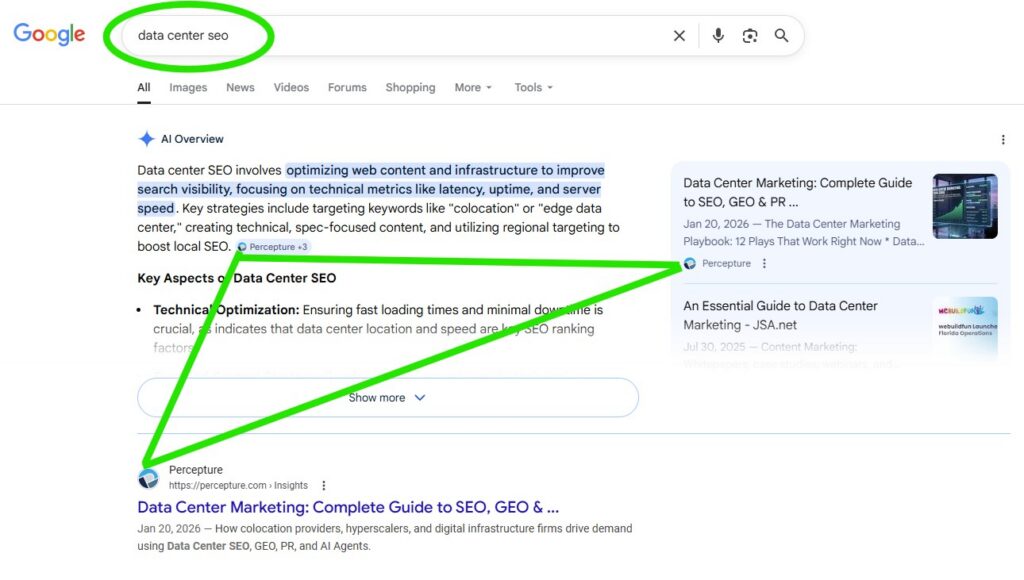
Percepture helps data center, telecom, fiber, and digital infrastructure companies become visible in Google, AI search, and buyer shortlists.
What we do:
- Data center marketing strategy and execution
- Enterprise SEO services for complex technical sites
- GEO services for AI search visibility (ChatGPT, Perplexity, Claude, Gemini, Google AI Overviews)
- Digital PR services for authority and backlinks
- Data center lead generation and demand capture
- Technical SEO audit services for crawlability, indexing, and Core Web Vitals
Results:
- Telstra colocation: 414% increase in organic traffic in 90 days
- FiberLight: SEO + Google Ads integration driving qualified leads
- ZenFi Networks: Lead generation and content strategy
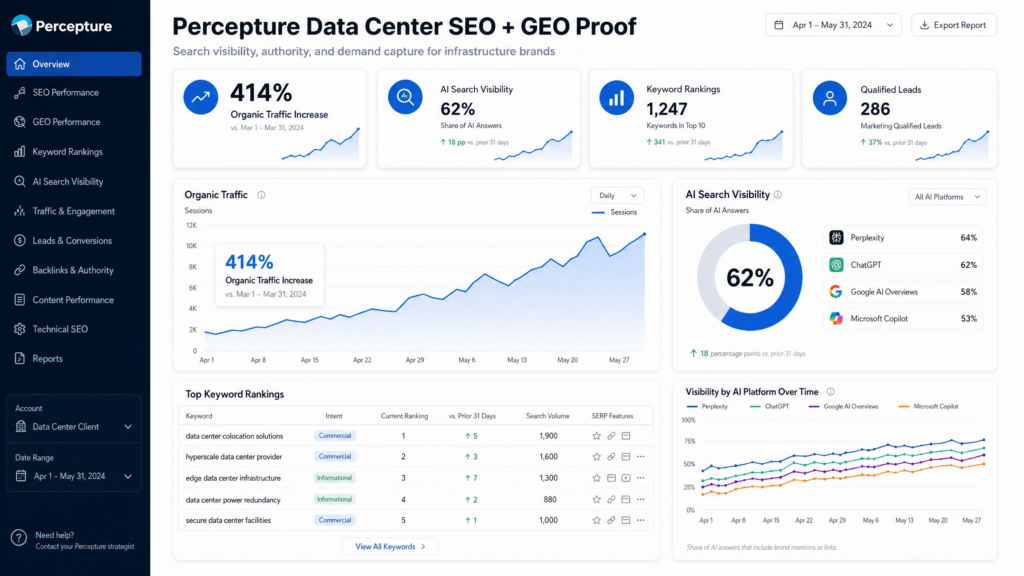
If your data center is real but invisible, Percepture can help.
Ready to make your data center visible in Google and AI search?
Percepture helps data center, telecom, and digital infrastructure companies turn complex infrastructure stories into search visibility, AI visibility, PR authority, and qualified demand.
Talk to Percepture See PricingExpert Interview: The Physical Reality Behind Chicago Data Centers

Chicago data centers are often described through square footage, megawatts, and provider names. That misses the deeper story. The real value of the Chicago market is shaped by physical fiber routes, Internet Exchanges, Meet-Me Rooms, carrier hotels, power availability, AI workload patterns, and the hard truth that not every powered building becomes an interconnection hub.
The following Q&A is based on AI-assisted research built from Hunter Newby’s interconnection research, public philosophy, and related source material. Any direct biological Hunter Newby quote should be reviewed before publication.
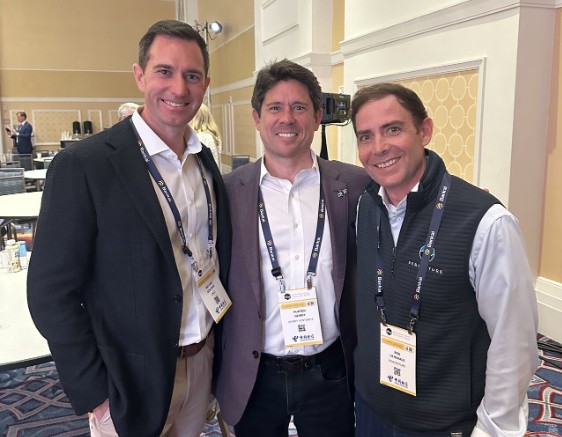
Q1. If you were advising an infrastructure fund looking to acquire or build a massive data center in the broader Chicago market today, what is the single biggest connectivity risk they are likely ignoring?
The biggest risk is confusing network proximity with network participation.
A site can sit near long-haul fiber and still fail as an interconnection asset if it does not have a real Internet Exchange, lit carriers, useful cross-connect options, or a neutral path into the existing Chicago network ecosystem.
An Internet Exchange is the heartbeat of an interconnection hub. Without one, a facility may still be valuable as powered real estate, but it is not where the internet actually happens.
The key question for an investor is not, “Is there fiber nearby?”
The better question is, “Can networks exchange traffic here today, at scale, with low friction?”
“An IX is the difference between a static storage unit and a dynamic marketplace.”
Q2. What is the difference between a data center and a true interconnection hub?
A data center sells space, power, cooling, and physical security. An interconnection hub sells access to an ecosystem.
That distinction matters. A powered building can host servers. A hub lets networks, cloud platforms, enterprises, content companies, and service providers exchange traffic through a dense web of physical and commercial relationships.
A data center is useful when workloads need compute and storage.
An interconnection hub is powerful when workloads need access.
“A data center houses machines. An interconnection hub moves markets.”
Q3. Why does the presence of an Internet Exchange change the value of a data center?
An Internet Exchange changes the value of a facility because it creates a reason for networks to be there.
Networks do not join an IX just because a building is attractive. Networks join because other networks are there, traffic is there, and the cost of not being there becomes higher than the cost of joining.
That is network gravity.
Once the gravity starts, it compounds. More networks attract more routes. And more routes attract more buyers. coming full circle, more buyers attract more carriers. That is how a building becomes harder to compete with over time.
“You can buy power anywhere. You cannot buy an ecosystem overnight.”
Q4. What do real estate developers usually misunderstand when they build a “data center” and expect it to become a carrier hotel?
Developers often think the building is the product.
They focus on floor load, power density, cooling, security, and “clean” infrastructure. Those things matter, but they do not automatically create a carrier hotel.
A carrier hotel is built around traffic. The center of value is the Meet-Me Room, the cross-connect model, the carrier ecosystem, and the neutrality of the operator.
Developers get it wrong when they assume carriers will come simply because the building is new, large, and powered.
“Real estate developers build for tenants. Interconnection operators build for traffic.”
Q5. Why is 350 E. Cermak almost impossible to replicate?
350 E. Cermak is difficult to replicate because its value was built over decades.
The building had architectural advantages from its printing-plant past: heavy floor loads, large space, and infrastructure that could support major technical use. But the building’s real moat is not the concrete. It is the accumulated network ecosystem.
Once a facility has years of carriers, cross-connects, IXs, ASNs, cloud access, and customer dependencies, the ecosystem becomes extremely hard to move.
A new building can match the power.
It can improve the cooling.
And a new building cannot instantly recreate decades of network gravity.
“You can replicate the real estate. You cannot instantly replicate 25 years of accumulated network connections.”
Q6. How do Chicago’s physical fiber routes shape where data centers can realistically succeed?
Physical fiber routes are the rivers of the digital economy.
Chicago became a major network crossroads because long-haul routes from the East, West, North, and South meet there. That made the city a natural place for regeneration, exchange, and interconnection.
A data center can be built almost anywhere. A successful interconnection hub must sit where networks can reach it economically and physically.
If the site is too far from the fiber path, the cost of backhaul can weaken the business case. That is why downtown Chicago and certain suburban corridors matter more than a random parcel with cheap land.
“In Chicago, geography is destiny. If you are not on the fiber path, you are not in the game.”
Q7. What is the hidden danger of building a large AI data center away from the interconnection ecosystem?
The hidden danger is creating a stranded compute island.
Large AI training campuses can tolerate distance better because training jobs are less sensitive to user latency. AI inference is different. Inference is the real-time use of AI, and real-time applications need proximity to users, networks, cloud platforms, and exchanges.
A remote facility may have power, but if every interaction has to backhaul to a distant hub, latency and network cost can become the bottleneck.
The AI market is not only a power story. It is also an interconnection story.
“AI training chases power. AI inference chases proximity.”
Q8. How should investors think about power versus connectivity in the Chicago data center market?
Power gets the headline. Connectivity decides the long-term value.
A site with power can be valuable. But a site with power plus carrier density, cloud access, IX access, and diverse routes can become strategic.
The mistake is treating connectivity as a late-stage checklist item. It should be part of site selection from day one.
The right question is not, “How many megawatts can we get?”
The right question is, “What kind of workload will those megawatts support, and how will the traffic reach the rest of the world?”
“Power gets the site built. Connectivity determines what the site is worth.”
Q9. How does Meet-Me Room ownership affect whether a facility becomes an ecosystem or a bottleneck?
The Meet-Me Room is the town square of a data center.
If the MMR is neutral, accessible, transparent, and priced fairly, it encourages more connections. That helps the building grow as an ecosystem.
If the MMR is controlled like a tollbooth, the opposite happens. High recurring fees, unclear rules, preferred carriers, or operator conflicts can slow adoption and weaken trust.
The MMR should help traffic move. It should not punish every connection.
“The MMR operator should act like a facilitator of traffic, not just a landlord collecting tolls.”
Q10. What should a data center investor ask before believing a site is “well connected”?
The investor should ask:
- Which carriers are lit today?
- Which carriers have equipment in the building?
- Is there a public or private Internet Exchange?
- Are there cloud on-ramps?
- Is there a neutral Meet-Me Room?
- What are the cross-connect fees?
- Are cross-connects one-time, recurring, or both?
- How long does provisioning take?
- Are diverse fiber entrances available?
- Does the site depend on backhaul to another facility?
The answer should be specific. Vague phrases like “fiber-rich,” “near major networks,” or “carrier-ready” are not enough.
“If the answer is vague, the risk is real.”
Q11. How does Chicago differ from emerging data center markets?
Chicago is not just an emerging power market. It is an established interconnection market.
Many emerging markets are trying to attract data centers through land, power, tax incentives, and available development sites. Chicago already has something harder to build: network history.
That history creates both an advantage and a constraint.
The advantage is density.
The constraint is that density is hard to move.
This makes Chicago different from markets that are still trying to create their first real ecosystem.
“Chicago is not starting from zero. That is both the opportunity and the challenge.”
Q12. What is the biggest mistake people make when comparing downtown Chicago data centers with suburban campuses?
The biggest mistake is treating them as interchangeable.
Downtown facilities often win on interconnection, carrier density, financial services proximity, cloud access, and low-latency traffic exchange.
Suburban campuses often win on power, land, cooling design, expansion room, and large-scale deployments.
Neither is automatically better. They solve different problems.
The best answer depends on the workload.
“Downtown is where networks meet. The suburbs are where scale often grows.”
Q13. How does the Chicago data center market change when you separate AI training from AI inference?
AI training and AI inference create different infrastructure needs.
Training is about large-scale compute, power density, cooling, and cost efficiency. It can often happen farther from users.
Inference is about real-time response. That means latency, routing, and proximity matter much more.
Chicago can serve both roles, but not always in the same building. Large suburban campuses may support training or enterprise compute. Downtown interconnection hubs may matter more for inference, exchange, financial applications, and traffic-sensitive workloads.
“Training wants megawatts. Inference wants milliseconds.”
Q14. What should public officials understand before approving or recruiting new data center projects?
Public officials should understand that not all data center projects create the same kind of value.
A project that only consumes power and land may create construction activity, tax revenue, and some jobs. But a project that improves interconnection can strengthen the region’s digital economy.
The question is not only, “How large is the facility?”
The question is, “Does this project improve the region’s connectivity, resilience, and ability to support future applications?”
A better data center strategy looks at power, fiber, community impact, workforce, sustainability, and interconnection together.
“The best data center projects do more than consume power. They improve the market around them.”
Q15. What is the single sentence every data center investor should understand about Chicago?
Chicago’s data center market is not just a real estate market; it is a physical network market where power, fiber, exchanges, carrier hotels, and buyer demand all collide.
“Chicago is not just a place to put servers. It is a place where networks decide what becomes valuable.”
Frequently Asked Questions
What are Chicago data centers?
Chicago data centers are facilities that provide colocation, interconnection, cloud access, and compute infrastructure across the Chicago metropolitan area. The market includes downtown carrier hotels, suburban campuses, and AI-ready sites designed for high-density workloads.
Why is Chicago a major data center market?
Chicago is a major data center market because of its geographic position at the intersection of major fiber routes, its legacy as a network crossroads, strong demand from financial services and enterprise, and low natural-disaster risk compared to coastal markets.
What is the difference between a carrier hotel and a data center?
A data center provides space, power, cooling, and security. A carrier hotel is a data center with dense carrier presence, Internet Exchanges, Meet-Me Rooms, and peering—where networks exchange traffic. Not every data center is a carrier hotel.
What is 350 E. Cermak?
350 E. Cermak is the most important interconnection hub in Chicago. Operated by Digital Realty, it hosts 13 Internet Exchanges, hundreds of carriers, and thousands of cross-connects. It is where the Chicago internet happens.
How many data centers are in Chicago?
Directory estimates vary. Baxtel lists approximately 208 data centers from 67 providers. DataCenterMap lists 155 facilities from 23 operators. The exact count depends on methodology, but Chicago is clearly a major market.
What is the difference between downtown Chicago data centers and suburban campuses?
Downtown facilities win on interconnection, carrier density, and low-latency access to financial exchanges. Suburban campuses win on power availability, expansion room, and cost efficiency. They solve different problems.
How is AI changing the Chicago data center market?
AI is increasing demand for high-density power and cooling. Addressing AI training workloads can tolerate distance from users. The AI inference workloads need proximity to networks and cloud platforms. Chicago can serve both, but not always in the same building.
What should I ask before choosing a Chicago data center?
Ask which carriers are lit, whether there is an Internet Exchange, what the cross-connect fees are, whether the Meet-Me Room is neutral, and whether the site depends on backhaul to another facility. Vague answers are a warning sign.
How do data center companies become visible in Google and AI search?
Data center companies become visible through SEO, GEO (generative engine optimization), digital PR, and content that demonstrates expertise, experience, authority, and trust. Percepture helps data center companies build that visibility.
What is the Chicago Data Center Gravity Map™?
The Chicago Data Center Gravity Map™ is a Percepture framework for explaining how Chicago data centers earn value through four forces: power gravity, network gravity, buyer gravity, and visibility gravity.
What to Do Next
If you are evaluating Chicago data centers, start by clarifying your workload requirements. Determine whether you need interconnection density, power scale, or both. Verify carrier presence, IX access, and cross-connect economics before signing a lease.
If you are a data center operator or marketer, consider whether your facility is visible in Google, AI search, and buyer shortlists. If not, Percepture can help.
Next steps:
- Request a Data Center SEO + GEO Visibility Audit
- Read the Chicago Colocation Provider Guide
- See Percepture Pricing
Testimonial: Data Center Industry
Connect with us today!
About the Author
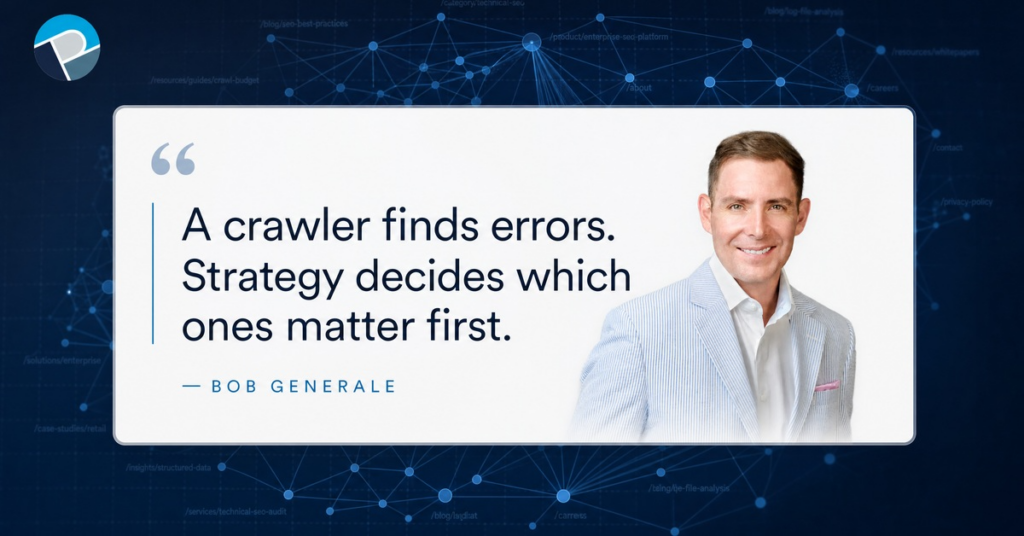
Bob Generale is know for being the Navy Seals of Marketing and SEO. He is the President of Percepture, a digital marketing agency specializing in SEO, GEO, digital PR, and lead generation for data center, telecom, fiber, and digital infrastructure companies. Bob has worked with clients including Vodaphone, Telstra, FiberLight, Bolydn Networks, Connected Nation, Bulk Infrastructure, Digital Fortress, Netrality, and eStruxture. He is a recognized expert in data center marketing, AI search visibility, and technical SEO for complex B2B industries.
Connect with Bob on LinkedIn: Best GEO SEO Expert Consultant