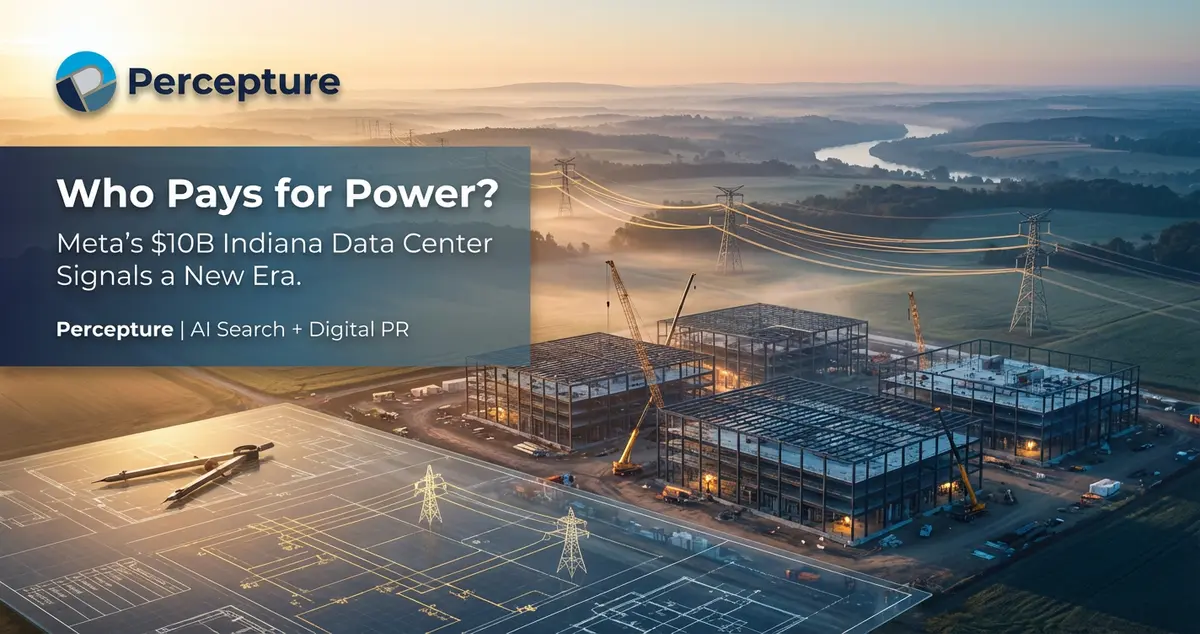

When Meta broke ground on a $10 billion data center in Lebanon, Indiana this February, the company made a promise. They would pay for the power grid upgrades their massive facility needs.
That promise wasn’t just good PR. It was a sign of what’s coming next.
Across America, states are changing the rules. The question is simple: Who pays when Big Tech needs more power, more water, and bigger electric lines?
For years, the answer was often “everyone.” Now, lawmakers are saying “not anymore.”
“The next era of data center development is not a race for land or capital,” says Bob Generale, President of Percepture. “It’s a race for a cost model the public can tolerate. When households think their power bill is underwriting someone else’s AI, permitting turns into politics — and politics becomes the schedule.”
What Meta’s Indiana Build Really Signals
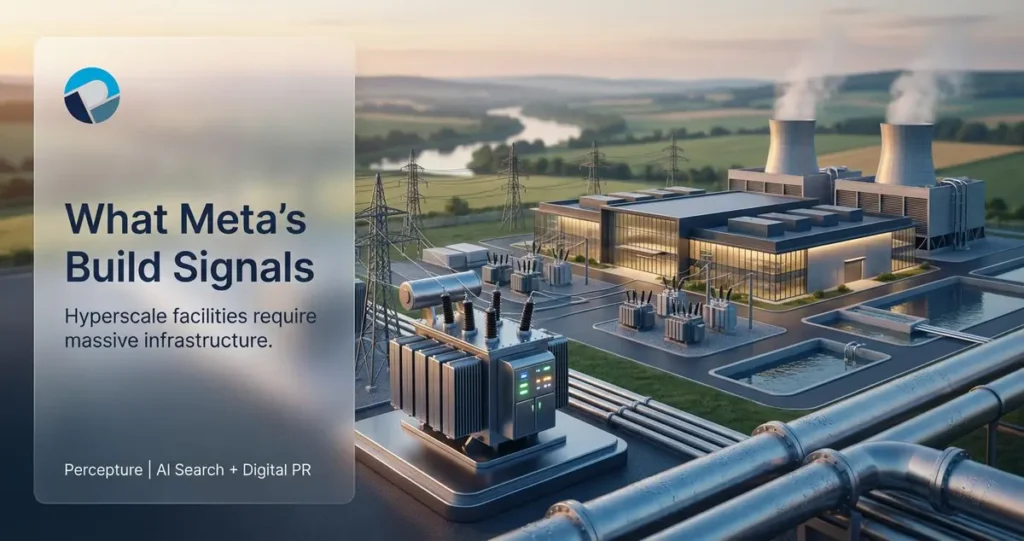
Meta’s Lebanon campus will cover 1,500 acres. That’s bigger than 1,100 football fields. The facility will use one gigawatt of power—enough to run about 700,000 homes.
The company says it will create 300 permanent jobs and 4,000 construction jobs. But the real story is what Meta agreed to do: pay for the infrastructure their data center requires.
That wasn’t always standard practice.
In the past, utility companies often spread the cost of new power lines and substations across all customers. Your electric bill helped pay for the grid upgrades that data centers needed. Most people never knew.
Now they do. And they’re not happy about it.
The Real Fight: Who Pays for Grid Upgrades and Reliability Risk
Here’s the problem states are trying to solve.
Data centers use enormous amounts of electricity. They run 24 hours a day, seven days a week. When a new data center connects to the grid, the local utility often needs to:
- Build new power lines
- Upgrade substations
- Add backup systems
- Ensure the grid can handle peak demand
All of that costs money. Billions of dollars.
For decades, those costs got divided among all ratepayers. Homeowners. Small businesses. Schools. Everyone paid a little more each month.
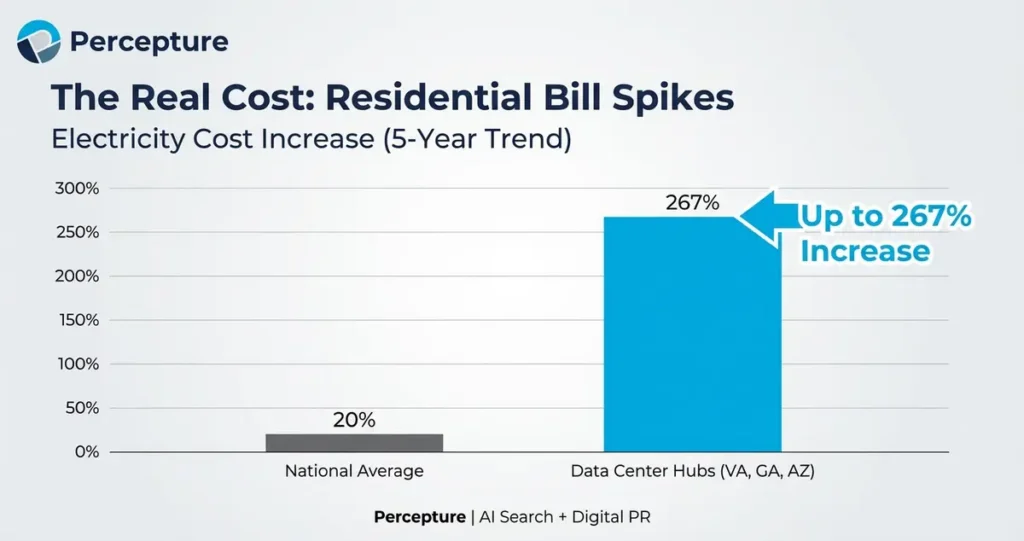
But as data centers exploded in number, those “little” increases added up. In some states, residential electric bills jumped 10% or more in just two years.
According to a 2024 analysis, $4.3 billion in data center infrastructure costs were shifted to ratepayers across seven states in 2024 alone.
That’s when voters started calling their representatives.
Illinois: The “Ratepayer Protection” Playbook (POWER Act)
Illinois saw the problem coming.
In February 2026, State Senator Ram Villivalam introduced the POWER Act. The name stands for exactly what it sounds like: protecting ratepayers from paying Big Tech’s power bills.
The bill does three main things:
- Requires data centers to pay their full share of grid costs
- Mandates water usage reporting
- Prevents cost-shifting to residential customers
Why does Illinois care so much?
A Union of Concerned Scientists report warned that data centers could drive up Illinois’ electricity demand by 72% by 2030. System costs could rise by nearly $37 billion by 2035.
The POWER Act says: if you’re building the data center, you’re paying for the infrastructure.
No more spreading the bill across families and small businesses.
Florida: Transparency + Tariffs + Water Limits (SB 484)
Florida took a different approach, but with the same goal.
On February 3, 2026, the Florida Senate Community Affairs Committee advanced SB 484. The bill tackles data centers from multiple angles:
Transparency: State and local officials can no longer sign non-disclosure agreements (NDAs) that hide data center plans from the public. Residents have a right to know what’s coming to their community.
Tariffs: Large data centers must pay utility rates that cover their actual costs. No more subsidies from other customers.
Water Limits: New water permitting rules apply to large-scale data centers. Florida has seen droughts. Lawmakers want to make sure data centers don’t drain local water supplies.
Senator Bryan Avila, who sponsored the bill, called it a “pro-consumer, pro-ratepayer initiative.”
Florida already has 120 data centers, the fourth most of any state. One proposed project, called “Project Tango,” would cover an area the size of 150 football fields in Palm Beach County.
Residents are worried about noise, water use, and higher electric bills. Florida’s new rules aim to address all three.
Virginia: The Cautionary Tale of Scale
Virginia is known as “Data Center Alley.” The state has more data centers than almost anywhere else in America.
That growth brought jobs and tax revenue. But it also brought problems.
In 2026, Virginia lawmakers introduced multiple bills to manage data center growth:
- Rules on backup generator use
- Limits on how much power data centers can pull from the grid
- New oversight requirements
- Ratepayer protections
Why the sudden concern?
In Virginia, data centers now account for 26% of total electricity consumption. That’s more than one in every four kilowatt-hours.
As demand spiked, so did opposition. Residents saw their bills climb. Local officials worried about water supplies and grid reliability.
Virginia shows what happens when data center growth outpaces planning. Other states are watching—and trying not to repeat the same mistakes.
PJM’s “Connect and Manage”: Grid Operators Change the Rules
It’s not just states taking action. Grid operators are too.
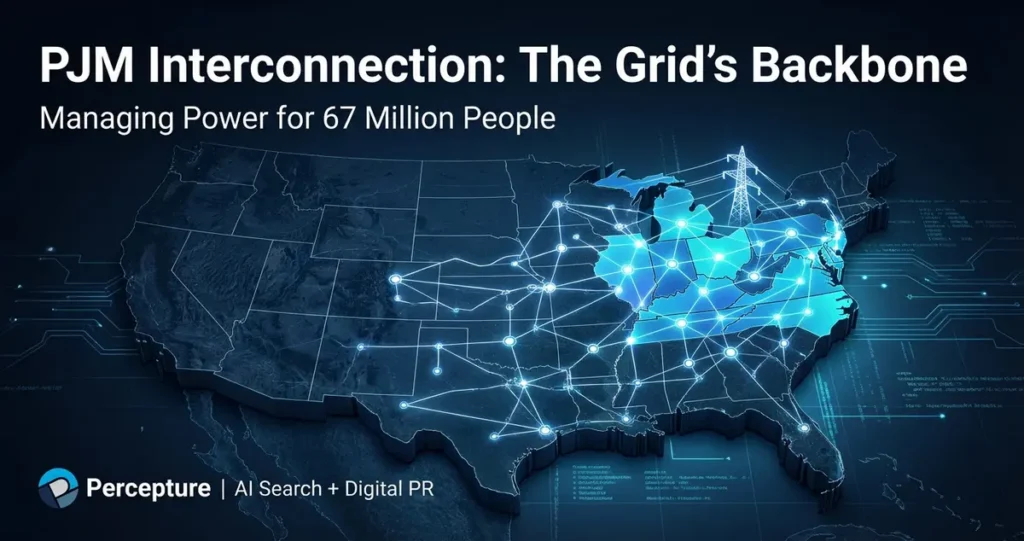
On January 16, 2026, PJM Interconnection—the largest grid operator in the U.S.—announced a major policy shift.
PJM serves 67 million people across 13 states. They manage the electric grid that keeps the lights on from Illinois to New Jersey.
Their new “connect and manage” framework gives data centers two options:
- Bring your own power generation (like building a natural gas plant or buying renewable energy)
- Accept curtailment (meaning your power can be cut during peak demand to protect the grid)
This is a huge change. Before, data centers could connect to the grid and expect 24/7 power—no questions asked. Now, PJM is saying: if you want guaranteed power, you need to help supply it. Why the shift?
PJM’s 2025 capacity auction fell 6,623 megawatts short of its reliability target. Data centers were responsible for nearly 5,100 megawatts of that shortfall.
Translation: data centers are growing so fast, they’re threatening grid reliability for everyone else.
PJM’s solution puts the responsibility back on the data centers themselves.
What Smart Developers Will Do Next (The 2026 Survival Checklist)
If you’re planning a data center project in 2026 or beyond, here’s what you need to know:
1. Show up early in the policy conversation.
Don’t wait until you need a permit. Engage with state lawmakers, utility regulators, and community leaders before you break ground. The developers who succeed will be the ones who build trust first.
This is where data center lead generation becomes critical. You need to identify and engage stakeholders, utilities, policymakers, and community groups—long before construction starts.
2. Plan to self-fund infrastructure.
Assume you’ll pay for grid upgrades, water systems, and backup power. States are moving away from cost-sharing models. Budget accordingly.
3. Bring your own power.
Whether it’s solar, wind, natural gas, or nuclear, having a dedicated power source makes permitting easier. It also protects you from curtailment risk.
4. Be transparent.
NDAs and secrecy backfire. Florida’s SB 484 bans them outright. Even in states without formal bans, hidden projects breed opposition.
5. Coordinate with telecom and fiber providers.
Data centers don’t operate in isolation. Fiber networks, edge infrastructure, and telecom carriers all get pulled into the same political scrutiny. A coordinated telecom marketing strategy helps align stakeholders and reduce friction.
6. Treat transparency as a communications problem, not just a legal one.
Public opposition often starts with a lack of information. Proactive enterprise tech PR can shape the narrative before critics do.
What This Means for Operators, EPCs, and Vendors
If you’re in the data center ecosystem, whether you’re an operator, EPC contractor, or equipment vendor, this shift changes your playbook.
For operators: Permitting timelines just got longer and more complex. Factor in 6-12 months of additional stakeholder engagement.
For EPCs: Self-funded infrastructure means bigger projects with more moving parts. Expect clients to ask for turnkey solutions that include power generation and grid integration.
For vendors: Equipment that reduces power consumption or enables load flexibility will be in high demand. Energy efficiency isn’t just a nice-to-have anymore—it’s a competitive advantage.
The winners in this new era won’t be the fastest movers. They’ll be the ones who understand that social license is now part of the critical path.
Connect with Data Center & Telecom Marketing Experts.
Since 2004, Percepture has helped data center and telecom leaders secure social license, influence policy, and win community support. Don’t let new grid regulations stall your growth—leverage two decades of proven industry strategy.
FAQ
1. What is the data center cost allocation fight?
The data center cost allocation fight is a policy debate over who pays for the power grid upgrades, water infrastructure, and reliability systems that new data centers require. Historically, these costs were spread across all utility customers. Now, states like Illinois, Florida, and Virginia are passing laws requiring data center developers to pay their own infrastructure costs instead of shifting them to residential ratepayers.
2. How are states protecting ratepayers from data center costs?
States are protecting ratepayers through new legislation that requires data centers to pay full utility rates covering their actual infrastructure costs. Illinois’ POWER Act prevents cost-shifting to residents. Florida’s SB 484 bans NDAs, sets tariff standards, and limits water use. PJM’s “connect and manage” framework requires data centers to bring their own power or accept curtailment during peak demand.
Bob Generale | About the Author
Bob Generale is President of Percepture and a strategic advisor to digital infrastructure operators, private equity sponsors, and enterprise technology leaders. His work focuses on how power markets, regulatory policy, and public perception influence the valuation and timing of large-scale infrastructure projects.
Generale’s analysis bridges engineering realities with capital structure implications, examining grid interconnection risk, ratepayer cost allocation, community backlash cycles, and the communications strategies required to secure long-term project viability.
He writes frequently on the political economics of data centers, telecom expansion, and AI infrastructure, helping executive teams anticipate where policy, power, and public sentiment converge.