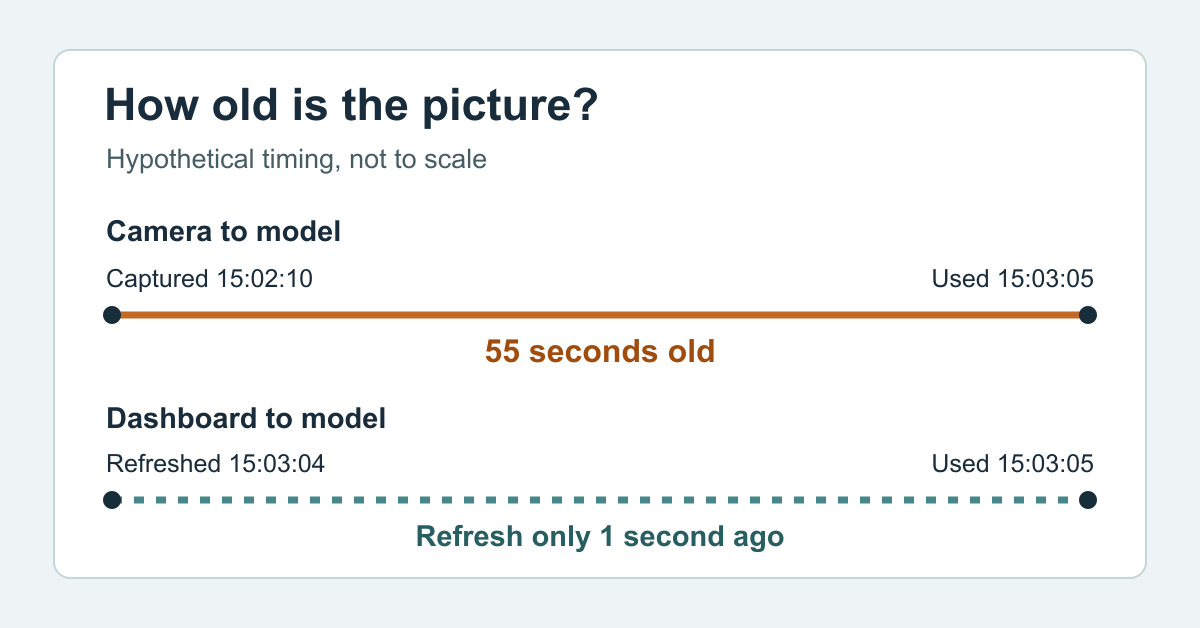

A monitoring dashboard can say it updated one second ago while the picture on it is nearly a minute old. Both timestamps can be correct. One tells you when a system received or displayed the picture. Only the other tells you when the camera saw the scene. A model can process the old frame quickly and still give your team an answer about the wrong moment.
For buyers evaluating AI inference in Reno, Nevada, the question is not just how fast the model runs. Ask whether the system can prove how old its input was when it used it, and what it does when that age cannot be established.
What the Nevada camera network illustrates
The University of Nevada, Reno's description of the ALERTWildfire expansion describes a network with permanent and mobile cameras and views that authorized responders can adjust. A monitored location, its current view and the time of the observation all matter. The announcement describes a planned expansion; it is not an inventory of installed cameras or a specification for their data pipelines.
Use that setting to design an acceptance test for a system you are buying, not to infer what ALERTWildfire runs or how an authority should respond. The same test is useful when a remote site sends production-line images or footage of an unattended loading area: a receiving service may be reachable even if it has nothing current to share.
Set a freshness budget before measuring model speed
Start with the decision the application supports. For historical review, a late frame may be valuable. For a view labeled current, the application owner should define how old the frame can be at the time the model uses it. Set a separate limit for how long a result remains usable after that, if the workflow requires one.
Ask the supplier to show the camera and view identifier, when the source captured the frame, when the service received it, and when the model used it. Keep those values as separate fields. The OpenTelemetry log data model makes a useful distinction between an event's occurrence time and the time a collection system observed it. That distinction is a logging design pattern, not proof that a particular camera's clock is reliable.
For example, say a test frame was captured at 15:02:10 and entered the model at 15:03:05. It was 55 seconds old. If the dashboard refreshed at 15:03:04, its refresh was only one second earlier. With a hypothetical 30-second input budget, the frame is too old even though the dashboard looks current. These times illustrate the test; they are not Nevada field data or a recommended emergency threshold.
Test the cases a good connection will not reveal
Use a recorded or simulated feed in a controlled test. Keep the expected frame identifiers and timestamps alongside the supplier's records so you can compare what went in with what the model actually used.
Camera-feed freshness tests
| Test case | What to change | What the buyer should see |
|---|---|---|
| Delayed frame | Deliver an older captured frame through a healthy connection. | The system shows its original capture time and does not label an over-budget frame as current. |
| Frozen feed | Keep the session open while repeating the same frame identifier. | A healthy connection does not mask the lack of a new observation. |
| Missing capture time | Send a frame without a trustworthy source timestamp. | The result indicates that input age is unknown; the receipt time is not quietly substituted. |
| Changed view | Change the test camera's preset or switch its source without changing the dashboard label. | The record distinguishes the new view from the old one before results are compared. |
| Return to service | Deliver late frames and then new ones after a test interruption. | The current view uses eligible new frames. Late footage remains distinguishable in the history. |
For a failed test, ask for the first point where evidence went missing. If the source timestamp arrives intact at the receiving service but disappears before model use, adding compute capacity will not fix that loss of context. If a source clock is wrong, correct and verify it before reporting numerical frame ages. A repeated identifier is a helpful test in a system that provides one, but one still image by itself cannot tell you why a stream stopped advancing.
Assign responsibility before choosing where inference runs
Name the team that owns capture and time quality, the team that owns delivery, and the team that decides when the interface must say that current evidence is unavailable. Make them agree on how a test result is recorded and who has to fix an exception. A model benchmark can help size execution capacity, but it cannot establish a guarantee about the upstream feed.
If your workload still misses its response target after input age is measured correctly, use the inference demand guide to ask which part of the application would improve at a different location. If the next decision is where to house equipment, use the Reno colocation buyer's guide to compare purchasable facilities and their connectivity.
Before signing off on a design, ask the vendor to run the five cases and give you the input record, the selected frame and the label the operator saw for each run. The useful outcome is not a prettier dashboard. It is being able to tell, at a glance and in the record afterward, whether you actually have a current observation.

About Bob Generale
Bob Generale is President of Percepture, a digital marketing and public relations agency.