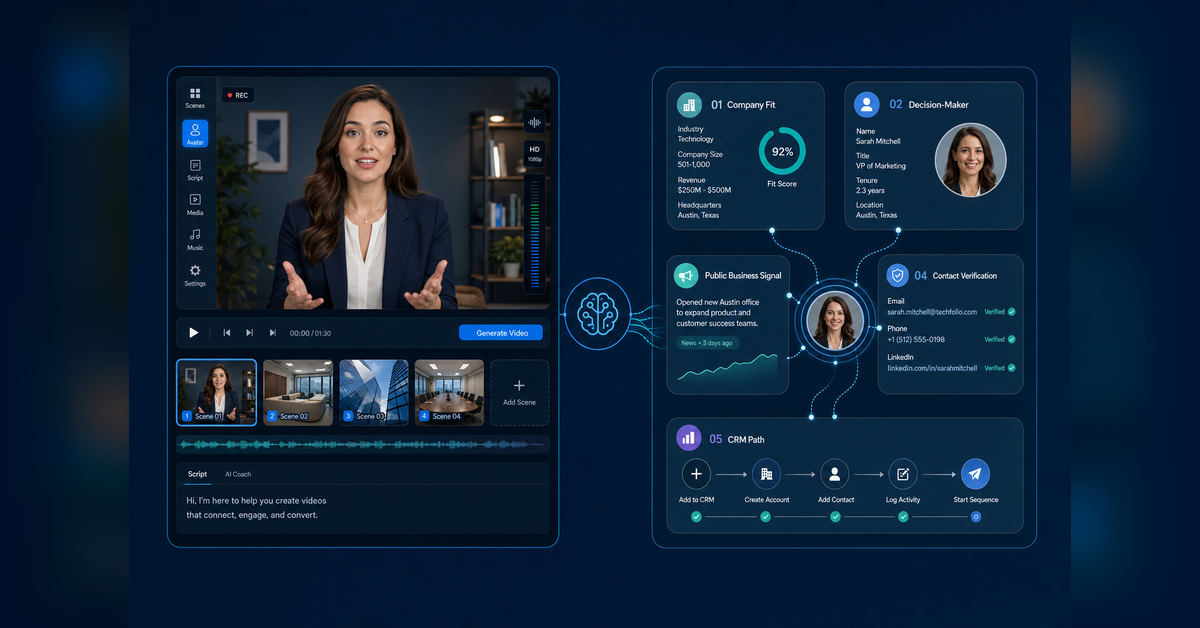

If you are deciding where to find high-quality AI avatars for marketing, begin by defining what “avatar” means to your team. You may need a synthetic video presenter, a digital version of an approved spokesperson, a fictional research persona, or a source-backed profile of a real buyer.
A presenter helps create and deliver content. A buyer avatar helps determine which account and decision-maker should receive that content, why the timing may matter, and what the team should do next. Mixing those jobs leads to the wrong shortlist, the wrong scorecard, and often the wrong purchase.




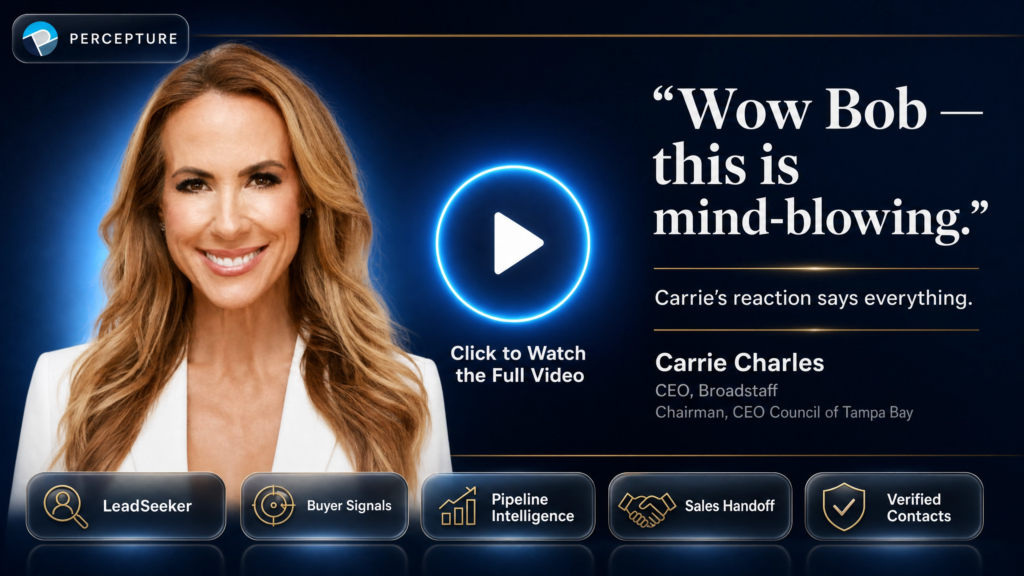
The Broadstaff case study shows how Percepture connects market visibility, credible positioning and qualified B2B demand.
Where to find high-quality AI avatars for marketing: which type should you choose?
Choose the platform by the job. Use an AI video-avatar platform when you need a synthetic presenter. Use a custom-avatar platform when an approved spokesperson must scale video production. Use a persona tool for structured ideation. Use prospect intelligence when you need real accounts, relevant decision-makers, source-backed context and a human-approved next action.
The two meanings most teams should not mix
A face for the campaign
Visual AI avatars solve a production problem. They help a team create presenters, explainers, localized videos, training assets and campaign variations.
A buyer for the campaign
Buyer avatars solve a targeting and activation problem. They help a team define the account, role, evidence, context and next action.
A persona for planning
A fictional or synthetic persona organizes assumptions about a segment. It can help with messaging but does not identify a contactable buyer.
A dossier for action
A source-backed prospect dossier connects a real company and decision-maker with verification, public evidence and a reviewable workflow.
Who this guide is for
Marketing and content leaders
Use the guide to compare presenters, custom likenesses, production workflows, brand controls and content rights.
Revenue and sales leaders
Use it to distinguish fictional personas from real-account research, verified decision-makers and controlled sales activation.
Legal, brand and security teams
Use it to review consent, likeness ownership, disclosure, access, retention, commercial use and prohibited impersonation.
Founders and subject-matter experts
Use it to decide whether a digital spokesperson can extend approved expertise without weakening trust or control.
Six questions to answer before comparing AI avatar tools
Do you need a presenter or a buyer?
A presenter appears in the content. A buyer receives the content. Video-avatar platforms optimize creation, delivery and localization. Buyer-intelligence platforms optimize account selection, role relevance, evidence and activation. The outputs are different enough that they should never share one undifferentiated vendor scorecard.
Does the avatar represent a real person?
A fictional presenter avoids some likeness issues but still requires brand and content controls. A custom avatar based on a founder, employee or expert requires documented consent, ownership, approved use, access rules and revocation. A buyer avatar based on a real prospect requires careful data handling and human review.
What must be verified?
For video, verify the script, pronunciation, visual output, rights and approved distribution. For buyer intelligence, verify the company, role, available contact data, source date and whether the person fits the intended buying committee. Verified facts should remain separate from hypotheses and suggested messaging.
What creates the business value?
Video avatars create value when approved content becomes faster or easier to produce without lowering quality. Buyer avatars create value when the profiles improve targeting, research, replies, meetings or qualified pipeline. The quantity generated is not the primary outcome in either category.
Where does human approval occur?
Approval should happen before a likeness is published, before a buyer profile enters outreach, and before sensitive interpretations become campaign language. The workflow should show who can edit, approve, reject, suppress and revoke each asset or record.
How will the team learn?
Use one repeatable test. Video teams should compare the same script, audience and distribution goal. Revenue teams should compare the same ICP, exclusions, source requirements and next-action rules. Record why outputs were accepted or rejected so the next test becomes more precise.
| Primary need | Best category to test first | Evidence to request | Decision owner |
|---|---|---|---|
| Scale training or explainer videos | AI video presenter | Same-script test, export quality, voice and workflow review | Content, brand and training leaders |
| Scale an executive or expert likeness | Custom digital spokesperson | Consent, ownership, disclosure, security and revocation terms | Executive, legal, brand and security |
| Organize audience assumptions | Persona or research tool | Research inputs, assumptions, uncertainty labels and validation plan | Marketing strategy and research |
| Find real accounts and decision-makers | Prospect-intelligence workflow | Source transparency, verification, exclusions and human approval | Revenue, sales operations and marketing |
Test the quality of the buyer definition first
Bring one ICP, a clear offer, the roles you want to reach, useful trigger events and explicit exclusions. Review whether the resulting accounts, people, sources and suggested actions make sense before expanding the workflow.
Build Five Buyer Avatars FreeFour AI avatar categories
AI video presenters
Synthetic on-screen presenters created from scripts or production inputs. They are useful for explainers, product education, training, social content and localization. They create the messenger, not the market.
Custom digital spokespersons
Digital versions of approved founders, executives, trainers or experts. These systems require written consent, ownership rules, approved uses, script controls, disclosure standards, access permissions and a process for revoking use.
Fictional and synthetic personas
Research-based or AI-generated representations of customer segments. They can support brainstorming, message testing and journey planning, but they do not establish that a real person has need, authority, budget or timing.
Source-backed buyer avatars
Profiles tied to real companies and relevant decision-makers. The useful version includes ICP fit, verification, public evidence, source transparency, communication guidance and human approval before activation.
A practical guide to AI video-avatar platforms
The dominant search intent around AI avatars concerns video creation. Commonly researched examples include Synthesia, HeyGen, D-ID, Colossyan, Adobe Firefly and InVideo. Treat those names as a research set rather than a ranking. Capabilities, usage rights, security controls and pricing can change.
Run the same script through every shortlisted platform. Include brand names, technical language, pauses, pronunciation challenges and a clear call to action. Marketing, legal, brand and the person represented should review the output against the same criteria.
AI video-avatar evaluation scorecard
| Criterion | What to inspect | Why it matters |
|---|---|---|
| Visual consistency | Facial movement, gestures, framing, lip-sync and continuity | Poor presentation distracts from the message and lowers trust. |
| Voice quality | Clarity, pacing, pronunciation, emotion and approved voice options | The voice must fit the audience, speaker and subject. |
| Production workflow | Scripting, review, collaboration, revisions, exports and version control | Fast generation is not useful when approvals become harder. |
| Brand control | Templates, colors, backgrounds, media handling and access rights | Teams need repeatable output without unauthorized assets. |
| Likeness governance | Consent, ownership, revocation, disclosure and prohibited uses | A digital likeness requires clear human, legal and brand controls. |
| Commercial rights | Usage restrictions, channels, retention and contractual responsibility | The finished content must be usable in its intended campaign. |
| Security | Access management, data handling, retention and organizational controls | Sensitive scripts, likenesses and media require suitable protection. |
| Total cost | Plan limits, volume, languages, custom work, revisions and exports | Headline pricing may not represent the actual operating cost. |
AI avatar types compared
| Avatar type | What it creates | Best use | Real person? | Current buyer evidence? | Primary limitation |
|---|---|---|---|---|---|
| AI video presenter | Synthetic on-screen presenter | Videos, explainers, training and localization | Sometimes | No | Creates the messenger, not the market |
| Custom digital spokesperson | Digital version of an approved representative | Executive content and scalable branded video | Yes | No | Requires strong consent and governance |
| Fictional buyer persona | Representative audience profile | Planning, content and messaging workshops | No | Usually no | Can turn assumptions into false confidence |
| Synthetic research persona | AI-simulated customer response | Brainstorming and early hypothesis testing | No | No | Simulation is not demand validation |
| Source-backed buyer avatar | Profile of a real account and relevant decision-maker | Targeting, research, outreach and CRM activation | Yes | When reliable public evidence exists | Requires clear ICPs and human review |
The deciding question: do you need a face for the campaign or a real buyer for the campaign?
What buyer avatars add to the marketing decision
A buyer avatar should not merely add a name to a fictional persona. It should connect the target market to a real account, a relevant role, reviewable evidence and a sensible action. A public trigger is a reason to investigate. It is not proof that the company will buy.
A working buyer profile may include ICP fit, company context, role relevance, available contact verification, a public business signal, communication guidance, exclusions, sources and an editable next step. Facts, interpretations and recommendations should be labeled separately.
Teams that need help defining the market can begin with strategy and planning. Teams coordinating targeting, content, media and nurture can use an omnichannel marketing approach to connect the buyer definition to the wider campaign.
How Lead Seeker turns an ICP into a buyer avatar
Lead Seeker prospect intelligence is designed for the buyer side of the category. It does not create synthetic presenters. It helps teams describe a desired buyer, identify matching accounts and people, review public context, verify available contact information and prepare a source-backed prospect dossier.
- Define the ICP. Record the industry, company size, region, buyer roles, problem, offer, exclusions, trigger events and sales motion.
- Map meaningful signals. Identify public events worth investigating, such as an executive hire, expansion, acquisition, technology change, product launch or public statement.
- Run a plain-English search. Describe the accounts, roles, geography, scale and events the workflow should investigate.
- Review the dossier. Inspect the person, role, company, contact verification, evidence, source, context and suggested opener.
- Approve and activate. Review fit, timing, sensitivity, message, offer and next action before CRM entry, outreach or nurture.
- Learn from outcomes. Measure which ICPs, signals, roles, messages, offers and channels lead to replies, meetings and qualified opportunities.
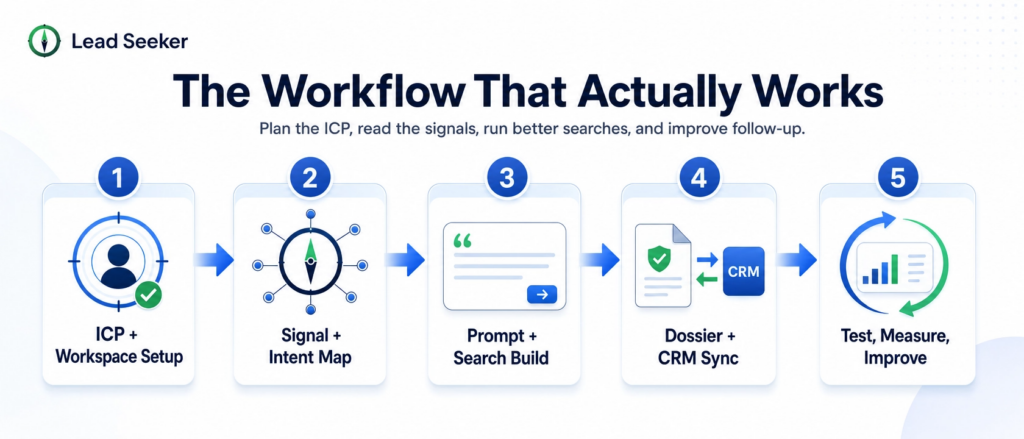
The Avatar-to-Account Conversion Framework
The framework separates buyer research from automatic activation. Each stage must produce enough evidence for a person to approve the next step.
- 1Define
Document the ideal customer profile, offer, buyer roles, exclusions, geography, useful signals and the outcome the campaign needs.
- 2Discover
Identify possible accounts and people using public sources, market context and the approved search definition.
- 3Verify
Check the company, role, available contact data, source dates and whether the record matches the intended buyer.
- 4Interpret
Explain why the account may deserve review while clearly separating verified facts from hypotheses and message suggestions.
- 5Approve
Apply human review to fit, timing, consent, sensitivity, exclusions, offer, channel and the proposed next action.
- 6Activate and learn
Move approved profiles into CRM, outreach, nurture or account-based workflows, then use outcomes to improve the next search.
What happens after the buyer avatar is built?
The controlled path is buyer avatar → human review → CRM segmentation → approved outreach → nurture audience → relevant content and media → sales learning. The buyer profile does not replace the customer journey. It gives the journey a more defensible starting point.
Teams can use AutoNURTURE audience workflows after approval, customer-journey mapping to define the experience after engagement, and conversion-rate optimization to improve the pages and forms that receive the campaign.
Broader deployment may also involve AI systems, AI sales-agent services, B2B intent data services and B2B lead-generation services.

Need a presenter, a persona or a real buyer workflow?
Percepture can help separate the production decision from the targeting decision, define the operating controls and build a test that produces evidence before a larger commitment.
- Clarify the output and buyer problem
- Build one controlled evaluation scorecard
- Connect approved avatars to content, CRM and conversion
Test one ICP before expanding the workflow
Bring
Your website, offer, target market, company-size range, desired roles, useful signals, exclusions and current sales motion.
Evaluate
Account fit, person relevance, verification, source quality, signal meaning, sensitivity, communication guidance and next-step usefulness.
Approve
Decide which profiles are suitable for CRM, outreach, nurture or account-based marketing and which records should be excluded.
Learn
Measure replies, meetings, qualified opportunities, source quality, message performance and the reasons profiles were accepted or rejected.
A small pilot reduces risk because it exposes weak ICP definitions, irrelevant signals, verification gaps and activation problems before scale makes them expensive.
How budget affects the AI avatar decision
| Category | Primary cost drivers | Hidden operating cost | Best evaluation metric |
|---|---|---|---|
| AI video presenter | Minutes, languages, exports, collaboration and premium assets | Script review, corrections and approval time | Approved usable videos per production cycle |
| Custom digital spokesperson | Avatar creation, voice, training, rights and enterprise controls | Consent, legal review and revocation governance | Approved content delivered without brand or rights issues |
| Persona and simulation tools | Seats, model usage, research depth and integrations | Time spent validating unsupported assumptions | Research questions improved, not personas produced |
| Prospect-intelligence workflow | Research depth, verification, signals, integrations and human review | Data cleanup, exclusions, message approval and sales follow-up | Approved profiles, replies, meetings and qualified opportunities |
| Managed buyer-intelligence program | Strategy, implementation, content, activation and measurement | Cross-team coordination and change management | Qualified pipeline and learning returned to the ICP |
Pricing should be judged against the operating result, not the number of generated faces or profiles. Verify current vendor pricing and contractual terms directly before purchase.
Also account for implementation time, internal review capacity, training, data cleanup and the cost of correcting weak output. A lower subscription price can become expensive when the workflow creates more review work than usable marketing or sales assets.
Seven mistakes to avoid with AI avatars
- Confusing a fictional persona with a verified buyer. A useful segment description is not a contact record.
- Treating a public signal as proof of intent. A trigger supports investigation; it does not prove budget, authority or timing.
- Using a likeness without durable consent. Custom avatars need clear rights, controls, disclosure and revocation procedures.
- Testing different platforms with different inputs. Use the same script or ICP so quality differences are visible.
- Automating activation before review. Human approval should control who enters outreach, nurture and account-based campaigns.
- Ignoring total operating cost. Review, correction, governance and integration time often matter more than the subscription price.
- Measuring production instead of outcomes. Videos, personas and dossiers are outputs. Approved content, replies, meetings and qualified pipeline are outcomes.
Frequently asked questions
How do I decide where to find high-quality AI avatars for marketing?
Start with the output you need. Choose a video-avatar platform for a synthetic presenter or approved digital spokesperson. Choose a persona tool for planning and ideation. Choose a prospect-intelligence platform when the goal is a real account, a relevant decision-maker, source-backed context, verified contact information and a reviewable next action.
What is the best AI avatar platform for marketing videos?
There is no universal winner without a defined use case and scoring method. Test shortlisted platforms with the same script and compare visual consistency, voice, lip-sync, language support, consent controls, commercial rights, security, collaboration, exports and total operating cost.
What is the difference between an AI avatar and a buyer persona?
An AI video avatar is a synthetic or digitally reproduced presenter. A buyer persona represents a customer segment. A source-backed buyer avatar connects a defined ideal customer profile to a real account and relevant decision-maker, then adds reviewable evidence and a proposed next action.
Can AI create an ideal customer profile?
AI can organize inputs such as industry, company size, region, buyer roles, business problems, offers, exclusions and trigger events. People should validate the result against customer data, sales experience, CRM evidence, market research and campaign outcomes.
Are AI-generated buyer personas accurate?
AI-generated personas can organize research and help teams form hypotheses. They do not prove that a real buyer has authority, budget, need or current intent. Validate assumptions with customer interviews, sales feedback, market evidence and measurable campaign results.
What should a source-backed buyer avatar contain?
A useful buyer avatar may contain ICP fit, company context, role relevance, available contact verification, a public business signal, the source, communication guidance, exclusions and an editable next action. Facts, interpretations and recommendations should be labeled separately.
Does Lead Seeker use real people or fictional profiles?
Lead Seeker is positioned around real companies and decision-makers rather than fictional characters. A human should still review account fit, role relevance, contact verification, source quality, timing, sensitivity, message, offer and the proposed next action.
Can buyer avatars connect to CRM and nurture workflows?
Approved buyer profiles can support CRM segmentation, account-based marketing, outreach, nurture audiences and sales research. Integration should follow human review, consent requirements, suppression rules, ownership assignments and the organization’s data-governance policies.
What should I test before choosing an AI avatar system?
Inspect output quality, evidence quality, governance, usability, workflow fit and total cost. Test video-avatar platforms with the same script. Test buyer-intelligence platforms with the same ICP, exclusions, source requirements and review scorecard.
How much do AI avatar tools cost?
Costs vary by category. Video-avatar pricing depends on production volume, languages, custom likenesses, exports and collaboration. Buyer-intelligence costs depend on research depth, contact verification, signal coverage, integrations, workflow support and the amount of human review required.
Test a reviewable avatar sample
When the question is where to find high-quality AI avatars for marketing, begin with one use case and one controlled test. Use the form below or contact Percepture to describe the presenter, persona or buyer workflow you need reviewed.
Editorial and source note
Technical contribution: Alex Mannine, Percepture’s AI and Technical Automation Strategist, contributed workflow perspective on AI systems, agents, automation and technical marketing operations.