

Choosing among agencies who specialize in ai search optimization is not a matter of finding the firm with the loudest AI message. The right partner must connect technical search work, useful content, brand authority, and measurement to a real business objective.
This guide gives CEOs, CMOs, and marketing leaders a practical way to compare providers. It focuses on operating capability, not trend-driven labels.
Evaluate an AI-search agency by the system it can prove
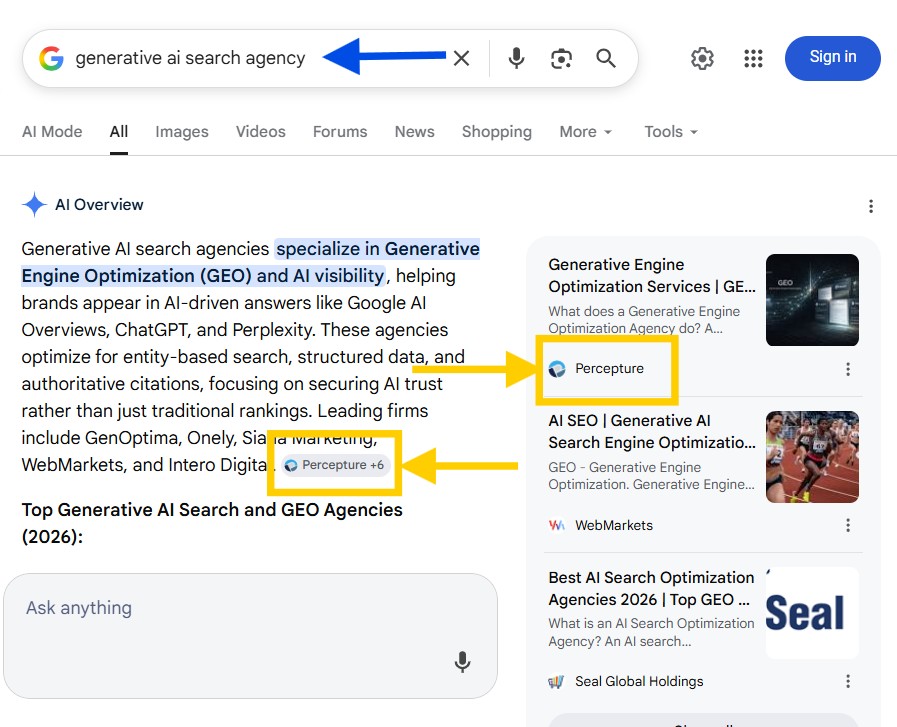
Percepture applies the same search, GEO, authority, and conversion disciplines to its own category positioning. The proof below gives buyers something concrete to inspect before comparing proposals.
 Founded in 2004
 Inc. 5000 recognized
 NMSDC certified
 SEO, GEO and digital PR
What should an AI search optimization agency do?
Agencies who specialize in ai search optimization improve how clearly search engines and AI systems can find, understand, trust, and reference a company. Their work should combine technical SEO, structured content, entity clarity, digital authority, and conversion planning rather than treating AI visibility as a separate publishing trick.
Executive summary
Start with the business question
Define which buyers, services, markets, and decisions the program must influence before discussing content volume.
Inspect the operating system
Strong agencies who specialize in ai search optimization can explain how research becomes technical work, content, authority, measurement, and action.
Demand useful evidence
Ask for audits, work samples, reporting logic, and a clear explanation of what the agency will measure.
Compare scope before price
A low fee may exclude technical implementation, authority building, analytics, or senior strategy. Compare deliverables and ownership first.
Who this buyer guide is for
CEO or owner
You need to know whether the agency can connect visibility to market position, demand, and commercial priorities.
CMO or marketing leader
You need agencies who specialize in ai search optimization to coordinate SEO, content, PR, web, and analytics without creating another isolated channel.
Search or content leader
You need technical depth, usable workflows, implementation support, and clear rules for measuring progress.
Procurement or finance leader
When comparing agencies who specialize in ai search optimization, you need comparable scope, ownership terms, staffing clarity, reporting expectations, and a defensible investment model.
The best agencies who specialize in ai search optimization can address each perspective without replacing clear scope with vague promises.
Why AI search requires a broader operating model
Search behavior now spans standard result pages, conversational tools, answer summaries, review platforms, social sources, and publisher sites. A buyer may discover a brand in one environment, validate it in another, and convert through a third.
This does not make established SEO obsolete. It raises the standard. Pages still need to be crawlable, useful, well structured, and connected to a credible site. The difference is that the information must also be easy to extract, compare, and attribute.
A capable program therefore needs more than prompt testing or a batch of AI-written articles. It needs technical foundations, clear entities, direct answers, connected topic coverage, reliable source material, and authority beyond the company’s own website. That wider operating model is what buyers should expect from agencies who specialize in ai search optimization.
That wider view is why Percepture connects generative engine optimization services with enterprise SEO, content, analytics, and earned visibility. Each discipline solves a different part of the discovery problem.
Find the gaps before comparing proposals
Start with a visibility review covering technical access, answer-ready content, entity clarity, authority, internal links, and measurement. The result gives your team a common basis for evaluating recommendations from agencies who specialize in ai search optimization.
What agencies who specialize in ai search optimization should own
The phrase “AI search” can hide major differences in scope. One provider may offer content briefs. Another may handle technical remediation, structured data, authority development, reporting, and implementation. A buyer should separate the label from the work.
Search and answer-market research
The agency should identify the questions buyers ask at each stage, the sources already shaping answers, and the pages competing for visibility. Research from agencies who specialize in ai search optimization should include commercial questions, comparison questions, definitions, objections, and implementation concerns.
Keyword lists are still useful, but they are not enough by themselves. The agency must map topics to buyer intent and decide whether each need belongs on a service page, comparison page, guide, tool, case study, or supporting article.
Technical discovery and extraction
Content cannot perform if important pages are difficult to crawl, render, interpret, or connect. Technical work may cover indexation, site architecture, internal linking, canonical signals, structured data, page templates, and performance.
Ask agencies who specialize in ai search optimization who finds technical issues, who writes the requirements, and who implements the changes. Some agencies stop at an audit. That can be workable when the client has a strong development team, but the division of responsibility must be explicit.
Content architecture and information quality
AI-search content should answer real questions quickly while giving the reader enough depth to make a decision. Strong pages use descriptive headings, concise definitions, tables, steps, FAQs, and specific examples where approved evidence exists.
Agencies who specialize in ai search optimization should also prevent duplication. Publishing several pages with nearly identical intent can split authority and confuse both users and search systems. A disciplined content plan decides when to create, update, merge, or retire a page.
Entity and authority development
A company must be described consistently across its site and credible external sources. Services, people, products, industries, locations, and expertise should have clear relationships. Conflicting descriptions weaken understanding.
Authority cannot be manufactured only with on-site copy. Agencies who specialize in ai search optimization may also need to coordinate expert participation, useful research, public relations, publisher outreach, and reference-worthy resources. Percepture’s digital PR services and content marketing services support those connected needs.
How to compare agencies who specialize in ai search optimization
A useful comparison of agencies who specialize in ai search optimization starts with capability, not a list of company names. Market lists change, service descriptions evolve, and two agencies using the same label may deliver very different programs.
Use the matrix during every call with agencies who specialize in ai search optimization. Record the answer, the evidence offered, and the person responsible for delivery. This prevents polished presentations from outweighing operating detail.
AI search agency decision matrix
Score agencies who specialize in ai search optimization against the same strategy, implementation, authority, measurement, and commercial-fit criteria.
| Evaluation area | What a strong response includes | Warning sign | Buyer question |
|---|---|---|---|
| Strategy | Buyer questions, search demand, business priorities, page types, and a sequenced roadmap | A generic content calendar presented before discovery | How do you decide what not to publish? |
| Technical SEO | Crawlability, indexation, templates, structured data, rendering, architecture, and implementation ownership | Technical work is reduced to installing a plugin | Who turns audit findings into deployed changes? |
| Content quality | Direct answers, expert input, differentiated pages, editorial review, and intent control | Success is defined mainly by article volume | How do you prevent unsupported statements and duplication? |
| Entity clarity | Consistent descriptions of the company, people, services, products, industries, and relationships | Entity work is discussed without checking the full web presence | How will you identify and resolve conflicting signals? |
| Authority | Useful assets, expert participation, digital PR, relevant references, and earned coverage | Authority is treated as bulk link acquisition | What makes a source or mention worth pursuing? |
| Measurement | Baseline visibility, rankings, citations, traffic quality, conversions, and documented limitations | A single proprietary score with no supporting detail | Which metrics guide decisions, and which are directional? |
| Commercial fit | Named owners, meeting cadence, deliverables, dependencies, change control, and reporting | Senior experts sell the work but disappear after kickoff | Who will make decisions on our account each week? |
The Percepture CLEAR Visibility Framework
Percepture uses the CLEAR Visibility Framework to organize AI-search work into five connected areas: Crawl, Language, Entities, Authority, and Response. It gives buyers a simple way to diagnose where visibility is breaking down.
How the CLEAR Visibility Framework works
C — Crawl
Confirm that priority pages can be discovered, rendered, indexed, and reached through a logical site structure.
L — Language
Map buyer questions to clear pages, concise answers, useful headings, comparisons, definitions, and next steps.
E — Entities
Clarify what the company does, whom it serves, who its experts are, and how its services and topics connect.
A — Authority
Build credible supporting signals through expert material, useful resources, earned media, and relevant references.
R — Response
Measure discovery, engagement, qualified actions, and revenue signals, then use the findings to set the next work cycle.
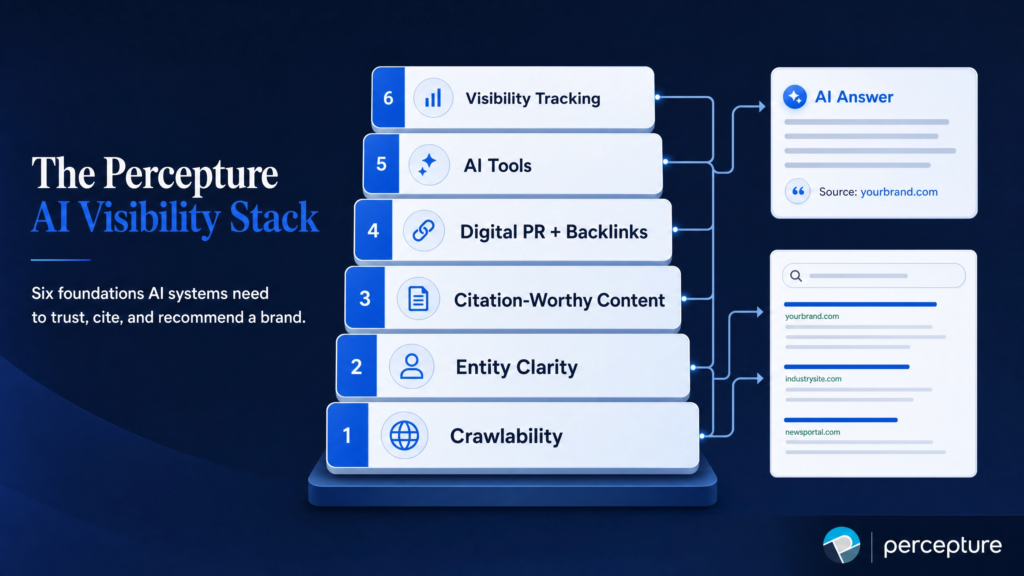
The framework also exposes incomplete proposals from agencies who specialize in ai search optimization. If an agency focuses on Language but ignores Crawl, the content may never reach its potential. If it covers on-site work but ignores Authority, the brand may remain difficult to validate.
For larger programs, the framework can connect to strategy and planning, attribution and analytics, and conversion rate optimization. Visibility is useful only when the buyer can move from an answer to a meaningful next step.
A practical agency selection process
Move from a long list to a defensible decision
- Define the job. List the markets, services, buyer groups, technical constraints, internal resources, and commercial outcomes involved.
- Request the same evidence. Give each agency the same questions and ask for a sample roadmap, reporting view, staffing model, and responsibility map.
- Score the operating fit. Use weighted criteria for strategy, technical depth, content, authority, measurement, collaboration, and cost.
Step 1: Write a one-page decision brief
Before contacting agencies who specialize in ai search optimization, write down the decision you are making. State why the work matters now, which business units are involved, what has already been tried, and what internal teams can execute.
Include constraints. A complex site may require development support. A regulated organization may require legal review. A small marketing team may need an agency that can implement rather than advise. These factors change the right engagement model.
Step 2: Ask every provider the same questions
Standard questions make agencies who specialize in ai search optimization easier to compare. Ask the agency to describe its first 30 days, the information it needs from your team, its approach to technical fixes, how experts contribute, and how it handles weak or conflicting evidence.
Then ask for a sample deliverable. A roadmap, brief, technical ticket, or reporting example often reveals more than a capabilities deck. Remove confidential client information before sharing anything internally.
Step 3: Test how the team thinks
Give each finalist among the agencies who specialize in ai search optimization a realistic scenario. For example, ask how it would handle a service page that ranks in standard search but is rarely surfaced in conversational answers. A strong response should investigate the query set, page quality, entity signals, competing sources, authority, and technical access before prescribing more content.
This exercise shows whether the agency diagnoses systems or reaches for the same deliverable every time.
Step 4: Clarify implementation ownership
Strategy without implementation can leave a capable internal team with an overloaded backlog. Full execution without internal coordination can produce changes that conflict with brand, legal, or product priorities.
Document who owns technical changes, editorial approval, expert interviews, publishing, outreach, analytics configuration, and executive reporting. The responsibility map should appear in the proposal or statement of work.
Step 5: Agree on a review cycle
AI-search work benefits from a test-and-learn cadence. The team should review what was shipped, what changed, what did not change, and what the evidence suggests doing next. Avoid a reporting process that simply exports dashboards without making decisions.
Agency evaluation checklist
- The agency can explain how SEO and AI-search work reinforce each other.
- The proposal separates audit, strategy, implementation, content, authority, and measurement.
- The team has a process for checking factual support and expert input.
- Technical findings can be converted into deployable requirements.
- Content decisions are tied to intent, page type, and cannibalization risk.
- Entity work covers the wider web presence, not just schema markup.
- Reporting includes business actions as well as visibility indicators.
- The day-to-day team and senior decision makers are identified.
- Dependencies on the client are stated before work begins.
- Ownership of created assets, accounts, and data is clear.
Pricing and scope for agencies who specialize in ai search optimization
Pricing from agencies who specialize in ai search optimization cannot be compared responsibly without scope. An assessment, a strategy engagement, and a managed program solve different problems. Site size, technical complexity, publishing volume, expert access, authority work, analytics, and implementation support all affect the engagement.
Compare engagement models before comparing fees
| Engagement model | Best fit | Typical scope questions | Main buyer risk |
|---|---|---|---|
| Diagnostic assessment | A team that needs a baseline and prioritized problem list | Does it include technical, content, entity, authority, and measurement findings? | Receiving recommendations without resources to implement them |
| Strategy and roadmap | An internal team that can execute but needs direction | Are page decisions, dependencies, owners, timing, and measurement included? | A roadmap that is too broad to enter the production queue |
| Specialist workstream | A mature program with one defined gap | How will the specialist coordinate with SEO, PR, content, development, and analytics? | Local improvement that creates problems elsewhere |
| Managed program | A company seeking coordinated strategy and execution | Which deliverables, implementation tasks, reporting, and senior reviews are included? | Paying for activity without a clear operating plan |
Ask finalist agencies who specialize in ai search optimization to price the same scope and identify exclusions. Percepture publishes separate information about GEO pricing and packages so buyers can examine the service structure alongside the proposed work.
Do not assume the largest content allocation creates the best value. A program may produce more value by repairing templates, consolidating duplicate pages, improving core service content, or building one reference-worthy resource than by publishing many shallow articles.
What valid AI-search agency proof looks like
A useful case study shows the starting problem, the work delivered, what the agency controlled, what the client controlled, and which outcomes can be verified. Screenshots and testimonials should support the operating story rather than replace it.
From technical expertise to visible market authority
In this interview, Cody Clegg discusses a Percepture program that positioned OPTK Networks around hyperscale and AI-infrastructure topics. The example shows how research, expert input, search architecture, and answer-ready content can work together.
This telecom example documents the method. It is not a guarantee that every company will reach the same ranking or timeline.
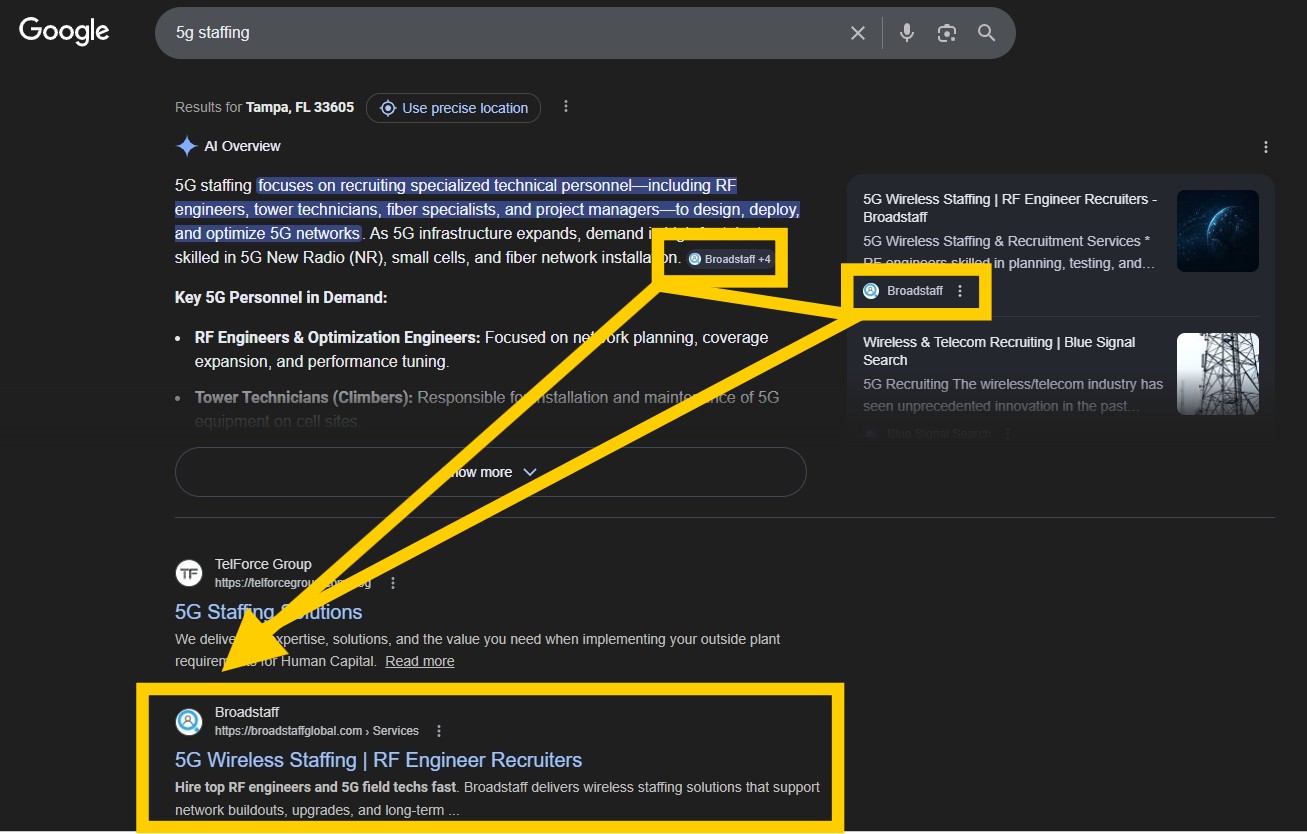
Ask every finalist to provide:
- A clear before-state, problem definition, and approved scope
- Examples of actual deliverables rather than outcome claims alone
- An explanation of agency-controlled and client-controlled variables
- Reporting that separates observations, interpretation, and limitations
- Evidence connecting technical, editorial, authority, and conversion work
Percepture’s case studies provide a starting point for reviewing its broader work.
Compare the strategy, scope, and implementation plan
Review how Percepture compares with agencies who specialize in ai search optimization by connecting AI visibility with search, content, authority, analytics, and customer journeys. Bring your current plan or agency proposal for a practical comparison.
Common mistakes when hiring an AI search agency
Buying a new label instead of a complete capability
Some agencies who specialize in ai search optimization rename an existing content service without adding technical, entity, authority, or measurement depth. Ask what changed in their process, deliverables, staffing, and reporting when AI search became part of the service.
Treating mentions as the only outcome
AI visibility can be useful, but a mention without relevance, accuracy, buyer fit, or a conversion path may have limited value. Measurement should connect visibility to qualified discovery and business action where the available data allows it.
Skipping brand and expert input
Generic content is easy to reproduce. Strong material depends on product knowledge, executive judgment, customer questions, approved evidence, and a clear point of view. The agency should have a practical method for collecting those inputs without slowing every page to a halt.
Ignoring the existing site
A new article plan may fail when core service pages are weak, site architecture is confusing, or older pages compete with one another. Review the current content estate before adding another large publishing commitment.
Percepture’s guide to technical SEO audit services explains why technical diagnosis must sit beside content planning. Its article on SEO sprints also shows how focused work can be structured around a defined search problem.
Separating visibility from the customer journey
A buyer who discovers a company through an AI answer still needs a useful destination, clear proof, and a sensible next step. Connect the visibility program to customer journey strategy rather than measuring discovery in isolation.
How to govern the agency relationship
The client and agency should maintain one prioritized backlog. Every item needs a reason, an owner, a dependency, a completion state, and a measurement plan. This makes tradeoffs visible and reduces work that exists only because it appeared in a monthly calendar.
Set separate forums for production and executive decisions. Production reviews handle briefs, technical tickets, approvals, and publishing. Executive reviews address market shifts, investment, risk, major findings, and changes in direction.
Agencies should also state where measurement is incomplete. AI platforms and search interfaces do not expose every impression, answer, or buyer path. A responsible report combines available observations instead of presenting an estimated visibility score as a complete account of performance.
Strong agencies who specialize in ai search optimization will welcome this governance because it gives both sides a clear operating record. Weak partnerships tend to rely on activity totals and broad status updates.
Frequently asked questions
What do agencies who specialize in ai search optimization do?
Agencies who specialize in ai search optimization improve how a company is discovered, understood, evaluated, and referenced across standard and AI-assisted search. The work can include technical SEO, content architecture, direct-answer formatting, entity clarification, structured data, digital authority, analytics, and conversion planning. Exact scope varies, so buyers should compare deliverables rather than agency labels.
Is AI search optimization different from SEO?
Agencies who specialize in ai search optimization address new discovery environments and answer formats, but their work still relies on many SEO foundations. Crawlability, useful pages, internal links, clear entities, authority, and sound site architecture remain important. A practical program coordinates SEO and AI visibility instead of running them as unrelated channels.
How long does AI search optimization take?
Timing depends on the site, competition, technical backlog, publishing process, authority, and scope. An assessment can identify priorities quickly, while implementation and market response take longer. Ask the agency for milestones tied to shipped work and observable changes rather than a guaranteed ranking or citation date.
How should a company measure AI-search performance?
Use a balanced set of indicators: visibility for priority questions, traditional rankings, cited or referenced pages, qualified organic traffic, engagement, conversions, and sales feedback. No single metric captures the whole journey. Reporting should document the queries tested, the method used, and the limits of the available data.
What should an AI search agency proposal include?
Proposals from agencies who specialize in ai search optimization should define objectives, scope, deliverables, owners, staffing, dependencies, timing, reporting, implementation responsibility, approval steps, and exclusions. They should also explain how technical SEO, content, entities, authority, and conversion paths fit together. Buyers should be able to see what happens after the initial audit.
How much do AI search optimization services cost?
Cost depends on whether the engagement is an assessment, roadmap, specialist workstream, or managed program. Site complexity, technical implementation, content production, expert input, authority work, and analytics also affect scope. Compare proposals against the same responsibility map before comparing the final fee.
Can an internal SEO team handle AI search optimization?
Yes, when the team has enough technical, editorial, analytics, and authority-building capacity. An outside partner may still help with diagnosis, specialist execution, additional production, or cross-functional coordination. The decision should depend on capability gaps and available time rather than the novelty of the channel.
What is the biggest warning sign when selecting an agency?
A major warning sign among agencies who specialize in ai search optimization is a fixed prescription before the agency understands the site, buyers, market, and internal resources. Be cautious when the pitch depends mainly on content volume, guaranteed inclusion, or an unexplained proprietary score. Good agencies diagnose the system before committing to a production plan.
Choose an operating partner, not an AI label
If you are comparing agencies who specialize in ai search optimization, Percepture can review your current visibility, technical constraints, content system, authority signals, and measurement plan. The conversation is designed to identify the right work before defining the engagement.

About Bob Generale
Bob Generale is President of Percepture. He works with executive teams on SEO, generative engine optimization, digital PR, content systems, and integrated visibility programs that connect discovery to qualified action.