

What is ISP marketing? ISP marketing is the strategy internet service providers use to build trust, create demand, capture local searches, generate leads, and convert serviceable addresses into subscribers. It connects SEO, paid media, PR, direct mail, community outreach, CRM follow-up, sales automation, and conversion tracking around the provider’s actual network footprint.
In plain English, ISP marketing helps a broadband provider turn a real network into real customers. It is not just traffic. It is not just brand awareness. It is the system that moves a serviceable home, business, building, MDU, or community from awareness to action.
Trusted by telecom, infrastructure, and complex B2B growth teams
Percepture brings PR, SEO, GEO, paid media, analytics, and lead-generation experience to broadband, telecom, data center, private equity, and other complex B2B markets.








Last updated: July 2026
What Is ISP Marketing?
This discipline is serviceability-aware market conditioning. It is the strategy an internet service provider uses to build trust, create demand, capture local searches, qualify leads, and convert homes, businesses, buildings, and communities that the network can actually serve.
Unlike generic marketing, the program starts with the network map. The campaign should know which addresses are live, which are pre-sale, which are future-serviceable, which are MDUs, and which are business or DIA opportunities before money is spent.
Executive Summary for Broadband Leaders
The starting point
When executives ask what is ISP marketing, the answer should start with the network. The home, business, MDU, service area, or building has to be sellable, planned, or properly segmented before spend scales.
The business outcome
The goal is not generic traffic. The goal is more address searches, pre-registrations, qualified leads, installs, subscribers, DIA opportunities, MDU conversations, and revenue from markets the provider can actually serve.
The channel stack
SEO, generative engine optimization services, paid search, media buying, PR, direct mail, CRO, analytics, and sales follow-up need to work from the same serviceability truth.
The risk
If the campaign reaches homes or buildings the ISP cannot serve, the provider wastes spend and damages trust before the sales team has a fair chance to convert demand.
“Most ISPs do not lose because the network is weak. They lose because the market was never conditioned to trust, search, click, schedule, and buy.”
Bob Generale, President, Percepture
Who This Guide Is For
This guide is for leaders who need a plain-English definition before they choose the operating model. It is useful for ISP CEOs, founders, marketing leaders, sales leaders, grant-funded broadband teams, investors, and executives responsible for fiber take-rate, residential subscriber growth, MDU deals, DIA pipeline, or market expansion.
Residential broadband providers
Need to turn fiber passings, local awareness, address checks, and installation capacity into paying subscribers.
BEAD-funded operators
Need public trust, adoption communication, local education, and a clean handoff from community outreach to subscriber action.
DIA, metro Ethernet, and dark fiber teams
Need technical credibility, account-based targeting, route or SLA proof, and qualified enterprise conversations.
Download the ISP Growth Framework Pack
Get the framework Percepture uses to connect serviceability, trust, search, paid media, PR, and sales follow-up. If your leadership team is still asking what is ISP marketing, this pack shows how the answer becomes an operating system.
See the ISP Marketing Agency Hub Request an ISP Growth Audit
ISP Marketing Definition
ISP marketing is the process internet service providers use to turn network availability, service areas, passings, community trust, local search demand, paid media, PR, and sales follow-up into subscribers, qualified leads, and revenue.
In practice, the definition is judged by whether the program can move real serviceable locations toward buying decisions. The best ISP campaigns are not built around impressions alone. They are built around serviceability, trust, timing, offer clarity, and conversion.
A practical way to answer what is ISP marketing is this: it is the full system that turns a serviceable market into actual customers. ISP marketing is not just getting people to the website. It is getting the right serviceable person to the right offer at the right time.
An ISP must know where it can sell, when it can install, who is ready to buy, and what the sales team should do next. That is why a broadband growth program should connect the commercial plan to strategy and planning, the website experience, the CRM, the call path, the sales handoff, and the install calendar.
This is also why the definition page should route qualified readers to the larger ISP marketing agency hub. A definition can teach the model. The hub can explain how the system is built.
Why Broadband Growth Is Different From Normal Marketing
Normal marketing can start with broad audiences and broad geographies. the growth program has to respect the network map. If marketing reaches homes the ISP cannot serve, the campaign wastes spend, creates frustration, and weakens community trust.
That constraint changes everything. Targeting, copy, landing pages, address search, paid media, direct mail, CRM rules, offer strategy, local PR, sales routing, and reporting all have to reflect the footprint. The network decides what can be promised.
Normal Marketing vs. ISP Marketing
| Normal Marketing | Broadband Growth |
|---|---|
| Starts with audience personas | Starts with serviceability and build timing |
| Targets broad geographies | Targets sellable addresses, neighborhoods, buildings, and markets |
| Measures traffic and leads | Measures address searches, pre-registrations, installs, subscribers, and qualified pipeline |
| Can sell anywhere online | Can only sell where the network can serve or credibly pre-sell |
| Uses generic offers | Uses market, build, competitor, and buyer-specific offers |
| Treats PR as awareness | Uses PR to build local trust before adoption |
| Treats SEO as traffic | Uses SEO to capture service-area demand and local proof |
| Treats forms as leads | Routes leads by address, readiness, buyer type, and sales priority |

Address-level targeting also changes budget decisions. Paid search, media buying, retargeting, and direct mail should not run as isolated channel plays. They should be suppressed, segmented, or expanded based on the footprint, build phase, sales capacity, competitor pressure, and offer readiness.
At this stage, the work becomes the discipline of spending only where the provider can create a credible path to service. The more precise the footprint, the more precise the marketing can become.
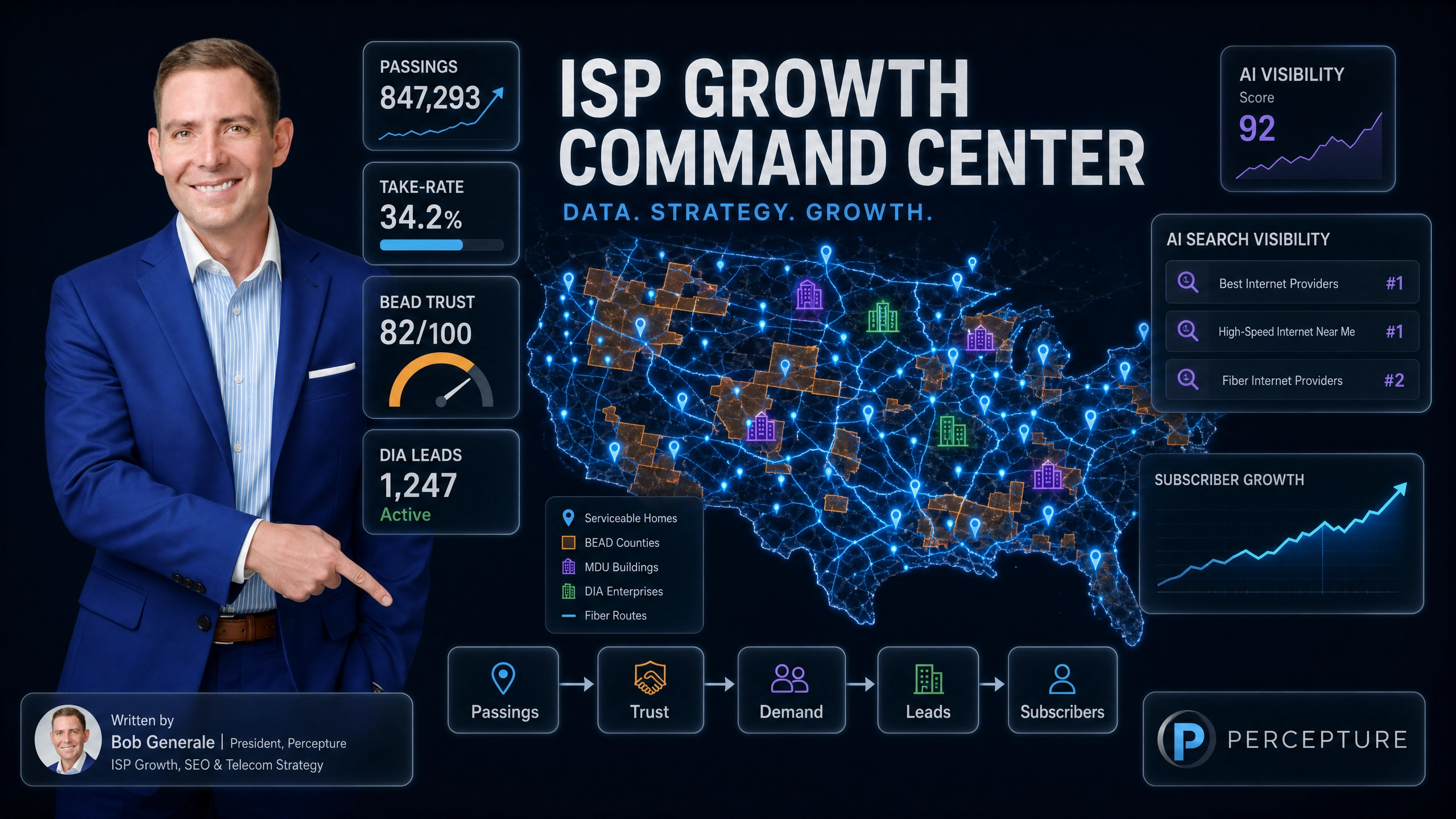
The Percepture ISP Trust-to-Take-Rate System
The Percepture ISP Trust-to-Take-Rate System shows how a broadband provider turns physical network truth into trust, search visibility, demand, leads, installs, and subscribers. It is a simple idea: the campaign must be built around the actual path from serviceability to revenue.
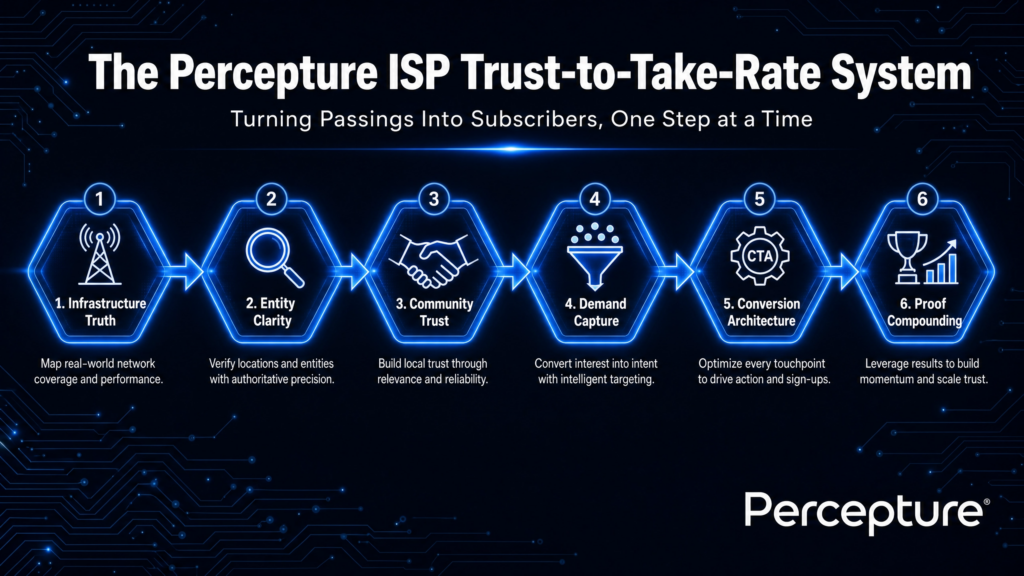
The Six-Part Framework
1. Infrastructure Truth
What can the ISP actually sell, where, and when? This is the operational first answer to what is ISP marketing.
2. Entity Clarity
Do search engines and AI systems understand who the ISP is, what markets it serves, and what services it offers?
3. Community Trust
Do residents, local leaders, businesses, property owners, and anchor institutions trust the provider?
4. Demand Capture
Can the ISP capture active searchers, address lookups, pre-registrations, service inquiries, MDU leads, and DIA opportunities?
5. Conversion Architecture
Do landing pages, forms, offers, call tracking, CRM, routing, and sales follow-up convert interest into action?
6. Proof Compounding
Do PR, reviews, case studies, rankings, local mentions, executive visibility, and third-party citations make the brand easier to trust and retrieve?
This is where what is ISP marketing becomes a board-level question. The provider is not buying a channel. It is building a market-conditioning system around a physical asset.
What Does the Broadband Growth System Include?
A strong broadband growth program does not treat channels as separate tactics. Local SEO, paid media, direct mail, PR, AI search, and CRM follow-up should all work from the same serviceability truth. For operators, the channel stack has to be organized around where the network can create subscribers.
Broadband Growth Channel Stack
| Growth Function | What It Does | Business Outcome |
|---|---|---|
| Local SEO | Helps buyers find fiber, broadband, and business internet in service areas | More address searches and qualified visits |
| GEO / AI Search Visibility | Makes the ISP easier for AI systems to understand and retrieve | Better visibility in AI answers and buyer research |
| Paid Search | Captures active shoppers searching for internet service | More high-intent leads |
| Programmatic Advertising | Targets homes, buildings, events, and business buyers | Better reach in defined markets |
| Digital PR | Builds local, industry, and investor trust | Stronger credibility and third-party proof |
| Direct Mail | Reaches serviceable homes and neighborhoods | More local awareness and pre-registration |
| Community Outreach | Explains construction, service launches, and adoption | Less confusion and more trust |
| Offer Strategy | Matches pricing, incentives, and urgency to market reality | Better landing-page conversion |
| CRO | Improves address search, forms, CTA, and checkout flow | More leads from the same traffic |
| AI Sales Agents | Qualify, route, and follow up with prospects faster | Better speed-to-lead |
| Analytics | Connects campaigns to forms, calls, sales, installs, and recurring revenue | Clearer ROI reporting |
The SEO layer can include organic SEO services, local landing pages, service-area content, technical fixes, comparison pages, definition pages, and schema. The PR layer can include digital PR services, community stories, launch announcements, thought leadership, third-party proof, and public education. The performance layer can include paid search, retargeting, geofencing, and address-level suppression.
AI search adds another requirement. ISPs need clear facts, crawlable pages, entity consistency, expert content, third-party mentions, and structured answers that systems can parse and retrieve. Percepture’s generative engine optimization services connect that content work to AI retrieval and answer visibility.

“AI sales agents are useful when they protect speed-to-lead. They should qualify, route, and support the sales team, not replace the sales team.”
Alex Mannine, Head of Global Strategy and AI
Lead follow-up matters because a prospect can be serviceable, not-yet-serviceable, pre-sale, MDU, DIA, or outside the footprint. Teams exploring automation should also understand how AI outbound calling agents fit into compliance, routing, and human sales support.
Who Needs This Kind of Broadband Growth System?
For different providers, the answer changes by footprint, product, buyer, and growth stage. The common thread is that the network sets the rules.
Provider Fit Cards
Regional Fiber Providers
Pain: passings are not converting into subscribers fast enough.
Need: local SEO, paid search, serviceability mapping, PR, retargeting, direct mail, and sales follow-up built around take-rate.
BEAD-Funded Broadband Providers
Pain: funding does not guarantee adoption.
Need: public education, construction communication, affordability messaging, community trust, digital equity outreach, and local PR.
Residential ISPs
Pain: households compare fiber, cable, fixed wireless, price, speed, bundles, and local trust.
Need: search visibility, offer testing, direct mail, retargeting, reviews, installation scheduling, and follow-up.
MDU Broadband Providers
Pain: property owners need more than an internet pitch.
Need: owner outreach, managed Wi-Fi positioning, resident-experience messaging, install planning, and bulk agreement support.
DIA and Business Fiber Providers
Pain: IT directors need confidence before switching providers.
Need: serviceable building targeting, route diversity proof, SLA messaging, sales engineering handoff, and account-based campaigns.
Dark Fiber and Infrastructure Providers
Pain: the value is real, but the buyer needs technical proof and a clearer business case.
Need: interconnection messaging, conference campaigns, PR, executive thought leadership, and targeted pipeline development.
Providers that sell complex infrastructure can also learn from adjacent markets. Percepture’s guide to data center marketing shows the same pattern: technical truth, local trust, entity clarity, and commercial follow-up have to work together.
How Marketing Supports Fiber Take-Rate
The campaign helps serviceable homes understand the provider, trust the offer, check their address, pre-register, schedule installation, and stay engaged after the first visit. That is why take-rate is one of the most important outcomes to track.
Fiber passings are not revenue. Take-rate is the percentage of serviceable locations that become subscribers. Low take-rate can come from weak trust, weak offers, poor timing, slow follow-up, address-check friction, lack of local SEO, lack of local PR, or a missing direct mail and retargeting plan.
For a deeper plan, read Percepture’s guide to fiber take-rate marketing. If the leadership team needs a simpler definition first, the companion guide on what is fiber take rate explains the metric in plain English.
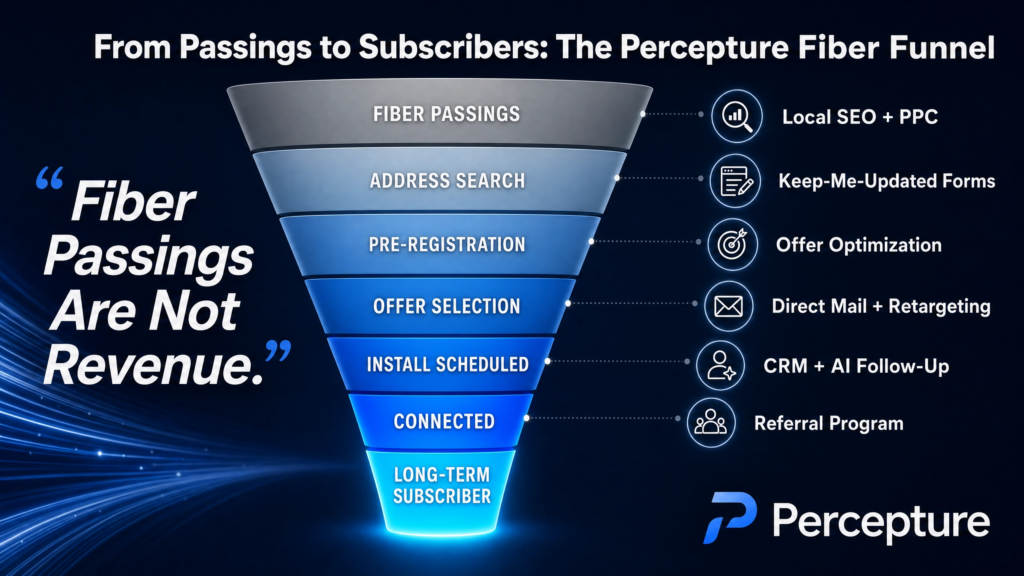
“A fiber launch needs a clean handoff from campaign to form, from form to CRM, and from CRM to install. That is where many ISP campaigns leak revenue.”
Amanda Pacheco, Client Success Manager, Percepture
Review the ISP Growth Investment Path
If the question is budget, start with the workstream. Serviceability cleanup, local SEO, PR, paid media, CRO, analytics, and sales follow-up each solve a different leak in the funnel.
Marketing for BEAD, MDU, DIA, and Business Fiber
The growth system is not the same in every market. A residential fiber launch, a BEAD adoption plan, an MDU bulk agreement campaign, and a DIA lead-generation program each need different proof, different targeting, and different conversion paths.
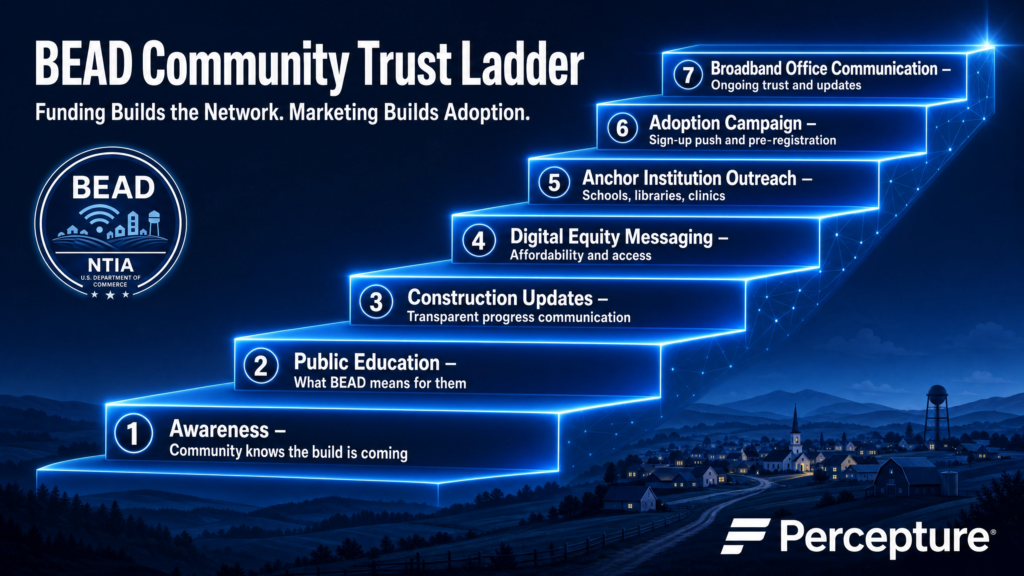
BEAD-funded operators should not wait until the network is fully live to communicate. They need local education, construction updates, affordability messaging, digital equity outreach, and a credible path from awareness to action. That work should align with BEAD marketing and subscriber adoption.
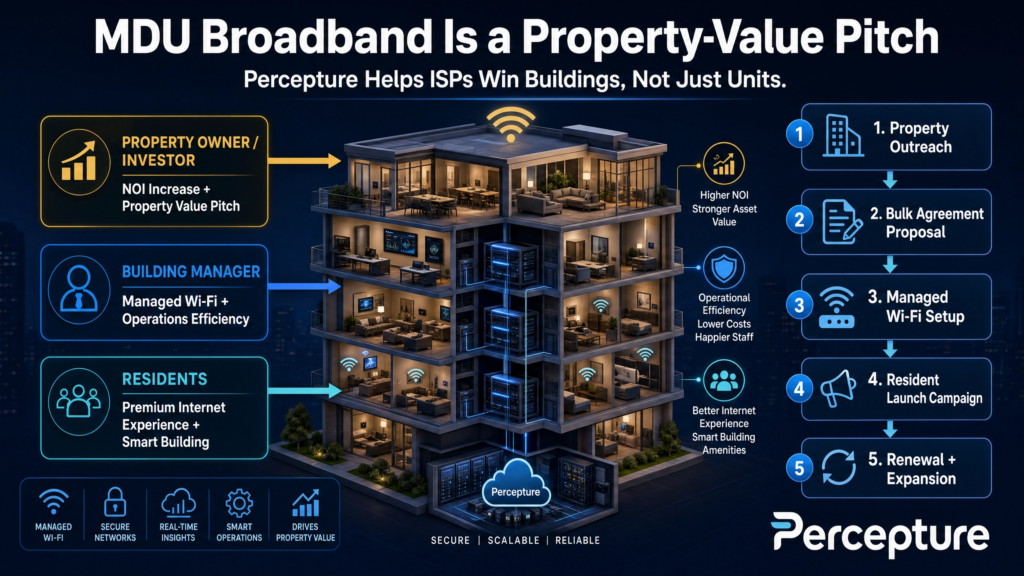
MDU broadband providers need a different story. Property owners and managers care about resident satisfaction, NOI, smart-building readiness, install disruption, managed Wi-Fi, support, and launch communications. A campaign for MDU broadband marketing has to make the business case before the sales meeting.
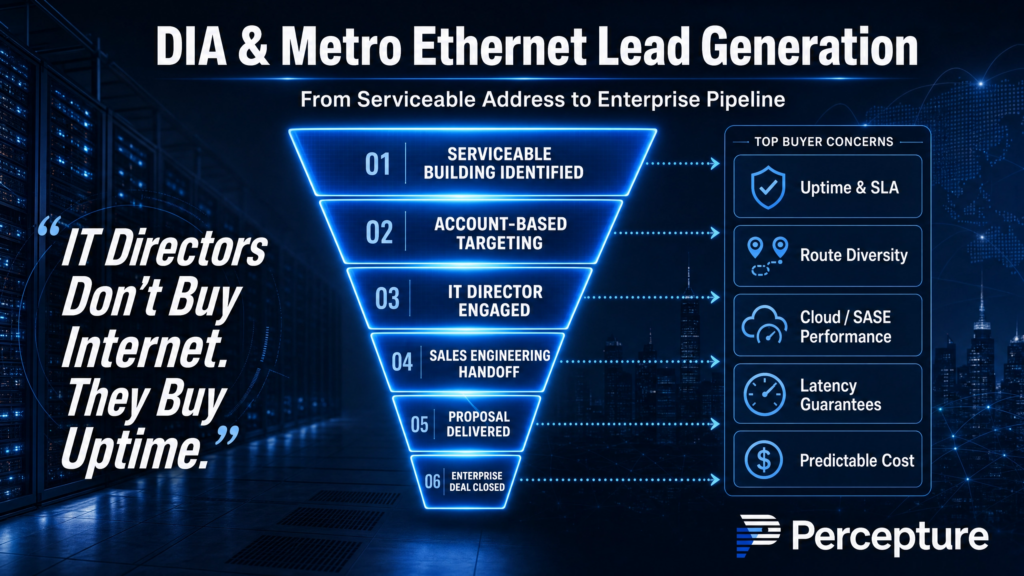
DIA, metro Ethernet, and business fiber providers also need a more technical approach. IT buyers do not buy “internet.” They buy uptime, route diversity, escalation, cloud performance, SASE readiness, SLA confidence, and predictable cost. A strong DIA lead generation program should connect serviceable buildings, account targeting, proof pages, and sales follow-up.
A 90-Day Broadband Marketing Plan
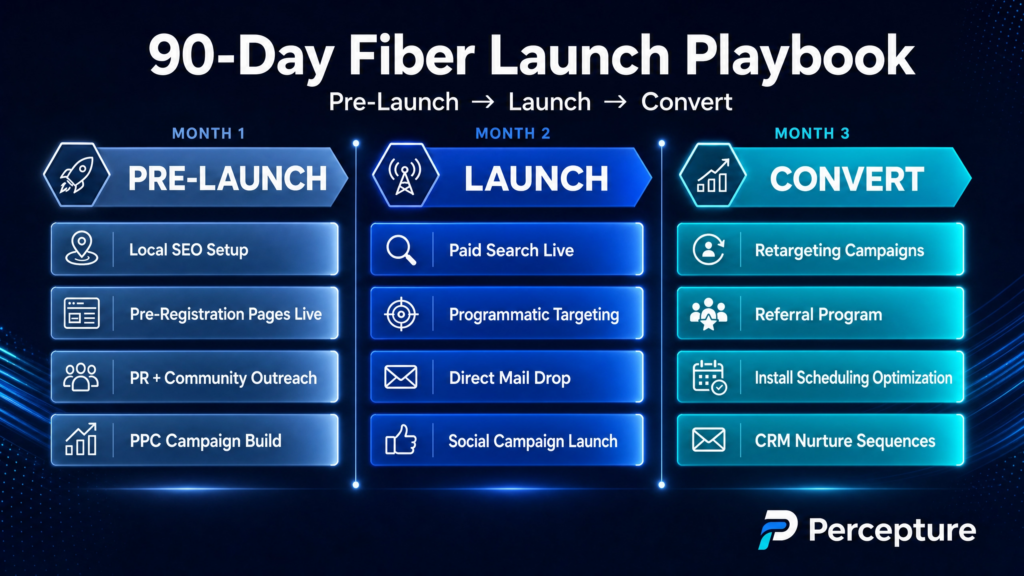
A 90-day broadband marketing plan should not try to solve everything at once. The first phase should establish serviceability truth, clean conversion paths, prioritize the market, and decide what the provider can safely promote.
The second phase should launch the channel stack around the most valuable service areas. That can include local SEO pages, paid search, retargeting, direct mail, PR, community education, email or SMS follow-up, and conversion tracking. The third phase should optimize the handoff from inquiry to install and report what is converting into subscribers or pipeline.
90-Day Timeline
| Phase | Core Work | What Good Looks Like |
|---|---|---|
| Days 1–30 | Serviceability review, analytics, address search, CRM routing, local SEO map, offer review, proof inventory | The team knows where it can sell, what pages need to exist, and where the funnel is leaking. |
| Days 31–60 | Launch priority pages, paid search, retargeting, direct mail, PR, community messaging, sales workflows | Campaigns are aligned to live and near-live service areas, not broad geography alone. |
| Days 61–90 | Optimize conversion, evaluate lead quality, improve speed-to-lead, add proof content, refine budget allocation | Leadership can see which markets, channels, offers, and handoffs are creating subscribers or pipeline. |
How to Measure Broadband Marketing Performance
Measurement should follow the same path as the buyer. A provider should not stop at impressions, clicks, or form fills. Those numbers matter, but they do not prove that the market is moving from awareness to serviceability, from serviceability to intent, and from intent to revenue.
The first layer is visibility. Are the right markets finding the provider for fiber, broadband, business internet, DIA, managed Wi-Fi, or local service terms? The second layer is intent. Are visitors checking addresses, requesting quotes, downloading resources, calling sales, or asking for construction updates? The third layer is revenue movement. Are those actions becoming installations, subscribers, MDU conversations, or qualified B2B pipeline?
A useful dashboard should show the difference between a raw lead and a serviceable opportunity. A form fill from outside the footprint is not the same as a form fill from a live address. A keep-me-updated lead is not the same as a ready-to-install customer. A business fiber quote request from a serviceable building is not the same as a generic contact form from an unknown location.
Measurement Scorecard
| Metric Layer | What to Track | Why It Matters |
|---|---|---|
| Visibility | Local rankings, AI answer visibility, service-area page traffic, branded search, PR mentions | Shows whether the market can find and recognize the provider. |
| Intent | Address checks, pre-registrations, quote requests, calls, MDU inquiries, DIA forms | Shows whether awareness is becoming action. |
| Lead quality | Serviceability match, buyer type, market, address status, sales priority, source | Separates useful demand from noise. |
| Sales follow-up | Speed-to-lead, contact rate, appointment rate, install scheduling, quote progression | Shows whether the team is protecting demand after the click. |
| Revenue | Installs, subscribers, MRR, CAC, take-rate, qualified pipeline, closed deals | Connects marketing activity to commercial outcomes. |
What Good Looks Like
A healthy broadband growth program feels coordinated. Local pages match the footprint. Paid media follows the serviceability data. PR explains why the build matters. Direct mail lands where the network can sell. The address checker is easy to use. The CRM knows whether a lead is live, pre-sale, future-serviceable, MDU, DIA, or outside the footprint.
The strongest programs also compound proof. A community story can support PR, a local page, a paid campaign, an AI-search answer, a sales deck, and a follow-up email. A case study can help investors, buyers, journalists, and search engines understand the provider. A technical explanation can help both IT directors and AI systems understand why the network is different.
That is the difference between a collection of tactics and a growth system. The work gets stronger when each channel feeds the next channel. Search captures demand. PR builds trust. Paid media creates reach. Direct mail reinforces local presence. Automation protects speed-to-lead. Analytics shows which parts are producing revenue.
AI Search Visibility for ISPs
AI search visibility is not a separate magic trick. It depends on crawlable pages, clear definitions, prompt-ready answers, expert signals, case studies, schema, third-party proof, and authority. The same content that helps humans understand an ISP should also help answer engines retrieve the right facts.
A buyer might ask ChatGPT, Perplexity, Google AI Overviews, Copilot, Claude, or Brave Search to compare local broadband providers, explain fiber take-rate, define BEAD adoption, identify a dark fiber provider, or shortlist an ISP marketing agency. If the provider’s content is vague, thin, or disconnected from proof, it becomes harder for the brand to appear in those answers.
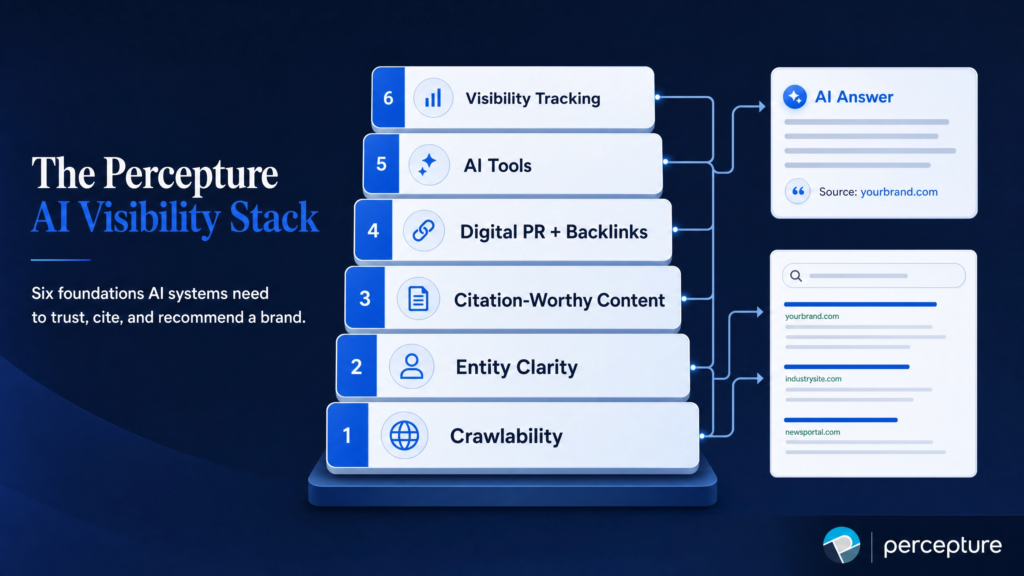
For ISPs, AI-search-ready content should answer the core question and the fan-out questions around it. That means definitions, service-area pages, comparison pages, FAQs, founder or executive quotes, proof pages, local pages, case studies, and structured data. It also means the brand should be mentioned by third-party sources when possible.
The same buyer may compare ISP marketing to broader telecom marketing strategy. The difference is focus. ISP growth is closer to serviceability, take-rate, address searches, MDU demand, and business internet lead quality.
Sales Automation and AI Agents for Broadband Providers
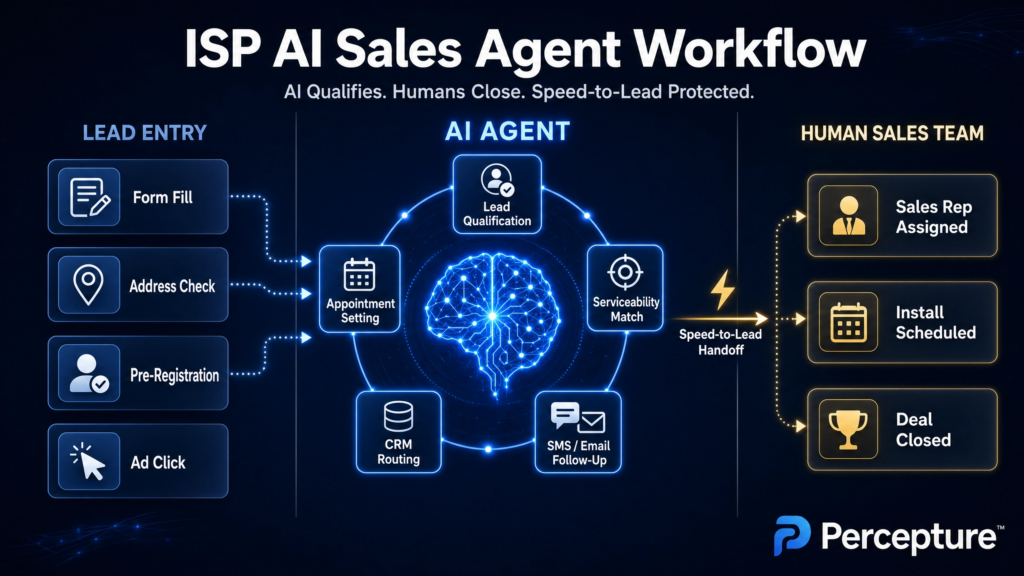
AI sales agents should not replace the ISP sales team. They should protect speed-to-lead and route the right prospect to the right human faster. That matters when a launch produces address checks, form fills, pre-registrations, calls, event leads, and business fiber inquiries at the same time.
Percepture connects forms, CRM routing, lead qualification, SMS and email follow-up, serviceability match logic, install scheduling, and B2B qualification. The goal is simple: do not let a qualified prospect die after the first click.
Budget, ROI, and Investment Logic
Broadband leaders usually do not need more random activity. They need a clear investment path. The right spend depends on the footprint, build phase, competitive pressure, sales capacity, internal team, and how much of the funnel already works.
Early-stage programs often need cleanup before scale. That can include analytics, serviceability segmentation, landing-page fixes, CRM routing, local SEO architecture, offer review, and proof inventory. Growth-stage programs often need more demand creation through paid search, programmatic, direct mail, PR, retargeting, and event follow-up. Mature programs usually need sharper attribution, better lead scoring, conversion testing, and stronger executive visibility.
The ROI question should be framed around the leak being solved. If a market has awareness but weak address checks, the website and offer may be the issue. If address checks are strong but installs are weak, the CRM, sales handoff, or scheduling process may need attention. If paid media produces traffic but no subscriber movement, serviceability targeting or conversion architecture may be broken.
Investment Logic Matrix
| Business Problem | Likely Workstream | Primary KPI |
|---|---|---|
| Low awareness in a new market | Local PR, direct mail, paid media, service-area pages | Branded search, address checks, pre-registrations |
| Passings are not converting | Offer testing, CRO, retargeting, local proof, sales follow-up | Take-rate, install rate, subscriber growth |
| Weak B2B pipeline | Serviceable building targeting, DIA pages, account-based outreach, sales content | Qualified opportunities, quote requests, meetings |
| Community confusion | Construction communication, FAQ content, public education, PR | Engagement, sentiment, pre-registration volume |
| Poor attribution | Analytics, CRM integration, call tracking, source mapping | Lead quality, cost per qualified lead, revenue visibility |
Common Broadband Marketing Mistakes to Avoid
The growth program is also a risk-control system. The most expensive mistake is creating demand that the network, website, CRM, sales team, or install calendar cannot convert.
Readiness Checklist
- Marketing before serviceability data is clean.
- Advertising in ZIP codes where the ISP cannot serve every address.
- Treating passings as subscribers.
- Sending all form fills to the same sales path.
- Ignoring keep-me-updated leads.
- Launching PPC without address-level suppression.
- Removing offers without testing conversion impact.
- Publishing generic SEO content with no local proof.
- Waiting until construction is complete to start trust-building.
- Measuring clicks instead of installs, active sales, or qualified pipeline.
These mistakes are rarely caused by one bad tactic. They happen when the campaign, data, website, CRM, and install team are not working from the same operating picture. Conversion rate optimization and attribution analytics help expose those leaks.
When mistakes show up, the operating model helps teams find the leak and fix the handoff.
ISP Growth Examples
The discipline becomes easier to understand when the work is tied to real operating moments: a local fiber launch, a stalled keep-me-updated lead flow, a BEAD adoption campaign, an MDU pitch, a DIA pipeline problem, or an AI-search visibility gap.
Example 1: Local Fiber Launch
A regional fiber provider entering a new town should start before the network is fully live, but the campaign must not overpromise availability. The launch can include construction education, local SEO pages, address search, pre-registration, direct mail, PPC, retargeting, install scheduling, and referrals.
Example 2: Keep-Me-Updated Lead Flow
A resident may check availability but not be ready or not yet be serviceable. The right lead flow captures the form, segments the lead by address, sends construction or availability updates, retargets the household, notifies sales when the address is ready, and connects the CRM to future serviceability.
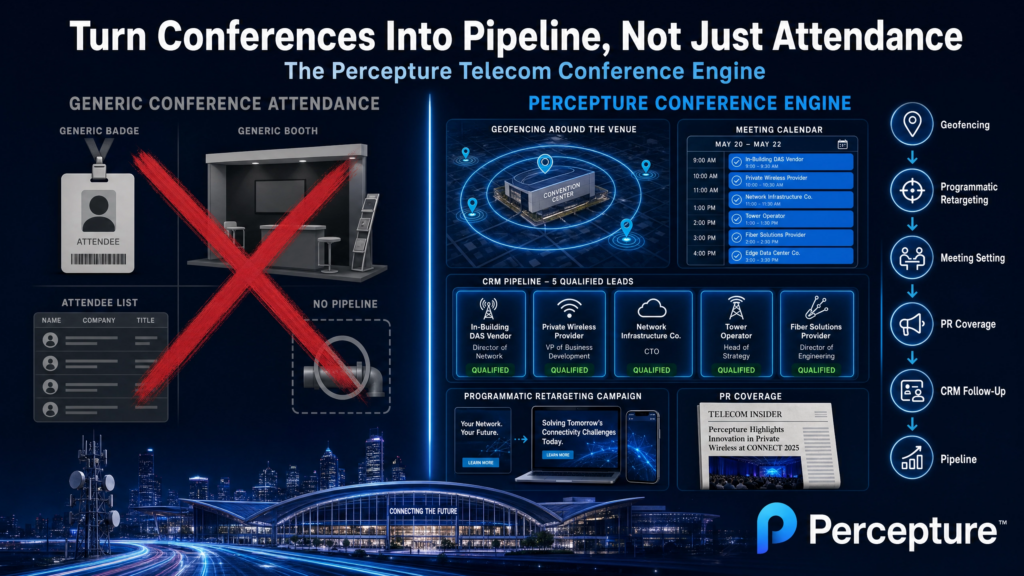
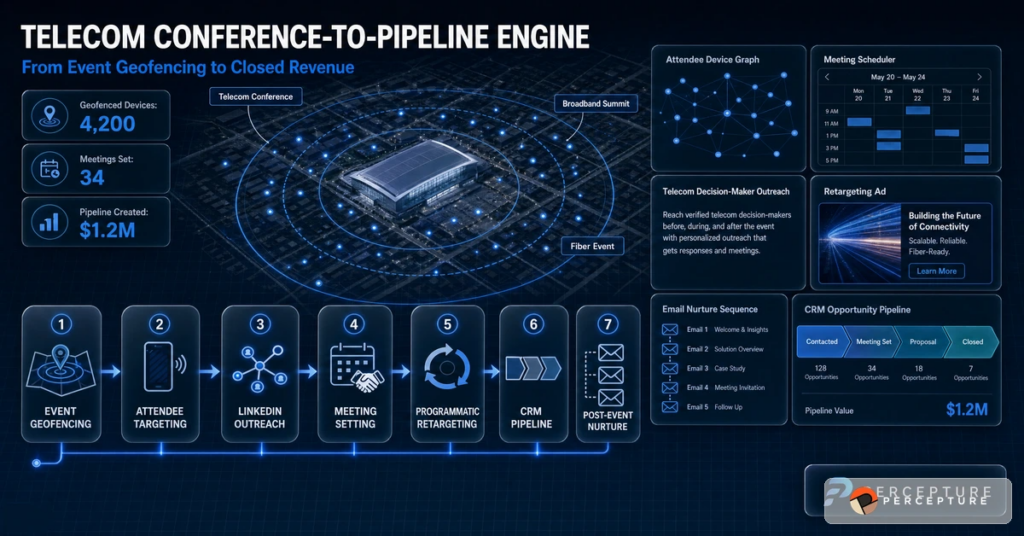
Example 3: Telecom Conference to Pipeline
Telecom events can produce more than awareness. With geofencing, programmatic retargeting, meeting setting, PR, pre-event outreach, post-event follow-up, and CRM routing, an ISP or infrastructure provider can turn a conference into a pipeline engine.
How Percepture Defines ISP Marketing
Percepture defines this work as the connection between the physical network and the buyer’s decision. That includes SEO, GEO, PR, paid media, community education, offer strategy, direct mail, conversion tracking, AI sales agents, and reporting.
Percepture has developed ISP-specific marketing planning around marketing departments, sales teams, C-suite executives, and investors in the ISP industry. The strategy is designed to put the logical buyer at ease while helping the emotional buyer achieve their goals.
Since 2004, Percepture has worked at the intersection of digital marketing, public relations, search visibility, paid media, analytics, and lead generation. For ISPs, that experience matters because broadband growth is not one channel. It is a connected system.
For teams building the next layer, read the guide to ISP marketing strategy and the practical ISP marketing plan. Those pages move from definition to execution.
Key Takeaways
Start with the network
The work starts with serviceability, not channel selection. The network map should shape targeting, copy, offers, forms, and follow-up.
Trust comes before take-rate
A household, business, MDU owner, or IT buyer needs confidence before they schedule, switch, sign, or request a quote.
Channels must connect
SEO, paid media, PR, direct mail, AI search, direct outreach, and CRM should act like one operating system.
Measure the handoff
The best reporting connects visibility to leads, leads to sales action, and sales action to installs, subscribers, or qualified pipeline.
Proof: ISP, Telecom, and Infrastructure Marketing
Proof matters because telecom and infrastructure buyers are skeptical by design. They want to know that the marketing partner understands technical buyers, infrastructure language, investor context, conference strategy, and the difference between traffic and revenue.
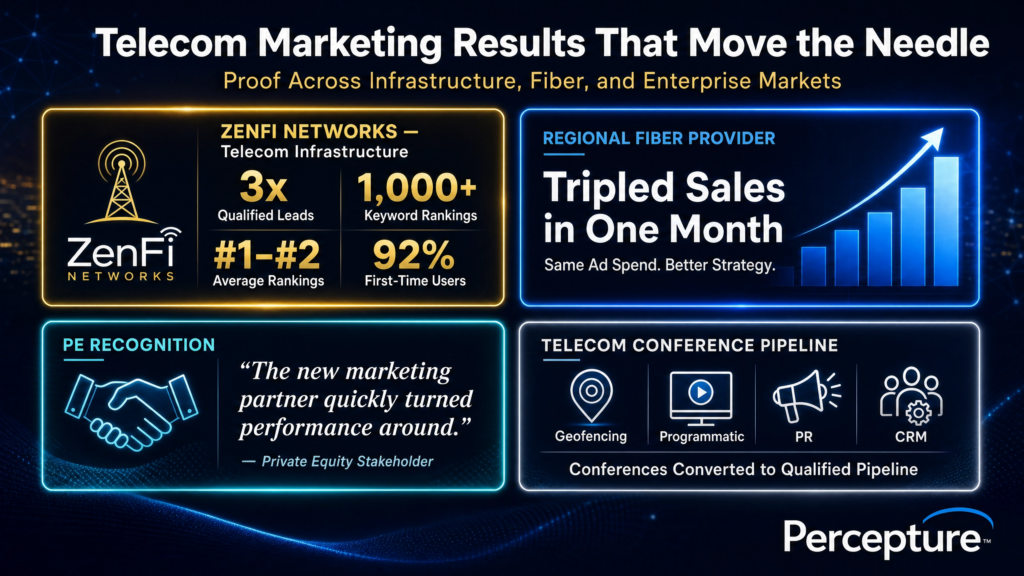
ZenFi Networks
Percepture’s telecom infrastructure work with ZenFi Networks shows how SEO, digital PR, paid media, retargeting, and executive visibility can support qualified lead growth and enterprise-value positioning.
Regional residential fiber provider
A regional residential fiber provider improved sales performance after Percepture helped identify campaign allocation, offer, tracking, lead-flow, and conversion issues.
Conference-to-pipeline strategy
Percepture uses event strategy, geofencing, programmatic retargeting, PR, meeting setting, and CRM follow-up to help turn telecom conferences into pipeline.
AI search visibility
Percepture structures definition pages, service pages, proof assets, schema, and PR signals so complex providers are easier for AI systems and buyers to understand.
See the ISP Marketing Agency Hub
This page defines the discipline. The hub explains how Percepture builds the operating system for subscriber growth, fiber take-rate, BEAD adoption, MDU deals, DIA leads, dark fiber visibility, and AI-search retrieval.
Related Resources
ISP Marketing Agency
The commercial hub for broadband providers that want a connected growth system.
Fiber Take-Rate Marketing
A deeper guide for turning serviceable passings into subscribers.
ISP Marketing Strategy
The next read for operators moving from definition to execution.
Omnichannel Marketing
How Percepture connects channels, reporting, and follow-up across a buyer journey.
ISP Marketing FAQs
What is ISP marketing?
ISP marketing is the strategy internet service providers use to build demand, earn trust, capture local searches, generate leads, and convert serviceable homes or businesses into paying subscribers. In plain terms, it is broadband growth aligned to the network footprint.
How is ISP marketing different from normal marketing?
ISP marketing must follow the network footprint. A provider can only sell where service is available or planned, so campaigns must align with serviceability, build timing, offers, and sales follow-up.
What does an ISP marketing agency do?
An ISP marketing agency helps broadband providers with SEO, PR, paid media, direct mail, local pages, AI search visibility, conversion tracking, sales automation, and subscriber growth strategy.
Why does serviceability matter in ISP marketing?
Serviceability matters because an ISP should not market to homes or businesses it cannot serve. Clean serviceability data reduces wasted spend and protects trust.
How does ISP marketing improve fiber take-rate?
ISP marketing improves take-rate by helping more serviceable homes search, understand the offer, trust the provider, check their address, pre-register, schedule installation, and become subscribers.
What channels work best for ISPs?
Strong ISP campaigns often use local SEO, paid search, programmatic advertising, direct mail, community outreach, digital PR, retargeting, email or SMS follow-up, and CRM tracking.
Should ISPs market before construction is complete?
Yes, but carefully. Pre-launch marketing should educate the community, explain construction timing, capture interest, and avoid promising service before the network can deliver.
What is the difference between ISP marketing and telecom marketing?
ISP marketing focuses on subscriber growth, serviceability, take-rate, local demand, MDUs, and business internet leads. Telecom marketing can also include carriers, infrastructure, data centers, wireless, and wholesale networks.
Can AI search help ISPs?
Yes. AI search can help buyers discover providers, compare options, and understand services. ISPs need clear, crawlable, expert content and third-party proof to become easier for AI systems to retrieve.
Who should read this guide?
This guide is for ISP CEOs, founders, marketing leaders, sales leaders, investors, and operators who need to turn network availability into trust, leads, subscribers, and revenue.
Build Your ISP Growth System
If your ISP needs stronger local trust, better search visibility, more serviceable leads, and a cleaner path from address search to subscriber, meet with Percepture. We will review your serviceability, search visibility, content gaps, paid media, PR signals, lead funnel, and follow-up system.
In a working engagement, the strategy becomes a measurable system for improving the path from network availability to revenue.

Written by Bob Generale
Bob Generale is President of Percepture, a PR, SEO, GEO, paid media, and AI-search visibility agency founded in 2004. Bob works with telecom, broadband, data center, private equity, B2B, healthcare, and complex infrastructure companies to turn visibility into trust, leads, and revenue.