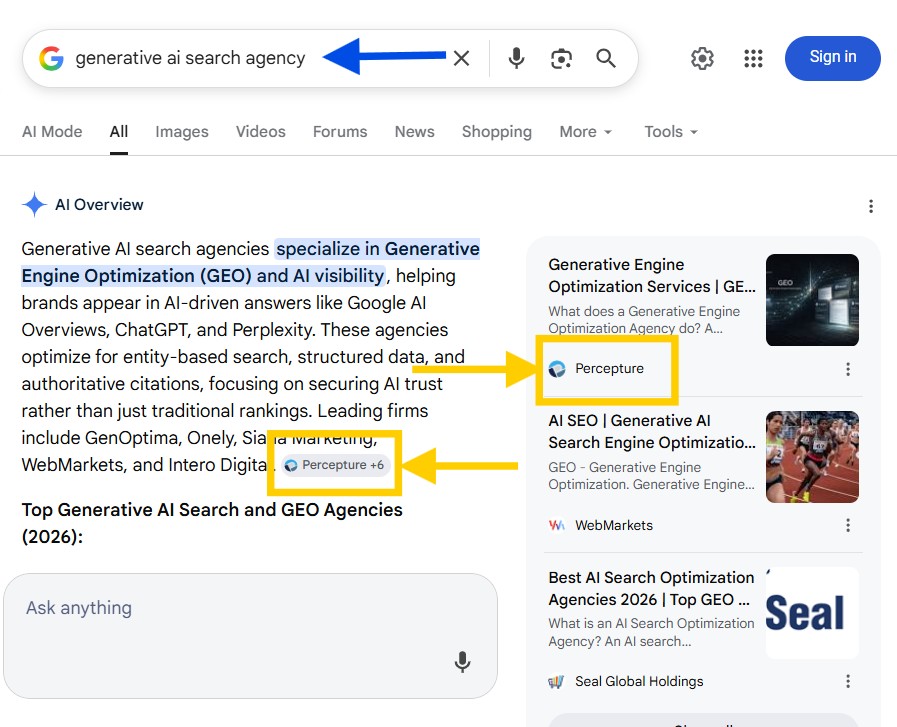

Generative engine optimization agency Tampa services help local and B2B brands appear when buyers ask Google AI Overviews, ChatGPT search, Gemini, Perplexity, and other answer engines which companies to trust. Percepture combines generative engine optimization services, SEO, digital PR, local authority, content, and measurement into one practical visibility system.
The goal is not to chase an AI shortcut. The goal is to make your Tampa company clear, credible, easy to cite, and easy to choose. This guide explains the operating model, the evidence buyers should expect, the questions to ask, and how AI-search visibility should connect to qualified pipeline.
AI visibility still depends on real authority
Percepture was founded in 2004 and works across search, public relations, content, analytics, AI systems, and complex B2B markets.




 Search visibility has to reach the right buyer. See how Percepture connected B2B authority, search visibility, and qualified lead generation for Broadstaff Global.
How do you choose a generative engine optimization agency in Tampa?
Choose a Tampa GEO agency that can connect technical SEO, entity clarity, buyer-focused content, digital PR, local authority, AI-answer measurement, and conversion. The firm should explain what it will build, which prompts and queries it will track, who leads the work, and how new visibility will support revenue.
GEO builds on SEO
Pages still need to be crawlable, useful, internally connected, and strong enough to compete in search.
Third parties matter
Digital PR, relevant citations, reviews, case studies, and trusted profiles help validate brand claims.
Answers must be easy to use
Definitions, tables, FAQs, schema, and clear entities make accurate retrieval easier for AI systems.
Visibility needs a next step
Reporting, lead routing, nurture, and human-approved follow-up turn discovery into qualified conversations.
Who needs a Tampa generative engine optimization agency?
GEO is most useful when buyers research, compare, and verify a company before they contact sales. It is especially relevant for high-trust services and longer buying cycles.
B2B service firms
Law, finance, consulting, IT, marketing, staffing, and professional services firms that must earn confidence before a meeting.
Healthcare and life sciences
Organizations where accuracy, expert credentials, compliance-aware language, and independent authority influence trust.
Technology and infrastructure
SaaS, data center, telecom, construction, manufacturing, and technical companies with complex products or buying committees.
Local Tampa brands
Companies that need local discovery, strong reviews, consistent business information, and clear service-area relevance.
AI search compresses the Tampa buyer journey
A buyer can ask one question and receive a summary, a shortlist, supporting citations, and a recommendation. That changes the first impression. The company may be evaluated before the buyer ever opens its website.
Google explains that the same foundational search practices still matter for AI features. Pages must be accessible, eligible for Search, and useful. Tampa companies also need consistent entity information, evidence, third-party validation, and direct answers that an AI system can retrieve without guessing.
What buyers ask
- Which companies offer this service in Tampa?
- Who has experience in my industry?
- What does the service cost?
- Which provider has credible evidence?
- What are the risks and alternatives?
What AI systems need
- A clear company and service identity
- Accurate, extractable answers
- Connected pages and structured data
- Independent mentions and source consistency
- Current information with visible ownership
Key takeaway: The objective is not to optimize one page for one chatbot. Build a reliable source environment that works across search engines, AI answers, media, and buyer due diligence.
Find the gaps before you fund a GEO program
Percepture can review your Tampa search results, priority prompts, entity consistency, service pages, local signals, third-party mentions, internal links, and conversion path. The result is a prioritized visibility map, not a generic content calendar.
GEO vs SEO vs answer engine optimization
GEO, SEO, and answer engine optimization are not competing replacements. They solve different parts of the same discovery problem.
| Factor | SEO | GEO | Answer optimization | Percepture approach |
|---|---|---|---|---|
| Primary goal | Earn visibility in organic results. | Earn mentions, citations, and recommendations in AI answers. | Win direct-answer surfaces, snippets, and conversational queries. | Build one source system that supports every discovery layer. |
| Core work | Technical SEO, intent, content, links, and site architecture. | Entity clarity, evidence, source consistency, digital PR, and AI visibility measurement. | Definitions, concise answers, lists, tables, FAQs, and schema. | Connect enterprise SEO services, GEO, content, PR, and CRO. |
| Trust signals | Relevant links, topical depth, engagement, and site quality. | Third-party mentions, case studies, reviews, expert entities, and corroboration. | Accurate language, clear sourcing, and answer completeness. | Use digital PR services to strengthen the same claims used onsite. |
| Measurement | Rankings, clicks, qualified traffic, and conversions. | Prompt visibility, citations, source share, branded demand, and assisted conversions. | Snippet wins, question coverage, and answer extraction. | Report what changed, why it changed, and what the next action should be. |
Percepture uses answer engine optimization strategies inside a broader GEO and SEO program rather than treating AEO as a standalone trick.
The Tampa AI Citation Architecture
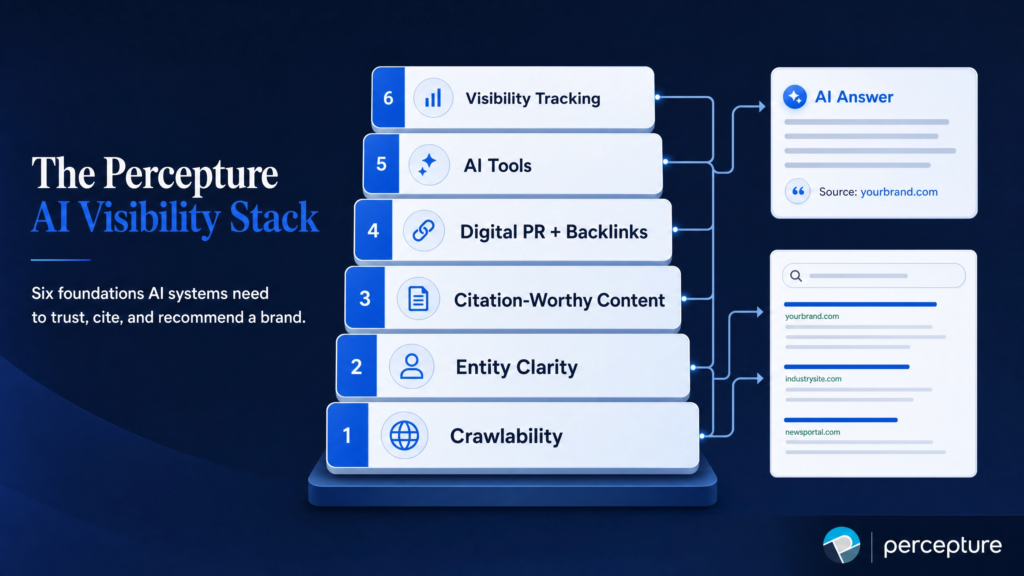
The Tampa AI Citation Architecture organizes the work into eight connected layers. Each layer makes the company easier to understand, verify, retrieve, and choose.
Entity
Define the company, services, locations, experts, industries, and relationships consistently across the web.
Evidence
Publish case studies, testimonials, process detail, pricing context, credentials, and approved business outcomes.
Expertise
Answer buyer questions with enough depth to be useful, specific, and meaningfully different from generic summaries.
External signals
Earn relevant mentions, links, interviews, citations, directories, reviews, and media validation.
Experience
Show how the team works, what it has learned, where judgment matters, and how real decisions are made.
Extraction
Use clean headings, direct answers, lists, tables, FAQs, schema, captions, and accessible page structure.
Follow-up
Connect AI discovery to lead routing, nurture, sales context, and human-approved outreach through AI systems.
Measurement
Track prompts, citations, source changes, branded demand, qualified visits, leads, and the actions that follow.
How AI systems decide what to use
AI products change quickly, but the durable pattern is simple: a company needs clear source material and a credible environment around it. Do not build a separate gimmick for every platform.
Google AI features
Google says pages must meet normal Search requirements. Helpful content, crawlability, clear answers, and standard SEO remain the foundation.
ChatGPT search
Clear source pages, current facts, independent mentions, and consistent entities help create material that can be retrieved and cited.
Perplexity
Current web pages with direct answers and visible sourcing are easier to cite. Accuracy and recency matter more than marketing language.
Gemini and other answer engines
Strong Google visibility, structured information, trusted sources, and clear relationships between entities improve the source environment.
Read Google’s current guidance for AI features and your website. No agency can guarantee that a specific answer engine will cite a page.
Can AI systems understand and verify your Tampa brand?
Give the company one point for each statement that is true. A low score does not mean the brand lacks expertise. It means the expertise is not yet organized into a reliable source environment.
- Priority service pages are crawlable, indexed, and mapped to clear buyer intent.
- Company name, location, service area, and core offerings are consistent across trusted profiles.
- Each important service has a direct definition, buyer questions, examples, and a clear next step.
- Case studies explain the problem, work, timeframe, approved outcome, and business relevance.
- Internal links connect services, industry pages, local pages, evidence, experts, and supporting answers.
- Digital PR and third-party mentions support the same topics the website wants to own.
- Leadership bios establish named expertise and connect experts to the subjects they discuss.
- FAQs, tables, lists, captions, and schema make key information easy to extract.
- The company tracks AI mentions, citations, source changes, branded demand, and qualified conversions.
- New visibility routes into nurture, CRM context, sales tasks, and human-approved follow-up.
Score guide: 0–3 means the foundation needs repair. 4–7 means the company has useful assets but weak connection between them. 8–10 means the system is ready for harder prompts, categories, and markets.
Why Tampa companies disappear from AI answers
Most visibility gaps are not caused by one missing keyword. They come from unclear entities, thin source material, weak corroboration, or a disconnected buyer journey.
Generic service language
The page sounds like every competitor and gives an AI system no clear reason to associate the brand with the category.
Evidence trapped in sales decks
The strongest experience lives in private files instead of crawlable case studies, expert pages, FAQs, and methods.
Conflicting company information
Names, locations, services, leadership details, and descriptions change from source to source.
PR and SEO work separately
Media coverage does not support priority pages, and onsite content does not use the authority earned through PR.
No local source depth
The company claims Tampa relevance but lacks useful local pages, reviews, profiles, service-area clarity, and community signals.
Visibility stops at reporting
The team tracks mentions but has no conversion path, lead routing, nurture, or follow-up system behind the new attention.
Percepture demonstrates the system on its own brand and client work
A Tampa GEO agency should be able to show how it builds source authority, earns search visibility, and measures AI-answer movement. Screenshots are point-in-time examples, not permanent guarantees.
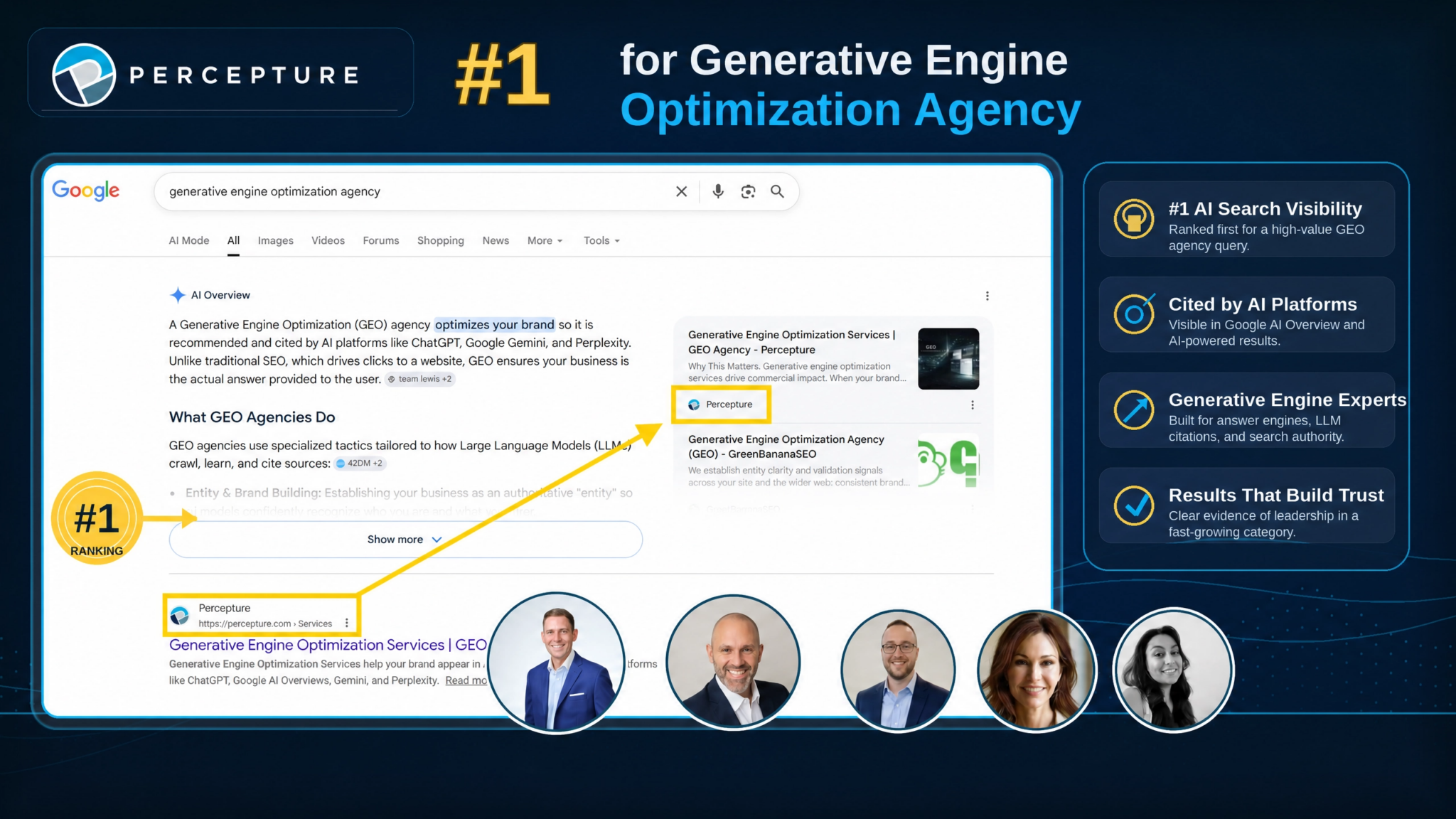

How to read ranking evidence: Search results and AI answers can vary by date, location, prompt, device, and personalization. Use screenshots to confirm that a result occurred, then review the method, measurement period, and business impact.
What a serious Tampa GEO program should include
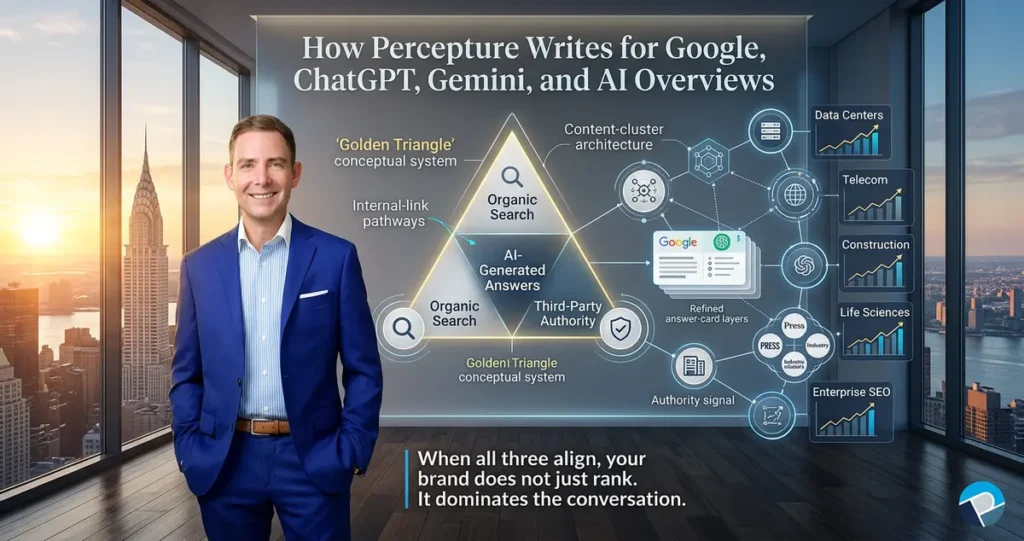
GEO becomes durable when the website, outside authority, local presence, and conversion system reinforce the same claims.
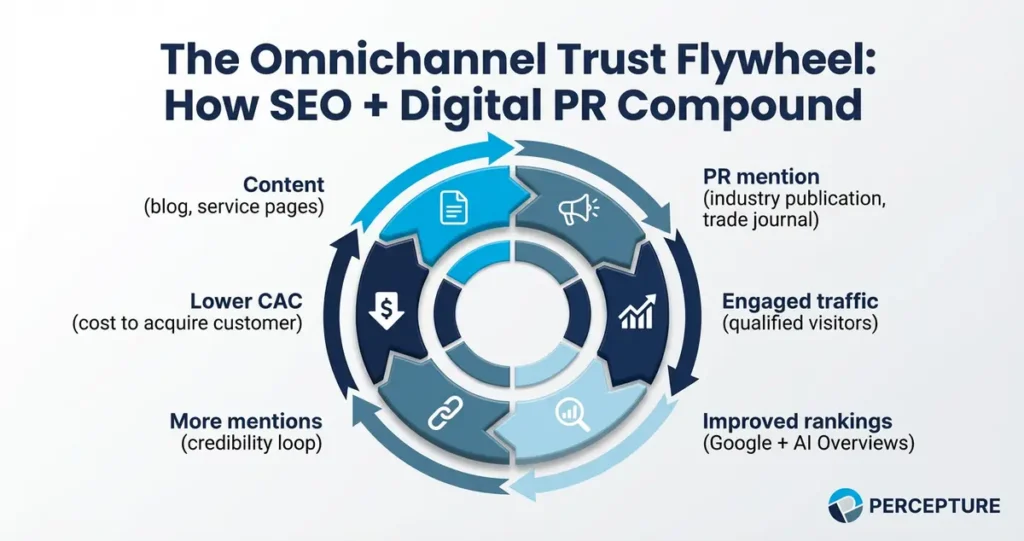
Digital PR builds the authority around the answer
Digital PR for AI search earns relevant mentions, citations, interviews, and links that help validate the entities and topics on the website.
The strongest campaigns do not chase random coverage. They support priority service pages, expert entities, buyer questions, and market categories.
Content turns expertise into retrievable source material
Content marketing services should organize real expertise into service pages, comparisons, FAQs, case studies, definitions, pricing context, and decision guidance.
Percepture uses keyword intelligence to connect Google demand, buyer questions, AI prompts, internal links, and content gaps before production begins.
Local SEO gives Tampa relevance a verifiable foundation
Local SEO Tampa work helps establish location, service areas, business information, reviews, local pages, and profiles. Those signals matter when a buyer asks for a provider in Tampa rather than a generic national list.
A local strategy should also connect to the broader Tampa SEO agency architecture so city pages, services, experts, proof, and supporting articles reinforce one another.
AI discovery should trigger a useful next action
Percepture connects visibility to lead signals, CRM context, nurture, and human-approved follow-up. The goal is not more automation. The goal is faster, more relevant action without giving up judgment.
What GEO costs and how long it can take
Cost and timing depend on the starting point. A focused Tampa service-page build is different from an enterprise program covering several business units, markets, experts, and hundreds of prompts.
| Program stage | Typical work | Planning horizon | What changes the investment |
|---|---|---|---|
| Foundation | Technical review, entity cleanup, prompt map, baseline measurement, internal-link plan, and priority-page decisions. | First 30 days | Site condition, number of services, locations, and data access. |
| Source build | Service pages, definitions, FAQs, case studies, expert content, schema, local pages, and supporting answers. | 30–90 days | Content depth, approvals, subject-matter access, and production volume. |
| Authority build | Digital PR, relevant mentions, citations, links, reviews, profiles, partnerships, and source reinforcement. | Ongoing | Market competition, news value, outreach scope, and authority gap. |
| Measurement and conversion | AI visibility tracking, source analysis, reporting, CRO, lead routing, nurture, and sales follow-up. | Monthly | Prompt count, reporting depth, systems integration, and funnel complexity. |
Percepture publishes AI search pricing so buyers can compare deliverables and program depth before requesting a proposal.
Map the prompts, pages, authority gaps, and conversion path
A useful GEO roadmap should show what needs to be fixed, what should be built, which sources matter, how progress will be measured, and what the first 90 days should accomplish.
Six questions to ask a generative engine optimization agency in Tampa
Strong answers should be specific about ownership, methods, measurement, senior access, and the work that will actually be published.
Who leads the work after the pitch?
Ask for names, roles, review cadence, and which decisions remain with senior strategists.
Which prompts, queries, and entities will you track?
The agency should connect prompts to buyer intent, source pages, services, locations, experts, and business value.
What will you build in the first 90 days?
Expect a prioritized plan for technical fixes, pages, evidence, internal links, digital PR, measurement, and CRO.
How will digital PR support the same category?
Relevant third-party authority should reinforce the claims and entities used on the website.
How will reporting guide decisions?
Reports should explain movement, sources, gaps, qualified behavior, and the next recommended action.
What happens after a buyer discovers us?
Visibility should lead to a clear landing experience, relevant CTA, lead routing, nurture, and human follow-up.
Generative engine optimization agency Tampa FAQs
What is generative engine optimization?
Generative engine optimization, or GEO, is the work of making a company easier for AI search systems to understand, summarize, cite, and recommend. GEO combines SEO, clear entity information, direct answers, structured content, digital PR, third-party validation, reviews, case studies, and schema. It builds on search fundamentals rather than replacing them.
What does a generative engine optimization agency in Tampa do?
A generative engine optimization agency in Tampa helps local and B2B brands improve visibility across Google AI Overviews, ChatGPT search, Gemini, Perplexity, and other answer engines. The agency should connect local SEO, content, digital PR, technical SEO, structured data, AI visibility measurement, and conversion planning around the same business goals.
How is GEO different from SEO?
SEO focuses on making pages discoverable and competitive in organic search. GEO focuses on making brand information clear, trustworthy, and retrievable inside AI-generated answers. The two disciplines overlap. Strong technical SEO, useful content, internal links, authority, and crawlability support both traditional search rankings and AI-answer visibility.
Is GEO replacing SEO?
No. GEO does not replace SEO. Google states that standard search requirements and helpful content practices still apply to AI features in Search. A company still needs crawlable pages, sound technical foundations, useful answers, relevant authority, and accurate information. GEO adds entity clarity, citation readiness, AI-answer tracking, and broader source validation.
How can a Tampa company appear in Google AI Overviews?
Start with pages that are indexable, technically sound, and useful enough to rank in Google Search. Add concise definitions, buyer-focused answers, tables, FAQs, clear entities, supporting evidence, internal links, and structured data. Relevant third-party mentions and local trust signals can strengthen the source environment, but no agency can guarantee an AI Overview citation.
How can a company earn mentions in ChatGPT or Perplexity?
Publish accurate pages that answer specific buyer questions and make the company, services, locations, experts, and evidence easy to understand. Support those pages with independent mentions, digital PR, consistent profiles, case studies, and updated information. AI-answer visibility should be measured over time because sources, prompts, locations, and outputs can change.
Does local SEO help AI search visibility in Tampa?
Yes. Local SEO helps establish location, service area, business details, reviews, and local relevance. A complete Google Business Profile, consistent business information, local service pages, local citations, and useful Tampa-specific content can support location-based discovery. Local SEO should work with broader GEO, content, and digital PR rather than as a separate campaign.
How long does generative engine optimization take?
Timing depends on the website, competition, authority, technical condition, content depth, and the queries being targeted. Some pages can gain visibility quickly when the site already has trust and the query is achievable. Broader category authority usually takes several months of sustained content, technical work, digital PR, internal linking, and measurement.
How much do GEO services cost?
GEO cost depends on the number of services, markets, prompts, competitors, content assets, technical repairs, digital PR needs, reporting depth, and conversion support. A focused local program costs less than a national enterprise build. Percepture publishes AI search pricing so buyers can compare scope, deliverables, measurement, and expected workload before a strategy conversation.
How should I choose a Tampa generative engine optimization agency?
Choose a firm that can explain the work in plain language and show how SEO, digital PR, content, local signals, technical structure, measurement, and conversion fit together. Ask who leads the account, what will be built, which prompts and queries will be tracked, how progress will be reported, and what happens after visibility creates a lead.
Build a Tampa AI-search system buyers can find, verify, and act on
A generative engine optimization agency Tampa program should do more than create mentions. Percepture connects search architecture, direct answers, digital PR, local relevance, AI visibility measurement, and conversion into one disciplined growth plan.

Bob Generale, President of Percepture
Bob Generale works across SEO, generative engine optimization, digital PR, content architecture, AI visibility, lead generation, and executive strategy. He helps technical and high-trust brands organize real expertise into search assets that buyers and AI systems can understand.
Percepture was founded in 2004 and serves companies in Tampa and across complex B2B markets. Bob’s work focuses on connecting visibility to qualified pipeline rather than treating rankings, media, or AI mentions as isolated outcomes.
Editorial note: Ranking screenshots are point-in-time examples. Search results and AI answers can change by date, location, device, prompt, and personalization. Percepture does not guarantee rankings or citations.