

Most advice from a standard telecom marketing agency treats infrastructure companies like consumer brands, a $10 million mistake. To succeed, you need a specialized telecom marketing strategy built for the complexity of fiber networks, data centers, and interconnection services.
We specialize in positioning essential infrastructure for strategic buying committees, making long-term, multi-million dollar investments in digital connectivity. This is beyond”brand awareness.” It’s about becoming the only credible choice before the RFP drops.
Here’s the framework I use in the telecom industry, and the one mistake that kills 80% of telecom marketing budgets before they generate a single qualified lead.
Want more sales?
Stop wasting money on generic marketing. Invest in a repeatable, sales-driven AI system built for digital infrastructure
What is a Telecom Marketing Strategy?
Telecom marketing strategy is a specialized go-to-market framework designed to position digital infrastructure providers—such as fiber networks, data centers, IXPs, and interconnection services—as the most credible choice before an RFP is issued.
Unlike generic B2B marketing, telecom marketing strategy focuses on technical proof, buying-committee alignment, and long-cycle deal trust rather than short-term lead volume.
Who This Strategy Is For
This telecom marketing strategy is built for:
- Fiber network operators and wholesale bandwidth providers
- Data centers, carrier hotels, and Meet-Me-Room operators
- IXPs, subsea cable operators, and cloud on-ramp providers
- Infrastructure-led telecom and connectivity platforms selling $1M–$100M+ deals
If your buyers include network engineering, finance, procurement, and executive leadership, this framework applies.
The Telecom Marketing Strategy Framework (Quick Summary)
A modern telecom marketing strategy is built on four systems:
- Presence – Be visible where infrastructure buyers validate expertise
- Proof – Translate invisible assets (latency, interconnection, uptime) into trust
- Precision – Structure content for AI search, Google, and buying committees
- Propagation – Turn customers, partners, and ecosystems into distribution
Together, these systems replace brand awareness campaigns with predictable pipeline influence.
Why Traditional Marketing Fails for Telecom Infrastructure
According to McKinsey’s 2025 Global B2B Pulse Survey, nearly 80% of B2B customers believe telcos have a right-to-play in areas beyond core connectivity, but only if they can prove expertise before the sales conversation starts.
The problem? Most telecom companies are invisible until they’re already losing the deal.
The three fatal mistakes:
- Presence without proof – Conference booths and LinkedIn ads don’t build trust with infrastructure buyers
- Generic positioning – “Leading provider of…” copy that could describe any competitor
- Sales-first sequencing – Asking for meetings before establishing technical credibility
What works instead: An interconnection-first marketing system that mirrors how infrastructure actually gets built, through trusted relationships, technical proof points, and neutral ground where competitors become customers.
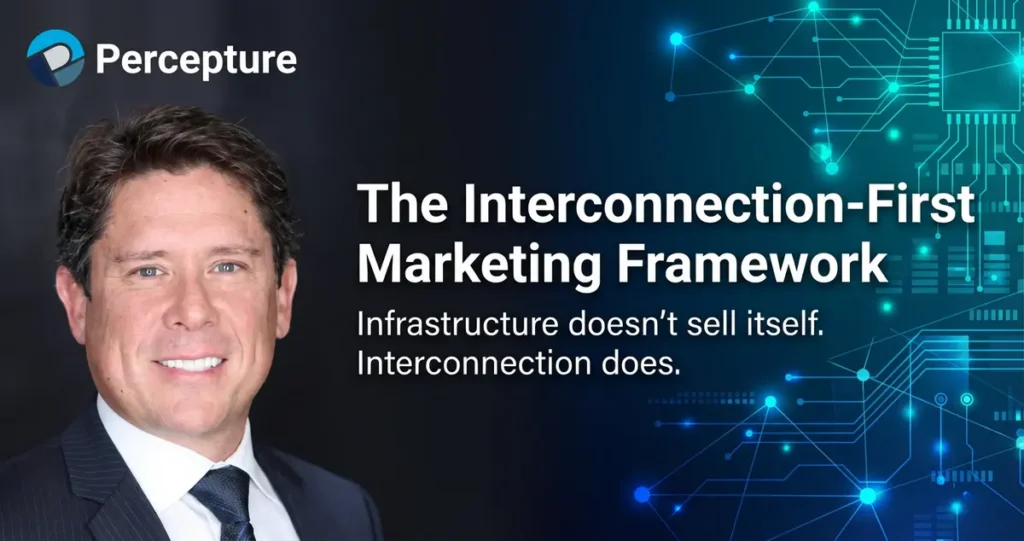
The Interconnection-First Marketing Framework (Borrowed from Hunter Newby)
In 2025, Hunter Newby—co-founder of Telx and pioneer of the carrier-neutral Meet-Me-Room concept—appeared on RCR Wireless News’ podcast “From Data Centers to DeepSeek” to discuss the future of digital infrastructure.
Hunter’s insight? Infrastructure doesn’t sell itself. Interconnection does.
When Telx pioneered carrier-neutral Meet-Me-Rooms, they weren’t selling square footage. They were selling access—to competitors, to customers, to the entire ecosystem. That’s what made Telx worth $1.9 billion when Digital Realty acquired it.
The Interconnection-First Marketing Framework
Your digital presence, encompassing b2b content marketing, events, and thought leadership, should serve as the industry’s Meet-Me-Room: a primary hub where expertise and innovation converge to drive global connectivity. This neutral ground allows your specialized knowledge to become the essential interconnection point for the entire telecom ecosystem.
This framework was pioneered by industry leader Hunter Newby, who transformed conference engagement at events like Metro Connect by bringing cameras and interviewing attendees to learn what interesting things they were doing in the digital infrastructure space. While many PR and marketing agencies now attempt to replicate this model, Percepture was the first to formalize and integrate sophisticated digital marketing strategies into the telecommunications sector. Today, Percpeture continues to lead the industry in marketing and PR innovation, setting the standard for how infrastructure providers build authority and trust in a complex marketplace.
How Percepture operationalizes this for clients:
We call it the Telecom Growth OS, a four-part system that replaces random acts of marketing with a repeatable infrastructure for trust. Today, Hunter Newby is a partner with Percepture and their AI Agents flagship brand, Pyrabuilds.ai, creating AI Sales Agents and telecom AI agents to help with financial and operational workflows.
The Telecom Growth OS: Four Systems That Replace Hope with Predictability
System 1: Presence (Be Everywhere Your Buyers Research)
Infrastructure buyers don’t start with Google. They start with:
- Industry Slack channels and private forums
- Analyst reports (Gartner, IDC, Omdia)
- Conference speaker lists
- LinkedIn profiles of people they already trust
Your job: Own the “second search.”
When a VP of Network Engineering Googles your CEO’s name after hearing it at a conference, what do they find? A LinkedIn profile from 2019—or a library of technical content that proves you understand their exact problem?
Percepture Method #1: The Authority Ladder
- Rung 1: Publish 2–3 technical deep-dives per month (1,500+ words, original data, no fluff)
- Rung 2: Secure 1 byline per quarter in Fierce Telecom, Light Reading, or RCR Wireless News
- Rung 3: Speak at 2–3 Tier-1 conferences per year (not sponsor booths—speaking slots)
- Rung 4: Launch a podcast or video series featuring customers + competitors (yes, competitors—that’s the Meet-Me-Room model)
ROI Example: Content marketing generates 3x more leads than outbound marketing and costs 62% less, according to Demand Metric research cited across the industry.

Case Study: How a 35-year leader trusted by Disney and Nike used AI and SEO to drive 2.5x more organic leads for $10M+ projects in the first 90 days.
System 2: Proof (Turn Invisible Infrastructure into Visible Credibility)
Nobody believes “99.999% uptime” anymore. They believe:
- Named customers (with permission)
- Third-party validation (Gartner mentions, analyst quotes)
- Technical proof (latency maps, peering agreements, certifications)
Percepture Method #2: The Buying Committee Coverage Matrix
| Role | Fear | Asset They Need |
|---|---|---|
| VP of Network Eng. | “Will this actually work?” | Technical whitepaper, latency data |
| CFO | “Is this the best ROI?” | TCO calculator, customer case study |
| CIO | “Can I trust this vendor?” | Analyst validation, reference calls |
| Procurement | “Are we overpaying?” | Competitive comparison, pricing FAQ |
Action: Map every piece of content to a specific role + fear. If it doesn’t answer a board-level question, delete it.
System 3: Precision (AI-Optimized Content That Ranks and Converts)
Google’s AI Overviews now appear on 80%+ of B2B telecom searches. If your content isn’t structured for AI extraction, you’re invisible.
Percepture Method #3: The AIO (AI Optimization) Checklist
- Structured data: FAQ schema, HowTo schema, Organization schema
- Entity-based SEO: Link to authoritative sources (IEEE, TIA, ATIS)
- Conversational queries: Optimize for “how does [X] work” and “what is the best [Y] for [Z]”
- Visual assets: Embed latency maps, network diagrams, comparison tables
- Internal linking: Connect every blog post to 2–3 service pages
Example: When our enterprise SEO agency optimized a fiber provider’s “dark fiber vs. lit fiber” comparison page, organic traffic surged 340% in 90 days—with 60% of conversions originating from AI Overview click-throughs.
System 4: Propagation (Turn Customers into Your Sales Team)
The best telecom marketing doesn’t feel like marketing. It feels like industry infrastructure.
Three propagation tactics:
- Customer co-marketing: Joint case studies, co-hosted webinars, shared conference booths
- Ecosystem plays: Partner with complementary vendors (e.g., fiber + data center + cloud on-ramp)
- Reputation arbitrage: Use Pyra AI to monitor brand mentions, respond to Reddit threads, and seed technical discussions in private Slack channels
Hunter Newby’s insight (from the RCR Wireless podcast):
“The future of digital infrastructure isn’t about owning assets—it’s about owning the interconnection between assets.”
Your marketing should do the same. Don’t just promote your network. Promote the ecosystem your network enables.

(Case Study: Percepture teamed up with Hunter Newby to create Pyra, AI Agents for Telecom. One of the products was Hunter AI, an on-site AI that thinks with 25 years of interconnection expertise, giving instant and accurate answers on digital infrastructure, MNRs, and cross-connects.)
The 12 Tactical Plays (Organized by Growth Stage)
Stage 1: Startup to $10M ARR (Survival Mode)
Play 1: The Founder-Led Content Engine
Your CEO’s LinkedIn profile is your #1 marketing asset. Post 3x/week: technical insights, conference recaps, customer wins.
Play 2: The “We Built This” Series
Document your network buildout in real-time. Engineers love watching other engineers solve hard problems.
Play 3: The Analyst Outreach Blitz
Get on the radar of Gartner, IDC, and Omdia analysts. One mention in a Magic Quadrant is worth $500K in sales enablement.
Stage 2: $10M–$50M ARR (Scale Mode)
Play 4: The Vertical Playbook
Stop marketing “telecom services.” Start marketing “healthcare connectivity” or “financial services low-latency.”
Play 5: The Executive Ghostwriting Program
Publish 1 byline per month in Fierce Telecom, Light Reading, or Data Center Dynamics. Hire a journalist to ghostwrite if needed.
Play 6: The Customer Advisory Board
Invite your top 10 customers to a quarterly roundtable. Record it. Turn it into a podcast. That’s 12 months of content.
Stage 3: $50M+ ARR (Dominance Mode)
Play 7: The Industry Report
Publish an annual “State of [Your Niche]” report with original survey data. Distribute via PR wire. Watch competitors cite you.
Play 8: The Certification Program
Create a free training course for network engineers. Offer a certification. Build a talent pipeline and a marketing funnel.
Play 9: The M&A Narrative
Position your company as the acquirer or the acquisition target. Either way, you’re now “strategic.”
Stage 4: Universal Plays (Works at Any Scale)
Play 10: The Latency Map
Publish an interactive map showing your network’s latency to major cloud on-ramps. Engineers will bookmark it.
Play 11: The “Ask Me Anything” Series
Host monthly AMAs on Reddit, LinkedIn, or industry Slack channels. Answer technical questions. Build trust.
Play 12: The Competitor Comparison Page
Yes, really. Create a “[Your Company] vs. [Competitor]” page for every major competitor. Rank #1 for branded searches.

Board-Pack Metrics: What to Measure (and What to Ignore)
Most telecom CMOs get fired because they measure the wrong things.
Vanity metrics (ignore these):
- Website traffic
- Social media followers
- Email open rates
Board-level metrics (report these):
| Metric | Why It Matters | Target |
|---|---|---|
| SQL (Sales Qualified Leads) | Only metric sales cares about | 10–15/month |
| Pipeline Influence | % of deals that touched marketing content | 60%+ |
| Avg. Deal Size | Marketing should attract bigger deals | +20% YoY |
| Sales Cycle Length | Good marketing shortens sales cycles | -15% YoY |
| Customer Acquisition Cost (CAC) | Cost to acquire $1 of ARR | <$0.30 |
Pro tip: If your board asks about “brand awareness,” you’ve already lost. Reframe every metric around revenue.
The 90-Day Execution Sprint (Q1 Roadmap)
1) Month 1: Foundation
- ✅ Audit existing content (delete 50%, update 30%, keep 20%)
- ✅ Install FAQ schema on top 10 pages
- ✅ Launch CEO LinkedIn content calendar (3 posts/week)
- ✅ Identify 3 target accounts for ABM pilot
2) Month 2: Amplification
- ✅ Publish 2 technical deep-dives (1,500+ words each)
- ✅ Secure 1 podcast interview or webinar slot
- ✅ Launch customer case study co-marketing program
- ✅ Set up Pyra AI for reputation monitoring
3) Month 3: Optimization
- ✅ A/B test 5 landing page variations
- ✅ Launch retargeting campaign for blog readers
- ✅ Publish “State of [Your Niche]” mini-report
- ✅ Present results to board (focus on SQL + pipeline influence)
What are Common Objections?
Objection 1: “Our sales team says marketing doesn’t generate leads.”
Response: Because you’re measuring MQLs instead of SQLs. Implement lead scoring. Only pass leads with 50+ points to sales.
Objection 2: “We don’t have budget for content.”
Response: You have budget for trade show booths that generate zero pipeline. Reallocate 30% of events budget to content.
Objection 3: “Our CEO doesn’t want to be on social media.”
Response: Your CEO doesn’t have to write the posts. Hire a ghostwriter. Record 30-minute brain dumps. Turn them into 12 LinkedIn posts.
Objection 4: “Our competitors will copy our content.”
Response: Good. That means you’re leading. By the time they copy you, you’ll be 6 months ahead.

If you only do one thing after reading this, do this:
Audit your Google presence.
- Google your CEO’s name. What shows up?
- Google “[Your Company] vs. [Top Competitor]”. Who ranks #1?
- Google “best [your service] for [your niche]”. Are you in the top 3?
If the answer to any of these is “not us,” you have a visibility problem—not a product problem.
Fix it by:
- Publishing 1 technical deep-dive this week
- Updating your CEO’s LinkedIn profile
- Creating a “[Your Company] vs. [Competitor]” comparison page
Frequently Asked Questions on 2026 Telecom Marketing Strategies
What is a telecom marketing strategy?
A telecom marketing strategy is a specialized approach to positioning connectivity and digital infrastructure services for complex buying committees. It focuses on technical credibility, third-party validation, and long sales cycles rather than high-volume lead generation.
How is telecom marketing different from B2B SaaS marketing?
Telecom marketing targets infrastructure buyers who prioritize reliability, interoperability, and long-term risk over features or UX. Unlike SaaS, telecom decisions involve engineers, finance, procurement, and executives—often over 6–18 months.
What channels work best for telecom marketing?
The most effective telecom marketing channels include technical content, industry media, analyst relationships, conference speaking, LinkedIn thought leadership, and AI-optimized search content. Paid ads alone rarely build sufficient trust.
How do telecom buyers research vendors before an RFP?
Telecom buyers research vendors through peer referrals, analyst reports, conference credibility, LinkedIn profiles, and technical content—often long before procurement is involved. Marketing must influence this “pre-RFP” phase to win.
What content builds trust with network engineering leadership?
Engineers trust detailed technical documentation, architecture diagrams, latency data, certifications, and transparent comparisons. Marketing content that avoids fluff and explains how things work earns credibility.
How do you market invisible infrastructure like latency and interconnection?
Invisible infrastructure is marketed through proof artifacts such as latency maps, peering diagrams, customer case studies, third-party validation, and ecosystem partnerships that make performance tangible.
What metrics matter most in telecom marketing?
Board-level telecom marketing metrics include sales-qualified leads (SQLs), pipeline influence, deal size, sales cycle length, and customer acquisition cost. Vanity metrics like traffic or impressions matter far less.
How long does telecom SEO take to generate pipeline?
Telecom SEO typically begins influencing pipeline within 60–120 days when content targets technical buyer intent and AI search visibility. Results compound as authority and third-party citations grow.
What is the best go-to-market strategy for telecom companies?
The best telecom go-to-market strategy aligns content, proof, and distribution around buyer roles—engineering, finance, procurement, and executives—while positioning the company as a neutral, trusted infrastructure partner.
What is a telecom marketing plan structure?
A strong telecom marketing plan includes authority content, analyst relations, conference strategy, AI-optimized SEO, case studies, and ecosystem partnerships—executed as a system, not isolated campaigns.
How do conferences like Metro Connect and PTC fit into telecom marketing?
Conferences are validation engines, not lead generators. The real value comes from content capture, relationship building, and post-event digital amplification that reinforces credibility across the buying committee.
How do you get cited in ChatGPT and Google AI Overviews for telecom topics?
AI systems favor content that is well-structured, authoritative, cited elsewhere, and aligned to clear questions. Definitions, FAQs, tables, and trusted industry references increase citation likelihood.
What are telecom marketing best practices for regional providers?
Regional telecom providers win by owning niche expertise, local credibility, and technical depth rather than competing on scale. AI search allows smaller operators to outperform larger incumbents with focused authority.
How do competitor comparison pages work in telecom marketing?
Competitor comparison pages address procurement and executive concerns directly. When written factually and respectfully, they rank for branded searches and influence late-stage buying decisions.
Infrastructure Marketing Is Infrastructure
Hunter Newby didn’t sell Telx for $1.9 billion because he had the best data centers. He sold it because Telx became the neutral ground where the entire industry interconnected.
Your marketing should do the same. Start building the ecosystem where your network becomes indispensable.
Want to grow your network faster?
Stop guessing what works. Let us look at your business and show you a simple 90-day plan to get more customers.
Video Transcript
Telecom marketing strategy is not brand awareness. It’s pre-RFP influence.
Most telecom companies waste millions because they market like consumer brands. But digital infrastructure doesn’t sell on emotion. It sells on credibility.
Fiber networks, data centers, IXPs, subsea cables — these are multi-million dollar decisions made by engineers, CFOs, procurement, and executives.
If you’re not visible before the RFP drops, you’re already losing. A real telecom marketing strategy runs on four systems.
- Presence: Be visible where infrastructure buyers validate expertise.
- Proof : Turn invisible assets like latency, interconnection, and uptime into tangible trust.
- Precision: Structure content for Google, AI Search, and buying committees.
- Propagation: urn customers, partners, and ecosystems into distribution engines.
This is the interconnection-first marketing framework. Infrastructure doesn’t sell itself. Interconnection does. When your company becomes the neutral ground where expertise converges – like a Meet-Me-Room, you stop chasing leads and start attracting the right ones.
SEO drives discoverability.
PR builds authority.
AI Search increases citation visibility.
Paid amplification accelerates trust velocity.
Telecom marketing strategy is not about traffic. It’s about becoming the only credible choice before procurement calls. Infrastructure marketing is infrastructure. Build it like you build networks, with intention, architecture, and trust.
Connect with us today!
About the Author: Bob Generale
Bob Generale is a senior marketing strategist and operator specializing in telecom, digital infrastructure, and enterprise technology markets. He has more than 20 years of experience designing growth systems for companies with long sales cycles, technical buying committees, and high-stakes reputation requirements.
Bob is the founder of Percepture digital division, an enterprise marketing, PR and AI search strategy firm that helps telecom providers, data center operators, and private equity–backed technology companies increase qualified demand through SEO, digital PR, AI Search Optimization (GEO), and conversion-focused content systems.
He began applying search-driven and earned-media strategies in the mid-2000s—well before digital PR and enterprise SEO became formal disciplines—and has guided organizations through every major platform shift, from early Google algorithms to today’s AI-powered search results and answer engines. His work focuses on translating complex technical offerings into credible, discoverable narratives that influence both human decision-makers and AI systems.
Bob is known for bridging infrastructure, marketing, and emerging AI search behavior, helping companies understand how visibility, trust, and authority are now evaluated across Google, AI Overviews, and large language models. His frameworks emphasize measurable outcomes, risk reduction, and durable brand authority rather than short-term tactics.
He regularly collaborates with industry executives, founders, and operators across telecom, data centers, cloud, and digital infrastructure on growth strategy, AI visibility, and reputation management.