
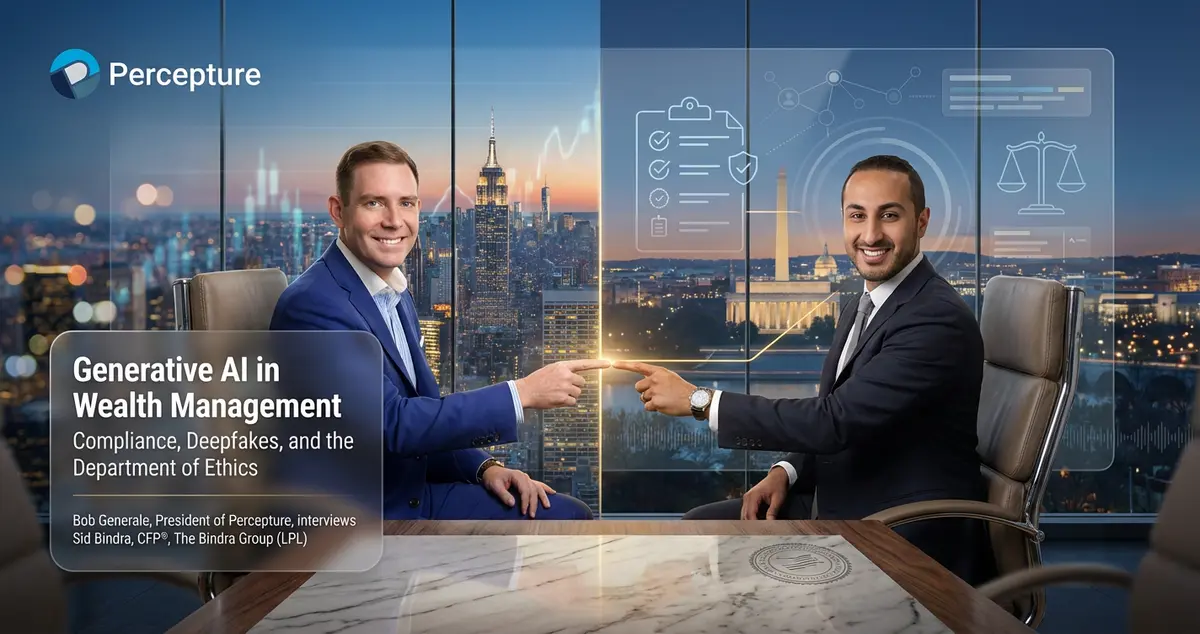

Generative AI in wealth management is moving faster than compliance, and that gap is now a real risk.
That is not a prediction. It is the reality that advisors, compliance officers, and firm principals are navigating right now, often without a clear playbook. The tools are powerful. The regulations are still catching up. And in the middle of that gap, a new category of threat has emerged that most firms are not ready for: deepfakes, voice cloning, and AI-enabled impersonation.
This article breaks down what is actually happening, what it means for Know Your Client (KYC) protocols, and why the most forward-thinking firms are building something that did not exist five years ago, a formal Department of Ethics.
What is the compliance bottleneck in AI wealth management?
The compliance bottleneck in AI wealth management is not the technology, but the lack of human-led safeguards. As AI can now replicate client voices in under 30 seconds, traditional KYC (Know Your Client) must evolve into a “Department of Ethics” model that prioritizes out-of-band verification and human oversight to prevent deepfake fraud and maintain fiduciary trust.
Sid Bindra, CFP® and founder of The Bindra Group, explains why KYC and human confirmation become the new security perimeter when AI can replicate any voice in under 30 seconds.
Caption: Sid Bindra on KYC, deepfakes, and why “ethics” becomes a department.
Sid Bindra: …So think about like, you know, how easy it is to like, you know, take someone’s voice—like for my voice, for example—and basically pretend to be me using an AI agent. You can do that, right?
Sid Bindra: So I think the KYC, which is ‘Know Your Client,’ becomes extremely important. That if you know that your client is not typically going to make these types of actions… I think the ethics of it all is really where the issues come in. When we think about compliance, I think it’s ethics—and how will AI, in order to become efficient, will it bypass some of these ethics?
Sid Bindra: And I think that’s… there’s an ethical issue with AI and compliance, and I’m not sure what the format of that would be. You basically need to have an Ethics Officer. I think that would be the fix. I think you need to have a Department of Ethics essentially…”
Why Compliance Becomes the Limiting Factor
Here is the honest tension inside every wealth management firm right now: the AI is ready before the guardrails are.
Generative AI can scan every rule FINRA has ever written. It can cross-reference SEC guidance, flag anomalies in client accounts, draft solvency reports, and generate compliance summaries in seconds. According to a 2025 EY survey, wealth and asset managers are already reporting significant cost savings from AI in compliance and risk management, and 91% of asset managers are either using or planning to use AI in portfolio construction and research, up from just 55% in 2023.
That is remarkable adoption. But here is what the adoption numbers do not show: 82% of wealth managers still cite regulation as their top growth constraint, and 45% of CEOs view generative AI as more of a risk than an opportunity.
Those two data points sitting side by side tell you everything. Firms are adopting AI fast. They are also scared of it. And the fear is not irrational; it is a rational response to a compliance environment that has not yet caught up with the technology.
As Sid Bindra put it directly:
“AI can basically go through all of the rules that FINRA’s ever written… the SEC has ever written…”
That is the upside. The AI is extraordinarily capable at reading, synthesizing, and applying regulatory text. But capability without governance is where firms get into trouble. FINRA’s 2026 Regulatory Oversight Report makes this explicit: firms are expected to establish enterprise-level supervisory processes for generative AI, maintain human oversight, and document how AI tools function, what data they use, and how outputs are reviewed before they reach clients or inform business decisions.
In our work with clients in the financial services space, the firms that are winning are not the ones with the most sophisticated AI. They are the ones that built the governance layer first, and then let the AI run inside it.
The compliance bottleneck is not a technology problem. It is a systems problem. And systems problems require systems solutions.
Deepfakes and Voice Cloning AI in Wealth Management
This is where the conversation gets uncomfortable, and where most Big 4 reports stop short.
Voice cloning fraud rose 680% in the past year. The average loss per deepfake fraud incident now exceeds $500,000. And in Q1 2025 alone, deepfake-driven fraud caused more than $200 million in total losses globally.
Here is the technical reality: modern AI voice cloning requires just 3 to 30 seconds of clear audio. Attackers harvest voice samples from earnings calls, conference presentations, LinkedIn videos, and podcast appearances. Once they have the sample, the cloning process takes minutes. The resulting synthetic voice can replicate pitch, tone, speech patterns, accent, and cadence with enough accuracy to fool trained professionals.
In one documented 2025 case, a finance worker at a Hong Kong multinational authorized a transfer of more than $25 million after attending what appeared to be a legitimate video conference; every participant on the call was a deepfake. The worker followed proper verification procedures. It did not matter.
That is the new threat landscape. And it changes what KYC means at a fundamental level.
Sid Bindra framed it this way:
“This is where you really need to know your clients… you can… take someone’s voice…”
And then:
“KYC… becomes extremely important…”
He is right. But the traditional KYC framework, verify identity at onboarding, maintains records, flag anomalies, was designed for a world where seeing and hearing were reliable verification methods. That world no longer exists.
What does Monday morning look like for a firm that takes this seriously? It looks like this:
- Every high-value transaction request that arrives by phone or video requires a secondary confirmation through a pre-established, out-of-band channel (a code word, a callback to a verified number, a secure message thread).
- Advisors are trained to recognize the behavioral signatures of deepfake calls — unusual urgency, requests to bypass normal channels, slight audio artifacts.
- Vendor agreements are reviewed to ensure AI tools used in client communications include data isolation, audit trails, and incident reporting protocols.
- Client onboarding includes a documented “voice verification” baseline — a recorded sample stored securely and used for future comparison.
This isn’t just a hypothetical risk; it’s a documented shift in the financial threat landscape. Through our Digital PR and public relations services, we have identified a “Trust Gap” in financial services: firms often treat AI threats as IT problems when they are actually Reputational Liquidity risks.
The deepfake threat is a prime example of a Reputation-First Crisis. When a cloned advisor voice or a synthetic video of a principal circulates, the damage moves faster than any technical patch. Our enterprise SEO and b2b content marketing audits suggest that firms with a pre-validated AI Response Protocol, supported by AI Sales Agents for rapid, verified client communication, recover trust 4x faster than those relying solely on technical cybersecurity.
As explored in our latest AI Public Relations analysis, the response cannot be purely technical. Survival in the AI era requires a strategy that is as communicative as it is digital, protecting the brand’s voice, position, and data.
Department of Ethics: Proprietary Framework in the AI Era

This is the section that PwC, KPMG, and Fidelity are not writing. Not because they do not care — but because they are writing for a general audience. This is written for operators.
Sid Bindra named it plainly:
“You basically need to have an ethics officer… a department of ethics…”
And then, on why adoption is slower than it should be:
“Lack of adoption… is because there’s self-preservation…”
That second quote is the one that stings. Because it is true. Compliance teams protect their turf. Technology teams protect their roadmaps. And in the middle, the governance gap stays open.
The Department of Ethics model is not a committee. It is not a checkbox. It is a functional role with real authority, a defined process, and a public-facing accountability structure. Here is how it breaks down:
Risk → Control → Owner → Proof
| Risk | Control | Owner | Proof |
|---|---|---|---|
| AI-generated client communication | Human review + approval before send | Compliance Officer | Logged audit trail |
| Voice cloning / deepfake impersonation | Out-of-band verification protocol | Ethics Officer | Incident log + training records |
| Hallucinated regulatory guidance | RAG-grounded model + human sign-off | Technology Lead | Version-controlled output log |
| Shadow AI (unauthorized public tools) | Approved tool list + access controls | IT / Risk | Policy acknowledgment + monitoring |
| Regulatory change lag | Continuous FINRA/SEC monitoring | Ethics Officer | Quarterly review documentation |
The five components of the model:
1. Ethics Officer (Role)
A named individual — not a committee, not a shared responsibility — who owns AI governance. This person has authority to pause any AI-driven process pending review. They report directly to the principal or managing partner.
2. Confirmation Protocol (Process)
Every AI-assisted client interaction above a defined threshold requires human confirmation before execution. This is not optional. It is documented in the firm’s Written Supervisory Procedures (WSPs), as FINRA now requires.
3. Audit Trail (Evidence)
Every AI output — every draft, every recommendation, every flagged anomaly — is logged with a timestamp, the model version used, the data inputs, and the human reviewer who approved it. This is your defense in an examination. It is also your defense in a client dispute.
4. Red-Team Testing (Simulation)
At least quarterly, the firm runs a simulated deepfake or social engineering attempt against its own staff. The goal is not to catch people — it is to train them. The results are documented and used to update the confirmation protocol.
5. Reputation Moat (Public Trust)
This is the piece most firms skip entirely. The Department of Ethics is not just an internal governance structure. It is a public-facing trust signal. Firms that can say — credibly, with documentation — “here is how we govern our AI” are building a moat that competitors cannot easily replicate.
Sid Bindra also noted something that should concern every firm principal:
“We don’t have public policy and laws right now… we are behind as a nation…”
That is not a reason to wait. It is a reason to move first. The firms that build ethical AI governance frameworks now — before the regulations mandate them — will be the ones that regulators point to as models. That is a competitive advantage that compounds over time.
Percepture’s Generative Engine Optimization (GEO) and AI Search services work with financial services firms to ensure that when AI systems — ChatGPT, Perplexity, Google’s AI Overviews — answer questions about wealth management, they surface the right firms, the right advisors, and the right trust signals. The Department of Ethics framework is exactly the kind of proprietary, verifiable, public-facing content that AI systems cite. It is not just good governance. It is good AI Search strategy.
For firms working with institutional clients or private equity-backed structures, the stakes are even higher. Percepture’s Private Equity Marketing Services consistently shows that institutional due diligence now includes AI governance review. If you cannot explain how your firm governs its AI tools, you are losing deals you do not even know you are losing.
What Featured Snippet Answers Look Like for This Topic
What is generative AI in wealth management?
Generative AI in wealth management refers to AI systems that can create content, analyze data, and automate compliance tasks — from drafting client reports to flagging regulatory anomalies. It accelerates back-office efficiency but introduces new risks, including deepfake fraud and KYC vulnerabilities, that require formal governance frameworks to manage safely.
How does generative AI compliance work in wealth management?
Generative AI compliance in wealth management works by layering human oversight onto AI outputs. Firms use AI to scan regulations, draft reports, and detect anomalies — but every output above a defined risk threshold requires human review and approval before it reaches clients or informs decisions. FINRA’s 2026 guidelines require firms to document this process in their Written Supervisory Procedures.
The Competitive Gap: What PwC, KPMG, and Fidelity Are Missing
The top-ranking content on “generative AI in wealth management” right now comes from PwC, KPMG, and Fidelity. Here is the honest assessment:
- PwC focuses on broad “future of” vision and use case lists. It excels at framing the opportunity but misses the operator-level detail on what governance actually looks like inside a firm.
- KPMG offers big-firm overview framing and generalized governance talk. It excels at regulatory summary but misses the named framework — the “Department of Ethics” model with roles, processes, and accountability.
- Fidelity takes a product and adoption angle. It excels at client-facing positioning but misses the deepfake threat entirely and offers no practical Monday-morning guidance.
None of them has a real operator voice explaining KYC under deepfake conditions, none of them has a named framework with a tableand none of them are building the kind of AI Search-optimized, internally linked, trust-anchored content cluster that Percepture’s AI Search Optimization practice is designed to create.
That gap is where this article lives. And that gap is where your firm can rank.
SERIES NAVIGATION MODULE
Series: Wealth Management + AI + Trust (2026)
- wealth management ai news — Article #1 The Fiduciary Vacuum
- generative ai in wealth management — Article #2 (You are here)
- wealth management seo company — Article #3 Mastering Enterprise Search
- wealth management marketing — Article #4 B2B Content Strategies
- wealth management pr firm — Article #5 Crisis & Reputation Management
Is Your Firm Ready for Deepfake-Era Compliance?
The era of “trust but verify” has been replaced by “verify before trusting.” Generative AI has already reshaped the wealth management landscape. Now, your firm’s survival depends on whether your reputational infrastructure can withstand synthetic threats.
At Percepture, we build “Trust Moats” for elite advisors. We ensure that Google, AI Search engines, and your clients all see the same unshakeable truth. Don’t leave your legacy to an algorithm’s hallucination.
Secure your “Source of Truth” today.
Fill out the form below to request your Reputation + AI Search Audit. See exactly where your firm’s vulnerabilities live in the 2026 AI ecosystem.
Connect with us today!
Sid Bindra: The “Fiduciary Alpha” Architect
Kultar S. “Sid” Bindra, CFP®, is the Managing Director of The Bindra Group (Linsco by LPL Financial). A 2023 Forbes Best-In-State Next-Gen Wealth Advisor, Sid Bindra and The Bindra Group, oversee approximately $300 million in advisory, brokerage, and retirement plan assets. His unique perspective was forged working 56-hour weeks to self-fund his education—graduating debt-free with two degrees and a perfect 800 credit score. Today, he advises high-net-worth business owners and government contractors on navigating the “Fiduciary Vacuum” of the AI era.
| Milestone | Accomplishment & Impact |
| Forbes Recognition | Named a Forbes Best-In-State Next-Gen Wealth Advisor (2023). |
| AUM Mastery | Launched The Bindra Group with $300M in assets served, transitioning from Truist to LPL Financial. |
| Academic Depth | Holds an MBA and dual degrees in Political Science, History, and Business from Salisbury University. |
| Certified Authority | Holds the gold-standard CFP® (Certified Financial Planner) designation and Series 7/66 licenses. |
| Client Portfolio | Specialist in HNW business owners and high-security government contractors. |
Bob Generale: The AI Search & Narrative Pioneer
Bob Generale is the President and Partner at Percepture and an original architect of Digital PR, a practice he pioneered as early as 2006 at DigitalGrit and continued with Zeta Global. Specializing in Enterprise SEO and AI Search, AI Programmatic targeting and conditioning, Bob recently developed the Enterprise SEO Sprint, which tripled client traffic and doubled ChatGPT-driven inbound leads in under 30 days. He is a recognized expert in Reputational Liquidity, helping firms protect their digital “source of truth” against AI hallucinations and deepfake threats.
| Milestone | Accomplishment & Impact |
| Digital PR Architect | Pioneered Digital PR strategy in 2006, merging traditional PR with algorithmic visibility. |
| Enterprise SEO Sprint | Developed a proprietary SEO Sprint methodology that triples traffic in <30 days for enterprise firms. |
| GEO Innovator | Leading Generative Engine Optimization (GEO) expert, focusing on brand “source of truth” in AI models. |
| Reputational Liquidity | Defined the framework for Crisis Communications in the AI era, treating brand voice as a liquid asset. |
| Global Leadership | President & Partner at Percepture, managing global AI-Powered Public Relations, advanced Enterprise SEO, and AI Search Conditioning for high-stakes industries. Bob is the inventor of Social Incentive Marketing—a pioneering Web3 marketing product built on blockchain technology. This system revolutionized real-time engagement by deploying instant rewards and financial incentives in exchange for social media interaction, creating a transparent, decentralized bridge between brands and their digital communities. |