
A facilitator hands your team a screenshot: a distributor has told customers that a product is discontinued. Your inventory lead says it is only delayed. The customer success manager needs something to tell callers, but the person who signs off on distributor messages is unavailable. Who gets to correct what?
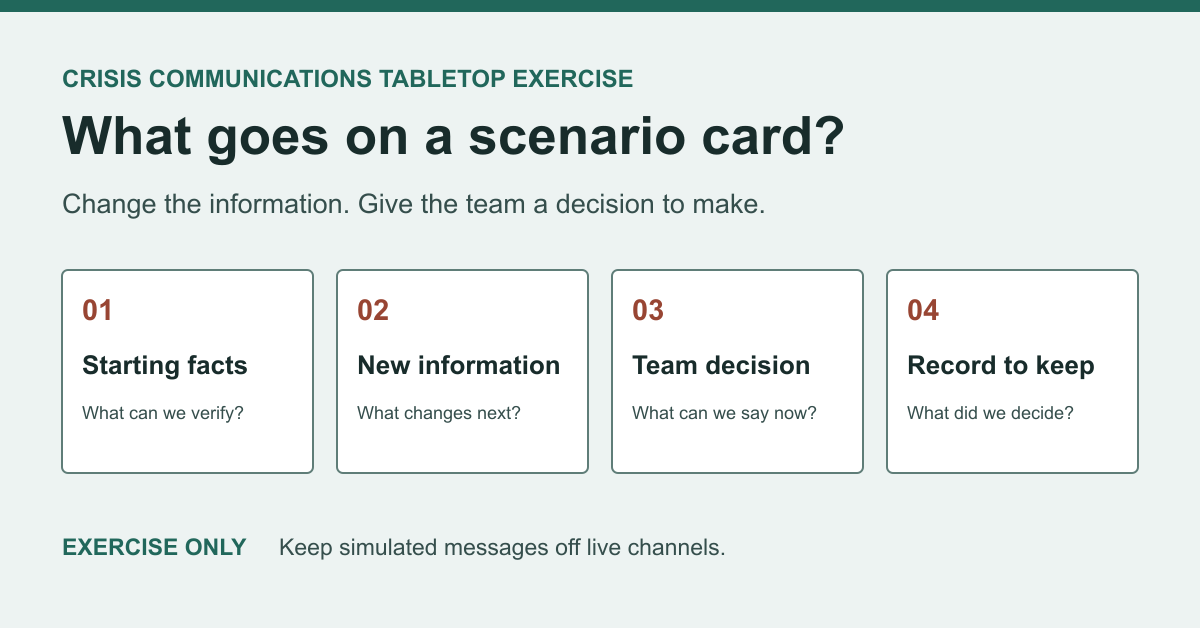
Use these four crisis communications tabletop exercise scenarios to test that kind of decision. Each card gives the facilitator a starting fact set, two developments to introduce, a choice the team must make and a record it should produce. The four cases are fictional. Choose one that exposes a weak handoff in your current plan, not the one that sounds most dramatic.
Pick a scenario by the decision it tests
| If you need to test | Use this card | Collect this record |
|---|---|---|
| Correcting a message your team did not send | A distributor sends the wrong notice | A correction ticket with separate owners for your channels and the distributor's |
| Communicating when two audiences need different details | A facility closure rumor spreads | An employee note and public reply drawn from the same fact list |
| Publishing under pressure when the usual approver is out | A leadership transition becomes public early | An approval record and the first authorized statement |
| Keeping sales, support and a partner aligned through a change | A support-channel change is announced too soon | A channel update list and fallback instructions |
The times are facilitator cues, not response standards. Start at minute zero and reveal a new fact only after the group has made or deferred the previous decision. Label all materials EXERCISE and keep them off live accounts and contact lists. Use Percepture's tabletop exercise guide to set up participants and run the debrief. FEMA's Exercise Starter Kits offer sample facilitator and evaluator materials. The four cards here are original business scenarios, not FEMA scenarios.
Scenario 1: A distributor sends the wrong notice
Start, minute 0. Your company has delayed shipment of one product line by a week. The current inventory update does not say the line is discontinued. A sales rep forwards a screenshot of a distributor email saying it has been permanently withdrawn. The distributor owns that email list; your team cannot see who received it.
Minute 6. Support logs three questions quoting the incorrect email. The distributor's account manager wants your company to post a public correction but cannot yet confirm whether the email went to the full list. Ask inventory for the wording it can stand behind today. Separate correcting your own records from getting the distributor to correct its message.
Minute 12. The distributor offers to put a correction in tomorrow's newsletter. An account manager wants to email customers this afternoon. Have the team decide what it can tell a known recipient now, who can approve that wording and who will confirm the distributor's correction went out.
Decision and evidence. Does the team correct one audience first, wait for the partner, or do both with different messages? Collect a ticket containing the exact wrong claim, the verified replacement, who can correct each channel, and how the account team will check the fix. A promise to forward the ticket is not confirmation that a customer saw the correction.
Scenario 2: A facility closure rumor spreads
Start, minute 0. A company has moved a training session because a conference room is being repaired. Shift schedules and building access are unchanged. A cropped calendar screenshot circulates with the claim that the company is closing the facility. People managers have not received a common answer.
Minute 7. A team lead asks whether staff should report tomorrow. A reporter separately asks whether jobs are at risk. The site manager can confirm tomorrow's schedule and the room repair, but has no authority to make a statement about company strategy. Ask the group what it can say promptly to employees and what it can verify for the reporter.
Minute 14. A draft public reply circulates internally that says there will be no staffing changes. The exercise fact sheet provides no basis for that assurance. Have the designated approver decide whether to remove it, who tells managers about the correction, and what the communications lead should say if asked the same question again.
Decision and evidence. Collect the employee note and the public reply. Then underline which verified fact supports each factual sentence. The employee note should answer what staff need for the next shift; the public reply should not promise anything the team cannot confirm. The audiences can receive different details without receiving contradictory facts.
Scenario 3: A leadership transition goes public early
Start, minute 0. The board has accepted an executive's resignation and named an interim leader. An employee announcement was scheduled for 3 p.m. A trade reporter has asked about the move before the scheduled announcement. The facts are confirmed internally, but the normal communications approver is unavailable.
Minute 5. A manager asks for wording to use in a scheduled customer meeting. The board liaison confirms the interim appointment but has not approved details about why the executive is leaving. Ask who can authorize the first statement under the written plan and what the manager should do while that decision is pending.
Minute 11. A partner says it will publish a congratulations message naming the interim leader in the next hour. One team member wants to advance the whole announcement; another wants to keep the original timing. Decide which communications can move separately, who gives the partner a clear answer, and what internal audience needs notice before the team speaks externally.
Decision and evidence. Collect the approval record and the first statement the authorized person would release. Name the authority for the timing decision and the facts that statement can include. The team should be able to explain why it advanced or held each message without leaning on an unavailable executive or inferring a reason for the departure.
Scenario 4: A support-channel change is announced too soon
Start, minute 0. A company is moving customer support from a shared mailbox to a help center next month. The help center is ready for a limited test, not the full customer base. A reseller has already posted instructions telling everyone to send requests there. The shared mailbox is still staffed.
Minute 8. Two customers say the new help center rejected their requests. A sales team member proposes forwarding missed requests manually, but cannot identify anyone who will be responsible for that queue. Decide what customers should do now and which channel owner can make that instruction consistent.
Minute 15. The reseller changes its web page, but a downloadable handout still gives the wrong instruction. Another partner asks whether it can use the new process early. Decide whether to hold the original launch date, authorize a limited exception, or change the rollout. In any case, name the owner who will confirm what each audience can actually see.
Decision and evidence. Collect a correction list with the reseller page, handout, sales reply and support instructions. Mark who controls each item, what the replacement says and how to check it. Separately, capture who handles requests already sent to the wrong place. Fixing the document does not resolve those requests.
Score one decision, not the whole team
Give the observer a single task: identify where one decision got stuck and which change would prevent that delay. Compare the decision record with what participants said in the room. A gap in the record is useful. It may reveal that two people assumed the other one was responsible.
| Observe | Ask for | Write down if it is missing |
|---|---|---|
| A fact was challenged | The source, time checked and owner | Which statement was unsupported |
| A message was delayed | The approver or backup and decision time | Which approval step had no owner |
| Two channels disagreed | Both messages and the shared facts | Which channel carried the wrong detail |
| A partner promised to correct an error | A way to check that recipients saw the correction | Who will verify it and when |
| The team changed its plan | One owner, deadline and retest | The exact decision to rehearse again |
For example, if a distributor's correction stalled, do not assign a broad task to "improve partner communications." Have the channel owner add one step: verify the corrected notice reached the affected list before closing the ticket. Rerun just that decision next time.
What if the team needs to write a statement?
Use the crisis holding statement template after the team has decided what it can verify and who can authorize release. Ask the facilitator to provide no facts beyond those on the card. When players need an answer the card does not contain, have them say who they would ask and what they can communicate in the meantime.
Choose the case closest to a real gap in your plan and run it at your next team meeting. For a session that needs an outside facilitator, Percepture's crisis communications services are a place to discuss the decision your team needs to rehearse.