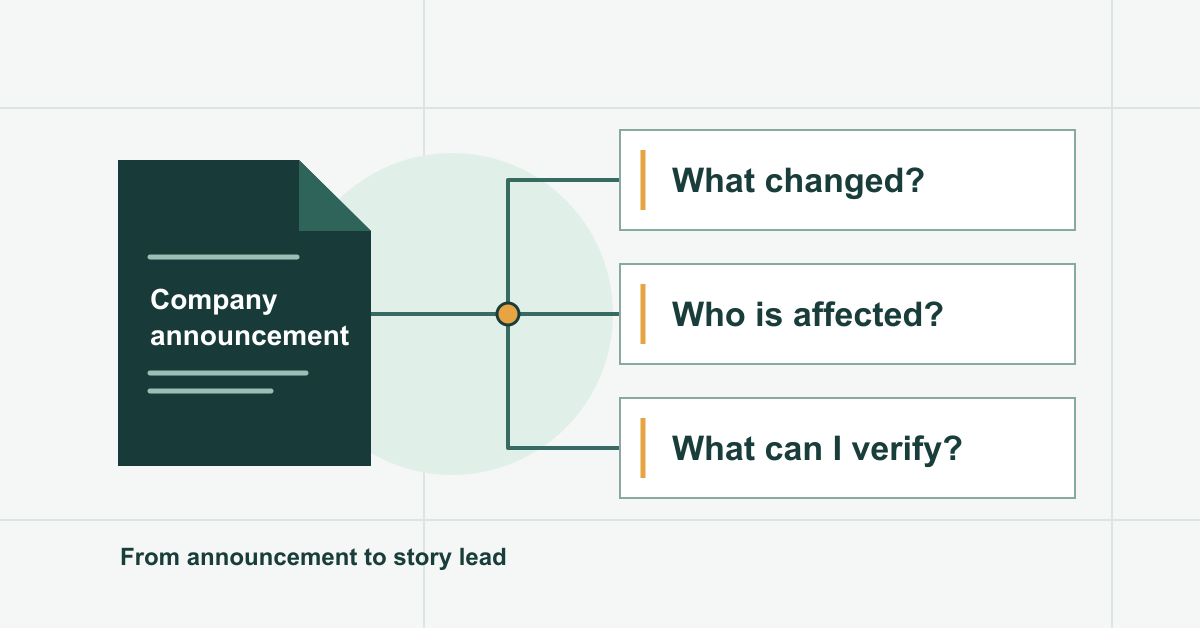

Your company has news. The reporter has a different problem: deciding whether it is news for their readers. If the email opens with how excited the company is, the reporter has to find the change, work out who it affects, and decide whether there's enough evidence to report it. Most won't do that work for you.
Journalists ignore company press releases when the pitch misses their beat, the announcement has no clear consequence for their audience, or the company hasn't made its claims easy to check. Before rewriting the subject line or hiring a new wire service, identify which of those problems you have.
The first test: who needs to know?
In Muck Rack's 2026 State of Journalism survey, 88% of respondents selected a mismatch with their coverage as a reason they'd immediately disregard a PR pitch. Seventy-one percent selected promotional language. The survey analyzed 897 responses, mainly from U.S. journalists. Respondents could select more than one reason. Those figures describe reported choices, not the odds that a particular release will get coverage.
Read a reporter's recent work and name the audience for this story. A reporter who covers regional transportation might care about a change in overnight bus service. A reporter who covers municipal finance might care about the public contract that pays for it. The same announcement could support both stories, but the relevant fact and source differ.
If the best explanation is "they cover our industry," the press list still needs work. Write one sentence connecting this change to a decision, cost, deadline or problem the outlet's readers recognize. Keep that sentence next to the pitch while you edit.
Diagnose the release before sending it again
| What you see | What to check | What to change |
|---|---|---|
| The lead names the company, the award and the executives, but not what changed. | Can a reader tell what happened and when from the first two sentences? | Put the change and its consequence first. Move company context below it. |
| Every outlet receives the same explanation. | Which recent story or recurring beat would this advance? | Narrow the list and choose a relevant angle for each outlet. |
| The most important claim is an adjective or a comparison. | Can an outside reader check the numbers, dates and comparison group? | Add the source and limits, or replace the claim with a fact you can substantiate. |
| The only available quote repeats the headline. | Who can answer an independent question about the change? | Offer an interview with someone who understands the subject. Confirm their availability first. |
| The release went out but replies are absent. | Did the email arrive, and is the story still useful on the reporter's deadline? | Check delivery and timing. Follow up only if you can add relevant information, or leave it alone. |
Silence alone doesn't tell you which row applies. A reporter may be working another story, may have covered the subject recently, or may simply disagree that the news matters. Treat the checklist as a way to improve the next decision, not to assign a motive to someone who hasn't replied.
Put the evidence where the reporter can use it
For an opening, identify the date, location and part of the operation that is actually open. Separate a signed commitment from a proposal. For a survey, give the field dates, sample size and question behind the number. Explain how the result was measured and link to a method note the journalist can read without signing in.
When you pitch an expert, say what they can explain and when they are available. A product lead may be the right person for an implementation question. The employee who wrote the announcement may not be. Obtain permission before sharing someone else's contact details, quotes, customer names or material under embargo.
Releases still help journalists find stories. Cision's 2026 survey announcement reports that 66% of surveyed journalists use PR-provided material for story ideas. That category includes pitches and media kits as well as releases. A release can give a reporter the official details, while the pitch explains why the story is worth checking and provides a way to do it.
Rewrite the pitch around the change, not the celebration
Hypothetical example: A packaging manufacturer announces an evening shift at an existing plant. The draft subject line is "Company celebrates investment in the future." The opening thanks executives and calls the expansion transformative.
A more useful pitch for a local business reporter would lead with the shift's start date and the number of positions currently open. Include the public job listings and offer a brief interview with the plant manager about the schedule and hiring. Keep proposed hires separate from filled roles. If no applications are open or the date isn't confirmed, don't imply otherwise.
The trade reporter may not want that story. They may want to know whether the additional shift changes order lead times. That's a different claim, and it needs evidence of its own. If operations can't substantiate it, leave it out and skip that pitch.
Choose what to do when the release isn't a media story
An announcement can be worth making without being worth pitching. Publish a short owned update when customers need a service date, applicants need a job link, or partners need an official reference. Use targeted outreach when you can offer an independently checkable change that matters to a specific outlet. When an audience would benefit from a longer explanation, write that explanation instead of asking a reporter to turn your release into one.
Keep the outcomes separate: a wire distribution receipt shows distribution; a reporter's independent article shows earned coverage. Neither proves that the audience took action. Percepture's guide to news-release uses explains where the official announcement can still serve a purpose even when the story isn't picked up.
Should you follow up on an unanswered press release?
Follow the outlet's instructions. A short follow-up is useful when it supplies a confirmed date, a direct source, a correction, or a change that makes the story timely. Repeating the original email gives a reporter no new reason to look at it.
Does a press release have to be exclusive?
No. Offer an exclusive only when you can honor what you're promising. Public announcements can still support useful, distinct stories. Confirm terms directly; don't assume a reporter accepted an embargo because you put a time at the top of an email.
Is a press release the same as a pitch?
A release is an official source for the announcement. A pitch gives a specific journalist a reason to investigate it. Link to the release when it helps, but make the audience, the change and the evidence clear in the pitch itself.
Before sending the next one, ask someone outside the project to read the first two sentences and tell you what changed and for whom. Where that answer is hard to find, fix the story before expanding the distribution list. For announcements that need that story work, Percepture's digital PR team can help identify the relevant audience, check what the company can support and plan outreach around it.