
Percepture's published public relations packages start at $4,500 per month. That's one agency's price for a defined scope, not a market rate. In its 2026 pricing guide, Clutch reports that the public relations projects it reviewed typically cost $10,000 to $49,999. Those are project totals, not monthly fees. Neither figure tells you whether your quote includes the work you need.
Before you compare rates, ask both agencies for the cost to deliver the same brief over the same period. A $5,000 monthly retainer can end up close to a $6,500 retainer once you add setup and outside expenses. It can still be the better deal, but only if both quotes cover the same work and you know what you owe when you stop.
Send each agency the same one-page brief
Start with a business event and an audience: “We're introducing a new product to US manufacturing buyers in February. By launch day we need an approved story, a prepared spokesperson and outreach to the trade publications they read.” That's easier to price than “we need more visibility.”
Name what your team already has. If engineering can supply product evidence but nobody can write or approve a press kit, say so. Ask who will interview the technical lead, check claims, draft materials and chase approvals. The agency that prices those jobs may look more expensive than one that puts them on your team.
Set the same reporting requirement for each bid. For a launch, that could be a weekly record of which outlets were approached, their responses, any coverage and what to change next. Separate the work an agency can commit to from an editor's decision to cover a story. An agency can promise to write a pitch and follow up; an independent outlet decides whether to publish.
Choose a fee model that matches the work
In its creative and PR agency RFP, CGIAR asked bidders to break down professional fees, rates and exclusions, and to specify whether the fees were retainer, project-based or hybrid. You can ask for that breakdown without running a formal procurement process. The right model depends on whether your need is repeatable, has an end date or is hard to predict.
| Fee model | It can suit | Ask before committing |
|---|---|---|
| Monthly retainer | Ongoing media relations and a steady pipeline of announcements | What is included each month, who does it, and what is the minimum term? |
| Fixed project | A launch, research release or event with a defined finish | What marks completion, how many revisions are included, and what changes trigger a new estimate? |
| Hourly or day rate | An advisory assignment, spokesperson training or work that is hard to size upfront | Which people are billed at which rates, and who approves hours beyond the estimate? |
| Retainer plus projects | An ongoing program with separate launches or production work | Can the same task appear on both bills? Ask for the boundary in writing. |
Don't compare a one-off release distribution fee with a full PR engagement. A wire distributes material. Research, messaging, pitching and follow-up are separate pieces of work. The scope, not the name on the proposal, tells you what you're buying.
Put both proposals on one 90-day worksheet
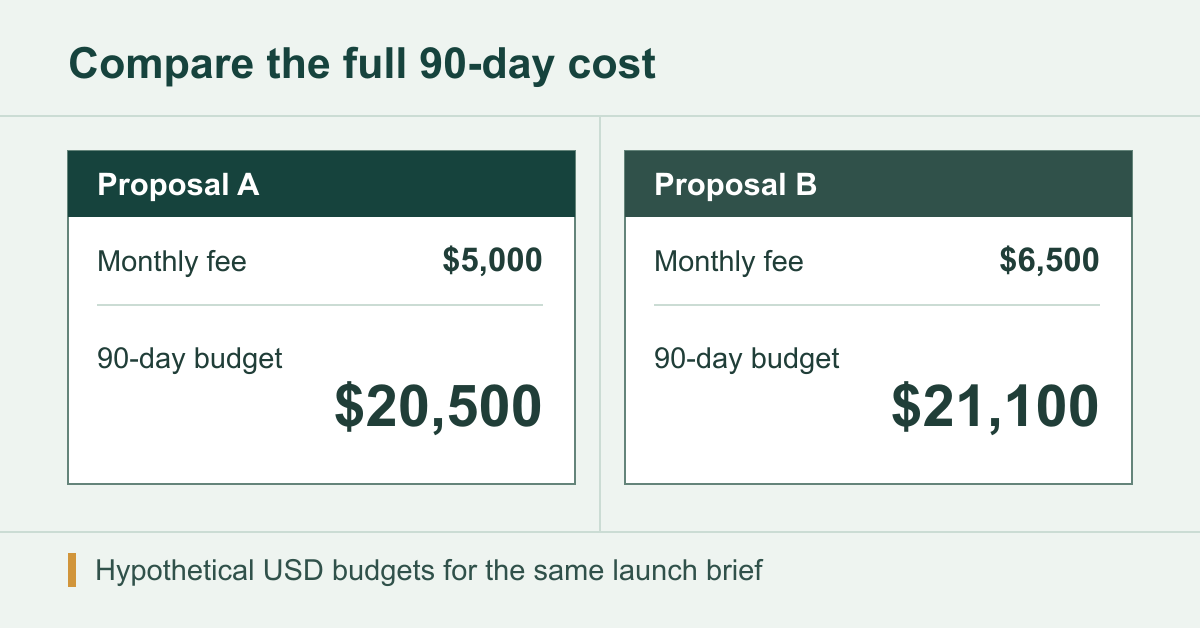
Imagine two agencies quoting the same three-month US trade launch. Both include the same approved story, targeted pitching, spokesperson preparation and weekly reporting. One charges separately for more of the outside production and distribution. The numbers below are hypothetical US dollar inputs, not agency prices, quotes or market averages.
| Cost over the same three months | Proposal A | Proposal B |
|---|---|---|
| Monthly fee times three | $5,000 x 3 = $15,000 | $6,500 x 3 = $19,500 |
| One-time kickoff | $2,000 | Included |
| Estimated production and distribution billed outside the fee | $2,500 | $600 |
| Buyer allowance for extra support in launch week | $1,000 | $1,000 |
| Modeled 90-day cash budget | $20,500 | $21,100 |
Proposal A's advertised fee is $1,500 less a month. For this brief, the budget difference is $600 over three months, not $4,500. If Proposal A needs another $700 in nonincluded work and nothing else changes, the cheaper headline rate becomes the more expensive option by $100. That's a reason to ask for a written cap or a more precise estimate, not a reason to pay more automatically.
Ask for a second figure: the minimum you owe if you end the engagement early. The modeled budget isn't necessarily the amount due under the contract. Check the notice period, noncancelable supplier charges and any fees triggered by handing off the work. Ask whether you can keep the materials you paid for and who will finish outreach already underway. Write those answers beside the price.
Ask where the quote can change
Ask the account lead to walk through launch week. Who handles a journalist's deadline after hours? Who updates the pitch if the announcement moves? Is the executive interview prep included or billed separately? Specific scenarios make it easier to see whether the proposed team can deliver and which line items are estimates.
Put outside costs in their own column. For each one, get the deliverable, expected amount, any markup, and who can approve it. A campaign with optional travel or a video shoot shouldn't assume a zero cost just because the fee table is silent. Equally, don't add wire distribution to your budget if you're not going to use it.
Finally, compare the work itself. If one proposal names an experienced strategist for planning but assigns outreach and reporting to a different team, ask to meet the people who will do those jobs. If another includes fewer press releases but more time developing an evidence-backed pitch, weigh that against your actual launch need. More deliverables don't make an offer better when they're the wrong deliverables.
Questions to resolve before you sign
What's a reasonable monthly PR budget?
Start with the agency's published or quoted fee, then build a budget for the specific assignment. Ask what can be accomplished at that fee and which essential jobs are missing. A published starting price is useful for screening; the written scope and committed costs are the numbers to present to finance.
Is a project cheaper than a retainer?
It depends on the work and term. A fixed project may be easier to budget for one launch. For an ongoing program, add up the projects you expect over the same months and compare their total scope with the retainer. A low project fee isn't a bargain if it leaves out ongoing follow-up you still have to buy.
What goes in the contract rather than the estimate?
Ask for the included work, approved team, billing schedule, approval process for expenses and extras, term, and notice requirements in writing. Keep estimates separate from amounts already committed. If time or production costs can change, agree on who can approve more spending before it's incurred.
Can we pay only for coverage?
First ask what the seller means by coverage. Paid placements and earned editorial coverage aren't the same thing. Confirm who pays whom, how an outlet or placement is described, and what work is owed even if independent editors decide not to run the story. Don't use a placement count as a substitute for whether the right audience will see the story.
If you're comparing Percepture with another agency, use the published PR pricing and package scopes to pick a starting point. Bring the same launch or program brief to each conversation. Ask both teams for the included work, outside costs and an all-in budget for the same period.