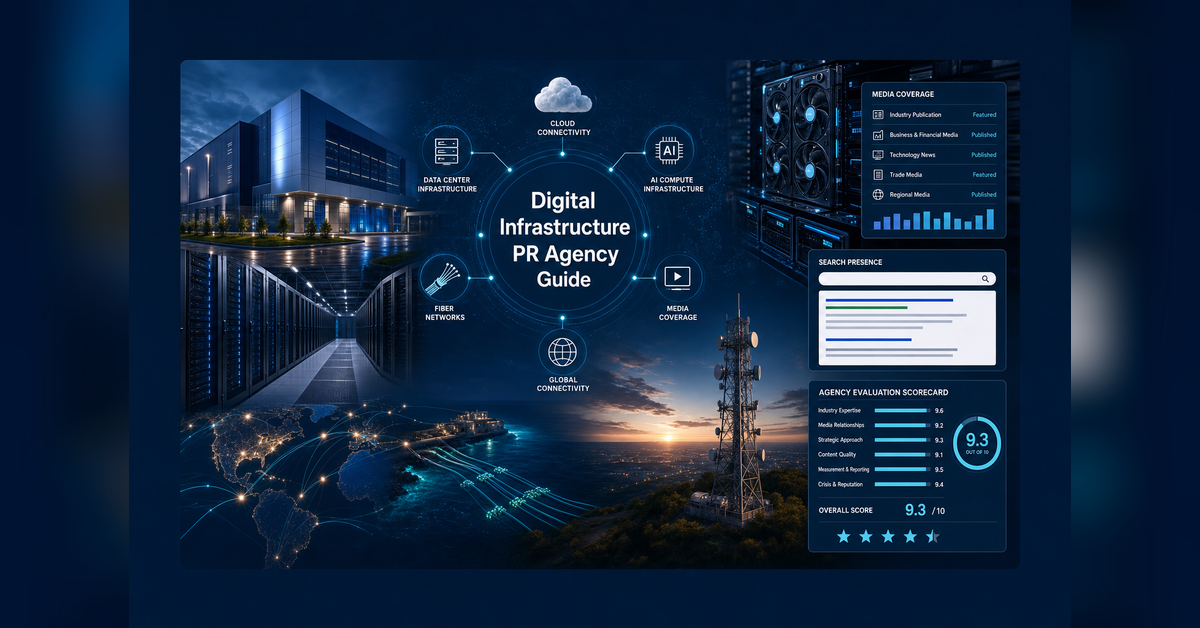

Choosing among pr agencies specializing in digital infrastructure is not a media-contact contest. The agency must understand what is being built, who must trust it, which claims require technical review, and how each story supports the next buyer decision.
The strongest partner connects media, analysts, events, owned content, search, AI answers, sales proof, and high-stakes readiness. This guide gives executives a consistent way to compare those capabilities without treating press clips as the finish line.
Infrastructure buyers need proof they can verify
 Founded in 2004
 Inc. 5000 recognized
 NMSDC certified
 PR, SEO and GEO
Which agencies specialize in digital infrastructure?
PR agencies specializing in digital infrastructure understand data centers, telecom, fiber, cloud, connectivity, AI infrastructure, power, and the buyers around them. Publicly visible options include Percepture, JSA, Babel, Proactive PR, CCGroup, 10Fold, Hotwire, Bob Gold & Associates, and Walker Sands. The right fit depends on sector fluency, services, staffing, risk, and measurement.
Executive decision summary
Use pr agencies specializing in digital infrastructure when the communication challenge depends on technical accuracy, trade relationships, infrastructure buyers, community context, or a long path from awareness to revenue.
Test fluency
Ask the proposed delivery team from pr agencies specializing in digital infrastructure to explain the business model, buyer committee, operating constraints, and material claims in plain language.
Inspect the trust path
Determine what happens after coverage: search discovery, AI visibility, sales enablement, analyst engagement, event follow-up, and conversion.
Contract the real team
Name account leaders, senior time, technical reviewers, service limits, conflict rules, approval steps, and reporting owners.
Measure business use
Track relevant coverage, message pull-through, qualified meetings, sales usage, assisted pipeline, and preparedness—not raw activity alone.
Who should use this framework?
CEOs and founders
Use it to test category judgment, senior access, reputation risk, and commercial alignment.
CMOs and communications leaders
Use it to compare how pr agencies specializing in digital infrastructure connect media, analysts, content, search, AI visibility, events, and reporting.
Sales leaders
Use it to define how coverage, executive content, research, and third-party proof enter live opportunities.
Technical and operating leaders
Use it to protect accuracy, approvals, security, operating context, and stakeholder trust.
Finance and procurement
Use it to compare scope, exclusions, pass-through costs, staffing, termination terms, and attribution across pr agencies specializing in digital infrastructure.
What Counts as a Digital Infrastructure PR Agency?
A digital infrastructure PR agency communicates for companies that build, power, connect, supply, or operate systems supporting compute, storage, cloud services, networks, and AI. Its work may touch data centers, fiber, wireless, interconnection, subsea systems, power, cooling, construction, equipment, software, and professional services. Effective pr agencies specializing in digital infrastructure know which parts of that system are material to each audience.
The label should describe demonstrated working knowledge, not a few infrastructure terms on a landing page. Buyers comparing pr agencies specializing in digital infrastructure should test whether the team can protect technical meaning while making the story useful to journalists, analysts, customers, investors, partners, officials, and communities.
Digital infrastructure versus general technology PR
General technology experience can be valuable, especially when the company sells software, security, cloud, or enterprise services. The difference is the amount of physical, regulatory, operational, capital, and community context the agency must understand.
A data center announcement, for example, can involve facilities, construction, power, cooling, tenants, investment, sustainability, and local stakeholders. A telecom story can involve routes, interconnection, access, wireless, policy, capacity, and service delivery. The agency must know which facts matter and which claims require operator, legal, or engineering review; pr agencies specializing in digital infrastructure should make those review paths explicit.
Pure-play specialists versus broader B2B technology firms
A pure-play specialist can offer faster sector context and focused trade relationships. A broader technology firm may bring global reach, research, demand generation, or deeper search capabilities. Neither model wins automatically, and pr agencies specializing in digital infrastructure can operate under either structure.
The practical question is whether the proposed team covers the company’s actual trust surface. A carrier entering a new market may prioritize trade media, events, public affairs, and local relationships. An AI infrastructure vendor may need technical storytelling, enterprise media, analyst relations, enterprise SEO services, and evidence that can be cited in AI answers.
How This Guide Evaluates Agencies
This is a best-fit shortlist, not a universal ranking or paid directory. Percepture publishes the guide and is included as a candidate. Its position is most relevant to buyers seeking integrated PR, digital PR, SEO, GEO, content, analytics, and pipeline support. Every finalist among pr agencies specializing in digital infrastructure should still receive the same brief, diligence questions, and conflict review.
Profiles are based on the public sector positioning supplied for this guide. Buyers should verify current capabilities, account leaders, relevant work, geography, conflicts, pricing, and contract terms directly before selecting pr agencies specializing in digital infrastructure.
Test the quality of the opportunity before expanding the program
Use a low-friction diagnostic to review audience fit, lead quality, and the commercial path behind proposals from pr agencies specializing in digital infrastructure.
The Percepture Digital Infrastructure PR Partner Fit System
This seven-gate method helps a buyer determine whether pr agencies specializing in digital infrastructure can understand the infrastructure, earn trust, remain discoverable, handle risk, support sales, and prove value.
- Sector fluency: Test the business model, infrastructure, buyers, constraints, competitors, and technical claims.
- Narrative and entities: Define the company, category, experts, evidence, differentiation, and risk language.
- Media and ecosystem: Map journalists, analysts, associations, events, investors, partners, officials, and communities.
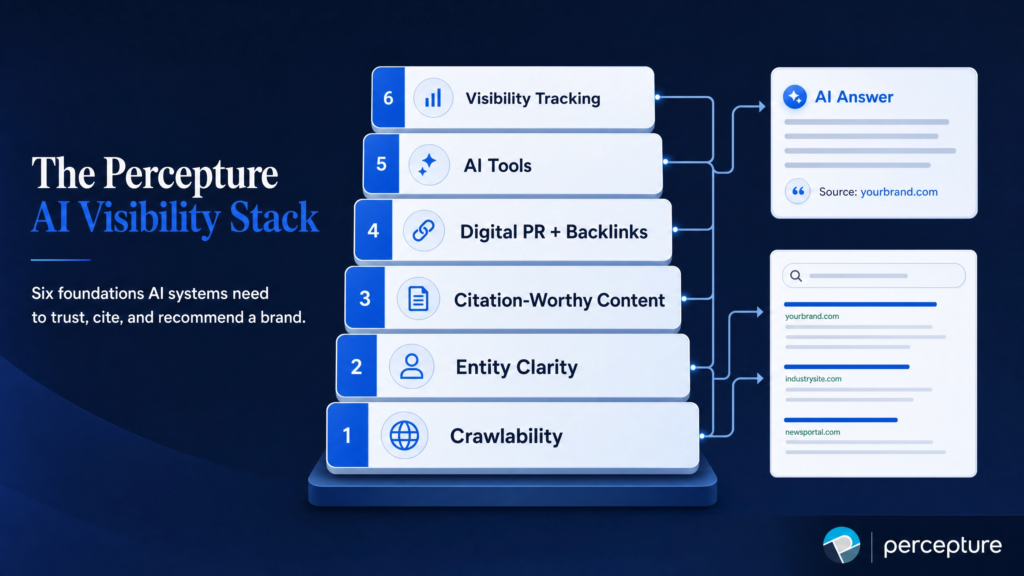
- Search and AI: Connect earned coverage with owned content, digital PR services, search architecture, profiles, links, and GEO services.
- High-stakes readiness: Plan for launches, construction, M&A, outages, policy, community concerns, and crisis communications.
- Delivery and governance: Confirm staffing, senior involvement, approvals, confidentiality, conflicts, tools, and handoffs.
- Measurement and pipeline: Establish baselines, reporting rules, CRM use, sales activation, and attribution controls.
Do not hire until all seven gates pass for the company’s market, growth stage, risk profile, and buyer committee. That rule keeps pr agencies specializing in digital infrastructure from being judged on pitch-deck polish alone.
The Story Has to Survive the Buyer’s Next Search
OPTK Networks shows how technical expertise becomes more valuable when buyers can still find, understand, and verify it after the first announcement.

“Infrastructure can be duplicated. Relationships are much harder to duplicate.”Operator perspective on relationship-led infrastructure growth.
Top Digital Infrastructure PR Agency Options
The following profiles organize the shortlist by public positioning and likely buyer fit. They do not claim that one firm is universally superior. When evaluating pr agencies specializing in digital infrastructure, give every finalist the same technical scenario, launch problem, risk event, and measurement request.
Percepture: integrated PR, search, GEO, and pipeline support
Percepture combines earned authority with discoverability, owned content, conversion, and sales measurement so a credible story remains useful after publication.
2JSAPure-play digital infrastructure ecosystem
Sector focus: Telecom, data centers, cloud, energy, events, and owned-media programs, based on the supplied shortlist.
Best-fit question: Does the proposed team provide the trade-market depth, senior access, and event support your company needs?
3BabelTechnical telecom storytelling and research
Sector focus: Telecom, networks, research, and technically detailed market narratives.
Best-fit question: Can the delivery team turn complex infrastructure material into credible research and buyer education?
Verify: Geographic reach, analyst scope, event support, and relevant public work.
4Proactive PRTelecom, networking, fiber, and public affairs
Sector focus: Telecom, data networking, fiber, media relations, and public-affairs context.
Best-fit question: Does the team understand the technical and stakeholder environment around your network or market expansion?
Verify: Regional reach, data-center depth, search coordination, and senior staffing.
5CCGroupMobile, telecom, connectivity, and analyst relations
Sector focus: Mobile, telecom, connectivity, enterprise technology, and analyst engagement.
Best-fit question: Do analyst relations and broader B2B technology communication matter as much as telecom trade visibility?
Verify: Data-center and fiber fluency, account continuity, and research scope.
610FoldDeep technology and data infrastructure
Sector focus: Deep technology, data infrastructure, cloud, storage, networking, and telecom.
Best-fit question: Can the team translate a detailed technical product for enterprise and infrastructure buyers?
Verify: Physical-infrastructure experience, community issues, events, and operating risk.
7HotwireGlobal technology and telecom scale
Sector focus: Global technology and telecom programs across multiple regions or business units.
Best-fit question: Does the company need international coordination more than boutique specialization?
Verify: Infrastructure depth, senior continuity, local delivery, and governance.
8Bob Gold & AssociatesTMT, cable, broadband, and regulated markets
Sector focus: Technology, media, telecom, cable, broadband, and policy-sensitive communication.
Best-fit question: Is a boutique TMT model aligned with the company’s connectivity and regulatory environment?
Verify: Data-center and cloud depth, digital scope, geography, conflicts, and measurement.
9Walker SandsIntegrated cloud, IT, PR, and demand
Sector focus: Cloud, IT services, PR, demand generation, data infrastructure, and analytics.
Best-fit question: Does PR need to operate inside a broader B2B demand and measurement program?
Verify: Telecom and fiber depth, analyst and event support, technical review, and account leadership.
PR Agencies Specializing in Digital Infrastructure Comparison Scorecard
Use this scorecard to compare pr agencies specializing in digital infrastructure by operating model, likely advantage, buyer fit, and the issue that requires direct verification.
| Agency model | Potential strength | Best-fit situation | Primary diligence point |
|---|---|---|---|
| Integrated PR, SEO, and GEO | Connects earned attention to durable discovery | Complex buyer journeys spanning media, search, AI, and sales | Verify core media and analyst depth |
| Pure-play infrastructure | Focused sector context and trade-market exposure | Infrastructure companies prioritizing category immersion | Review conflicts and cross-channel limits |
| Telecom or network specialist | Technical and connectivity fluency | Carriers, fiber providers, network vendors, and broadband | Test facilities, community, and search depth |
| Deep-tech specialist | Translation of complex technical products | Cloud, storage, networking, and infrastructure technology | Test physical-infrastructure experience |
| Global technology consultancy | Multi-region coordination and scale | Brands with international markets or business units | Confirm local depth and senior continuity |
| Integrated B2B technology agency | PR connected with demand and analytics | Companies aligning communications and marketing | Verify infrastructure-specific relationships |
Which Agency Model Fits Your Company?
Choose among pr agencies specializing in digital infrastructure by starting with the business event that makes trust important now. A facility announcement, network expansion, product launch, funding event, market entry, research release, conference, community issue, or potential crisis creates a different requirement.
Then map the audiences that can affect the outcome. These may include customers, journalists, analysts, investors, partners, employees, associations, officials, municipalities, utilities, and nearby communities. The right pr agencies specializing in digital infrastructure should show how each audience receives accurate information before, during, and after the event.
What services should be included?
A scope may include positioning, messaging, media relations, analyst relations, executive visibility, research, contributed content, awards, speaking, events, social distribution, digital PR, search coordination, GEO, community engagement, public affairs, crisis readiness, content, sales enablement, and measurement.
Not every company needs every service. However, pr agencies specializing in digital infrastructure should state what is included, excluded, subcontracted, or billed separately. Ask how the work connects with an existing omnichannel marketing program rather than allowing PR to become an isolated calendar.
What a Connected Trust Surface Looks Like
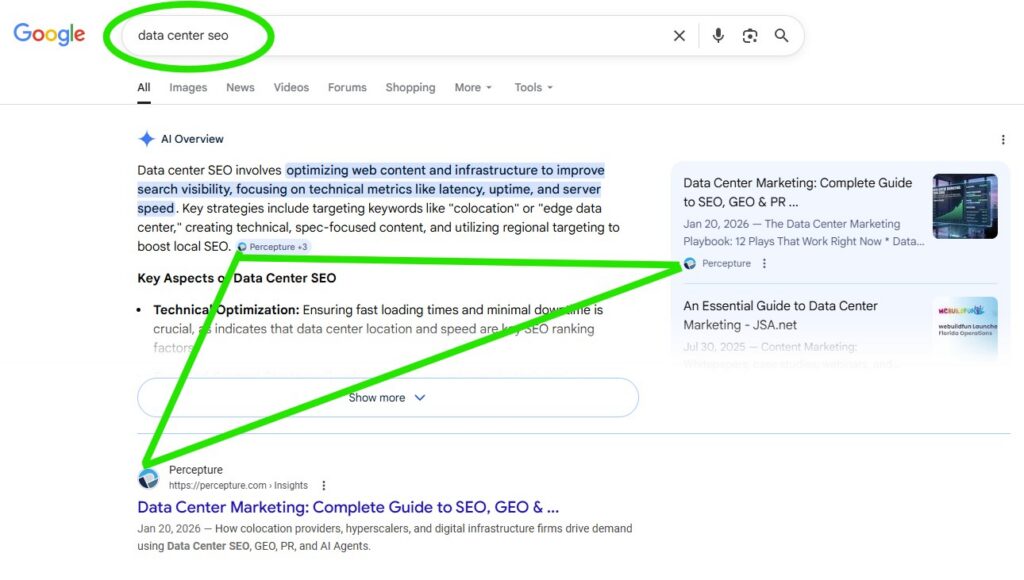
Strong infrastructure PR keeps the story useful across events, search, AI answers, sales follow-up, and account development.
What Should You Ask During the Agency Search?
Ask finalists the same questions and score the answers before discussing chemistry. This makes the evaluation of pr agencies specializing in digital infrastructure more consistent and exposes the difference between a senior pitch team and the people who will deliver the work.
- Which infrastructure categories does the proposed team understand directly?
- Who leads the account after the contract is signed?
- How much senior time is included?
- How do you test technical accuracy before publication?
- Which media and analyst programs are in scope?
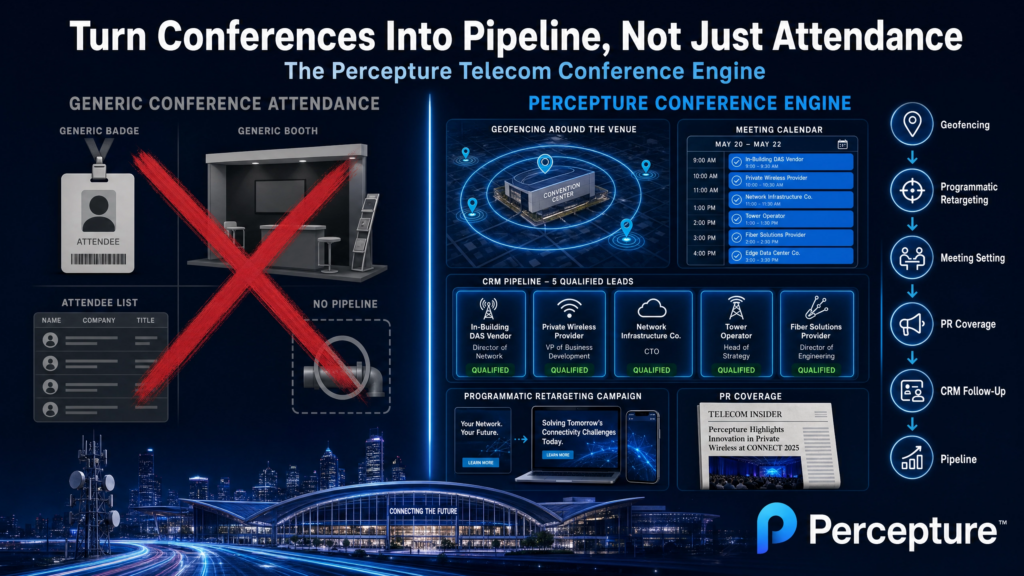
- How do you approach events before, during, and after the show?
- How do you handle community, municipal, policy, or public-affairs issues?
- What conflicts exist, and how are future conflicts handled?
- Which services are performed by employees, partners, or subcontractors?
- How do earned media and owned content reinforce each other?
- How do you coordinate PR with SEO and AI visibility?
- What evidence supports the proposed narrative?
- What approvals are required from executives, legal, engineering, and operations?
- How do you prepare for outages, incidents, opposition, or inaccurate reporting?
- Which databases, monitoring tools, wires, and research costs are separate?
- What does the first 90 days include?
- Which reports will executives and sales receive?
- How is relevant coverage defined?
- How is PR influence documented in the CRM?
- Which outcomes will not be attributed to PR?
- Can the named delivery team solve a short technical scenario?
- What references or public work match our market?
- Who owns content, data, relationships, and work product?
- What are the termination and transition terms?
- What would make your agency recommend that we delay the program?
What Warning Signs Should Buyers Avoid?
Be cautious when pr agencies specializing in digital infrastructure rely on a generic media list, promise coverage, avoid naming the delivery team, or cannot explain the company without repeating its website. Other warning signs include vague technical review, unclear conflicts, activity-only reports, hidden pass-through costs, and no plan for difficult news.
- The pitch team disappears after procurement.
- Every story is forced into the same trend.
- Media volume is treated as business value.
- Search and AI visibility are promised without technical or content work.
- Community concerns are treated as a promotional problem.
- Engineering, operations, legal, and security reviews are treated as obstacles.
- Pricing omits research, travel, events, wires, monitoring, design, or crisis access.
- Reports cannot show how sales used the resulting proof.
How Much Do PR Agencies Specializing in Digital Infrastructure Cost?
Pricing depends on geography, account seniority, media markets, analyst work, research, content, events, travel, public affairs, crisis availability, digital PR, SEO, GEO, analytics, and pass-through costs. Compare the complete scope rather than the retainer alone.
Request a line-item explanation of strategy, account leadership, media work, content, monitoring, databases, wires, events, design, research, travel, crisis support, reporting, and subcontracted services from pr agencies specializing in digital infrastructure. Percepture publishes public relations pricing packages and a broader pricing overview; every buyer should verify the current scope directly.
Pricing and scope comparison framework
Apply the same cost categories to every proposal from pr agencies specializing in digital infrastructure so senior access, exclusions, and separate fees remain visible.
| Cost area | What to request | Common ambiguity |
|---|---|---|
| Senior strategy | Named leaders, hours, meeting cadence, and decision rights | Senior staff appear only in reviews |
| Media and analysts | Markets, audiences, briefing work, and exclusions | Database access is presented as relationships |
| Content and research | Deliverables, interviews, revisions, design, and data ownership | Research or design is billed separately |
| Events and travel | Planning, meetings, onsite support, expenses, and follow-up | Travel and event labor sit outside the retainer |
| Search and AI | Technical, content, digital PR, measurement, and reporting scope | Visibility claims lack defined work or baselines |
| Crisis access | Availability, response window, simulations, approvals, and fees | Urgent work uses a separate rate structure |
How Should Results and ROI Be Measured?
Measurement should connect communication quality with commercial use. For pr agencies specializing in digital infrastructure, a useful dashboard can include relevant coverage, message pull-through, analyst outcomes, event meetings, branded search, referral visits, quality links, verified AI citations, executive visibility, sales usage, qualified opportunities, assisted pipeline, and crisis readiness.
- Relevant coverage rate: qualifying coverage divided by total coverage.
- Message pull-through: relevant coverage containing an approved priority message divided by relevant coverage.
- Qualified opportunity cost: attributable PR cost divided by qualified opportunities influenced or created under approved rules.
- AI citation share: verified company citations divided by monitored relevant answers.
- Sales usage: reviewed opportunities using PR or content proof divided by total reviewed opportunities.
- PR ROI: attributable gross profit plus verified avoided reputation cost, minus total PR cost, divided by total PR cost.
Do not assign revenue to impressions, coverage, rankings, or AI citations without an agreed attribution method. Require pr agencies specializing in digital infrastructure to pair communications reporting with CRM evidence and customer journey analysis.
Compare scope before comparing retainers
Review Percepture’s published pricing paths, then map Percepture and other pr agencies specializing in digital infrastructure against the seven Partner Fit System gates.
What Should the First 90 Days Look Like?
A disciplined selection process gives pr agencies specializing in digital infrastructure enough context to show judgment while protecting the buyer from a polished but generic proposal.
Days 1–30: define the case and evidence
Document the business event, audiences, category, proof, market, sales cycle, risks, budget, baseline, events, and decision rights. Build an evidence file covering claims, experts, prior work, search visibility, public profiles, and known issues.
Days 31–60: compare judgment
Give each finalist one consistent brief. Meet the delivery teams from pr agencies specializing in digital infrastructure, test sector fluency, examine conflicts, request references or comparable public work, and score the same technical, media, search, AI, event, crisis, and measurement questions.
Days 61–90: contract, baseline, and launch
Finalize scope, RACI, confidentiality, tools, ownership, expenses, approvals, termination, crisis access, and measurement. Complete interviews, messaging, media and analyst maps, risk scenarios, search and AI baselines, CRM setup, and the first approved campaign.
Bob Generale and Cody Clegg on Trust in Infrastructure Markets

Relationships outlast a single announcement
Infrastructure can be duplicated more readily than trusted relationships. Buyers should test whether an agency builds durable market connections or simply chases isolated clips.
Engagement starts before construction
Market and community education should begin before a high-stakes announcement, giving stakeholders time to understand the project and ask informed questions.
Municipal trust cannot begin with an urgent request
Relationships with local leaders and communities should exist before permits, issues, or urgent operating needs place pressure on the conversation.
Operator commentary is used as market context, not as an agency endorsement.
Choose the Partner That Strengthens the Full Trust Path
The best fit among pr agencies specializing in digital infrastructure is the partner that understands the system, protects technical truth, reaches the right ecosystem, prepares for difficult moments, and makes credible evidence easier for buyers to find and use. A long list of press targets cannot replace those operating disciplines.
Use the seven-gate framework, score every finalist consistently, and require the proposed delivery team to solve the same real-world scenario. That process reveals whether the agency can support the next announcement and the decisions that follow it.
PR Agencies Specializing in Digital Infrastructure FAQs
What is a digital infrastructure PR agency?
A digital infrastructure PR agency understands companies that build, power, connect, supply, or operate data centers, telecom networks, fiber, cloud, edge, AI infrastructure, and related systems. Effective pr agencies specializing in digital infrastructure translate technical information accurately while reaching relevant media, analysts, buyers, investors, partners, officials, and communities.
Which pr agencies specializing in digital infrastructure should be shortlisted?
Publicly visible options in the supplied research include Percepture, JSA, Babel, Proactive PR, CCGroup, 10Fold, Hotwire, Bob Gold & Associates, and Walker Sands. Some are sector specialists; others offer broader technology, global, analyst, demand, search, or AI-visibility capabilities. Select by fit, not list position.
Why hire a specialist instead of a general technology agency?
A specialist may require less education about infrastructure buyers, technical claims, trade media, events, operating constraints, and community issues. Specialization alone does not establish quality. Test the actual delivery team, references, conflicts, technical review process, risk planning, service limits, and measurement model.
How are telecom PR and data center PR different?
Telecom PR often emphasizes networks, fiber, wireless, interconnection, services, and policy. Data center PR can add facilities, construction, power, cooling, capital, tenants, sustainability, and community context. Many businesses cross both categories, so the agency should explain the full system without flattening important differences.
Can PR improve SEO and AI visibility?
PR can create credible mentions, links, expert associations, original evidence, and third-party sources. Those signals can support search and AI discovery when paired with clear entities, crawlable content, sound technical SEO, useful pages, and consistent facts. A press result alone does not guarantee rankings or AI citations.
How long does agency selection and onboarding take?
A structured process can be organized across 90 days: define the business case, build the evidence file, brief finalists, test the delivery teams, complete diligence, finalize scope, establish baselines, and launch. Urgent work may move faster, but technical, legal, security, and operating reviews should remain intact.
What should be included in a digital infrastructure PR scope?
A scope for pr agencies specializing in digital infrastructure can include messaging, media and analyst relations, executive visibility, research, contributed content, events, awards, social distribution, community engagement, public affairs, crisis readiness, digital PR, SEO and GEO coordination, sales enablement, and measurement. Require written inclusions, exclusions, owners, and pass-through costs.
How should PR performance be reported?
Report relevant coverage, message pull-through, analyst and event outcomes, branded search, referral activity, quality links, verified AI citations, executive visibility, sales usage, qualified meetings, assisted pipeline, and crisis readiness. Do not convert impressions or coverage into revenue without an approved attribution method.
Compare Your Digital Infrastructure PR Options
Percepture can help you evaluate pr agencies specializing in digital infrastructure across media, search, GEO, content, risk, analytics, and pipeline requirements.