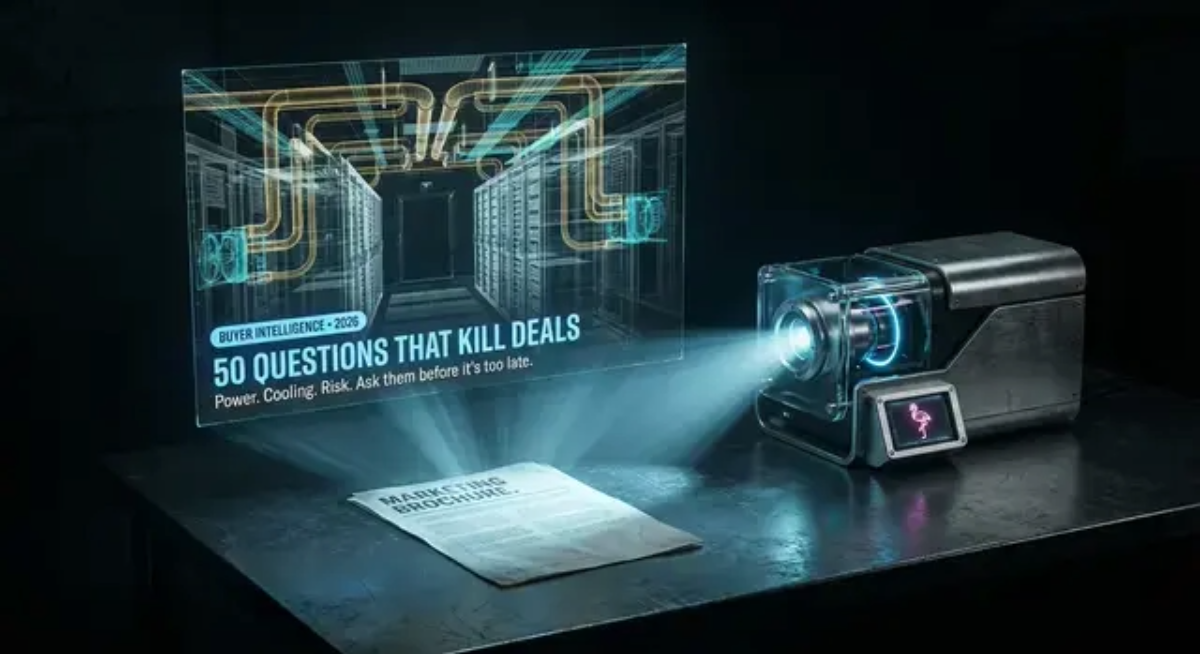

Do we actually have power, or do we have a brochure?” That’s the question keeping data center buyers awake in 2026. With AI workloads pushing rack densities past 100kW, grid interconnection queues stretching 5+ years, and community moratoriums blocking expansion, the stakes have never been higher.
This isn’t a guide for beginners asking “what is colocation?” or “what is data center marketing?” This is for operators, procurement teams, and finance leaders who need to separate marketing promises from engineering reality. We built these 50 questions by applying the RFP rigor of a specialized telecom marketing agency to three specific inputs: (1) real buyer query patterns, (2) the hard questions found in buying committees, and (3) operator realities—power constraints, cooling density, and uptime risk.
Then we scored each question by shortlist impact and how quotable the answer is when optimizing AI Search for Telecom and infrastructure queries.
The result: 50 operator-grade questions organized the way real buyers think. Questions marked with ⭐ are ones buyers should ask but often don’t, until it’s too late.
These are the exact questions buyers ask AI. Do you show up as the answer?
Decision-makers don’t just Google anymore — they ask ChatGPT, Gemini, and AI Overviews to explain risk, validate claims, and shortlist vendors. If your data center company isn’t being cited when these questions come up, you’re often filtered out before the first meeting. We build the content, structure, and authority signals that get you referenced in AI search — without turning your site into marketing fluff.
Power & Grid Reality
1. What’s the real timeline to energize X MW in this market?
Don’t accept “12-18 months” as an answer. Ask for the utility interconnection queue position, substation capacity headroom, and whether long-lead equipment (transformers, switchgear) is already on order. According to the U.S. Department of Energy, grid interconnection timelines have doubled since 2020 in high-demand markets.
2. What happens if the grid requires curtailment—what’s in the contract? ⭐
Curtailment clauses are becoming standard in constrained markets. Who absorbs the cost? What’s the notification protocol? How does it affect your SLA? If the provider can’t answer this, they haven’t stress-tested their power strategy.
3. Can you support AI load profiles without destabilizing power quality?
AI workloads create spiky, non-linear demand. Ask about power quality monitoring (THD, voltage sag), UPS sizing for transient loads, and whether the electrical design accounts for simultaneous peak draw across racks.
4. What’s your approach to on-site generation / PPAs / behind-the-meter?
With grid constraints tightening, behind-the-meter generation (natural gas, fuel cells, even nuclear SMRs) is moving from “nice-to-have” to “table stakes.” What’s the provider’s roadmap? Do they have existing PPAs or generation assets?
5. How do you price power when supply is constrained?
Transparent pass-through? Fixed escalators? Demand charges? Understanding the pricing model prevents re-trading late in the process and protects your pro forma.
Cooling & Density
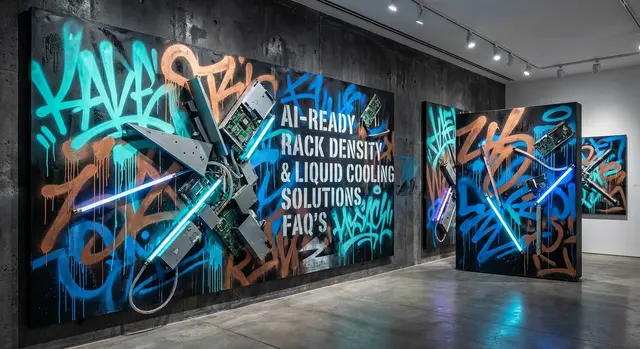
6. What rack densities can you reliably support today vs 12 months out?
“AI-ready” is marketing. Ask for specific kW-per-rack limits, current utilization, and the engineering basis (CFD modeling, thermal testing). Then ask what changes in 12 months—because AI chip roadmaps don’t wait.
7. Liquid cooling: what’s supported (direct-to-chip, rear-door, immersion) and why?
Not all liquid cooling is created equal. Direct-to-chip requires CDU infrastructure and leak detection. Rear-door heat exchangers are simpler but less efficient. Immersion is exotic and operationally complex. What has the provider actually deployed at scale?
8. What’s the failure mode (leaks, CDU failure) and who owns the risk? ⭐
This is the question most buyers skip. If a CDU fails or a coolant line leaks, who pays for downtime? Hardware damage? Is there redundant cooling capacity? What’s the MTTR?
9. What’s your plan for heat reuse / water strategy / reclaimed water?
Water scarcity is a regulatory and reputational risk. Ask about water usage effectiveness (WUE), reclaimed/industrial water sourcing, and heat reuse partnerships (district heating, agricultural). Bonus points if they can show you a public sustainability report.
10. What’s the total cost delta for “AI-ready” build vs traditional?
Liquid cooling, higher-density electrical, and advanced monitoring add 20–40% to capex. Make sure the provider’s pricing reflects reality, not a legacy air-cooled model.
Reliability & Outage Trust
11. What’s your SLA, and what triggers service credits?
Read the fine print. Does the SLA cover power, cooling, and network? What’s excluded (planned maintenance, force majeure)? What’s the credit structure—and is it meaningful enough to matter?
12. Power is the top cause of impactful outages—how do you design against that?
According to Uptime Institute, power-related incidents account for 40%+ of significant outages. Ask about N+1 vs 2N redundancy, generator testing frequency, automatic transfer switch (ATS) reliability, and whether they’ve had a “severity 1” power event in the past 24 months.
13. What’s your first 60 minutes communication protocol during incidents? ⭐
Outages are inevitable. What separates good providers from bad is communication. Who gets notified? How fast? What’s the escalation path? Do they have a status page and real-time updates?
14. How often do you test failover and emergency procedures?
Monthly generator tests under load? Annual full-facility failover drills? If they can’t show you a testing calendar, they’re not serious about reliability.
15. What’s your track record on “severity 1” events (and how do you report it)?
Ask for a 24-month incident history. If they won’t share it, that’s a red flag. Transparency builds trust.
Security & Compliance
16. What certifications do you maintain (SOC 2, ISO 27001, etc.)?
SOC 2 Type II, ISO 27001, PCI-DSS, HIPAA—these aren’t optional for enterprise buyers. Ask for current audit reports and recertification timelines.
17. How do you handle customer audits and security questionnaires?
Do they have a customer portal for audit documentation? How long does it take to respond to a security questionnaire? Slow responses kill deals.
18. Who owns shared responsibility boundaries (facility vs customer vs cloud)? ⭐
This is where finger-pointing happens during incidents. Get it in writing: who owns physical security, network security, access control, and monitoring?
19. What’s your physical security model and escalation procedure?
Biometric access? 24/7 on-site security? Video surveillance retention? Escort policies? Ask for a facility tour and observe the reality vs the brochure.
20. How do you manage third-party/vendor access?
Vendor access is a common attack vector. What’s the vetting process? Escort requirements? Logging and audit trails?
Want more tours, better pipeline, and stronger trust?
We help data center teams grow with a simple, full-stack system: content that answers buyer questions, PR that builds credibility, and targeting that reaches the right people. No junior handoffs. Our average expert has 15+ years of experience.
What you get (plain English)
- Show up in search: Google + AI search (ChatGPT-style answers)
- Build trust: industry + major media placements
- Reach exact accounts: efficient targeting + follow-up
- Turn interest into meetings: nurture + sales-ready assets
Get a free quick plan
Network & Interconnection
21. How many carriers, exchanges, and cloud on-ramps are on-net today?
Network density = optionality. Ask for a current carrier list, not a “coming soon” roadmap. Bonus: Are AWS Direct Connect, Azure ExpressRoute, and Google Cloud Interconnect available?
22. What’s the cross-connect process and typical lead time?
Is it same-day? 48 hours? A week? Cross-connect delays can bottleneck your go-live timeline.
23. What’s your “network density roadmap” over 12–24 months? ⭐
If you’re signing a 5-year deal, you need to know what the network ecosystem will look like in year 3. Are new carriers coming? New peering exchanges?
24. How do you engineer latency-sensitive connectivity?
For AI inference, gaming, or financial services, every millisecond counts. Ask about fiber routing, switch architecture, and whether they can guarantee sub-5ms latency to key destinations.
25. Do you support diverse entry paths and documented resiliency?
Single points of failure kill uptime. Ask for diverse conduit entry, geographically separated meet-me rooms, and documented fiber path diversity.
Business Model: Colo vs Wholesale vs Build-to-Suit
26. What’s the difference in contract structure between colo and wholesale here?
Colocation = per-rack/kW pricing, shared infrastructure. Wholesale = dedicated space, longer terms, more control. Understand the trade-offs before you commit.
27. Which model is better if the buyer expects rapid AI expansion? ⭐
If you’re scaling AI workloads, you need expansion rights, flexible power allocation, and the ability to retrofit cooling. Wholesale or build-to-suit gives you more control.
28. What drives pricing: term, MW, density, delivery timeline, interconnect?
Pricing is multidimensional. Longer terms = lower rates. Higher density = premium. Faster delivery = premium. Understand the levers so you can negotiate intelligently.
29. What’s your flexibility around phased capacity delivery?
Can you take 5 MW now and 10 MW in 18 months? Phased delivery reduces upfront capex and aligns spend with revenue.
30. How do you handle early termination, expansion rights, and ROFO/ROFR?
What if your business pivots? What if you need to exit early? What if you want to expand but the provider is sold out? Get these terms in writing.
Turn RFPs from two weeks into under 30 minutes (draft-ready)
RFPs steal time from sales, engineering, security, and legal. Our RFP AI agent pulls the right answers from your approved materials, connects teams in one workflow, and produces a clean draft that’s ready for review — fast. It’s built for enterprise requirements: secure, compliant, and already used by real teams to increase deal velocity.
Site Selection & Expansion
31. What markets can you deliver fastest with power (not just land)?
Land is easy. Power is hard. Ask which markets have utility capacity today, not in 3 years.
32. What’s the permitting risk profile (moratoriums, opposition, zoning)? ⭐
Northern Virginia, Phoenix, and Dublin have all faced moratoriums or community opposition. What’s the provider’s track record navigating this? Do they have a government affairs team?
33. How do you handle community engagement “before the shovel hits dirt”?
Proactive community engagement (job creation, tax revenue, sustainability commitments) reduces opposition. Reactive engagement invites lawsuits and delays.
34. What’s the supply chain risk for transformers/switchgear and how do you mitigate?
Lead times for transformers are 18–24 months. If the provider hasn’t ordered long-lead equipment, your timeline is fiction.
35. What’s the realistic commissioning timeline and who owns schedule risk?
Ask for a Gantt chart with critical path milestones. Who owns delays? What’s the liquidated damages clause?
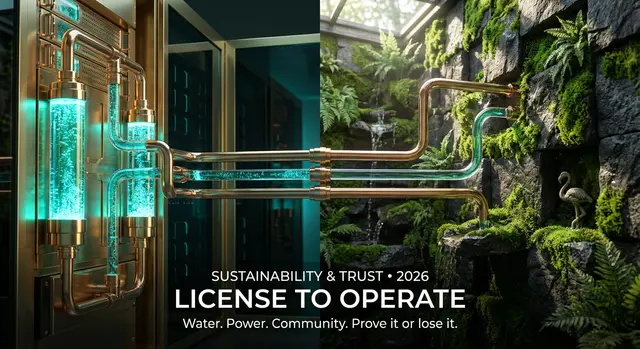
Sustainability, Water, and “License to Operate”
36. What is your water strategy and transparency approach?
Water usage is under scrutiny. Ask for WUE metrics, reclaimed water sourcing, and public reporting. If they won’t share data, they’re hiding something.
37. How do you answer community concerns about utility prices and resource strain?
Data centers can strain local grids and water supplies. What’s the provider’s narrative? Do they have partnerships with utilities to offset impact?
38. What do you do if a community says “no” or pushes for concessions? ⭐
This is happening more often. Does the provider have a playbook? Have they successfully navigated opposition before?
39. What’s your plan to use reclaimed/industrial water where feasible?
Potable water for cooling is increasingly unacceptable. Ask about reclaimed water infrastructure and partnerships with municipal water authorities.
40. What sustainability claims can you prove with data (not marketing)?
“Carbon-neutral” and “100% renewable” are easy to claim, hard to prove. Ask for PUE data, renewable energy certificates (RECs), and third-party verification.
Finance & Exit Math (CFO / Investor Lens)
41. How does constrained power change underwriting and valuation?
Lenders and investors are tightening credit standards. Power certainty, customer credit quality, and contract length drive valuations. Understand how your deal stacks up.
42. What contract terms improve bankability (term, credit, take-or-pay)? ⭐
Longer terms, investment-grade customers, and take-or-pay clauses make deals more financeable. If you’re building a portfolio, these terms matter.
43. How do you structure escalators and pass-through without scaring buyers?
Transparent escalators (CPI-linked, utility pass-through) are acceptable. Opaque or uncapped escalators kill deals.
44. What de-risks the exit: customer mix, power certainty, expansion rights?
If you’re planning to sell or refinance, you need diversified customers, contracted power, and expansion optionality. Ask how the provider structures deals to maximize exit value.
45. What triggers re-trading late in the process and how do you prevent it?
Re-trading happens when assumptions break: power timelines slip, costs escalate, or scope changes. Prevent it with detailed LOIs, fixed-price commitments, and schedule guarantees.
PR, Trust Signals & “AI Shortlist Visibility”
46. When buyers ask AI “who’s credible,” what signals influence the answer?
AI search prioritizes authoritative content, structured data, and third-party validation. Providers need SEO-optimized FAQs, case studies, and analyst recognition to show up in AI-generated shortlists.
47. Which publications/analysts actually move trust for this category? ⭐
Data Center Knowledge, Uptime Institute, Gartner, 451 Research, and trade press (Data Center Dynamics, Mission Critical) drive credibility. Earned media > paid ads.
48. How do you structure content so AI can quote it (tables, FAQs, definitions)?
AI models prefer structured, quotable content: tables, bullet lists, FAQ schema, and concise definitions. If your content isn’t AI-friendly, you’re invisible.
49. How do you combine earned media + targeted distribution (programmatic/LinkedIn) so decision-makers actually see it?
Earned media builds authority. Programmatic and LinkedIn ABM ensure the right people see it. The combination = shortlist velocity.
50. What’s your crisis narrative: what do you say when things go wrong, and how fast?
Outages and incidents are inevitable. The providers who survive are the ones who communicate fast, transparently, and with a clear remediation plan. Do you have a crisis comms playbook?

From Checklist to Competitive Advantage
These 50 questions aren’t just an RFP template. They’re a window into how serious buyers evaluate risk, trust, and long-term value. The providers who can answer them clearly—with data, proof, and zero deflection—are the ones who win.
And in 2026, these questions don’t just show up in email threads. They show up at Data Center Conferences in 2026, in hallway conversations, in follow-up calls, and in the “quick summary” buyers ask AI tools to generate before they ever book a tour. That’s why the best operators treat these questions like a go-to-market asset, not a procurement chore.
At Percepture, we help data center providers turn these questions into content that performs in the real world and in AI search services. That includes the messaging, pages, proof points, and distribution strategy that make answers easy to trust—and easy for machines to interpret. We also help teams use AI Agents for Data Centers to speed up follow-ups, organize buyer questions, and keep responses consistent across sales, engineering, security, and leadership.
Because in a market where power is constrained, cooling is complex, and trust is everything, the providers who can explain their value—fast, clearly, and repeatedly—are the ones who capture it. And the brands that invest in Public Relations for Digital Infrastructure earn authority where it matters most: the publications, analysts, and industry voices that shape buyer perception before the first meeting.
Want to see how your content stacks up? Contact Percepture for a content audit and AI-readiness assessment.
Featured Questions
What questions should I ask a data center provider?
Ask about power delivery timelines, cooling capacity for AI workloads, SLA terms, security certifications, network carrier density, contract flexibility, permitting risk, water strategy, and incident communication protocols. Focus on engineering reality, not marketing promises.
How do I evaluate data center reliability?
Review their SLA structure, incident history, redundancy design (N+1 vs 2N), generator testing frequency, failover procedures, and communication protocols during outages. Power-related incidents cause 40%+ of significant outages, so prioritize electrical resilience.