
If you’re evaluating a life sciences marketing agency, this is the 2026 playbook for digital marketing that drives qualified leads, not just traffic.
What is digital marketing for life sciences?
Digital marketing for life sciences is the strategic use of enterprise SEO, paid search, LinkedIn ads, programmatic ABM, AI Search (GEO) services, life sciences content marketing, digital PR, and AI-powered tools to reach scientists, procurement teams, and decision-makers who are actively researching suppliers, CDMOs, biotech partners, and pharma services.
What You’ll Learn:
- The 7 channels that actually drive pipeline in 2026
- How to stay compliant without killing speed
- KPIs that matter to owners and sales leaders
- How AI search and agentic workflows are changing the game
- A 90-day execution plan you can start Monday
Get your 2026 Life Sciences Growth Plan
If sales needs more meetings, you need a plan that is both compliant and fast. We’re a senior life sciences marketing + PR team (doing this since 2004). No junior handoffs. Clear steps. Real KPIs.
- Best channel mix for your niche (CDMO, biotech, pharma, chemicals)
- Fastest path to qualified leads (not just traffic)
- Compliance-safe speed using approved claims + smart workflows
- AI search visibility so buyers can validate you before the call
- 15+ years average experience across the team
- Built for owners and sales leaders who need pipeline
- SEO + paid + ABM + PR + AI workflows — one team
- Plain English deliverables your team can execute Monday
What Is Digital Marketing for Life Sciences?
Digital marketing for life sciences is not the same as B2C marketing or even standard B2B. It requires technical depth, compliance awareness, and the ability to reach highly specialized audiences.
Life Sciences vs. Pharma vs. Biotech vs. CDMO
Each niche has different buying cycles, compliance requirements, and decision-making units.
- Pharma: Patient-facing and HCP-focused marketing with strict FDA and MLR review.
- Biotech: Investor relations, partnership development, and scientific credibility.
- CDMO/CRO: B2B procurement, RFP response speed, and capacity messaging.
- Specialty Chemicals: Technical data sheets, regulatory compliance, and supply chain trust.
The buying committee in life sciences often includes scientists, procurement, quality assurance, and legal. That means your content must satisfy multiple stakeholders at once.
What Changed in 2026
AI Search and Longer Questions
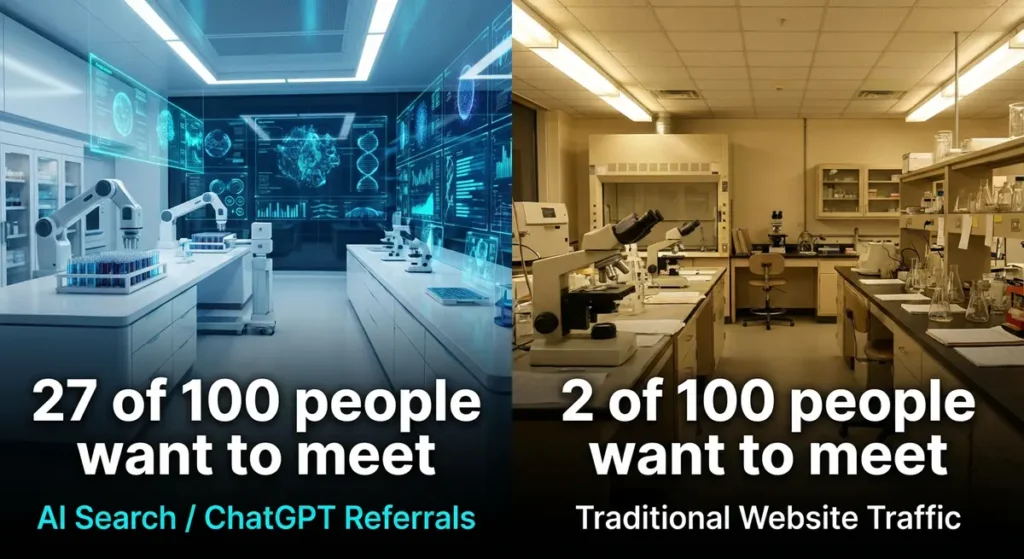
Buyers are no longer just typing “CDMO near me.” They’re asking Perplexity, ChatGPT, and Google AI things like “What’s the best aseptic fill finish CDMO for biologics under 10,000 units?”
If your content isn’t structured to answer those questions, you’re invisible. Google’s AI search guidance emphasizes that helpful, people-first content with clear answers and quality visuals performs best.
Compliance Plus Speed
The old model was “wait 6 weeks for legal to approve a blog post.” The new model is building an approved claims library and using AI agents to draft compliant content in minutes, not months.
This is how you stay fast without breaking rules.
Trust Signals Buyers Need
With 61% of B2B buyers now preferring a rep-free experience (Gartner), your digital presence must do the selling before a rep ever enters the room. This makes high-trust channels, specifically AI Search Overviews and SEO, critical for securing meetings. We proved this approach with an enterprise CDMO client, where dominating these ‘trust signals’ drove the following results.
[CASE STUDY]
- AI: AI Overview mentions grew 82% in 30 days (33 → 60).
- SEO: Website traffic rose 48% YoY in 30 days (5,500 visits) and generated 53 leads (3x).
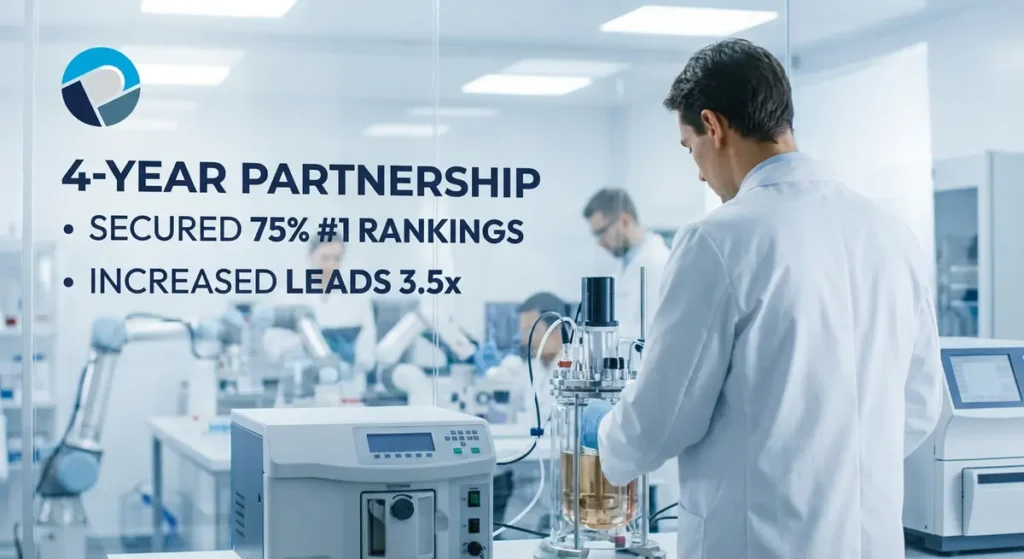
- Rankings: Hit #1 in Google for 18 top keywords.
- Paid: Conversions/leads jumped 3x (+200%) with a 14.29% conversion rate.
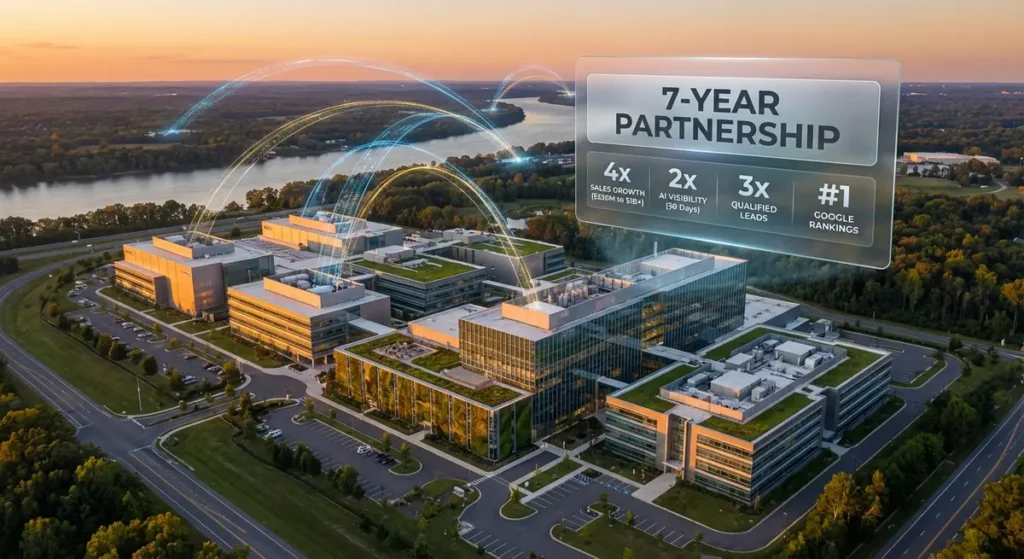
- Revenue: Annual sales grew $250M → $1B+, helping drive a €60M expansion and 70 new hires.
The 7 Channels That Actually Drive Pipeline
SEO for Life Sciences
SEO is how you capture demand when buyers are actively searching. In life sciences, that means ranking for high-intent terms like “lyophilization CDMO,” “aseptic fill finish,” or “biologics contract manufacturing.”
Percepture has been doing life sciences SEO since 2004. We’ve helped clients increase fill finish leads by 200% and traffic by 438% using AI-powered keyword research and technical content.
Life Science Content Marketing
Scientists have fluff detectors. You need technical depth, not generic blog posts. That means white papers, case studies, process diagrams, and compliance workflows.
Life science content marketing is about proving you understand the science, not just the sales pitch.
Paid Search for Life Sciences
Google Ads let you intercept competitive traffic and target high-intent searches. We’ve driven 15 conversions and 6 phone calls in 30 days for a contract manufacturing client using tightly targeted campaigns.
The key is negative keywords and tight match types so you don’t waste budget on unqualified clicks.
LinkedIn Ads for Life Sciences
LinkedIn lets you target by job title, company, and industry. We’ve reached 25,800 target audience members and generated leads from companies like Lonza, GSK, and Capstone with conversion rates as high as 14.29%.
LinkedIn works because you can reach the exact decision-makers who control budgets and RFPs.
Programmatic and ABM for Life Sciences
Programmatic ABM uses IP targeting and behavioral data to reach specific accounts. We’ve achieved CTRs of 5.28% and cost per landing page view as low as $0.35 for highly specialized audiences.
This is how you reach the top 50 accounts that matter most to your pipeline.
Digital PR for Life Sciences
Digital PR is how you build authority and feed the LLMs that buyers use to research you. Press releases aren’t just for news wires anymore. They’re for AI search.
Percepture has been doing digital PR since 2004. We combine earned media, backlinks, and content distribution to build trust and rankings.
Events and Follow-Up Systems
Trade shows like BIO and CPHI are still important, but the real ROI comes from geofencing, retargeting, and follow-up campaigns that capture traffic before you even set up the booth.
Channel Mix Decision Tree (Life Sciences)
Pick your situation. We’ll recommend what to prioritize first so you can drive qualified leads without breaking compliance. Built by a senior team doing life sciences marketing + PR since 2004.
Run the tool to generate your report.
Compliance Without Slowing Down
The Review Workflow That Works
Most life sciences companies slow down because they don’t have a system. Here’s the fix:
- Build an approved claims library
- Use AI Sales Agents to draft RFP’s from approved materials
- Route for review only when new claims are introduced
- Publish and measure

What to Document and Why
Document your approval process, your claims library, and your review SLAs. This protects you in audits and speeds up your team.
The FDA’s Office of Prescription Drug Promotion (OPDP) ensures promotion is “truthful, balanced, and accurately communicated.”
“OPDP ensures promotion is truthful, balanced, and accurately communicated.” — FDA
The Percepture System: 22 Years of Integrated PR and Digital
We’ve been doing this since 2004. Here’s what integrated marketing programs can deliver:
- Enterprise contract manufacturing division: Grew from $250M to over $1B annually, leading to a €60M expansion and 70 new hires.
- Specialty chemical provider: Increased qualified leads by 382% in the first 4 months with a 67% increase in qualified traffic.
- Global chemical supplier: Increased qualified leads by 6x with a 56% lift in qualified traffic in 120 days.
Results vary by market and offer. These are examples of outcomes from integrated programs.
Beyond GenAI: Agentic Workflows for Life Sciences Pipeline
AI agents are not just for writing blog posts. We deploy AI agents that:
- Draft 80% of an RFP response in minutes using your approved technical documentation
- Accelerate follow-up and meeting setting
- Create compliant ad variants and landing pages in real time
Important: AI agents do not create medical claims. They accelerate drafting and routing using approved materials and guardrails.
See the RFP Agent Workflow (Life Sciences)
RFPs and security questionnaires steal weeks because answers live across sales, QA, regulatory, and legal. Our workflow drafts the first version from your approved technical documentation in minutes — then routes it for review when it matters. No made-up claims. No shortcuts. Just speed with guardrails.
KPIs That Matter to Owners and Sales
Moving Beyond Vanity Metrics
Traffic is nice. Leads are better. But what executives care about is pipeline, meetings, and revenue.
The KPI Table
| Metric | Definition | Why It Matters |
|---|---|---|
| MQL | Marketing Qualified Lead | Shows top-of-funnel health |
| SQL | Sales Qualified Lead | Shows handoff quality |
| Meeting Rate | % of SQLs that book meetings | Shows sales readiness |
| Pipeline Value | Total $ value of open opportunities | Shows revenue potential |
| Cycle Time | Days from MQL to close | Shows efficiency |
The 90-Day Execution Plan
(1) Days 1-30: Foundation
- Audit current rankings and traffic
- Build approved claims library
- Set up tech stack (CRM, analytics, schema)
- Launch SEO pilots
(2) Days 31-60: Scale
- Launch paid ABM campaigns
- Deploy digital PR
- Activate AI agents for content and RFP workflows
(3) Days 61-90: Authority
- Publish case studies and proof blocks
- Run CRO tests on landing pages
- Build internal linking structure
What are some FAQs?
1. What is the average budget for life science digital marketing?
Budgets range from $5,000/month for startups to $50,000+/month for enterprise CDMOs and pharma divisions.
2. How does policy pressure like the BIOSECURE Act affect CDMO marketing?
The BIOSECURE Act would prohibit federal contracting with certain biotechnology providers connected to foreign adversaries. This creates procurement pressure and makes supply chain messaging critical.
3. Why is SEO critical for biotech IPOs?
Investors research companies online. If you don’t rank for your brand and key terms, you lose credibility.
4. How long does it take to see results from life sciences SEO?
Typically 90-120 days for initial ranking improvements and 6-12 months for sustained pipeline impact.
5. What’s the difference between digital PR and traditional PR?
Digital PR focuses on backlinks, online mentions, and feeding AI search engines. Traditional PR focuses on print and broadcast.
6. Can AI agents really draft RFPs?
Yes. AI agents can digest your technical documentation and draft 80% of an RFP response in minutes, then route it for human review.
7. What’s the best channel for CDMO lead generation?
SEO and LinkedIn ABM tend to drive the highest quality leads for CDMOs.
8. How do you measure digital marketing ROI in life sciences?
Track MQLs, SQLs, meetings, pipeline value, and revenue influence.
9. What’s the biggest mistake life sciences companies make in digital marketing?
Treating it like a brochure instead of a pipeline engine.
10. How do you stay compliant and still move fast?
Build an approved claims library and use AI agents to draft content from approved materials.
While approved matrial may not change, materialtools have changed, but the goal hasn’t: compliance, security, trust, and revenue. If you want qualified leads, not traffic charts, we can help you track what matters. Meetings. Opportunities. Cycle time. Revenue influence through our AI Agents for Life Sciences.
We’ll also review your AI search visibility and digital PR footprint; mapping your channel mix, review your AI search visibility, and show you the fastest path to qualified leads.