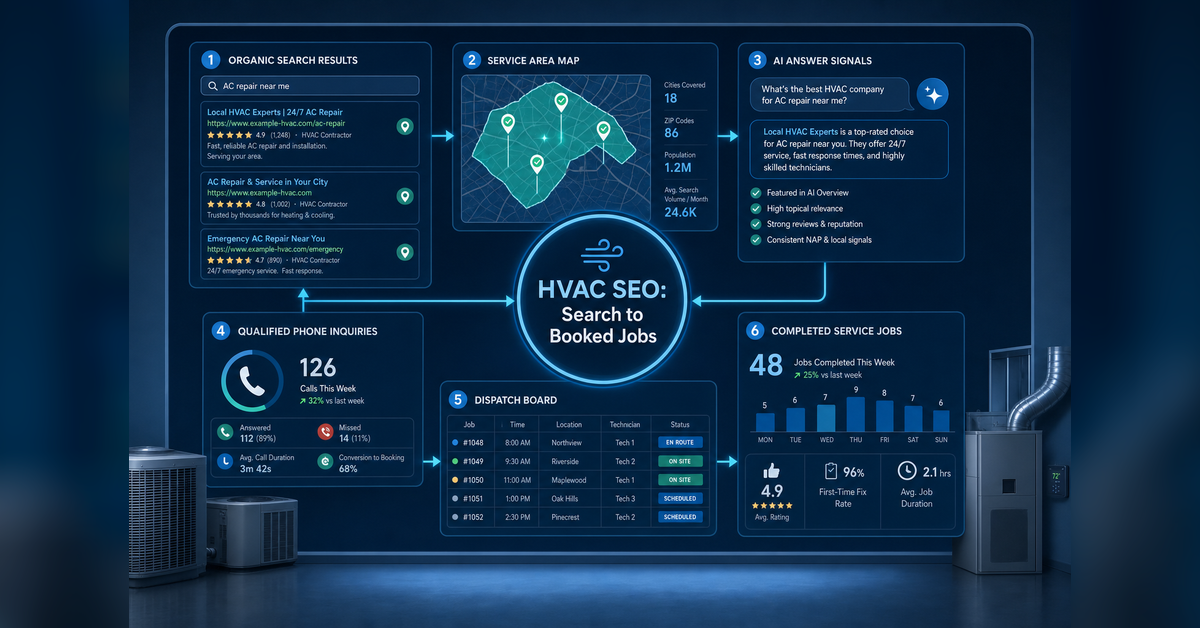

HVAC SEO is the process of improving a heating and cooling company’s visibility in Google Search, Google Maps and AI-generated answers. It combines technical website work, service and location pages, Google Business Profile management, expert content, reviews, authority signals and conversion tracking to generate qualified calls and booked jobs.
The goal is not to rank for every HVAC keyword. The goal is to create qualified demand for profitable services in markets the company can serve.
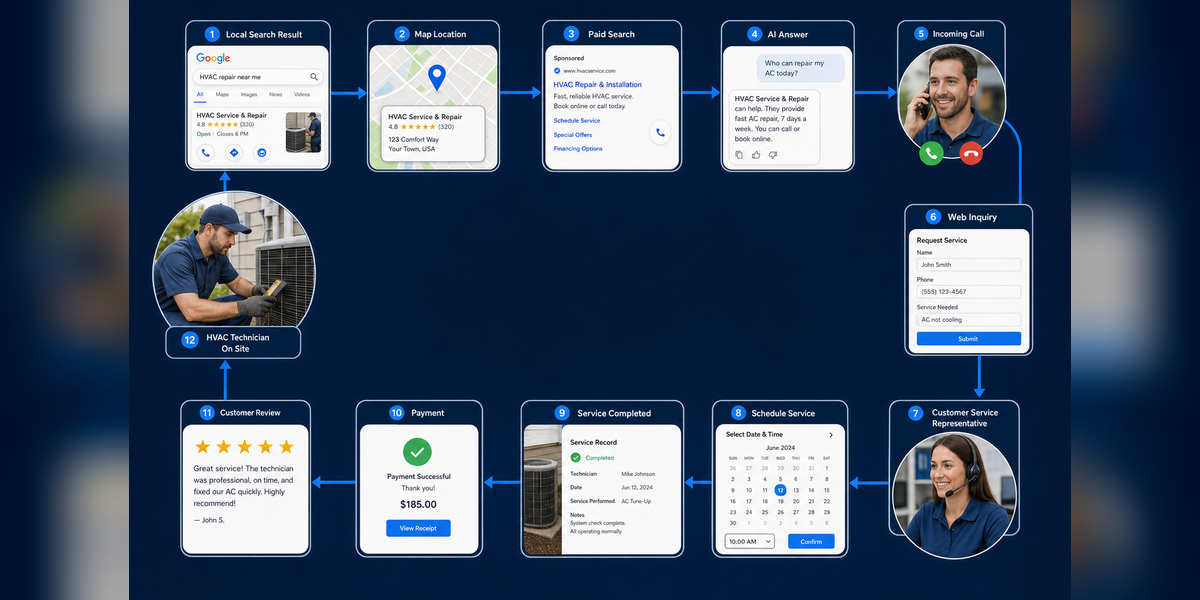
HVAC search works better when the full path works
Percepture has worked across construction, engineering, infrastructure and complex B2B markets since 2004. The goal is not random traffic. The goal is qualified demand that the company can answer, book and complete.






What is HVAC SEO?
HVAC SEO connects search visibility to the operating realities of an HVAC company: available services, technician capacity, install capacity, geography, seasonality, call handling and job profitability. A sound plan measures more than traffic. It follows demand from the search result through the call, booking, dispatch, completed job and revenue record.
Reviewed July 2026. Search surfaces, platform rules and buyer behavior can change. Verify current implementation details before changing profiles, tracking or site architecture.
Executive summary
Start with capacity
Set search priorities based on staffing, travel limits, service mix, seasonality and business goals.
Build distinct search assets
The search program must account for organic results, Maps and AI answers as overlapping surfaces with different jobs.
Design for real buyers
Service pages should answer the question behind a no-cool call, replacement search, maintenance need or commercial request.
Measure completed work
Connect visibility and leads to bookings, dispatches, estimates, closed work, gross profit and repeat business where data permits.
Who this guide is for
Owners and CEOs
Use search visibility to prioritize profitable market share, recurring work and manageable demand.
Marketing leaders
Use the plan to prevent keyword cannibalization, weak city pages and disconnected channel reporting.
Revenue leaders
Use it to define qualified calls, territory fit, booking rate, close rate and average ticket.
Operations leaders
Use it to align promotion with technician skills, dispatch capacity, inventory and service boundaries.
Why HVAC SEO is different from general SEO
A generic campaign may chase the largest search volumes. A useful search campaign must ask a harder question: which searches represent work the company wants, can perform and can serve profitably?
A no-cool call has different urgency from a commercial controls project. A tune-up has different economics from a change-out. A maintenance agreement may support steadier demand than emergency repair. Residential repair, rooftop units, chillers and building controls also require different pages, proof and sales paths.
This is why search planning belongs inside a broader strategy and planning process. Marketing priorities should change when the dispatch board, service mix or target geography changes.
Check where good HVAC leads are getting lost
Before adding more traffic, check whether current inquiries match your services, territory and capacity. The review helps separate a search problem from a call-handling or booking problem.
- Check service and territory fit
- Find leaks between the click and booked job
- See which issue should be fixed first
The ten parts of a complete search program
This search scorecard connects each discipline to an operating question and a defined output.
| Part | Operating question | Primary output |
|---|---|---|
| Technical health | Can search systems crawl, render and index the right pages? | Clean indexation and dependable page performance |
| Keyword research | What is the searcher trying to buy, solve or compare? | Intent map |
| Service pages | Does each priority service have a useful destination? | Service architecture |
| Location architecture | Which real markets require local information? | Distinct location pages |
| Maps visibility | Are profiles accurate and supported by local proof? | Google Business Profile plan |
| Expert content | Are customer questions answered accurately? | Reviewed guides and decision content |
| Authority | Do reputable sources support the company’s relevance? | Citations, links and earned coverage |
| AI visibility | Can machines identify the company, services and evidence? | Clear entities and retrievable answers |
| Conversion | Can a qualified visitor call, book or request an estimate? | Clear conversion paths |
| Measurement | Which searches become completed work? | Search-to-job reporting |
The HVAC Golden Triangle Search-to-Job System
Percepture’s framework connects Google organic results, Google Maps and AI-generated answers to profitable services, qualified calls, booked jobs and measurable outcomes. Capacity and job economics shape every search priority.
Capacity and Profit Map
Document offered services, excluded work, margins, staffing, install capacity, geography, emergency coverage and seasonality.
Output: a clear demand boundary.Google Organic Authority
Build service, equipment, problem, comparison and commercial-use-case pages on a sound technical foundation.
Output: one useful destination for each priority intent.Google Maps and Local Authority
Maintain accurate profiles, real locations, suitable categories, reviews, photos, citations and local evidence.
Output: legitimate local visibility.AI Answer and Entity Authority
Publish clear definitions, named expertise, structured tables, consistent business facts and accessible public proof.
Output: stronger machine understanding and retrievability.Conversion and Booked-Job Intelligence
Track calls, forms, qualified leads, bookings, dispatches, estimates, completed jobs and revenue where data allows.
Output: search-to-job accountability.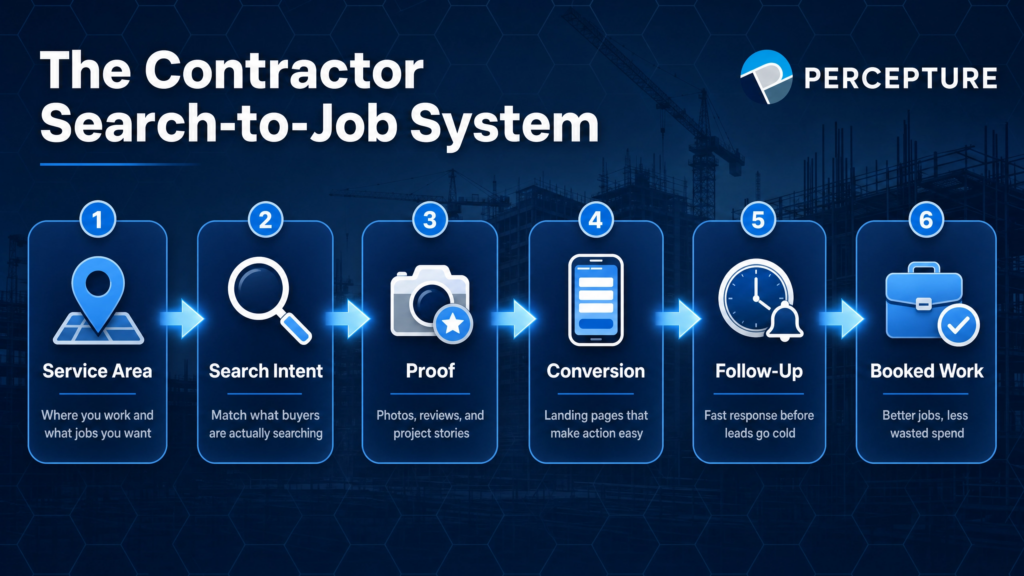
Key takeaway: Do not build demand without confirming that the company has the people, territory and service capacity to fulfill it.
HVAC SEO across organic results, Maps, AI answers and paid media
| Decision factor | Organic Google results | Google Maps/local pack | AI-generated answers | PPC and local ad formats |
|---|---|---|---|---|
| Primary job | Answer service, problem and research searches | Connect local intent with nearby providers | Synthesize answers and possible options | Buy immediate placement for selected queries |
| Main inputs | Technical health, pages, links and relevance | Profile accuracy, proximity, relevance and prominence | Clear entities, crawlable answers and public authority | Budget, bids, eligibility, targeting and landing pages |
| Best use | Durable topic and service coverage | Local service discovery | Research and recommendation visibility | Demand capture and message testing |
| Cost type | Ongoing strategy, content and technical investment | Profile, reputation and local optimization work | Content, entity and authority investment | Media spend plus management |
| Time horizon | Compounding | Ongoing and market dependent | Variable and not controllable | Placement can stop when spending stops |
| Measurement | Queries, pages, calls, bookings and revenue | Local visibility, profile actions and calls | Mentions, citations, referrals and assisted conversions | Spend, calls, leads, bookings and acquisition cost |
| Main risk | Targeting traffic without business fit | False locations or inconsistent information | Assuming citations can be guaranteed | Paying for weak or poorly handled leads |
Paid search can support seasonal demand or rapid testing. Percepture’s paid search service can sit beside organic work, while omnichannel marketing is useful when search must coordinate with other channels.
Build an HVAC keyword and intent map
Effective search planning does not treat every keyword as interchangeable. “AC repair” may indicate an immediate service need. “Repair versus replace” is a decision query. “Commercial HVAC maintenance contract” can signal a longer buying process involving operations, finance and facilities teams.
Group terms by service, problem, equipment, location, decision stage and buyer type. Then assign each group to one primary page. Percepture’s keyword intelligence system supports this kind of structured research.
Keyword-intent matrix
| Intent group | Examples | Best destination | Conversion path |
|---|---|---|---|
| Immediate service | No cooling, no heat, repair | Specific service page | Call or service request |
| Planned replacement | Installation, replacement, change-out | Installation or replacement page | Estimate request |
| Equipment | Heat pump, furnace, rooftop unit, chiller | Equipment page | Service or project inquiry |
| Problem research | Frozen coil, weak airflow, short cycling | Expert problem guide | Relevant service link |
| Commercial evaluation | Controls, maintenance planning, service contract | Commercial use-case page | Consultation or request for scope |
| Local intent | Service plus city or region | Real location page or profile | Local call or booking |
Design service, equipment and decision pages
Core pages may cover AC repair, installation, replacement, heating repair, furnace installation, heat pumps, maintenance agreements, indoor air quality, commercial HVAC and controls where those services are actually offered. Separate repair and installation pages when the intent, process and next step are materially different.
Problem pages can address an AC that is not cooling, frozen coils, weak airflow, short cycling, uneven temperatures or a furnace that will not start. Equipment pages can cover furnaces, heat pumps, mini-splits, rooftop units, chillers, air handlers, thermostats and controls.
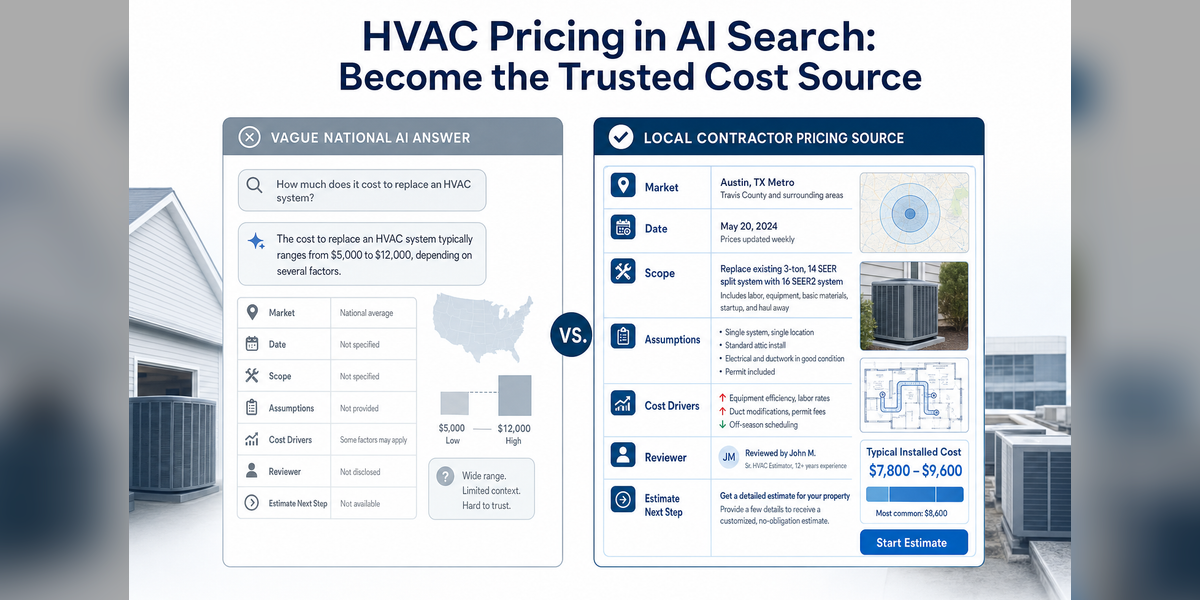
Decision content should help buyers compare repair and replacement, understand cost drivers, prepare for an estimate or plan maintenance. It should not copy manufacturer text or make unsupported energy, health or savings claims.
A useful page-architecture model
Service layer
Give the site one strong destination for each priority service and buyer intent.
Equipment layer
Pages for equipment categories the company services or installs.
Problem layer
Diagnostic content that explains likely next steps without replacing professional inspection.
Decision layer
Costs, comparisons, planning questions and selection criteria.
Location layer
Distinct pages for real service areas with locally relevant information.
Use real location and service-area architecture
For local search, a location page must offer more than a swapped city name. It should explain relevant services, service boundaries, travel context, local proof, available photos, customer questions and a clear next step. Publish only for markets the company actually serves.
Do not create fake offices, virtual-office profiles or one Google Business Profile for every service area. Profile and location decisions should reflect legitimate business operations. This protects the brand and keeps local reporting tied to real markets.
Google Business Profile and Maps checklist
- Use an accurate business name, location or service-area setup.
- Select categories and services that match actual operations.
- Keep hours and contact information current.
- Use real photos and location-level evidence when available.
- Request authentic reviews without fabricating or filtering sentiment.
- Respond to reviews with useful, non-sensitive information.
- Keep major citations consistent.
- Measure profile actions, calls and downstream lead quality.
Technical foundations for HVAC SEO
Technical work makes the site understandable and dependable. Crawlability means search systems can access pages. Indexability means an eligible page can be stored and considered for results. A canonical indicates the preferred version when similar URLs exist.
Review status codes, indexation, canonical tags, internal links, mobile behavior, page templates, structured data, image weight and conversion paths. A technical SEO audit service can help separate template-wide problems from individual page issues.
Technical readiness scorecard
| Check | Good condition | Warning sign |
|---|---|---|
| Indexation | Priority pages are eligible and discoverable | Important pages excluded or duplicate URLs indexed |
| Internal links | Services and guides connect logically | Orphan pages or repetitive keyword anchors |
| Mobile experience | Calls and actions are easy to complete | Overlays, tiny controls or unstable layouts |
| Performance | Templates and media load efficiently | Heavy scripts or oversized assets |
| Tracking | Calls, forms and key actions are classified | Traffic reports without lead disposition |
Publish expert content that buyers can trust
The best contractor search content starts with questions heard by dispatchers, technicians, estimators and service managers. Marketing turns those questions into clear pages, but a qualified subject-matter reviewer should check trade accuracy before publication.
Show who wrote the page, how it was developed, when it was updated and what evidence supports it. Use plain definitions, short answer blocks, tables and specific examples. Percepture’s content marketing service connects this editorial process to search intent and buyer needs.

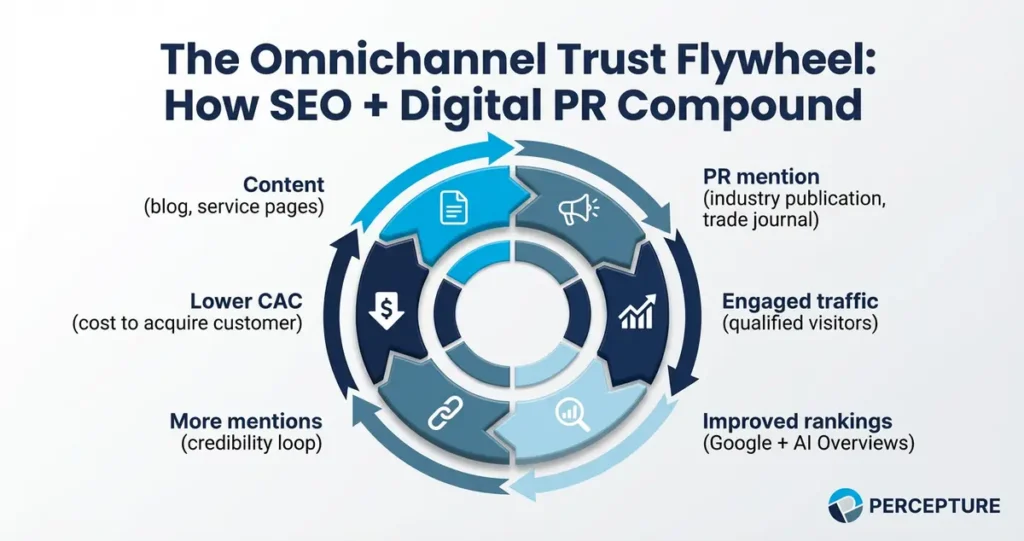
Reviews, citations, backlinks and digital PR
Reviews support local visibility while helping a buyer evaluate responsiveness, service quality and fit. They also support local prominence and conversion. Ask for honest feedback through a consistent operational process. Never create fake reviews or expose private customer information in a response.
Citations are public listings of business information. Backlinks are links from other websites. The strongest authority program earns relevant coverage, association references, local links, expert commentary and useful resources instead of buying a large volume of low-quality placements.
Percepture combines digital PR with search strategy so public authority, expert visibility and owned content reinforce one another. The related guide to PR for construction companies provides adjacent context for technical contractors.
How AI search changes HVAC SEO
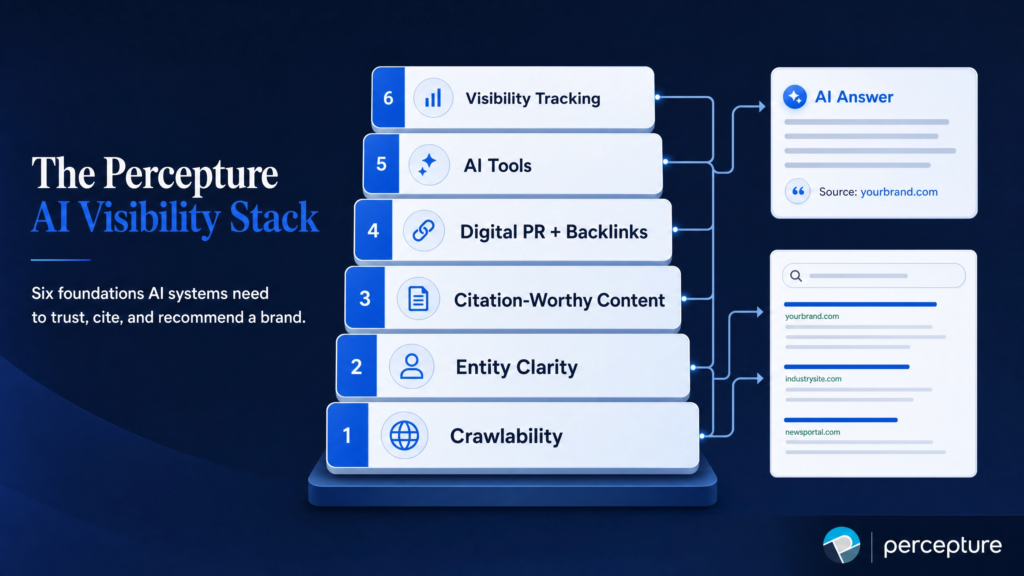
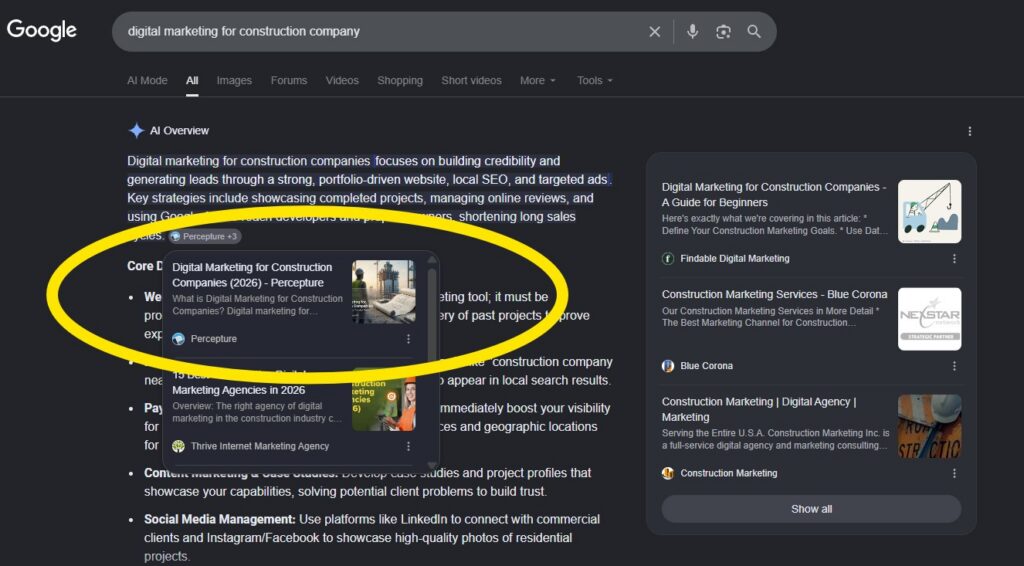
AI-generated answers can synthesize information from many public sources. An HVAC company cannot force or guarantee a citation. It can make its business easier to understand by publishing clear service information, consistent entity details, named expertise, useful answers and accessible evidence.
Traditional search and AI visibility share foundations: crawlable pages, strong topical coverage, clear entities and third-party authority. Percepture’s generative engine optimization services extend those foundations into AI-answer monitoring and content design.
See search pricing options
Scope depends on your markets, services, site condition, content needs, profile work and reporting gaps. Review the options before choosing a plan.
- Compare service and support levels
- Match the work to your markets and goals
- See what is included before the work starts
Turn visibility into qualified calls and booked jobs
Search traffic is only an input. The website must make the next action clear, especially on mobile. Calls should reach a team that can answer, classify and book them. Forms should collect enough information to route the request without creating unnecessary friction.
Conversion rate optimization improves page actions, while attribution and analytics connect marketing records with lead and revenue data. When broader pipeline support is required, lead generation services can coordinate acquisition and qualification.
Search-to-job measurement model
| Stage | Measure | Operating question |
|---|---|---|
| Discovery | Impressions, rankings, Maps visibility, AI mentions | Can qualified buyers find the company? |
| Engagement | Visits, calls, forms and chats | Do searchers take a useful action? |
| Qualification | Service fit, territory fit and valid contact | Is this a lead the company wants? |
| Sales handling | Answer, booking, dispatch and estimate rates | Can the team convert demand? |
| Business outcome | Closed work, completed jobs, revenue and gross profit | Did the campaign create profitable work? |
Residential, commercial and multi-location differences
Residential programs often emphasize urgent repair, replacement, maintenance, reviews and mobile calling. Commercial programs may require pages for rooftop units, chillers, controls, preventive maintenance, critical environments and longer buying committees. The proof, terminology and conversion path should match the work.
Multi-location groups need clear ownership for profiles, local pages, reviews, tracking and approvals. Each legitimate location should have distinct information. A shared template can provide governance, but every page still needs local value.
Technical contractors can also use lessons from SEO for construction companies and the evaluation criteria in Percepture’s contractor SEO agency guide.

What related contractor search work can prove
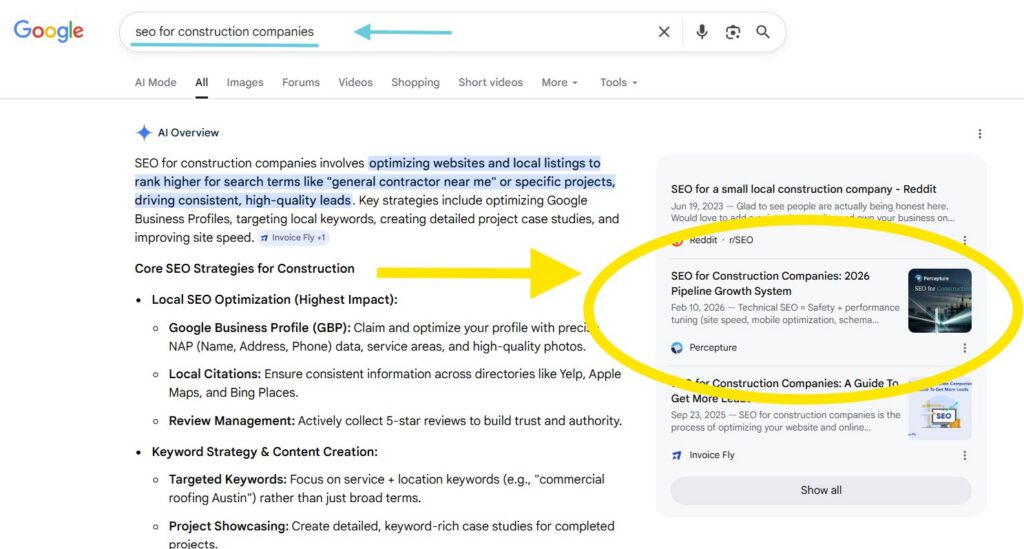
Percepture does not present a construction ranking as an HVAC client result. The useful lesson is the operating method: map buyer intent, build clear destinations, strengthen technical foundations, add credible proof and measure what becomes qualified demand.
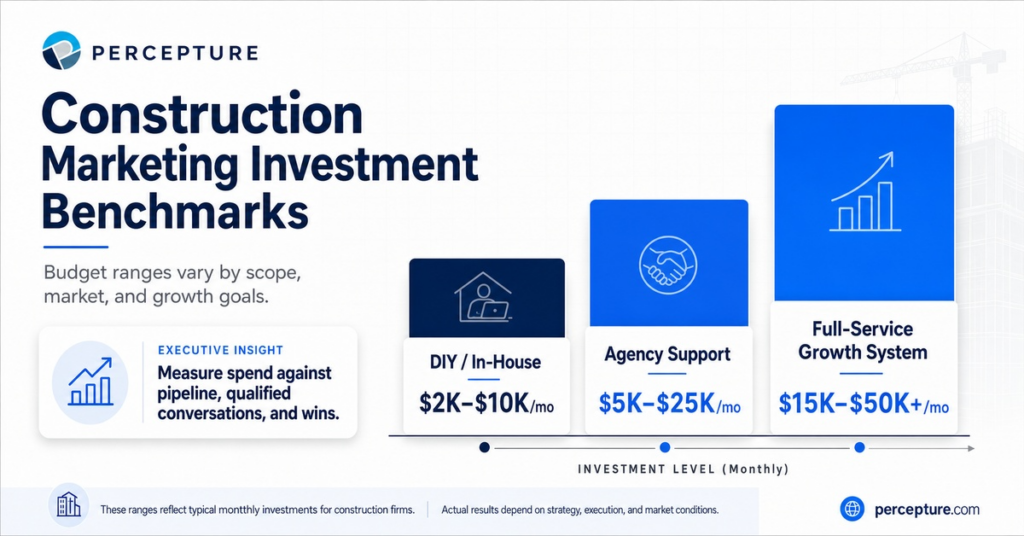
HVAC SEO pricing factors
The investment depends on scope rather than one universal package. Important variables include the number of locations, service lines, existing pages, technical condition, content requirements, review workflow, profile work, authority needs, analytics setup and implementation ownership.
| Cost driver | Lower-complexity condition | Higher-complexity condition |
|---|---|---|
| Markets | One defined service area | Multiple locations or overlapping territories |
| Services | Focused residential offering | Residential, commercial, controls and specialized equipment |
| Website | Sound templates and clean indexation | Migration, duplicate URLs or template repair |
| Content | Existing expert material | New interviews, review and extensive architecture |
| Measurement | Basic call and form tracking | CRM, dispatch, revenue and location-level attribution |
Use SEO pricing packages as a starting point for scope discussion rather than a promise of a fixed outcome.
The first 90 days
Days 1–30: establish the baseline
Collect access, audit technical health and profiles, document services and locations, map capacity and margins, review conversions, identify cannibalization and assess competitors.
Days 31–60: repair and build
Address priority technical issues, improve service pages, strengthen internal links, update legitimate profiles, refine forms and phone paths, and establish an AI-search baseline.
Days 61–90: publish and learn
Publish priority content, add available proof, pursue relevant authority, review call quality and bookings, remove poor-intent targeting and update priorities based on capacity.
The 90-day plan creates a controlled search operating rhythm. It does not establish a universal ranking deadline because competition, site condition, resources and market conditions vary.
Common mistakes and risk controls
When to hire an agency
Outside help can make sense when the company lacks ownership across technical work, content, local profiles, authority building, conversion and measurement. It can also help a multi-location group establish governance or give an internal marketing leader access to specialized execution.
Evaluate an agency by its process, implementation responsibilities, reporting definitions and ability to understand operational limits. Ask who owns the domain, content, profiles, analytics and accounts. Review whether senior strategy is included and how trade accuracy is checked.
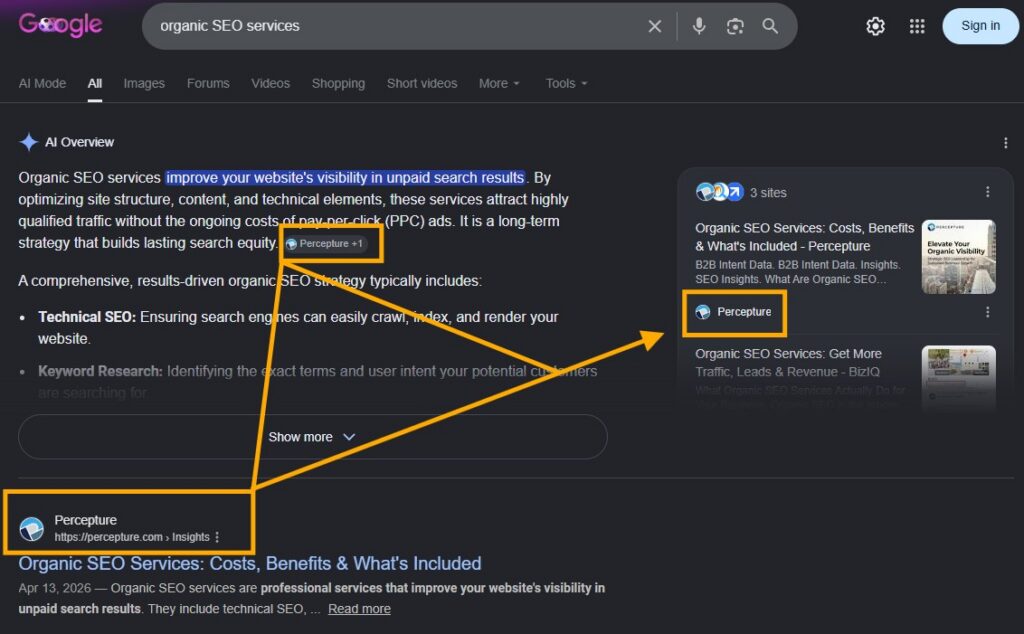
An enterprise SEO program may fit complex organizations, while organic SEO services provide broader context on search scope and deliverables.
Why Percepture’s approach is operator-led
Percepture approaches HVAC search as a search-to-job system rather than a list of isolated ranking tasks. The strategy joins organic search, local visibility, AI-answer readiness, content, digital PR, conversion and analytics around the work the company wants to sell.
The operating question stays consistent: can the company be discovered, understood, trusted, contacted and selected for a service it can profitably deliver?
Frequently asked questions
What is HVAC SEO?
HVAC SEO improves a heating and cooling company’s visibility in organic search, Google Maps and AI-generated answers. It includes technical work, keyword mapping, service and location pages, profile management, expert content, reviews, links, conversion paths and measurement. The business goal is qualified demand for services and markets the company can actually support.
How does SEO help an HVAC company?
Search visibility helps an HVAC company appear when buyers look for repairs, replacements, maintenance, equipment, commercial services or local providers. It also gives prospects useful information before they call. Its value should be measured through qualified inquiries, bookings, dispatches, completed work and revenue rather than rankings alone.
How do HVAC companies rank in Google Maps?
Maps visibility depends on factors that include relevance, distance and prominence. Companies should maintain accurate Google Business Profiles, use legitimate locations or service-area settings, select suitable categories, describe real services and build authentic reviews and local authority. Fake offices, false service areas and duplicate profiles create risk rather than a durable advantage.
Does an HVAC company need a page for every city?
No. A company should create location pages only for real markets where it can add useful local information. A worthwhile page explains services, boundaries, travel context, local evidence and next steps. Replacing a city name inside an otherwise duplicate template creates a weak experience and can produce unnecessary page competition.
Do reviews and backlinks matter?
Reviews help buyers evaluate a company and support local prominence. Backlinks can strengthen authority when they come from relevant, reputable sources. Neither should be manufactured. Build a repeatable review process and pursue links through useful resources, local relationships, associations, expert commentary and earned media rather than low-quality volume.
How does AI search affect HVAC companies?
AI systems can synthesize public information when answering service and provider questions. Companies should make their entities, services, locations, expertise and evidence clear across crawlable pages and credible third-party sources. That work can improve retrievability, but no company or agency can guarantee that an AI system will mention or cite a specific contractor.
How long does HVAC SEO take?
There is no universal timeline. Progress depends on competition, the current website, technical problems, location strength, content quality, authority and implementation speed. Early work can establish a baseline and fix obvious barriers. Competitive rankings and downstream job impact often require continued publishing, technical maintenance, authority building and operational follow-through.
Is SEO better than Google Ads?
They perform different jobs. Organic search can build compounding visibility across service and research queries. Paid search can capture demand quickly, test messages and support seasonal priorities, but placement depends on ongoing spend and program eligibility. Many HVAC companies use both, then compare lead quality, booking rate and acquisition economics by channel.
Build a clear HVAC SEO plan
Meet with Percepture to review your priority services, markets, website, Maps visibility, AI search presence and lead path. You will leave with a clearer view of the biggest gaps and the next work to prioritize.
- Review the services and markets you want to grow
- Find gaps in search, Maps, content and conversion
- Outline a practical 90-day starting plan
Schedule a Call With Percepture
No guaranteed rankings, leads or AI citations. The first conversation is used to understand fit, scope and priorities.