
AI BDRs cost 70-80% less than human reps. They work 24/7. They never quit. But they also can’t read a room, build trust, or close a complex deal.
So who wins? The answer depends on what you’re actually trying to do. Let’s break it down.
- ✅ Pilot-first approach (30 days)
- ✅ Human approval gates
- ✅ Secure. No brand risk
The question is, are you optimizing for volume or trust? This analysis breaks down cost, ROI, and performance—then shows the hybrid model most teams will use in 2026.
“See How AI Sales Agents Work”
Experience in a 15 min demo
Quick Answer: Who Wins and When
Use AI BDRs when: You need meetings booked fast, your ICP is clear, and you have high lead volume.
Use human BDRs when: Your deals are complex, relationships matter more than speed, and your target list is small and specific.
Use both (hybrid model) when: You want AI to handle volume and humans to handle trust. This is the winning strategy for 2026.
According to Salesforce’s 2024 State of Sales report, 83% of sales teams with AI saw revenue growth versus only 66% without AI. That’s a 17-point gap.
But here’s what the stats don’t tell you: AI works best when humans guide the strategy.
What Is an AI SDR?
An AI SDR (Sales Development Representative) is software that automates top-of-funnel sales tasks like prospecting, outreach, follow-ups, and lead qualification.
AI BDR vs AI SDR: The terms are often used interchangeably. BDRs focus on outbound prospecting (cold outreach).
Want to see how AI sales agents actually work in practice? Percepture builds custom AI systems that integrate with your existing sales stack.
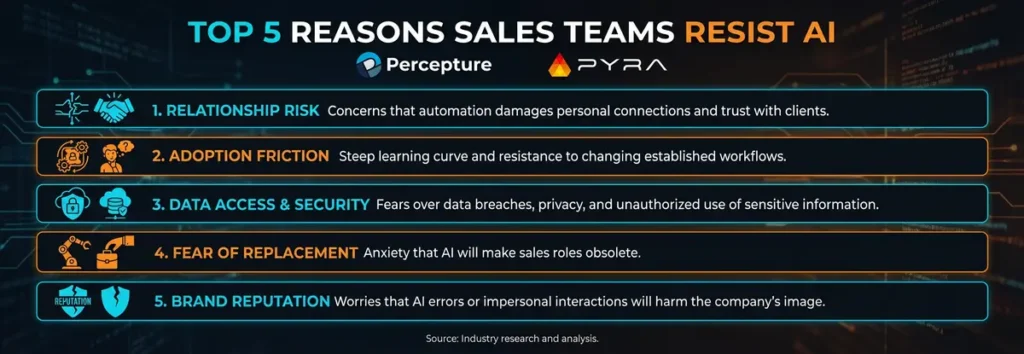
Why Sales Teams Hesitate to Use AI (The Real Reasons)
Here’s why your team might push back:
1. Relationship Risk
Sales reps worry AI will damage relationships they’ve spent years building. Nobody wants a robot emailing their best accounts.
2. Adoption Friction
Learning new tools takes time. If your team is already hitting quota, why change?
3. Data Access & Security
AI needs access to your CRM, email, and customer data. That makes IT nervous.
4. Fear of Replacement
Let’s be honest: reps worry AI will take their jobs. (Spoiler: it won’t. But it will change what their job looks like.)
5. Brand Reputation
Bad AI outreach sounds robotic. It can torch your domain reputation and land you in spam folders.
Cost: AI SDR vs Human BDR (Savings)
Let’s do the math. Here’s what a human BDR actually costs:
Human BDR (Fully Loaded Annual Cost)
- Base salary: $50,000–$65,000
- Benefits (health, 401k, etc.): $12,000–$18,000
- Payroll taxes: $5,000–$7,000
- Software & tools (CRM, LinkedIn, email): $3,000–$5,000
- Training & onboarding: $5,000–$10,000
- Management overhead (20% of manager’s time): $8,000–$12,000
Total: $83,000–$117,000 per year
And that’s before you factor in ramp time (3–4 months) and average tenure (14 months, per Salesforce data).
AI BDR (Fully Loaded Annual Cost)
- Platform subscription: $12,000–$30,000
- Setup & integration: $2,000–$5,000 (one-time)
- Email infrastructure (domains, warmup): $1,200–$3,000
- Ongoing optimization: $3,000–$6,000
Total: $18,200–$44,000 per year
Savings: $39,000–$73,000 per year, per hire.
That’s budget you can reinvest into Generative Engine Optimization (GEO), paid ads, or hiring closers.
Hidden Costs Most People Miss
Human BDRs:
- Sick days, vacation, burnout
- Turnover & re-hiring costs
- Inconsistent performance (bad days, distractions)
AI BDRs:
- Domain reputation damage if not set up correctly
- Ongoing prompt tuning & message testing
- Human oversight (someone still needs to review output)
ROI: A Simple Calculator (With Example)
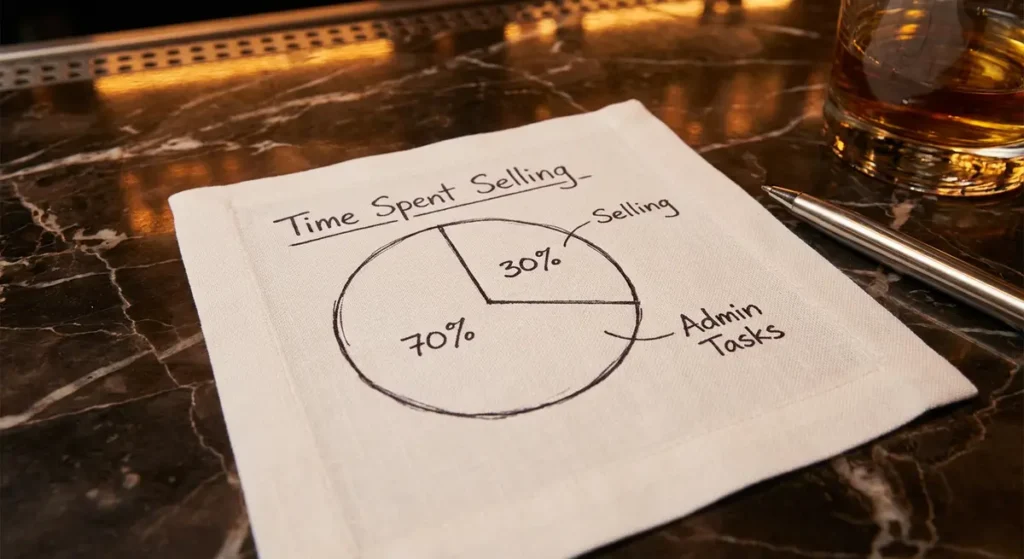
Here’s a back-of-the-napkin ROI formula:
ROI Formula
(Annual Cost of Human BDR) - (Annual Cost of AI BDR) = Annual SavingsExample:
- Human BDR cost: $100,000
- AI BDR cost: $25,000
- Savings: $75,000
But cost savings are only half the story. Let’s talk about productivity.
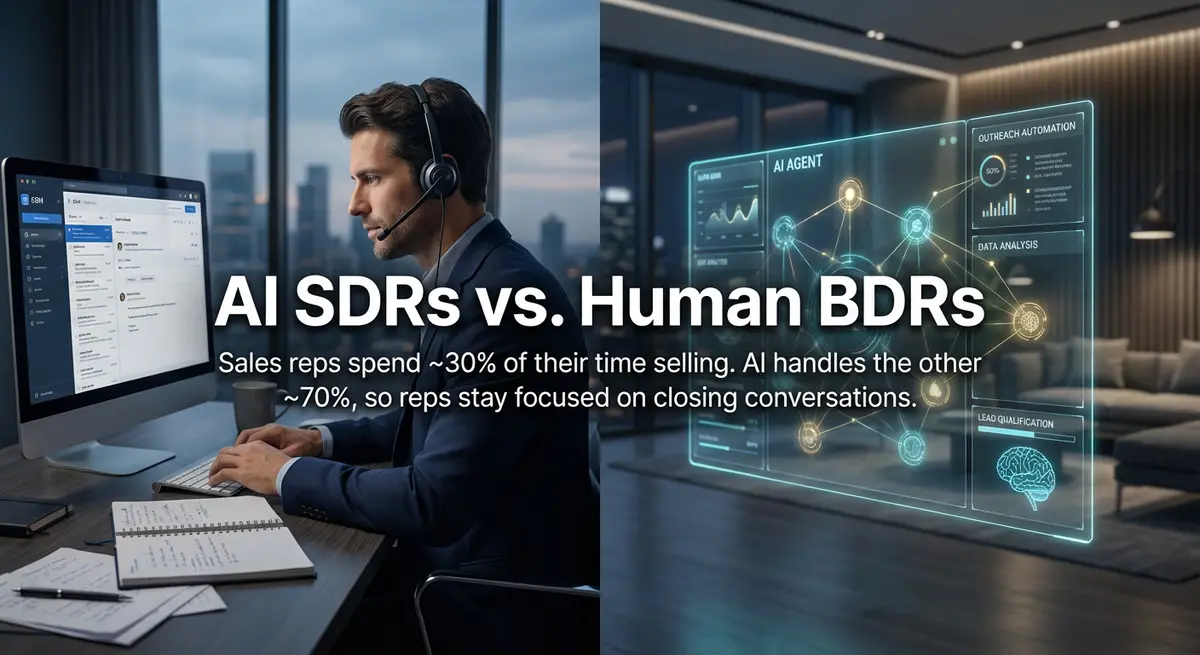
According to Salesforce, sales reps spend only 30% of their time actually selling. The other 70%? Data entry, research, and admin work.
AI handles that 70%. So your human reps can focus on the 30% that actually closes deals.
ROI Timeline: When Do You See Results?
- Week 1–2: Setup, domain warmup, CRM integration
- Week 3–4: First campaigns launch, initial meetings booked
- 30–60 days: Measurable pipeline impact
- 90 days: Full ROI visibility (most teams break even here)
Want a free AI SDR ROI calculator? We built one that factors in your team size, deal size, and close rate.
Performance: KPIs That Matter (Meetings, Reply Quality, Speed, Coverage)
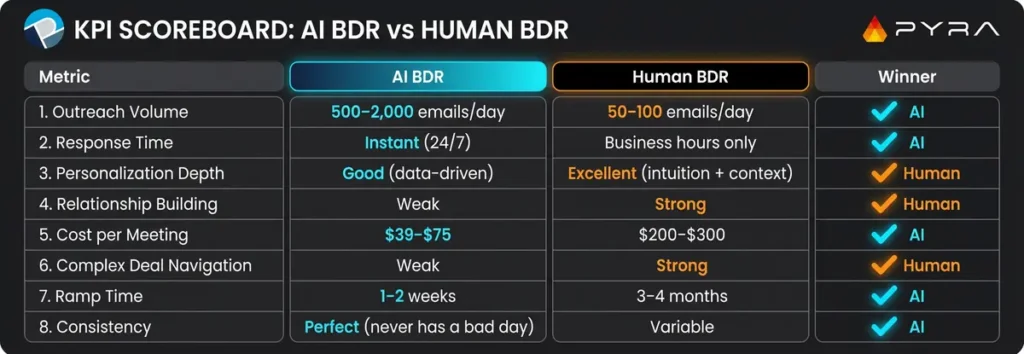
[IMAGE 5 HERE: KPI scoreboard graphic comparing AI vs Human across 6 metrics]
Let’s compare AI BDRs and human BDRs across the metrics that actually matter.
Comparison Table: AI SDR vs Human BDR
| Metric | AI BDR | Human BDR | Winner |
|---|---|---|---|
| Outreach Volume | 500–2,000 emails/day | 50–100 emails/day | AI |
| Response Time | Instant (24/7) | Business hours only | AI |
| Personalization Depth | Good (data-driven) | Excellent (intuition + context) | Human |
| Relationship Building | Weak | Strong | Human |
| Cost per Meeting | $39–$75 | $200–$300 | AI |
| Complex Deal Navigation | Weak | Strong | Human |
| Ramp Time | 1–2 weeks | 3–4 months | AI |
| Consistency | Perfect (never has a bad day) | Variable | AI |
Key Insight: AI wins on speed, volume, and cost. Humans win on trust, nuance, and complexity.
The Hybrid Model (Best of Both)
Here’s how winning teams structure their sales development in 2026:
AI Handles:
- Lead research & enrichment
- Initial outreach (cold email, LinkedIn)
- Follow-up sequences (3–7 touches)
- Meeting scheduling & calendar management
- Low-intent lead nurturing
Humans Handle:
- High-value account strategy
- Complex objection handling
- Relationship-building conversations
- Deal negotiation & closing
- Customer success handoffs
The Handoff Process
- AI identifies buying signals (job changes, funding, tech stack changes)
- AI sends personalized outreach
- AI qualifies interest (positive reply = handoff trigger)
- Human BDR takes over for discovery call
- AI logs everything in CRM for attribution
This is how companies like Pyra build AI agent systems that actually work—by designing smart handoffs between AI and humans.
30-Day Pilot Rollout Plan (Steps)
Don’t launch AI BDRs like a “big bang.” Use this phased rollout instead.
(1) Week 1: Strategy & Guardrails
- Define your ICP (Ideal Customer Profile)
- Set up approval gates (human review before send)
- Create a blacklist (customers, competitors, partners)
- Document compliance policies (GDPR, CAN-SPAM)
(2) Week 2: Technical Setup
- Authenticate sending domains (SPF, DKIM, DMARC)
- Warm up new email inboxes (2–4 weeks minimum)
- Connect CRM (Salesforce, HubSpot, etc.)
- Map fields for attribution tracking
(3) Week 3: Messaging & Personalization
- Draft persona-specific message frameworks
- Build a snippet library (case studies, proof points)
- Test tone (avoid robotic phrasing)
- Set up A/B testing for subject lines
(4) Week 4: Launch Micro-Campaigns
- Start with 2–3 narrow campaigns (e.g., “companies that just hired a VP of Sales”)
- Monitor reply quality, not just open rates
- Pause what doesn’t work, double down on what does
- Iterate weekly based on data
Need help with implementation? Check out what is an AI sales agent for a deeper dive.
FAQs
What is an AI SDR?
An AI SDR is software that automates sales development tasks like prospecting, outreach, follow-ups, and meeting booking. It uses AI to personalize messages and qualify leads without human input.
How much does an AI SDR cost per month?
Most AI SDR platforms cost $1,000–$2,500 per month. Fully loaded (including email infrastructure and setup), expect $1,500–$3,700 per month.
What is the fully loaded cost of a human BDR/SDR?
A human BDR costs $83,000–$117,000 per year when you include salary, benefits, tools, training, and management overhead.
How do you calculate ROI for an AI SDR?
Subtract the annual cost of the AI platform from the annual cost of a human BDR. Most teams save $39,000–$73,000 per year, per hire.
How long does it take to see ROI from an AI SDR?
Most teams see initial results in 30–60 days. Full ROI visibility typically happens around 90 days.
What tasks should AI handle vs a human BDR?
AI should handle volume work: research, outreach, follow-ups, scheduling. Humans should handle trust work: complex conversations, objections, relationship-building, and closing.
Will AI SDRs hurt deliverability or brand reputation?
Only if set up incorrectly. Use proper domain authentication (SPF, DKIM, DMARC), warm up inboxes slowly, and always include human review gates for messaging.
Why do sales reps hesitate to use AI in outbound?
Five reasons: relationship risk, adoption friction, data security concerns, fear of replacement, and brand reputation damage. Start small and involve reps in the process.
Are buyers turned off by AI outreach?
Only if it sounds robotic. Good AI outreach is indistinguishable from human-written emails. The key is personalization based on real signals, not generic templates.
What’s the safest way to pilot an AI SDR?
Start with low-risk, high-value tasks like meeting follow-ups and calendar booking. Use human approval gates. Launch 2–3 micro-campaigns before scaling.
What is the difference between an AI BDR and an AI SDR?
The terms are mostly interchangeable. BDRs typically focus on outbound (cold prospecting), while SDRs may also handle inbound leads. Both automate top-of-funnel sales tasks.
Can AI SDRs replace human sales reps?
No. AI handles volume and speed. Humans handle trust and complexity. The best teams use both in a hybrid model where AI does the grunt work and humans focus on closing.
The Future Is Hybrid of Sales
AI BDRs aren’t replacing human reps. They’re freeing them to do what they do best: build relationships and close deals.
The math is clear:
- 70–80% cost savings compared to human BDRs
- 30–60 day ROI timeline for most teams
- 83% of AI-enabled sales teams saw revenue growth (Salesforce, 2024)
But the real win isn’t cost. It’s focus.
When AI handles the repetitive work—research, outreach, follow-ups—your human reps can spend their time on the 30% of work that actually drives revenue.
What Happens Next
Step 1: Define your ICP and target accounts
Step 2: Choose 2–3 low-risk pilot campaigns
Step 3: Set up human approval gates
Step 4: Launch, measure, iterate
Step 5: Scale what works, pause what doesn’t