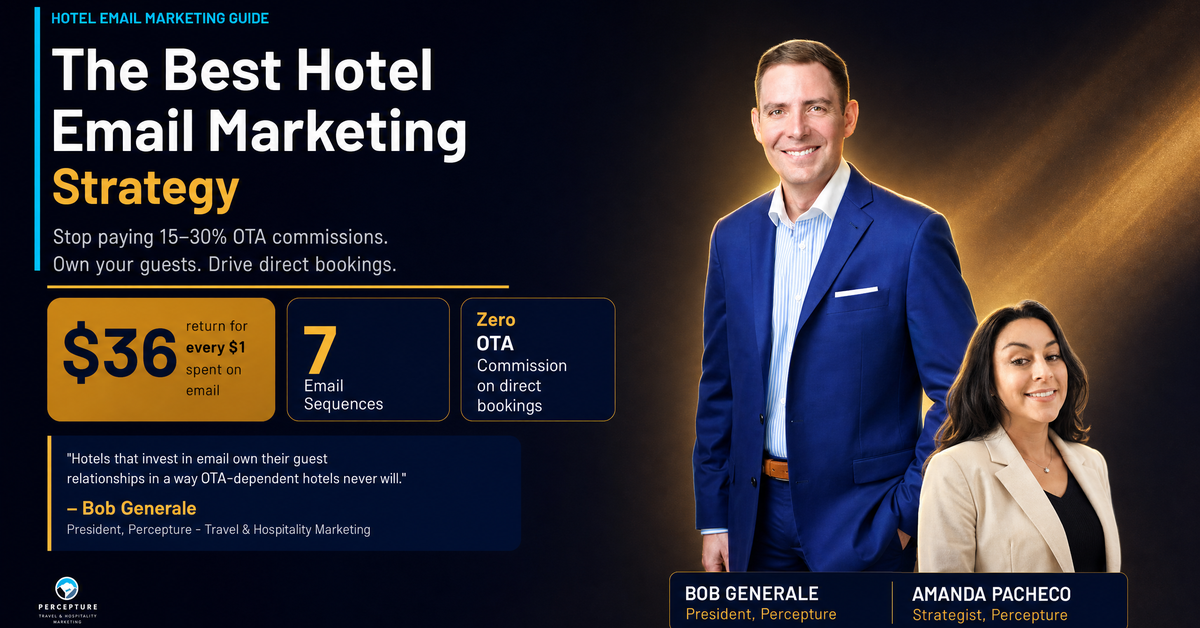

Hotel email marketing is one of the most practical ways to drive direct bookings, increase guest spending, and build long-term loyalty. Yet many hotels still treat email as an occasional newsletter instead of an owned revenue channel.
The hotels that get more from email connect each message to the guest journey. They nurture demand before booking, recover abandoned reservations, build anticipation before arrival, promote relevant experiences during the stay, and give past guests a reason to return.
The Best Hotel Email Marketing Strategy
The best hotel email marketing program is not a calendar of promotions. It is a guest-revenue system that turns first-party data into direct bookings, relevant upsells, stronger stays, reviews, and repeat demand.
Strategy grounded in travel and tourism



What hotel email marketing should accomplish
Hotel email marketing is the strategic use of email to communicate with prospective, current, and past guests throughout their relationship with a property. It includes pre-booking nurture, reservation recovery, confirmations, pre-arrival planning, on-property offers, post-stay follow-up, and retention.
Its value is broader than opens and clicks. A useful program should create more direct revenue, improve ancillary spend, strengthen guest experience, grow first-party data, and make repeat bookings easier.
- Before booking: answer questions and build intent.
- Before arrival: reduce uncertainty and surface relevant upgrades.
- During the stay: make useful experiences easier to discover.
- After checkout: earn reviews, permission, and future demand.
Map the revenue gaps in your guest email journey
Start with a practical review of the messages guests receive before, during, and after a stay. The goal is to identify missing triggers, weak handoffs, irrelevant offers, and places where an OTA still controls the relationship.
Why hotel email matters beyond the booking
Hotels face a structural margin problem. OTAs can deliver demand, but they also charge commissions and often remain between the property and the guest. Email helps a hotel build a channel it can measure, improve, and use again.
Reduce OTA dependence
Use value, convenience, personalization, and direct-booking benefits to make the hotel’s owned channel more useful than a generic discount.
Grow first-party data
Capture consent, stay history, preferences, and engagement signals that can improve future service and segmentation.
Increase ancillary revenue
Connect guests with room upgrades, dining, spa, transportation, activities, and packages when those choices are timely.
Build guest lifetime value
Use post-stay follow-up, loyalty recognition, and relevant return offers to turn one reservation into a longer relationship.
The G.U.E.S.T. Revenue Email System
Percepture’s G.U.E.S.T. system organizes hotel email around guest intent and operating value. It gives revenue, marketing, operations, and ownership teams a common structure for deciding what to send and why.
Gather permission and signals
Connect consent, source, stay history, booking behavior, preferences, and engagement without collecting data the team cannot responsibly use.
Understand the guest moment
Separate browsing, abandoned booking, confirmed stay, pre-arrival planning, on-property needs, checkout, and lapsed-guest signals.
Engineer the next best message
Choose one job for each email: answer, recover, reassure, upgrade, guide, thank, review, or rebook.
Serve a relevant offer
Match the message to the stay context, party type, length of stay, rate plan, known preference, and operational capacity.
Track revenue and learning
Measure delivered messages, clicks, completed bookings, upgrades, on-property revenue, unsubscribe rate, repeat stays, and incrementality where possible.
The best hotel email marketing strategies
A strong program starts with lifecycle coverage. Promotional broadcasts can support demand periods, but they should not replace the automated messages tied to real guest behavior.
Pre-booking nurture
Help interested travelers compare room types, understand the location, see relevant experiences, and resolve common booking objections. Link to the page that best answers the question instead of sending every reader to the homepage.
Abandoned booking recovery
Return the guest to the exact reservation context when possible. Remind them what they selected, answer a likely concern, and give them a clean path back without manufacturing urgency.
Confirmation and reassurance
Confirm the reservation details, explain what happens next, provide contact options, and reduce uncertainty. This operational message also establishes trust for later pre-arrival communication.
Pre-arrival planning and upsell
Offer upgrades, dining, spa, parking, transportation, activities, or celebration packages when they fit the guest and remain operationally available.
On-property guidance
Make useful services easier to find during the stay. Keep timing, frequency, and tone restrained so the email improves the visit instead of interrupting it.
Post-stay review and recovery
Thank the guest, request feedback, route service issues to the right team, and invite public reviews only after creating a sensible service-recovery path.
Win-back and loyalty
Use prior stay context, seasonality, geography, and known preferences to make the return message relevant. Recognition often works better than a blanket discount.
Hotel email marketing examples by guest moment
| Guest signal | Email job | Useful content | Primary measure |
|---|---|---|---|
| Viewed rooms or packages | Build confidence | Room differences, destination context, policies, direct-booking value | Return visits and booking starts |
| Started but did not book | Recover intent | Saved itinerary, availability, help, clear return link | Recovered reservations |
| Reservation confirmed | Reassure and prepare | Stay details, arrival guidance, contact path, next steps | Reduced service friction |
| Arrival approaching | Plan and increase value | Upgrade, dining, spa, parking, transportation, itinerary | Pre-arrival revenue |
| Currently on property | Improve the stay | Relevant services, time-sensitive experiences, support | Ancillary revenue and engagement |
| Stay completed | Learn and retain | Thank-you, feedback, service recovery, review, rebooking | Reviews, repeat bookings, retention |
Hotel email marketing best practices
Segment by useful context
Start with booking status, stay timing, property, source, geography, party type, loyalty status, and known interests. Add complexity only when it improves decisions.
Make mobile the default
Use readable type, concise copy, large tap targets, fast-loading images, and a reservation path that works cleanly on a phone.
Protect deliverability
Authenticate sending domains, monitor complaints and bounces, remove bad addresses, manage frequency, and make unsubscribing straightforward.
Coordinate with operations
Do not promote inventory, packages, or experiences the property cannot fulfill. Revenue and operations should approve offer rules and capacity.
Test one question at a time
Test timing, audience, subject line, offer, creative, or landing path with a defined hypothesis. Avoid changing everything in one send.
Build preference and consent controls
Respect regional requirements and guest choices. Separate operational messages from marketing permission and retain consent records.

Hotel email automation and software
The right platform depends on the property’s systems, volume, team, data maturity, and use cases. A long feature list matters less than dependable integration, usable segmentation, clean consent records, reliable reporting, and a workflow the team can actually maintain.
| Requirement | Questions to ask | Warning sign |
|---|---|---|
| PMS and booking integration | Can it receive reservation status, stay dates, cancellation, rate, property, and guest identifiers accurately? | Manual exports are the permanent operating model. |
| Identity and preference management | Can it reconcile duplicate profiles and preserve consent, suppression, and preference history? | The same guest receives conflicting messages. |
| Automation | Can the team build, test, pause, and audit event-driven journeys without vendor dependency? | Simple changes take weeks or require engineering. |
| Revenue attribution | Can reporting connect messages to reservations and ancillary purchases while documenting attribution rules? | Success is reported only as opens and clicks. |
| Governance | Are roles, approvals, data retention, security, and regional consent requirements supported? | Everyone has full access and nobody owns quality. |
How hotels should measure email performance
Delivery and engagement metrics help diagnose the channel, but they are not the business outcome. Build reporting from the reservation and guest economics backward.
Open rates can be directionally useful but are affected by privacy features and should not be treated as a revenue metric.
Hotel email works best inside a connected demand system
Email cannot create every demand signal by itself. Search, paid media, editorial coverage, public relations, destination content, social proof, and the booking experience determine who enters the owned audience and what they believe before subscribing.
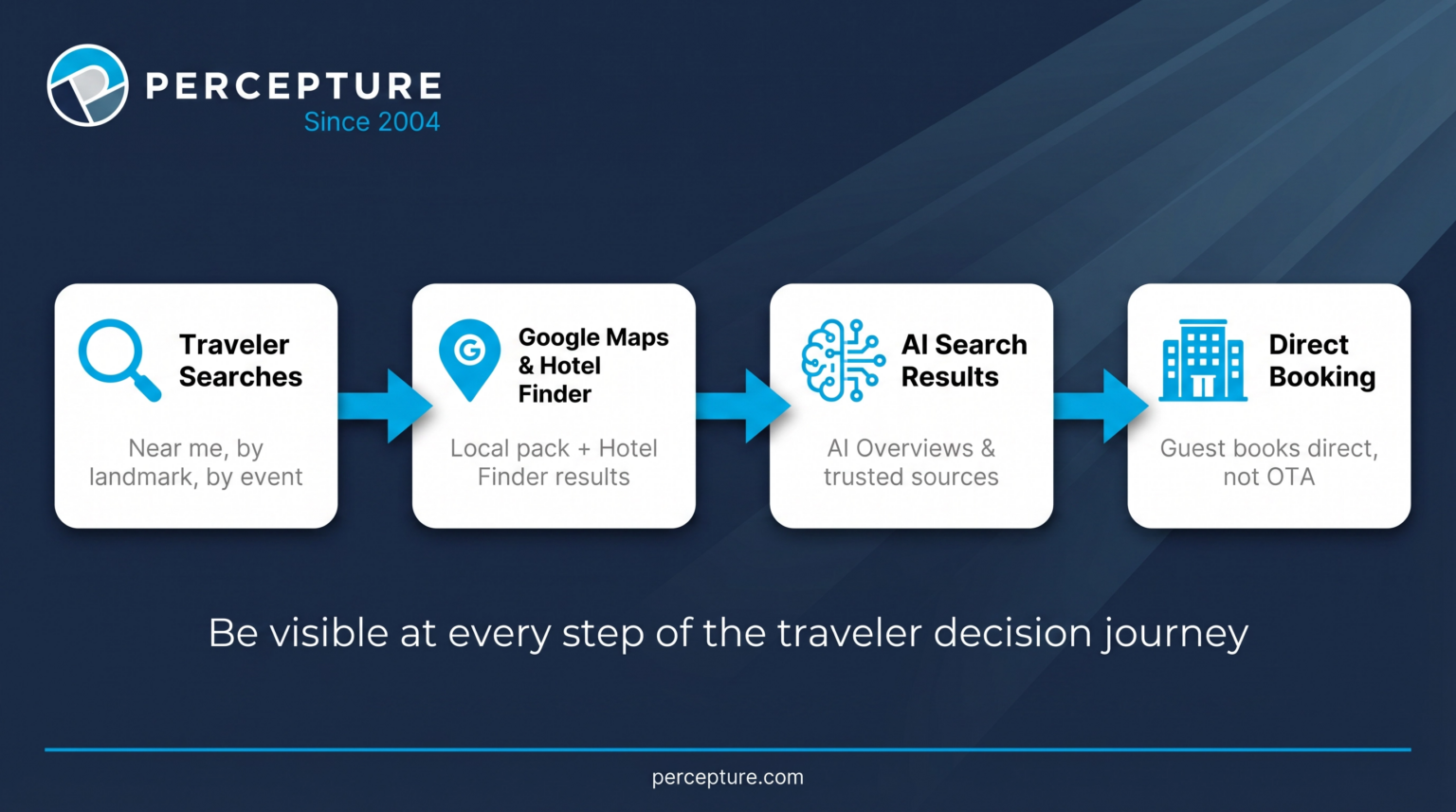
Percepture’s travel work connects awareness, intent, owned data, conversion, and reporting so the property can see the whole path rather than optimizing each channel in isolation.
Explore Percepture travel case studies
Turn guest data into a measurable direct-booking program
Percepture can help align the audience, lifecycle map, offer rules, editorial voice, automation, booking paths, and reporting. The work starts with the property’s real systems and guest economics.
Common hotel email marketing mistakes
Blasting the whole list
One message to every guest ignores booking status, timing, preference, geography, and reason for travel.
Leading only with discounts
Constant discounts train guests to wait and can weaken rate integrity. Use access, convenience, recognition, and relevance.
Ignoring pre-arrival demand
The period after booking is valuable. Guests are making plans and may welcome useful upgrades or experiences.
Separating marketing from operations
A promotion that the property cannot deliver creates service failure, refund risk, and distrust.
Counting clicks as revenue
Engagement is diagnostic. Connect it to reservations, upgrades, spend, retention, and incremental value.
Letting automations decay
Rates, policies, experiences, links, brand standards, and consent rules change. Review live journeys on a schedule.
How to build or repair the program
Audit and prioritize
Inventory data sources, consent, templates, automations, audience health, booking paths, offer rules, and measurement. Identify the largest lifecycle gaps and revenue risks.
Build the core journeys
Launch or repair confirmation, abandoned booking, pre-arrival, post-stay, and service-recovery flows. Establish governance and mobile QA.
Test and expand
Improve segmentation, add relevant upsells, document attribution, create a testing backlog, and connect lifecycle insights to search, paid media, content, and operations.

Connect hotel email marketing to the rest of the demand system
Use these Percepture guides to align email with the channels that create discovery, trust, direct-booking intent, and measurable guest demand.
Hotel SEO agency guide
Build qualified organic visibility around the searches travelers use before they enter an email journey.
Hotel PPC agency guide
Connect paid demand capture, landing-page conversion, remarketing, and direct-booking economics.
Travel PR guide
Use credible editorial visibility to strengthen what travelers believe before they subscribe or book.
SEO keywords for hotels
Prioritize high-intent topics and build better continuity between search content and lifecycle messaging.
Technical SEO for hotels
Protect the performance, indexation, and booking-path foundations that support conversion.
Local SEO for hotels
Improve location-level discovery and connect nearby demand with the property’s owned audience.
FAQs about hotel email marketing
What is hotel email marketing?
Hotel email marketing is the planned use of email across the guest lifecycle. It supports consideration, reservation recovery, confirmation, pre-arrival planning, on-property value, post-stay feedback, loyalty, and repeat bookings.
Why is email marketing important for hotels?
Email gives a hotel an owned way to communicate with guests, use first-party data responsibly, reduce dependence on third-party distribution, increase ancillary revenue, and encourage repeat stays.
What are the best hotel email marketing strategies?
The strongest programs usually include pre-booking nurture, abandoned booking recovery, useful confirmations, pre-arrival upsells, restrained on-property messaging, post-stay feedback, service recovery, and segmented win-back campaigns.
How often should hotels send marketing emails?
Frequency should follow guest context, not a universal calendar. Transactional and lifecycle messages should be triggered by real events. Promotional frequency should reflect consent, engagement, seasonality, and list health.
What is hotel email marketing automation?
Automation uses guest or reservation events to send the right message without manually scheduling each email. Common triggers include booking started, reservation confirmed, arrival approaching, checkout completed, and lapse since the last stay.
How can hotels increase direct bookings with email?
Capture permission before and after a stay, nurture interested travelers, recover abandoned reservations, explain the value of booking direct, personalize relevant return offers, and keep the booking path fast and mobile-friendly.
What should a pre-arrival hotel email include?
Include confirmed stay details, arrival information, a clear support path, and only the upgrades or experiences that fit the guest and remain available. The email should make planning easier.
How do hotels measure email marketing success?
Measure direct booking revenue, recovered reservations, ancillary revenue, repeat bookings, list health, complaints, and incremental value where testing is possible. Use opens and clicks as diagnostic signals rather than final outcomes.

Bob Generale
Bob Generale is President of Percepture. He helps travel, hospitality, telecom, construction, life sciences, and complex B2B organizations connect search, public relations, paid media, content, AI visibility, conversion, and revenue measurement.
Percepture was founded in 2004. Its hospitality work brings together senior strategy, travel editorial experience, performance marketing, and practical execution.
Connect with Bob on LinkedInBuild a hotel email system that earns more direct revenue
Bring your current platform, guest journeys, data sources, booking path, property priorities, and reporting questions. Percepture can help identify what to keep, repair, automate, test, and measure.
What we can review
Lifecycle coverage, segmentation, deliverability, consent, creative, offers, integrations, booking conversion, attribution, and operating ownership.
What you should leave with
A prioritized view of the revenue gaps, the highest-value journeys, the data requirements, and the next sensible tests.