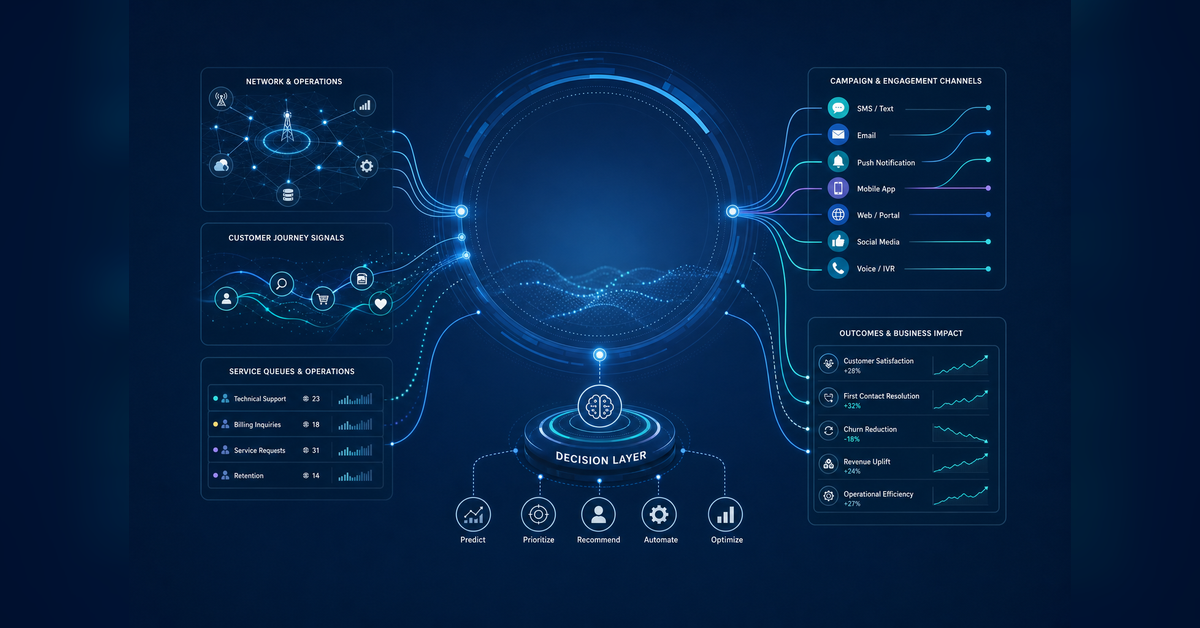

Agentic AI in telecom gives operators a way to coordinate work across marketing, sales, service, and operations instead of adding another isolated automation tool. The opportunity is real, but the first buying decision should be about workflow control, data access, and measurable business outcomes.
The safest path is to start with one bounded workflow, define what the agent may do, and measure completed work before expanding its authority. This guide shows leaders how to choose that workflow, set controls, compare implementation options, and build a 90-day roadmap.




What changes when AI can act, not just answer?
Agentic AI in telecom is the use of goal-directed AI agents to interpret a task, choose permitted actions, use connected systems, and complete work with defined oversight. It differs from a chatbot because it can move a workflow forward, while its permissions, escalation rules, and results remain visible to human owners.
“The biggest change is that AI is moving from answering questions to helping execute work.”
Cody Clegg, OPTK Networks
Executive summary
Start with a workflow
Select a repeated task with a clear owner, reliable inputs, and a measurable finish line. Do not begin with a broad mandate to automate a department.
Limit authority
Define which systems the agent may read, what it may change, when approval is required, and how a person can stop or reverse an action.
Measure completed work
Track accepted outputs, cycle time, exceptions, activated revenue, and attributable gross profit. Activity counts alone do not prove value.
Scale after evidence
A telecom AI agent should earn wider permissions through reliable performance in a bounded workflow, not through a large initial deployment.
Who this buyer guide is for
CEO and business owner
You need a clear link between telecom AI agents, accountable execution, customer value, and financial impact.
CMO and growth leader
You need telecom AI agents to coordinate audience research, campaign execution, lead handling, content operations, and attribution without losing brand control.
Sales leader
You need AI agents for telecom sales to accelerate account research and follow-up while preserving qualification rules, consent requirements, and human judgment.
Operations and technical owner
You need permissions, logs, exception handling, system boundaries, and a practical way to test a telecom AI agent before production use.
Choose the first workflow with Percepture
Bring us one repeated task that feels slow, fragmented or hard to measure. We will help you decide whether it is a good first agent workflow.
- Map the systems and handoffs
- Set clear limits and approval points
- Define what a useful result looks like
Agentic AI in telecom: definition and operating boundaries
Agentic systems combine a goal, instructions, access to tools or data, decision logic, and a process for taking action. The system may break a task into steps, collect information, prepare or execute an approved action, inspect the result, and decide what happens next.
That does not make the agent an employee, an executive, or an unrestricted decision-maker. The useful authority of a telecom AI agent comes from narrow permissions and explicit operating rules. A buyer should be able to name the workflow owner, allowed actions, prohibited actions, approval points, source systems, output destination, and stop condition.
A telecom agent program is therefore an operating-model decision as much as a software decision. A polished interface matters less than whether the agent can work safely across the systems, teams, and policies that govern the selected process.
How agents differ from chatbots and fixed automation
A chatbot usually responds to a prompt. Fixed automation follows predefined branches. An agentic system can select among permitted actions based on the current state of a task. That flexibility can help with work that contains several steps, changing inputs, and exceptions, but it also creates a greater need for controls.
Traditional automation remains the better choice when every step is stable and deterministic. A human-led process remains the better choice when judgment, negotiation, sensitive communication, or accountability cannot be reduced to a clear policy. The right architecture may use all three: deterministic automation for fixed steps, agents for variable coordination, and people for material decisions.
Agentic AI use cases in telecom
The strongest use cases begin with a specific queue of work rather than a vague ambition. Telecom AI agents can be evaluated across four practical domains: marketing, sales, customer service, and operations. Each domain needs its own owner, risk limits, and success measures.
Marketing orchestration
A marketing agent can collect approved inputs, classify audience signals, prepare campaign variants, route assets for review, update a work queue, and summarize channel results. It should not invent product claims, publish unreviewed regulated statements, or overwrite customer records without permission.
For leaders building connected programs, Percepture’s omnichannel marketing approach provides the broader channel context. The agent is one execution layer inside that plan; it is not the strategy itself.
A telecom AI agent becomes more useful when campaign goals and customer stages are already defined. A documented customer journey gives the agent clearer rules for timing, messaging, routing, and escalation.
Sales research and follow-up
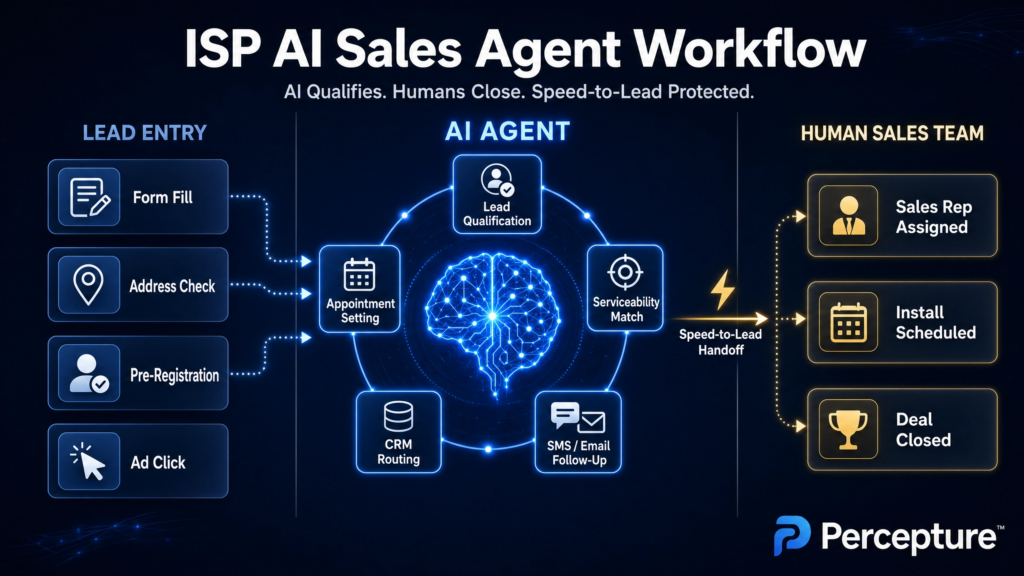
A sales agent can assemble account context from permitted sources, draft a briefing, identify missing qualification data, prepare follow-up language, and create a task for the right representative. Human approval should remain in the loop when an outreach action carries legal, reputational, pricing, or relationship risk.
Buyers considering voice or outbound workflows should also review the practical and legal questions covered in Percepture’s guide to AI agents making outbound calls. The channel, audience, consent basis, jurisdiction, and operating policy all affect whether a proposed workflow belongs in a pilot.
A managed telecom AI agents with CRM integrations program should define lead ownership, qualification rules, suppression logic, escalation, and CRM write permissions before activation. Those details determine whether faster execution produces cleaner pipeline or more noise.
Customer service coordination
In customer service, an AI agent can classify an incoming issue, retrieve approved account context, recommend a response, route the case, and monitor whether the next step occurred. A good first pilot uses a narrow issue category with a known resolution path and clear escalation triggers.
The system should expose uncertainty instead of hiding it. Low-confidence classifications, conflicting account data, unusual requests, and customer frustration signals should move to a person. The goal is not to remove people from service; it is to reduce avoidable handling work while keeping accountability clear.
Operational work queues
Operational agents can help with triage, reconciliation, status checks, documentation, and exception routing. Percepture’s article on AI tools for IT support ticket triage illustrates the kind of bounded queue where inputs, categories, owners, and escalation paths can be inspected.
A telecom AI agent should not receive broad production access merely because a test produced a useful answer. Reading data, drafting a recommendation, changing a record, triggering communication, and modifying infrastructure are different permission levels. Each requires a separate risk decision.
The Telecom Agent-to-Profit Control Loop
Percepture’s Telecom Agent-to-Profit Control Loop is a buyer framework for connecting agent activity to a controlled business result. It keeps the agent program focused on completed work and financial contribution rather than demonstrations, prompts, or raw output volume.
Five controls from intent to profit
- Intent: Define the business outcome, workflow owner, customer impact, and completion event.
- Permission: Specify the data, tools, actions, approval gates, prohibited actions, and stop conditions.
- Execution: Run the workflow with traceable steps, versioned instructions, and visible handoffs.
- Verification: Check accuracy, acceptance, exceptions, reversals, policy adherence, and downstream effects.
- Profit: Connect accepted work to cost avoided, revenue activated, margin, and attributable gross profit.
The loop repeats only after the owner reviews what changed. More autonomy is an earned operating privilege, not a default setting.
Intent: define the finish line
“Improve sales” is not a usable goal for a telecom agent program. “Prepare an approved account brief and create a representative task when defined qualification fields are present” is closer to an operating instruction. The second version has a clear output, owner, condition, and handoff.
Define what counts as started, completed, accepted, rejected, escalated, and reversed. Without those states, an agent can appear busy while moving little valuable work to completion.
Permission: design the control surface
List each system and assign the minimum access required for the agent. Read access does not imply write access. Drafting does not imply sending. Creating a task does not imply changing an opportunity stage. These distinctions belong in the workflow design, vendor review, and test plan.
A sound strategy and planning process also identifies who can change instructions, approve a new data source, expand permissions, pause execution, and accept residual risk.
Execution and verification: make work observable
Logs should make it possible to understand the inputs used, actions selected, systems touched, approvals received, and final outcome. The buyer does not need a wall of technical detail, but the operating team needs enough evidence to diagnose failure and reproduce success.
The agent workflow requires an exception path that works under pressure. When an input is missing, a tool fails, or a policy conflict appears, the agent should stop, explain the issue, and route the task. Quietly guessing is not a recovery plan.
Profit: connect output to economics
Completion is the bridge between agent activity and economics. Count accepted work units first. Then determine whether those units reduced handling cost, accelerated an eligible revenue event, improved conversion, protected retention, or prevented rework.
Percepture’s attribution and analytics services can help define the measurement model when several channels, systems, or teams influence the final outcome.
A practical 90-day implementation plan
A 90-day plan should produce evidence, not enterprise-wide autonomy. The aim is to establish whether a telecom AI agent can complete one useful workflow under real controls, with results that a business and technical owner can inspect.
Days 1–30: map and contain
- Select one repeated workflow with enough volume to observe.
- Name the executive sponsor, workflow owner, technical owner, and review group.
- Document inputs, outputs, decision points, systems, permissions, exceptions, and prohibited actions.
- Record a baseline for cycle time, handling effort, completion, acceptance, and error or rework.
- Define a test environment and a manual fallback.
Days 31–60: test and inspect
- Begin with read-only analysis or drafts where possible.
- Test normal cases, missing data, conflicting data, tool failures, and adversarial instructions.
- Review each output against a written acceptance standard.
- Measure exceptions, human corrections, reversals, and time saved or added.
- Adjust instructions and controls without expanding the workflow scope.
Days 61–90: operate and decide
- Run a limited production pilot with explicit monitoring.
- Compare accepted completion and economics against the baseline.
- Document failure modes, customer impact, team feedback, and unresolved risk.
- Decide whether to stop, revise, maintain, or expand one permission at a time.
- Create an owner-approved operating record for the next review cycle.
The calendar does not guarantee readiness. A workflow with unclear data rights or unstable inputs may need more design time. A simple internal queue may move faster. The decision gate should be evidence-based rather than tied to a launch announcement.
Agentic AI in telecom comparison and investment framework
Buyers evaluating telecom AI agents often compare a packaged product, a configurable platform, a custom build, and a managed implementation. No option is universally best. The right choice depends on workflow specificity, integration depth, internal skills, control requirements, and the amount of ongoing operating ownership the company wants.
Implementation model comparison
| Model | Best fit | Buyer advantage | Main diligence question |
|---|---|---|---|
| Packaged application | A common, narrow workflow with standard integrations | Faster path to a defined capability | Can its permissions, data use, and escalation rules match your policy? |
| Configurable agent platform | Several workflows that share tools and governance | Reusable components and centralized controls | Who will design, test, monitor, and maintain each workflow? |
| Custom implementation | A differentiated process or complex system environment | Greater control over workflow logic and integration | Can the team support security, evaluation, observability, and change management? |
| Managed program | A buyer that needs strategy, execution, and measurement support | External operating capacity with a defined business plan | How are ownership, access, deliverables, knowledge transfer, and performance defined? |
Do not compare offers only by license price. A telecom agent program may require workflow discovery, integration, data preparation, security review, evaluation design, monitoring, human review, training, and ongoing optimization. The buying model should expose those workstreams rather than bury them.
Telecom AI agent vendor and workflow scorecard
| Area | Strong answer | Warning sign |
|---|---|---|
| Workflow fit | The vendor can map the exact workflow inputs, actions, owners, and completion event. | The demonstration stays generic or depends on ideal inputs. |
| Permissions | Read, draft, write, send, and administrative access can be separated. | Broad access is treated as a setup shortcut. |
| Human control | Approval, pause, escalation, rollback, and fallback paths are explicit. | Human review is described but not built into the workflow. |
| Evidence | Tests measure accepted completion, exceptions, corrections, and downstream effects. | Success is reported as output volume or anecdotal time savings. |
| Economics | All implementation and operating costs can be assigned to the pilot. | Only the software fee appears in the cost model. |
| Ownership | A named business owner and technical owner govern changes. | The agent has no clear operational owner after launch. |
Cost, ROI, and attributable gross profit
A useful business case for telecom AI agents separates one-time implementation cost, recurring platform cost, internal labor, external support, integration, review, monitoring, and change management. It then compares that total with accepted economic value during the same period.
The agent program should be measured with conservative formulas that finance and operations can inspect. Start with three basic calculations:
- Net operating benefit = verified cost avoided + attributable gross profit − total agent program cost.
- ROI = net operating benefit ÷ total agent program cost × 100.
- Attributable gross profit = attributable revenue × applicable gross margin rate.
Use only revenue events that meet the agreed attribution rule. If the agent prepared research but a salesperson created the opportunity through separate work, the model should not award the agent full credit. If an agent-created task moved a qualified account to a measurable next step, partial or assisted attribution may be more appropriate.
Time saved is also easy to overstate. Subtract the time spent reviewing, correcting, investigating, and maintaining the workflow. A faster first draft that creates more downstream rework may have negative value.
Budget categories buyers should include
| Category | What it can include | How to control it |
|---|---|---|
| Discovery | Workflow mapping, baseline measurement, policy review, and pilot design | Use a fixed scope and a written decision gate. |
| Technology | Platform, model usage, connectors, storage, logging, and testing tools | Model expected volume and set usage alerts. |
| Integration | Authentication, system connections, data mapping, and environment setup | Separate required integrations from later enhancements. |
| Operations | Monitoring, review, exception handling, maintenance, and support | Assign owners and forecast recurring effort. |
| Risk control | Security, privacy, legal, compliance, and incident preparation | Review risk before production access is granted. |
| Adoption | Training, documentation, feedback, and process change | Measure actual use and accepted completion. |
Governance questions to settle before production
Governance should be designed around the workflow, not copied from a generic AI policy and left there. Telecom AI agents introduce action risk because a system may touch records, trigger messages, create tasks, or influence operational decisions.
Who owns the agent’s decisions?
A named business owner should approve the purpose and success criteria for the agent program. A technical owner should control access, deployment, monitoring, and changes. Security, privacy, legal, compliance, brand, and frontline teams should review the parts that affect their responsibilities.
What data may the agent use?
Document the approved sources, fields, retention rules, and prohibited data. Buyers should understand what the provider stores, how information is processed, which subprocessors or models may be involved, and whether customer data can be used beyond the contracted workflow.
What happens when the agent is wrong?
The answer for a telecom AI agent needs more detail than “a human is in the loop.” Identify who receives the exception, how quickly it must be reviewed, whether the action can be reversed, how affected records are corrected, and how the incident changes future tests.
Ericsson’s discussion of agentic systems describes trust as a control point in the changing telecom ecosystem. Deloitte’s telecom blueprint also frames agentic AI across networks and customer engagement. These perspectives reinforce a practical buyer lesson: operational authority and governance must be designed together.
For external context, see Ericsson’s telecom ecosystem overview and Deloitte’s agentic AI blueprint for telcos.
Evidence to request before expanding a pilot
- A workflow map showing systems, permissions, owners, and approval points
- A baseline and pilot report using the same completion definitions
- Accepted-output, correction, exception, escalation, and reversal records
- A full cost model that includes internal review and operating effort
- A documented security, privacy, legal, and compliance review
- A rollback plan, manual fallback, and named incident owner
- A decision record explaining why permissions should remain, expand, or contract

Review the pilot plan with Percepture
We can help compare a packaged tool, configurable platform, custom build or managed program. We will also explain the work behind the software, including integration, review, monitoring and measurement.
- Compare the build options
- See the likely work and cost areas
- Leave with a clear next step
Common implementation mistakes
Starting with a department-wide mandate
A broad telecom AI mandate hides the actual work. Start with one queue, one owner, one completion event, and one set of permissions. Expansion should follow evidence from that contained process.
Automating a broken handoff
An agent can move bad data and unclear decisions faster. Map the handoff first. Remove duplicate steps, settle ownership, and define the source of truth before connecting tools.
Treating a demonstration as production evidence
An agent demonstration proves that a selected example can run under selected conditions. It does not prove reliability across incomplete inputs, conflicting records, tool failures, policy boundaries, or real user behavior.
Measuring messages instead of outcomes
Drafts, calls, summaries, tasks, and classifications are activity measures. The business case needs accepted completion, qualified progression, cost avoided, attributable gross profit, customer impact, and risk-adjusted operating cost.
Granting write access too early
Begin with observation, analysis, or drafts when the workflow allows it. Add write or send permissions only after tests show that the output, controls, escalation path, and rollback process are reliable.
Ignoring search and content discoverability
AI-assisted execution does not remove the need for clear, accessible, authoritative information. Percepture’s GEO services address how brand information is structured for generative search, while enterprise SEO supports the search architecture that people and retrieval systems depend on.
Telecom AI agent executive readiness checklist
- We can name the first workflow and its business owner.
- We have a baseline for completion, time, cost, errors, and rework.
- We can separate read, draft, write, send, and administrative permissions.
- We have written approval, escalation, pause, rollback, and fallback rules.
- We know which data sources are permitted and prohibited.
- We can test normal cases, exceptions, conflicts, and tool failures.
- We can calculate total pilot cost and accepted economic value.
- We have a decision gate for stopping, revising, maintaining, or expanding.
Cody Clegg on agentic AI in telecom
Bob Generale interviewed Cody Clegg of OPTK Networks about how AI may change telecom operations. The transcript was lightly edited for grammar and flow while preserving Cody’s meaning and voice. Only the four agentic-AI questions selected for this guide appear below.

How is agentic AI changing the way telecom providers operate today?
Cody Clegg: We are still very early, but the biggest change is that AI is moving from answering questions to helping execute work. Telecom companies have enormous amounts of information spread across CRMs, network tools, billing platforms, email, and other systems. Historically, people have acted as the glue connecting all of those systems.
Agentic AI has the potential to change that. Instead of someone manually pulling five reports together to understand what is happening with a customer or circuit, an AI agent can gather the information, identify the issue, recommend an action, and potentially execute parts of the workflow.
At OPTK Networks, that is how we are trying to think about AI. It is not about using AI for the sake of using it. It is about removing friction so our people can spend more time solving customer problems and growing the business instead of handling monotonous day-to-day tasks.
Where will agentic AI create the biggest operational efficiencies?
Cody Clegg: I see three major areas: network operations, customer lifecycle management, and infrastructure planning. Imagine an agent that detects network degradation before a customer opens a ticket, correlates alarms across multiple systems, identifies the likely cause, and gives the operations team a recommended action.
On the commercial side, imagine AI continuously monitoring renewals, customer activity, network availability, construction projects, and new opportunities, then telling a salesperson exactly where to spend time. The biggest efficiency will not come from replacing one specific task. It will come from connecting workflows that currently require five people and five systems, saving time and money across the organization.
What misconceptions do people have about AI in telecom?
Cody Clegg: The biggest misconception is that AI somehow replaces the need for infrastructure. It is actually doing the opposite. Every AI model, cloud application, autonomous system, and new data center creates traffic that has to move somewhere.
That requires fiber, conduit, power, interconnection, and geographically diverse routes. AI may make networks smarter, but it will also make the physical network more important. The people who build, operate, and maintain that infrastructure become even more important too. Job security, baby.

How should ISPs prepare for AI-driven network operations?
Cody Clegg: Start with the data. If your inventory is wrong, your CRM is not clean, your network documentation is fragmented, and your systems do not communicate, AI will amplify those problems.
The first step is not buying an AI platform. It is building a strong operational foundation: clean data, documented processes, API connections between systems, and clearly defined ownership. Then automate incrementally. Pick measurable problems, prove value, and expand from there.
Frequently asked questions
What is Agentic AI in telecom?
Agentic AI in telecom uses goal-directed software agents to interpret a task, select among permitted actions, use connected tools or data, and move work toward a defined outcome. A production system also needs permissions, logs, approval rules, escalation paths, and a human owner who remains accountable for the workflow.
What is the best first telecom AI agent use case?
The best first telecom AI use case is usually a repeated, bounded workflow with clear inputs, a measurable completion event, and manageable risk. Examples can include research preparation, ticket classification, document checks, or draft creation. The company should choose based on its own workflow volume, data quality, controls, and business value.
How long does a telecom AI agent pilot take?
A 90-day roadmap can provide a useful planning structure for a telecom AI agent: map and contain the workflow, test it under varied conditions, and then run a limited production pilot. Actual timing depends on integration, data rights, security review, policy requirements, workflow complexity, and whether the team already has a reliable baseline.
How much does an agentic AI program cost?
The cost of a telecom agent program depends on discovery, software, model usage, integration, data preparation, security review, monitoring, human review, maintenance, and training. Buyers should compare total program cost rather than license price alone. A narrow pilot with a written scope makes those categories easier to estimate and inspect.
How should telecom leaders measure agent ROI?
To measure a telecom agent program, track accepted completed work first, then connect it to verified cost avoided or attributable gross profit. Include software, implementation, internal labor, review, corrections, monitoring, and support in total cost. Avoid assigning full revenue credit when the agent made only a small or indirect contribution.
Should an AI agent be allowed to contact customers?
A telecom AI agent should contact customers only after the company has reviewed the channel, audience, consent basis, jurisdiction, content rules, brand risk, approval process, suppression logic, and escalation path. Drafting and sending are different permissions. A lower-risk pilot may let the agent prepare communication while an authorized person reviews and sends it.
What governance does a telecom AI agent need?
A telecom AI agent needs, at minimum, a business owner, a technical owner, approved data sources, separated permissions, versioned instructions, logs, testing standards, approval gates, exception handling, rollback, and a manual fallback. Security, privacy, legal, compliance, and customer-facing teams should review the workflow where their responsibilities apply.
Can agentic AI replace traditional automation?
Agentic systems cannot replace traditional automation in every workflow. Fixed automation is often better when steps and rules are stable. Agents are more useful when a task requires controlled choices across changing inputs. Human judgment remains appropriate for sensitive, high-impact, ambiguous, or relationship-driven decisions. Many sound systems combine all three approaches.
Build a controlled 90-day telecom AI roadmap
If agentic AI in telecom is on your agenda, start with one workflow, clear permissions and a measurable finish line. Percepture can help turn the idea into a practical 90-day plan.
- Choose the first workflow
- Set controls, owners and success measures
- Plan the first 90 days