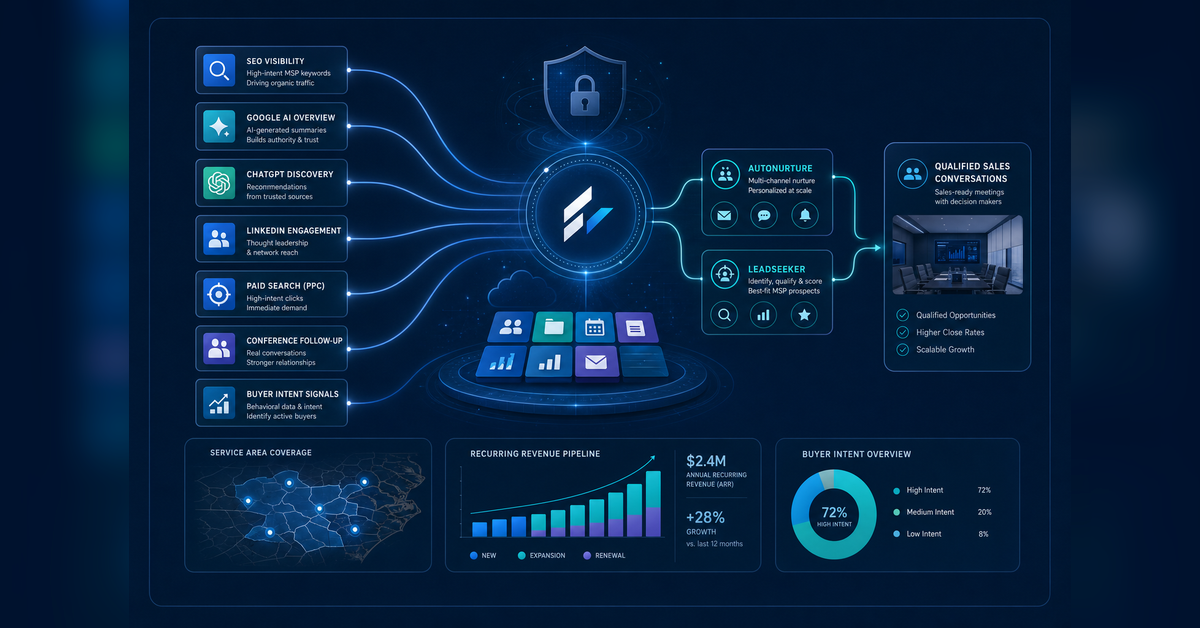

Lead generation for MSPs is the process of attracting, identifying, nurturing, and converting business buyers who need managed IT, cybersecurity, cloud, Microsoft 365, or co-managed IT support. The strongest programs combine SEO, AI search visibility, paid media, LinkedIn, conference follow-up, buyer intent data, and sales nurture so MSPs can create qualified conversations instead of random leads.
For an MSP owner, CEO, CMO, or sales leader, the problem is rarely that the market has no demand. The problem is that demand is hidden, delayed, fragmented, and shaped by risk. Buyers research uptime, cyber insurance, compliance pressure, help desk pain, ticket volume, SLAs, backup and disaster recovery, Microsoft 365 governance, endpoint security, cloud migration, and current-provider frustration before they talk to sales.
For digital marketing leaders, Lead Generation for MSPs should connect technical content, buyer intent, search visibility, and sales follow-up into one operating plan.

That is why effective MSP lead generation is not just a list, a form, or a call center. It is a system. It makes the MSP visible when buyers research independently, earns trust before the first call, uses intent signals to prioritize accounts, and keeps relationships warm until timing is right. Percepture approaches this as a senior SEO, GEO, digital PR, paid media, content, analytics, AI systems, and lead intelligence partner for technical B2B companies that need qualified commercial pipeline.
Ready to Build Your Intent-to-Revenue Engine?
Don’t let hidden demand slip to your competitors. Let our architects design a customized SEO, AI search, and buyer intent system that forces your sales pipeline wide open.
Architect My Pipeline StrategyThis guide is for MSP owners, CEOs, sales leaders, marketing leaders, and operators who want better managed IT leads, managed service provider leads, cybersecurity leads for MSPs, co-managed IT leads, Microsoft 365 leads, and cloud services leads without depending on random form fills.
The best Lead Generation for MSPs programs measure qualified conversations and sales opportunities, not just impressions, clicks, or rankings.
You will learn:
- What lead generation for MSPs means and how it works.
- Which channels fit different sales cycles, budgets, and risk profiles.
- How SEO, GEO, LinkedIn, paid search, conferences, referrals, and appointment setting compare.
- How LeadSeeker and B2B buyer intent data can help prioritize accounts.
- How AutoNURTURE supports MSP lead nurturing after events, referrals, webinars, and stalled proposals.
- How to score, route, and measure leads against MRR and pipeline quality.
A practical Lead Generation for MSPs strategy also has to reflect buyer committees, proof needs, comparison searches, and long sales cycles.
Is your MSP generating leads or just collecting names?
Get a clear view of where your pipeline system is leaking: search visibility, AI discovery, buyer intent, follow-up, conversion paths, or sales handoff.
- Review your managed IT, cybersecurity, cloud, and co-managed IT visibility.
- Find gaps in SEO, GEO, LinkedIn, paid search, and conference follow-up.
- Pressure-test your nurture, scoring, CRM routing, and MRR attribution.
- Compare your current strategy against higher-quality MSP lead generation services.
Get an MSP Lead Generation Gap Review
No hype. Just a clear review of visibility, intent, nurture, and sales handoff.
Table of contents
When Lead Generation for MSPs is built this way, every channel supports the same revenue goal instead of acting like a separate campaign.
- What is lead generation for MSPs?
- Why traditional MSP lead generation fails
- Who, what, when, where, why, and how
- The MSP Intent-to-Revenue Engine
- Best channels for MSP lead generation
- Conferences, channel relationships, and AutoNURTURE
- Buyer intent, LeadSeeker, scoring, and sales handoff
- Pricing, ROI, and lead quality risk
- Mistakes to avoid
- Proof, roadmap, FAQs, and next steps
What is lead generation for MSPs?
That is why Lead Generation for MSPs needs both category-level execution and executive-level reporting.
Definition: lead generation for MSPs
Lead generation for MSPs is the structured process of creating qualified sales conversations with business buyers who may need managed IT, cybersecurity, cloud, Microsoft 365, backup, business continuity, or co-managed IT support. It combines visibility, proof, intent signals, nurture, conversion paths, and sales handoff.
A strong system does not treat every lead equally. It separates high-fit accounts from noise, supports long technical buying cycles, and helps sales focus where risk, timing, and need are strongest.
MSP buyers do not usually wake up and choose a new provider in one meeting. They notice problems first: slow response times, recurring outages, weak cybersecurity posture, poor QBRs, cloud confusion, cyber insurance pressure, compliance gaps, or a lack of confidence in the current provider.
For digital marketing leaders, Lead Generation for MSPs should connect technical content, buyer intent, search visibility, and sales follow-up into one operating plan.
Then they research. They compare local MSPs, ask referral partners, check review sites, read cybersecurity content, ask peers, search Google, and increasingly ask AI tools. Google recommends creating helpful, reliable, people-first content, and its AI features rely on content that can be crawled, understood, and trusted. That is why AI search optimization, clear service pages, technical content, and proof matter for modern MSP marketing.
If your firm is evaluating an MSP SEO agency, a best MSP marketing company shortlist, or broader MSP digital marketing support, the goal should be the same: build a managed IT sales pipeline that sales can actually work.
The best Lead Generation for MSPs programs measure qualified conversations and sales opportunities, not just impressions, clicks, or rankings.
Why MSP lead generation fails when it only chases names
Lead generation for MSPs fails when the strategy is built around volume instead of fit. A spreadsheet of contacts is not pipeline. A form fill from the wrong company is not demand. A booked meeting with no authority, no pain, no budget, and no timing can waste sales capacity.
A practical Lead Generation for MSPs strategy also has to reflect buyer committees, proof needs, comparison searches, and long sales cycles.
9 reasons MSP lead generation fails
- No clear ICP.
- Generic managed IT messaging.
- Weak service-area SEO.
- No cybersecurity trust content.
- Paid ads without landing pages.
- No nurture after conferences or referrals.
- No CRM handoff.
- No lead scoring.
- Measuring clicks instead of MRR pipeline.
When Lead Generation for MSPs is built this way, every channel supports the same revenue goal instead of acting like a separate campaign.
An MSP lead generation company should understand that technical buyers are risk-aware. A CEO wants confidence. A CFO wants cost control. An IT director wants operational competence. A compliance stakeholder wants proof. If your content says only “we provide IT support,” it will not answer the real questions buyers are asking.
A stronger system uses lead generation services, content marketing services, digital PR services, paid media, SEO, GEO, and buyer intelligence together. For MSPs that need faster search improvements, an SEO Sprint can help diagnose technical and content gaps before a longer program begins.
That is why Lead Generation for MSPs needs both category-level execution and executive-level reporting.
How lead generation for MSPs works
Who: MSP owners, CEOs, sales leaders, marketing leaders, and operators trying to grow recurring revenue.
For digital marketing leaders, Lead Generation for MSPs should connect technical content, buyer intent, search visibility, and sales follow-up into one operating plan.
What: A lead generation system that combines visibility, trust, intent signals, nurture, and sales handoff.
When: Before the buyer is ready to issue an RFP or replace an IT provider. The best time to be visible is when the buyer starts researching risk, uptime, cyber insurance, compliance, Microsoft 365, cloud, or co-managed IT.
The best Lead Generation for MSPs programs measure qualified conversations and sales opportunities, not just impressions, clicks, or rankings.
Where: Google, Google AI Overview, ChatGPT, Gemini, Claude, Bing, Copilot, LinkedIn, partner ecosystems, vendor events, industry conferences, local markets, review sites, and the MSP’s own website.
Why: MSP buyers do not choose providers casually. They are trusting someone with uptime, data, security, users, cloud systems, and business continuity. CISA has warned that managed service provider and customer environments can be attractive targets, which reinforces why cybersecurity trust matters for MSP buyers.
A practical Lead Generation for MSPs strategy also has to reflect buyer committees, proof needs, comparison searches, and long sales cycles.
How: Use service-area SEO, technical content, proof, LinkedIn, paid search, digital PR, LeadSeeker, AutoNURTURE, CRM handoff, and MRR attribution. For search-specific depth, see Percepture’s guide to SEO for managed service providers and its technical SEO services perspective.
The MSP Intent-to-Revenue Engine
When Lead Generation for MSPs is built this way, every channel supports the same revenue goal instead of acting like a separate campaign.
The MSP Intent-to-Revenue Engine
The MSP Intent-to-Revenue Engine is Percepture’s framework for turning IT buyer research into qualified sales conversations and recurring revenue opportunities.
Define industries, company sizes, geographies, pain points, and IT triggers worth pursuing.
Build SEO and GEO assets for managed IT, cybersecurity, Microsoft 365, co-managed IT, and cloud support.
Answer downtime, data risk, compliance, cyber insurance, SLAs, and vendor accountability concerns.
Use events, webinars, vendor relationships, MDF, co-op, and partner programs to capture live buying context.
Identify better-fit accounts, enrich company data, and prioritize follow-up.
Keep conference contacts, referrals, LinkedIn connections, and stalled opportunities engaged over time.
Score leads, route high-fit accounts, and measure conversations, opportunities, close rate, and recurring revenue potential.
Framework one-liner: Visibility creates the opportunity. Trust earns the conversation. Intent data tells sales where to focus. AutoNURTURE keeps the relationship warm until timing is right.
Best channels for lead generation for MSPs
That is why Lead Generation for MSPs needs both category-level execution and executive-level reporting.
The best MSP lead generation solutions depend on sales cycle, geography, service mix, budget, proof, and sales capacity. No single channel does everything. SEO compounds. Paid search creates near-term demand capture. LinkedIn supports account-based selling. Conferences create relationship signals. Referrals convert well but are hard to scale. Appointment setting can work when targeting, offer, and follow-up are strong.
| Channel | Best use | Speed | Lead quality | Trust impact | Risk if done poorly |
|---|---|---|---|---|---|
| SEO | Capture managed IT, cybersecurity, cloud, and local service searches | Medium | High when intent-led | High | Thin pages and weak proof |
| AI search optimization / GEO | Help AI tools understand and surface the MSP | Medium | High when entity clarity is strong | High | Generic content that AI ignores |
| Paid search | Capture urgent service demand | Fast | Mixed to high | Medium | Expensive clicks without landing pages |
| Reach owners, IT leaders, and channel contacts | Medium | High when targeted | Medium | Spammy outreach | |
| Conferences and events | Create relationship signals and first-party context | Fast to medium | High when followed up | High | Badge scans with no nurture |
| Vendor/channel programs | Use MDF, co-op, marketplaces, and partner enablement | Medium | Medium to high | High | Vendor-first messaging only |
| Referrals | Turn trust into conversations | Medium | High | Very high | No repeatable ask or tracking |
| Email nurture / AutoNURTURE | Keep warm leads engaged | Medium | Medium to high | Medium | One-size-fits-all emails |
| Buyer intent data / LeadSeeker | Prioritize accounts and verify prospects | Fast | High when combined with ICP | Medium | Treating data as a magic lead machine |
| Appointment setting | Create direct conversations | Fast | Variable | Low to medium | Poor fit, weak context, no proof |
For digital marketing leaders, Lead Generation for MSPs should connect technical content, buyer intent, search visibility, and sales follow-up into one operating plan.
For MSPs investing in search, organic search engine optimization services and B2B SEO agency experience matter because technical buyers compare risk, not just keywords. If paid demand capture is part of the mix, connect paid search to service-specific landing pages and sales routing.
11 assets every MSP needs for lead generation
The best Lead Generation for MSPs programs measure qualified conversations and sales opportunities, not just impressions, clicks, or rankings.
- Managed IT service page.
- Cybersecurity service page.
- Co-managed IT page.
- Microsoft 365 support page.
- Cloud support page.
- Backup and disaster recovery page.
- Industry-specific pages.
- Case study or proof page.
- Comparison page.
- FAQ page.
- Lead magnet or checklist.
These assets help buyers self-qualify. A CFO may read pricing logic. An IT director may read cybersecurity and SLA content. A CEO may look for business continuity proof. A VP Sales may care about how IT downtime affects users, customers, and revenue.
A practical Lead Generation for MSPs strategy also has to reflect buyer committees, proof needs, comparison searches, and long sales cycles.
Why conferences, channel relationships, and MSP lead generation belong together
MSPs live inside relationship markets. Many opportunities start at conferences, partner events, vendor meetings, peer groups, webinars, channel programs, and referrals. Conference organizers do not just create events; they create concentrated rooms of intent.
When Lead Generation for MSPs is built this way, every channel supports the same revenue goal instead of acting like a separate campaign.
Percepture understands the world MSPs sell into because the agency has worked around telecom, enterprise technology, digital infrastructure, conference organizers, partner ecosystems, and companies where trust, timing, and technical credibility matter. This matters because MSPs often sell through or alongside referral partners, VARs, distributors, vendor marketplaces, channel partners, spiffs, MDF, co-op marketing, and partner enablement motions.
In MSP and telecom markets, the first touch often happens in person. The decision usually happens later, after the buyer checks your website, searches your name, compares your services, and asks peers or AI tools who they should trust.
That is why Lead Generation for MSPs needs both category-level execution and executive-level reporting.
A telecom marketing company lens helps here because enterprise and infrastructure buyers move through trust slowly. SEO/GEO ensures the buyer can find proof after the meeting. LeadSeeker helps prioritize accounts. AutoNURTURE keeps the relationship alive after the room clears.
7 ways conferences can feed MSP lead generation
For digital marketing leaders, Lead Generation for MSPs should connect technical content, buyer intent, search visibility, and sales follow-up into one operating plan.
- Pre-event outreach to target accounts.
- Partner and vendor co-marketing.
- Session follow-up based on topic interest.
- Badge scans enriched with LeadSeeker.
- LinkedIn connection sequence.
- AutoNURTURE campaign.
- Post-event sales prioritization.
How AutoNURTURE turns MSP interest into warmer conversations
The best Lead Generation for MSPs programs measure qualified conversations and sales opportunities, not just impressions, clicks, or rankings.
MSP leads often do not convert immediately. Buyers may be locked into contracts, waiting for renewal, unhappy with a current provider, or researching future risk. AutoNURTURE does not replace sales. It helps sales stay relevant until timing is right.
What happens after the badge scan, meeting, referral, or webinar?
Most MSPs lose momentum after the first touch. AutoNURTURE keeps the relationship moving with useful follow-up, reminders, thought leadership, and sales context over time.
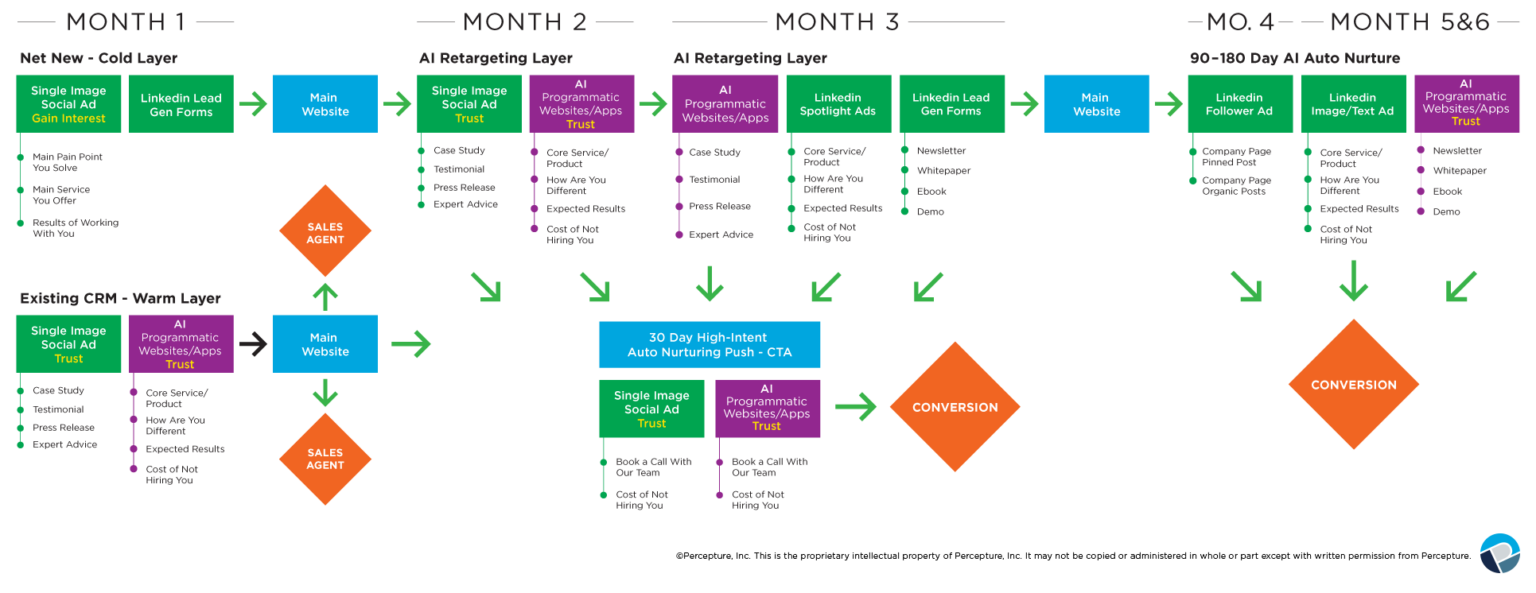
Use it for conference follow-up, referral follow-up, webinar follow-up, LinkedIn follow-up, proposal follow-up, and stalled opportunity reactivation. Segment by cybersecurity, co-managed IT, cloud, compliance, Microsoft 365, backup, or local service needs.
A practical Lead Generation for MSPs strategy also has to reflect buyer committees, proof needs, comparison searches, and long sales cycles.
How to use buyer intent data and LeadSeeker
Buyer intent data is useful when it helps sales focus. It is not a shortcut around trust. For MSP sales lead generation, intent signals can show which accounts are researching managed IT, cybersecurity, co-managed IT, compliance, Microsoft 365, pricing, or proof.
When Lead Generation for MSPs is built this way, every channel supports the same revenue goal instead of acting like a separate campaign.
| Signal | What it may mean | How to respond | Sales priority |
|---|---|---|---|
| Visits managed IT page | Active service research | Show relevant proof and local fit | Medium |
| Reads cybersecurity content | Risk or compliance concern | Share security checklist and meeting path | High |
| Searches co-managed IT | Internal IT team may need help | Send co-managed IT guide | High |
| Downloads compliance checklist | Regulated risk or audit pressure | Route to senior sales | High |
| Visits pricing/contact | Strong commercial intent | Fast follow-up | High |
| Attends conference session | Live topic interest | Add to event sequence | Medium to high |
| Engages with LinkedIn content | Awareness and trust building | Connect and nurture | Medium |
| Opens AutoNURTURE emails | Ongoing interest | Score and monitor | Medium |
| Returns to website after event | Relationship plus research | Sales follow-up | High |
| Views case study | Proof evaluation | Offer relevant consultation | High |
Use buyer intent signals and LeadSeeker to identify better-fit companies, verify leads, enrich account data, and support sales handoff. LeadSeeker should be part of a system, not a magic lead machine.
That is why Lead Generation for MSPs needs both category-level execution and executive-level reporting.
Prioritize better-fit MSP prospects
LeadSeeker supports prospecting and account prioritization by helping teams identify, verify, and enrich better-fit leads before sales spends time on outreach.

Buyer committee matrix for MSP lead generation
For digital marketing leaders, Lead Generation for MSPs should connect technical content, buyer intent, search visibility, and sales follow-up into one operating plan.
Lead generation for MSPs must speak to a buying committee, not one persona. The message that gets a CEO interested may not satisfy an IT director or compliance stakeholder.
| Buyer | Core question | Proof needed | Best CTA |
|---|---|---|---|
| CEO | Can this provider reduce business risk? | Business continuity, stability, leadership confidence | Strategy review |
| CFO | Will this control cost and risk? | Pricing logic, contract fit, ROI, downtime impact | Compare scope |
| VP Sales | Will IT issues slow revenue teams? | Help desk response, uptime, user support | Diagnose friction |
| VP Marketing | Will the MSP support growth systems? | Security, integrations, uptime, data access | Review environment |
| IT Director | Can this partner work with us? | Co-managed IT, SLAs, escalation process | Technical discussion |
| Operations | Will users get reliable support? | Ticket process, coverage, onboarding | Service review |
| Compliance/security | Will risk be managed? | Security content, policy, backup, governance | Risk assessment |
The best Lead Generation for MSPs programs measure qualified conversations and sales opportunities, not just impressions, clicks, or rankings.
Pricing, ROI, and the risk of poor lead quality
MSP lead generation cost depends on scope, market, competition, service mix, content needs, paid media budget, and sales capacity. A basic website or social retainer costs less than a full SEO + GEO + content + paid search + LeadSeeker + AutoNURTURE + attribution system, but it may not create enough qualified pipeline.
A practical Lead Generation for MSPs strategy also has to reflect buyer committees, proof needs, comparison searches, and long sales cycles.
| Program type | What it includes | Best fit | What to measure | Risk if underfunded |
|---|---|---|---|---|
| Basic website/social retainer | Light updates and posting | Brand maintenance | Engagement, traffic | Little pipeline impact |
| SEO/content program | Service pages, blogs, technical improvements | Organic demand | Rankings, qualified traffic, leads | Slow if authority is weak |
| SEO + GEO authority program | Search, AI visibility, entity clarity, proof | Competitive markets | AI visibility, rankings, assisted pipeline | Thin content ignored |
| Paid search + landing page program | Ads, landing pages, conversion tracking | Near-term demand | CPL, conversion rate, opportunity rate | Spend waste |
| Conference + AutoNURTURE program | Event lists, sequences, content, CRM follow-up | Event-heavy MSPs | Meetings, reactivation, pipeline | Lost event momentum |
| Full MSP pipeline system | SEO, GEO, paid, content, intent, nurture, reporting | Growth-focused MSPs | Qualified opportunities and MRR | Too many disconnected tactics |
| LeadSeeker buyer intent add-on | Prospect data, verification, prioritization | Sales teams needing focus | Fit, response, meetings | Data without follow-up |
The real cost is not the lead. It is sales time spent on the wrong lead.
Poor-fit leads create hidden cost: wasted discovery calls, bad proposals, long follow-up loops, low close rates, and weak MRR. Measure pipeline value, not just form volume.
Qualified pipeline value = qualified opportunities × average contract value × expected close rate
Use this formula to compare programs by opportunity quality, not by the cheapest cost per lead.
When Lead Generation for MSPs is built this way, every channel supports the same revenue goal instead of acting like a separate campaign.
MSP lead quality scorecard
Use this scorecard before sales treats a lead as qualified.
That is why Lead Generation for MSPs needs both category-level execution and executive-level reporting.
| Criteria | Low-quality sign | High-quality sign | Score |
|---|---|---|---|
| Company size | Too small or poor fit | Matches target employee or device count | 1-5 |
| Industry fit | Outside focus | Matches vertical expertise | 1-5 |
| Location fit | Outside service area | Inside service or remote support model | 1-5 |
| Service need | Vague IT question | Managed IT, cyber, cloud, Microsoft 365, or co-managed IT need | 1-5 |
| Urgency | No trigger | Renewal, outage, compliance, or provider pain | 1-5 |
| Authority | Student, vendor, or low influence | Owner, CFO, IT leader, operations, security | 1-5 |
| Budget | No commercial path | Can support recurring service | 1-5 |
| Current provider pain | No clear problem | Response, trust, SLA, or risk issue | 1-5 |
| Cybersecurity/compliance pressure | None stated | Audit, cyber insurance, endpoint, backup, or governance concern | 1-5 |
| Engagement behavior | One accidental visit | Repeat visits, case study, event, email, or contact page | 1-5 |
Should MSPs use SEO, paid search, LinkedIn, referrals, or appointment setting?
Use all of them only if you can connect them. SEO and omnichannel marketing help create persistent visibility. GEO helps AI systems understand the MSP. Paid search captures urgent demand. LinkedIn supports account-based trust. Referrals bring warmth. Appointment setting can create conversations, but without proof and nurture it often creates low-quality meetings.
A serious msp lead generation agency should help the MSP answer five questions:
- Which accounts are worth pursuing?
- Which services create the strongest commercial opportunity?
- What content proves technical credibility?
- Which channels create qualified conversations?
- How will sales know what to do next?
Mistakes to avoid
Avoid buying a list and calling it a strategy. Avoid service pages that sound like every other MSP. Avoid running paid search to a homepage. Avoid treating conference leads as one-time contacts. Avoid using AI search as a buzzword instead of building clear, crawlable, helpful content. Avoid measuring success only by traffic, impressions, or booked calls.
Also avoid choosing a provider based only on the label “msp lead generation firm” or “msp lead generation company.” The better question is whether the partner understands technical B2B, risk-based buying, long sales cycles, channel relationships, and sales handoff.
Proof: visibility and authority can create qualified demand
Broadstaff, a digital infrastructure staffing firm, used a focused search visibility and authority-building program to strengthen visibility for high-intent searches and convert that visibility into more qualified demand. The program reached 90% page-one visibility for tracked keywords and increased qualified leads 3x within 12 months. The lesson for MSPs is not that every market works the same way. The lesson is that technical B2B buyers respond when visibility, trust, content, and sales handoff work together.
Read the Broadstaff case study for the adjacent technical B2B proof model. MSPs can apply the same principle: match search visibility with authority, buyer education, and disciplined follow-up.
A practical 45-day implementation plan
Days 1-10: Diagnose fit and visibility
Define ICP, target geographies, priority services, current pipeline sources, service-area SEO gaps, technical SEO gaps, and content proof gaps. Review whether your managed IT, cybersecurity, co-managed IT, Microsoft 365, cloud, and backup pages answer buyer risk questions.
Days 11-20: Build the conversion path
Create or improve landing pages, proof modules, CTAs, tracking, CRM fields, and lead scoring. Add content that helps buyers compare options, understand risk, and know when to talk with sales.
Days 21-30: Activate channels
Launch SEO improvements, GEO/entity enhancements, paid search tests, LinkedIn outreach, conference follow-up, referral partner messaging, and LeadSeeker prospect prioritization. If AI discovery is important, connect your program to OptiSearch and search visibility workflows.
Days 31-45: Nurture, route, and measure
Use AutoNURTURE sequences, sales alerts, lead scoring, source reporting, and MRR attribution. Review qualified opportunities, meeting quality, and objections. Improve the system before scaling spend.
10 metrics MSPs should track
- Qualified lead volume.
- Sales-qualified opportunities.
- Source by channel.
- Lead-to-meeting rate.
- Meeting-to-opportunity rate.
- Cost per qualified opportunity.
- Close rate.
- Sales cycle length.
- MRR created.
- CAC payback.

Build Your MSP Lead Generation System
Talk with a senior strategist who understands technical B2B, telecom, managed services, conferences, enterprise buyers, and pipeline.
FAQs
What is lead generation for MSPs?
Lead generation for MSPs is the process of attracting, identifying, nurturing, and converting business buyers who may need managed IT, cybersecurity, cloud, Microsoft 365, backup, or co-managed IT support. The goal is not raw lead volume. The goal is qualified sales conversations with companies that match the MSP’s service model, geography, urgency, and recurring revenue potential.
How does lead generation for MSPs work?
It works by connecting visibility, trust, intent, nurture, and sales handoff. SEO and GEO help buyers find the MSP. Content and proof answer risk questions. Paid search, LinkedIn, referrals, conferences, and buyer intent data create signals. AutoNURTURE keeps relationships warm. Sales then prioritizes high-fit accounts and measures opportunity quality.
What is the best lead generation channel for MSPs?
There is no single best channel for every MSP. SEO is strong for compounding demand. Paid search can capture urgent intent. LinkedIn supports relationship selling. Conferences and referrals create trust. Buyer intent data helps prioritize accounts. The best channel mix depends on market, services, budget, proof, and sales follow-up capacity.
How much does MSP lead generation cost?
Cost depends on scope, market competition, content needs, ad spend, technology, sales support, and whether the MSP needs a basic program or a full pipeline system. Compare investment by qualified opportunities, close rate, and MRR potential instead of choosing the cheapest cost per lead.
How long does it take to see MSP lead generation results?
Paid search, events, referrals, and targeted outreach can create earlier conversations when the offer and follow-up are strong. SEO, GEO, content, authority, and nurture usually compound over a longer period. A practical first milestone is a 45-day diagnostic, launch, and measurement cycle, followed by ongoing optimization.
Should MSPs use appointment setting or inbound marketing?
MSPs can use both, but neither should stand alone. Appointment setting can create conversations quickly, but quality varies without tight targeting and proof. Inbound marketing builds visibility and trust over time. The stronger model combines search, content, intent data, nurture, and sales outreach.
How does AI search affect MSP lead generation?
AI search changes how buyers research options and compare providers. MSPs need clear service pages, helpful content, entity clarity, proof, FAQs, and consistent expertise signals. Google’s guidance emphasizes helpful, reliable content and crawlable pages, which also supports visibility across AI-assisted discovery experiences.
How can MSPs use conferences for lead generation?
MSPs can use conferences for pre-event outreach, partner co-marketing, session follow-up, badge scan enrichment, LinkedIn connection sequences, AutoNURTURE campaigns, and post-event sales prioritization. The key is disciplined follow-up. Many MSPs create good event conversations but lose pipeline because they stop after the first touch.
What makes MSP leads qualified?
A qualified MSP lead fits the target company size, geography, industry, service need, budget, urgency, and authority profile. Strong signals include current-provider pain, cybersecurity or compliance pressure, repeat engagement, pricing or contact visits, event interaction, case study views, and a clear need for recurring managed services.
Can AutoNURTURE help MSPs convert more leads?
AutoNURTURE can help MSPs keep warm contacts engaged after events, referrals, LinkedIn outreach, webinars, proposals, and stalled opportunities. It does not replace sales. It supports sales by sending useful follow-up, segmenting buyer pain, and keeping the MSP visible until the buyer is ready for a conversation.
Related MSP resources
- Compare agency selection criteria in Percepture’s best MSP marketing company guide.
- Review search-specific strategy in the MSP SEO agency resource.
- Build the broader channel plan with MSP digital marketing guidance.
- Strengthen search foundations with SEO for managed service providers.
- Compare investment models with AI search SEO pricing.
About the author
Bob Generale is President of Percepture, a senior SEO, GEO, digital PR, paid media, content, analytics, and AI systems agency helping technical B2B companies build visibility, trust, and qualified demand. Bob works with teams in telecom, managed services, enterprise technology, and complex B2B markets where long sales cycles, conference relationships, channel ecosystems, and buyer confidence shape revenue.
If your team is ready to improve lead generation for MSPs, Percepture can help connect intent, trust, nurture, and sales handoff into one pipeline system.