
What is Digital Marketing for Construction Companies?
Digital marketing for construction companies is the system that makes your company visible before a project ever goes out to bid. Today, owners, developers, and city planners start their research online, searching for builders they can trust, reviewing past projects, and validating credibility long before they pick up the phone. A strong digital marketing strategy puts your construction firm in the right places at the right time: showing up first in search results, proving expertise through real projects and visuals, and delivering the right message to every decision-maker involved. When done correctly, it doesn’t just generate leads; it shortens sales cycles, builds trust at scale, and positions your company as the obvious, low-risk choice for high-value projects.
Construction Digital Marketing Experts
Since 2004
Table of Contents
- Digital Marketing Guide for Construction
- Construction Marketing Buyer Psychology
- Construction Buying Committee
- Why Construction Digital Marketing is Complex
- The Construction Digital Marketing System
- Where AI Agents Help Construction Teams
- How Digital Marketing Can Support Sales
- How Long to See Digital Marketing Results
- Digital Marketing Construction Experience
- Frequently Asked Questions
- Build a Digital Marketing System for Construction
Digital Marketing Guide for Construction
As a construction marketing agency, we’ve learned that digital marketing only works when it reflects how construction projects are actually sold. Digital marketing for construction companies isn’t about channels. It’s about earning trust across a buying committee that thinks, evaluates, and decides very differently.
In 2026, the construction industry faces a unique challenge: longer sales cycles, multi-stakeholder approval, and a marketplace where reputation and proof matter more than hype. Whether you’re a general contractor, design-build firm, or specialty subcontractor, your digital marketing must speak to engineers, executives, procurement teams, and sales leaders—all at once.
This article breaks down the system that works: a strategic approach to SEO for Construction Companies, Digital PR, paid advertising, and AI-powered automation that shortens cycles, reduces risk, and wins more qualified bids.
Construction Marketing Starts With Buyer Psychology
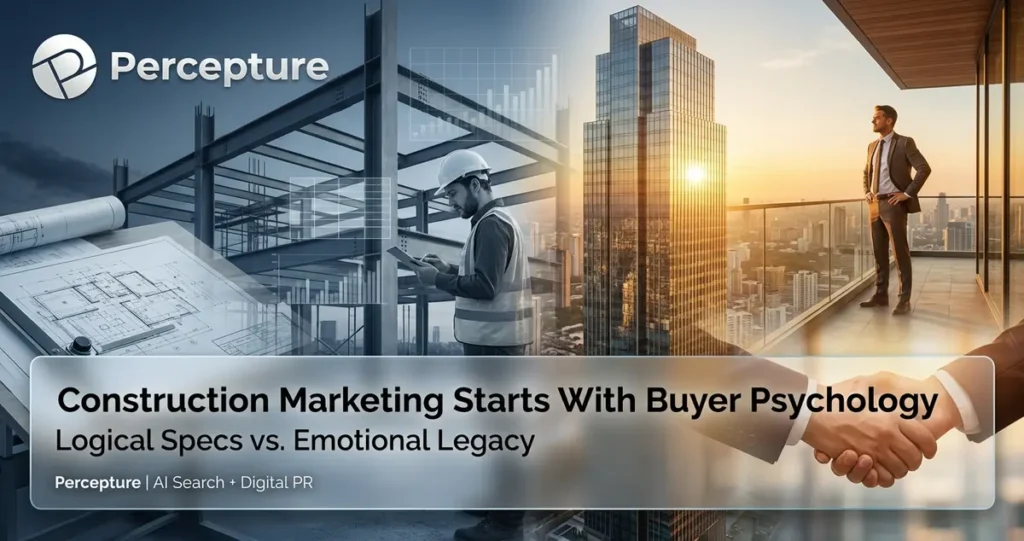
Most construction marketing fails because it treats everyone like the same buyer. But construction projects are decided by committees, not individuals. And each member of that committee has different priorities, fears, and decision-making styles.
There are two buyer modes you need to understand:
Logical Buyers
- Engineers: They care about accuracy, technical specs, and proof of execution.
- Procurement: They need compliance, vendor trust, and clear documentation.
- Finance/PE: They evaluate risk, margin, and ROI.
Emotional Buyers
- Owners/Developers: They want confidence, outcomes, and legacy.
- Executives: They prioritize growth, visibility, and authority.
- Internal Champions: They need to sell your solution internally.
Key Insight: Construction marketing fails when it treats everyone like the same buyer. Your messaging must align with how each stakeholder evaluates risk, trust, and value.
The Construction Buying Committee: Who You’re Really Marketing To
Here’s a breakdown of the key players in a construction buying decision—and what they need to see from your digital marketing:
| Buyer Role | What They Care About | What They Need to See | Best Channel |
|---|---|---|---|
| Owner/Developer | Risk, confidence, reputation | Proof, case studies, media mentions | Digital PR, search, video |
| Engineer | Accuracy, technical credibility | Deep technical content, specs, diagrams | SEO, PDFs, whitepapers |
| Executive | Growth, visibility, authority | Thought leadership, LinkedIn, PR | LinkedIn, Digital PR, paid ads |
| Sales Team | Speed, qualified leads | CRM integration, AI agents, automation | AI agents, email, CRM |
| Procurement | Compliance, vendor trust | Certifications, reputation assets, reviews | SEO pages, RFP tools, AI Search |
This table is the foundation of your digital marketing strategy. If your construction content marketing agency, ads, and website don’t speak to these five roles, you’re leaving opportunities on the table.
Why Construction Digital Marketing Is More Complex Than Other Industries
Construction isn’t like SaaS or e-commerce. The sales cycles are longer. The stakes are higher. And the decision-making process involves more people, more risk, and more scrutiny.
Here’s what makes construction marketing different:
- Long sales cycles: Projects can take 6-18 months from first contact to contract signing.
- Multi-stakeholder approval: You’re not selling to one person—you’re selling to a committee.
- Regulated environments: Government contracts, infrastructure, healthcare, and life sciences projects require compliance and transparency.
- Reputation risk: One bad project can damage your brand for years.
- “You don’t get a second chance” reality: Trust is earned slowly and lost quickly.
This is why construction companies need a system, not a channel. You can’t just “run Google Ads” or “post on LinkedIn” and expect results. You need a coordinated approach that builds trust, reduces risk, and shortens cycles.
The Construction Digital Marketing System (Not a Channel List)
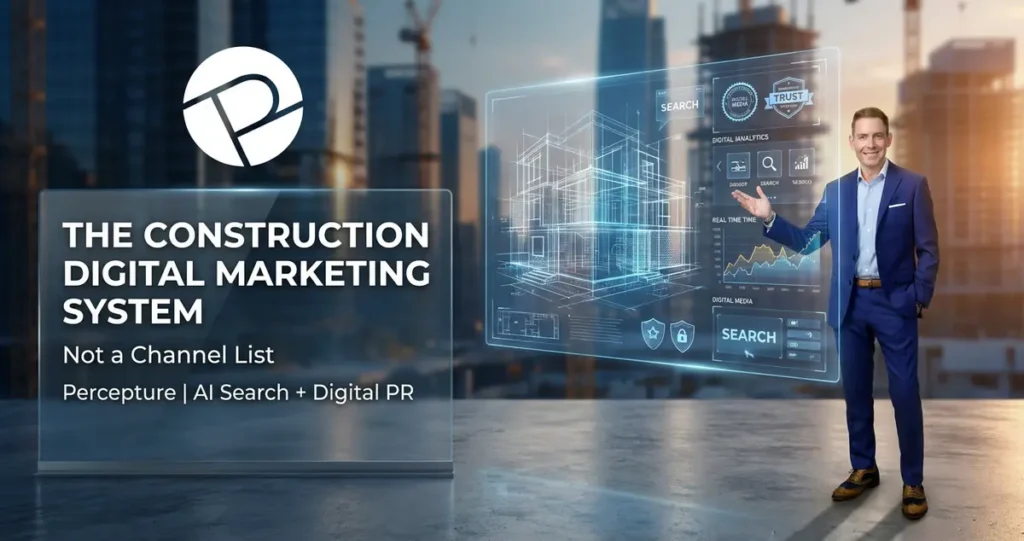
At Percepture, we’ve built a system that works for construction companies—whether you’re a $10M general contractor or a $500M design-build firm. Here’s how it works:
1. Search Visibility (SEO + AI Search)
Your website is your sales deck. If it’s not ranking for the services, markets, and capabilities you offer, you’re invisible. Enterprise SEO services ensure you show up when buyers search for “commercial construction in [city]” or “design-build healthcare facilities.”
But in 2026, SEO isn’t enough. You also need AI Search Optimization services, ensuring your brand appears in ChatGPT, Perplexity, Google AI Overviews, and other AI-driven search assistants.
2. Trust Amplification (Digital PR + Media)
Digital PR accelerates trust. When your company is mentioned in industry publications, local news, or trade media, it signals credibility. PR for construction companies also fuels AI citations—making your brand the “cited answer” in AI search results.
3. Precision Reach (Programmatic + Paid Ads)
Programmatic advertising lets you reach buyers where they actually are: trade publications, apps, streaming platforms, and conference websites. It’s not about vanity impressions—it’s about meeting decision-makers in their daily media consumption.
4. Sales Enablement (AI Agents + Automation)
This is where AI sales agents shine. RFP automation, proposal drafting, and sales follow-up can be handled by AI—freeing your team to focus on high-value relationships. We’ll cover this more below.
5. Conversion & Retention (CRO + Analytics)
Your website should convert visitors into calls, downloads, and qualified leads. Conversion rate optimization (CRO) ensures your site is built for action—not just traffic.
Where AI Agents Actually Help Construction Teams
AI agents aren’t hype—they’re practical tools that remove friction from your sales and marketing operations. Here’s where they fit:
| Role | Problem | AI Agent Solution | Value |
|---|---|---|---|
| Sales | RFP fatigue, slow response times | Proposal agent (RFP parsing, drafting) | Faster, more consistent responses |
| Marketing | Content sprawl, proof reuse | Content ops agent (case study repurposing) | Reuse proof everywhere |
| Executive | Visibility gaps, brand control | AI search agent (citation monitoring) | Brand control in AI results |
| Operations | Repetitive admin tasks | Workflow agent (scheduling, follow-up) | Time saved, fewer missed opportunities |
Key Point: AI agents don’t replace people. They remove friction. They let your team focus on relationships, strategy, and execution—not paperwork.
AI Sales Agent
From Visibility to Revenue: How Digital Marketing Supports Sales
Digital marketing doesn’t “close” construction deals. But it does three critical things:
- Shortens cycles: Pre-sells credibility before the first call.
- Reduces uncertainty: Provides proof, case studies, and reputation signals.
- Influences shortlists: Gets you invited to RFPs and bid opportunities.
Here’s how it works in practice:
- Pre-RFP influence: Your SEO and PR efforts ensure you’re top-of-mind when buyers start researching.
- Shortlist positioning: Your website, case studies, and media mentions make you the obvious choice.
- Sales enablement assets: Your marketing team creates proof pages, capability statements, and follow-up content that sales can use.
- Follow-up automation: AI agents handle post-call follow-up, ensuring no lead falls through the cracks.
What Most Construction Companies Get Wrong

Here’s what we see most often—and how to fix it:
- Treating marketing as lead volume: Construction isn’t about “more leads.” It’s about better-fit leads. Focus on quality, not quantity.
- Ignoring engineers: Engineers are often the gatekeepers. If your content doesn’t speak to their technical needs, you’ll lose deals.
- Publishing content sales never uses: Marketing and sales must be aligned. Create proof assets that sales can actually use in proposals and follow-up.
- No feedback loop between sales + marketing: Your sales team knows what objections buyers have. Use that intel to inform your content strategy.
How Long Will It Take to See Digital Marketing Results?
One of the most common questions we get: “How long will it take to see results?”
Here’s the simple model we use, or check out our Enterprise SEO ROI Calculator:
Inputs:
- Domain Authority (DA): Your site’s current authority (Percepture is ~26).
- Current Position: Are you ranking at all? Or starting from zero?
- Topical Coverage: How many supporting pages do you have? (4 articles + 1 service page is a strong start.)
- Trust Velocity: How fast are you earning backlinks, PR mentions, and engagement?
- Competition Level: How competitive is the keyword? (KD ~12 for “digital marketing for construction companies” is low-medium.)
Simple Rule:
- If you have some topical coverage: ~5 supporting pieces + a service page = 6-9 months to page 1.
- If you have none: ~10 supporting pieces + a service page = 12-18 months.
- High-trust links can compress time dramatically: One PR mention from a high-authority site can cut months off your timeline.
Example: Percepture (DA 26) with 4 construction-focused articles + 1 service page + construction-adjacent authority (telecom, life sciences) = 6-9 months to page 1 for “digital marketing for construction companies.”
How We’ve Done This for Others
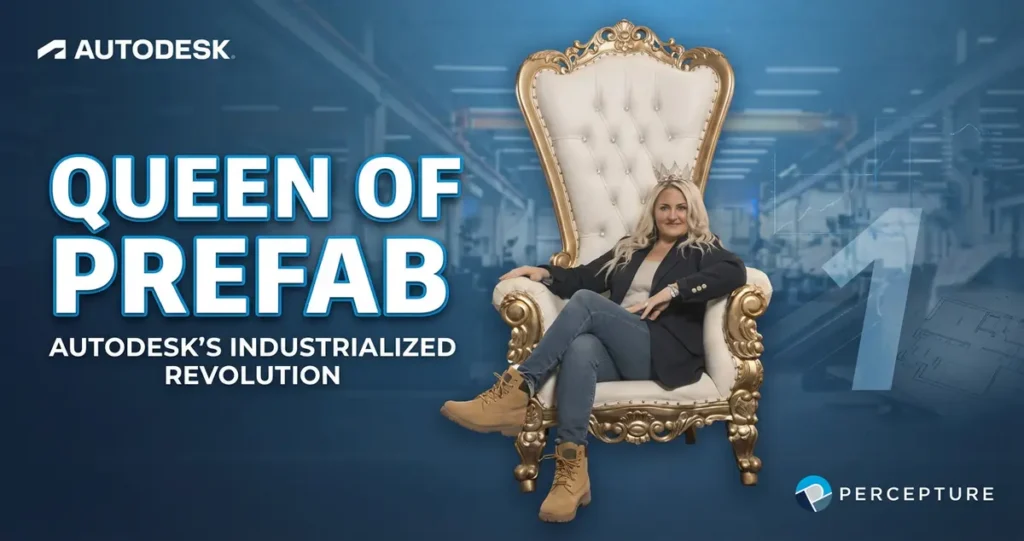
Autodesk
We’ve worked with Autodesk to execute enterprise-level campaigns that prioritize credibility, consistency, and high-trust messaging. The focus: reaching engineers, executives, and procurement teams with content that speaks to their specific needs.
Galorath
Our omnichannel approach with Dan Galorath (CEO) focused on what construction and engineering buyers care about: credibility, lead quality, and pipeline consistency. By aligning SEO, PR, and paid ads, we helped Galorath become the go-to name in their niche.
FAQs: Digital Marketing for Construction Companies
1. What is digital marketing for construction companies?
Digital marketing for construction companies is a strategic system that combines SEO, PR, paid ads, and automation to reach multi-stakeholder buying committees, shorten sales cycles, and win more qualified bids.
2. How is digital marketing for construction different from other industries?
Construction marketing must account for longer sales cycles, multi-stakeholder approval, regulated environments, and reputation risk. It’s not about volume—it’s about trust, proof, and fit.
3. What channels matter most in construction marketing?
SEO, Digital PR, LinkedIn, programmatic advertising, and AI Search Optimization are the most effective channels for reaching engineers, executives, and procurement teams.
4. How do you market to engineers vs. executives?
Engineers need technical content, specs, and proof of execution. Executives need thought leadership, visibility, and authority. Your content strategy must address both.
5. Does digital marketing help with RFPs?
Yes. Pre-RFP influence (SEO + PR) ensures you’re top-of-mind when buyers start researching. AI agents can also automate RFP parsing and proposal drafting.
6. Can AI help construction sales teams?
Absolutely. AI agents can handle RFP automation, proposal drafting, follow-up emails, and content repurposing—freeing your team to focus on relationships.
7. How long does digital marketing take to work?
For a DA ~26 site with 4 articles + 1 service page, expect 6-9 months to page 1 for low-medium competition keywords. High-trust PR links can compress this timeline.
8. What should we do first?
Start with Enterprise SEO and Digital PR. These two channels build the foundation for everything else.
Ready to Build a System That Works?
If you’re tired of marketing that doesn’t move the needle, let’s talk. At Percepture, we build digital marketing systems for construction companies that want predictable growth, qualified bids, and measurable ROI.
We’ll walk you through:
- Your ranking forecast (time-to-page-1)
- Your channel plan (SEO, PR, paid, AI)
- Your proof asset map (case studies, content, automation)
Connect with us today!
Author: Bob Generale
Bob Generale is a marketing operator and algorithm strategist focused on Enterprise SEO, AI Search (Generative Engine Optimization), and Digital PR for high-trust industries including construction, telecom, digital infrastructure, life sciences, healthcare, and private equity.
He is a partner at Percepture and co-founded its digital division, bringing modern search, paid media, and analytics systems to a firm that began as PR-first. Bob is also a co-founder of PyraBuilds.ai (AI agents for construction and telecom workflows, including RFP support) and a co-inventor of Social Incentive Marketing (SIM), a simple model that enables brands to instantly reward verified social actions to accelerate distribution and awareness.
Career timeline and industry focus
- 2006–present: Built early “Digital PR” systems that connect PR placements to search visibility and trust signals, laying groundwork for today’s AI-driven discovery.
- 2016–present: Construction and telecom work spanning positioning, demand creation, and reputation systems.
- 2018–present: Worked closely with Hunter Newby, a pioneer in digital infrastructure and the “Meet Me Room” ecosystem; supported AI-search positioning and authority-building initiatives.
- 2022–present: Worked alongside Todd Zabelle (Forbes Author), supporting market education efforts and connecting construction delivery thinking with adjacent infrastructure and manufacturing audiences.
- 2016–present: Collaborated with Amy Marks, helping elevate the digital strategy around her industry platform; the work contributed to 9M+ video views supporting the visibility of what is now known as “Queen of Prefab.”
Notable proof points
- Helped Century 21 achieve #1 rankings for ~80% of its top keywords (supported by a LinkedIn recommendation).
- Helped drive measurable growth systems at Percepture during a multi-year run recognized on the Inc. 5000 list (company recognition).
- Serves on the board and leadership team of Ferrari Club of America, Tampa, where the chapter moved from one of the smallest in 2024 to one of the fastest-growing in 2025, on pace to become one of the largest in 2026—supported by event strategy, content, and AI-search visibility aligned to owner-intent search behavior.
Bob’s approach is practical: SEO is a mathematical system influenced by authority, topical coverage, and trust velocity (links, mentions, engagement). His work aligns search, PR, paid media, and reputation so brands become the most current, most credible answer—across Google and AI assistants.
Video Transcript
Digital Marketing for Construction Companies: The 2026 System
- Digital marketing for construction companies is not about flashy ads.
- It is about building trust before the bid.
- Today, construction buyers research online for three to six months before they ever call a contractor. They search Google. They check LinkedIn. They review past projects. They look at safety records. They compare firms.
- If your company is not visible during that research phase, you are invisible.
- A modern construction digital marketing strategy has four parts.
- First: SEO for construction companies. You must rank for real buyer intent searches like “commercial contractor near me” or “design build firm for healthcare projects.”
- Second: Content marketing. Publish case studies, safety guides, and project walkthroughs that prove you can deliver.
- Third: PR for construction companies. Earn mentions and backlinks from trusted trade publications and local media. Authority drives rankings.
- Fourth: AI search optimization. Structure your content so it appears in Google AI Overviews and tools like ChatGPT.
- Construction marketing is not about getting clicks.
- It is about earning trust at scale.
- Because the contractor who shows up first… gets shortlisted first.