
PortCo private equity refers to the portfolio company owned by a private equity firm or fund. It is the operating business where the investment thesis has to become measurable through growth, margin discipline, retention, reporting, and exit readiness.
For operating partners, PortCo CEOs, CFOs, and marketing leaders, the practical question is not only what a PortCo means. The better question is what the portfolio company should do next to become easier to find, easier to trust, easier to measure, and easier to evaluate before the next board meeting, recapitalization, or sale.
A PortCo is a portfolio company owned by a private equity firm or fund. In private equity, a PortCo is the operating asset that must grow, improve margins, reduce risk, and become more valuable before an exit, recapitalization, or secondary sale. The PortCo is where the investment thesis becomes real.
Executive summary for PortCo private equity readers
Who this guide is for
What is a PortCo?
A PortCo is shorthand for portfolio company. In private equity, it usually means an operating business owned by a PE fund or private equity firm. The term matters because it changes the operating context. The company is not just trying to grow; it is trying to grow inside an investment timeline.
A portfolio company can be held by different types of investors, but in PE the company is usually managed with a defined value creation plan. That plan may include pricing discipline, leadership support, add-on acquisitions, operational reporting, sales system improvements, and stronger demand capture.
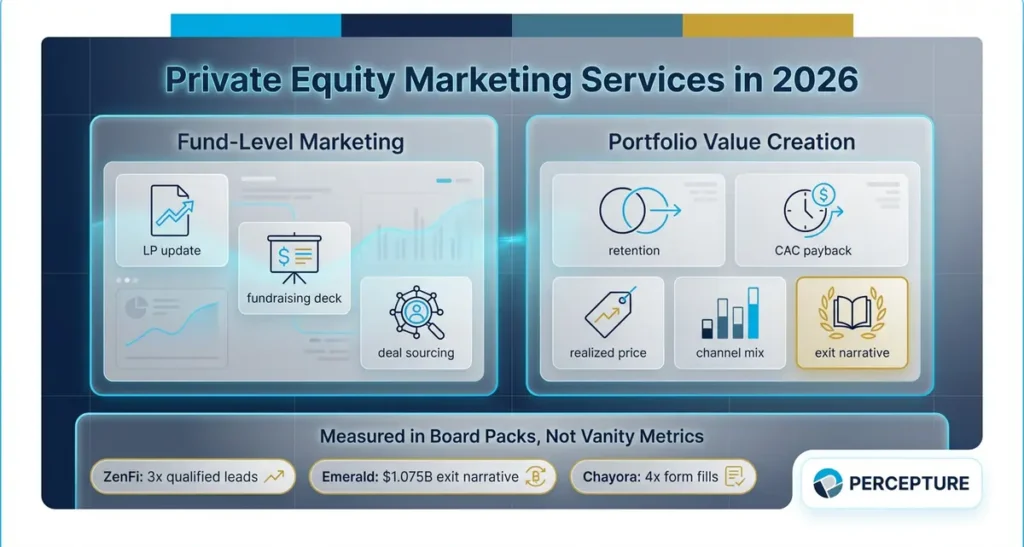
This is where private equity growth support has to think differently from a general B2B marketing program. A PortCo needs market clarity, proof, reporting, and speed that fit the operating model.
| Term | Meaning | PE relevance | Marketing and GEO implication |
|---|---|---|---|
| PortCo | A portfolio company owned by a PE fund. | The operating asset PE is trying to improve. | Needs visibility, trust, pipeline, proof, and reporting. |
| Portfolio company | Formal term for a company held in an investment portfolio. | Used by PE firms, venture firms, and investors. | Needs a clear market story and measurable growth plan. |
| Platform company | The main company PE builds around. | Often becomes the foundation for add-on acquisitions. | Needs category authority, integration messaging, and scalable demand capture. |
| Add-on acquisition | A smaller company acquired and added to a platform. | Supports buy-and-build strategies. | Needs narrative alignment, brand integration, and sales enablement. |
| Fund-level marketing | Marketing for the PE firm itself. | Supports deal sourcing, LP credibility, reputation, and authority. | Needs thought leadership, PR, executive visibility, and trust. |
| PortCo marketing | Marketing for the portfolio company. | Supports growth, revenue quality, and exit readiness. | Needs SEO, GEO, PR, paid media, CRO, content, analytics, and proof. |
How a PortCo fits into the private equity structure
The PE firm manages the investment strategy. The fund holds the investment. General partners manage the fund, limited partners provide capital, and the PortCo management team operates the business.
The operating partner often sits between investment goals and day-to-day execution. The board provides oversight. The management team turns the plan into revenue, margin, retention, systems, and a story that can be explained to buyers, lenders, and future investors.
The PortCo lifecycle
Every private equity PortCo has a timeline. The sequence varies, but the operating pattern usually moves from diligence to acquisition, then from early fixes to value creation and exit readiness.
Market, customer, financial, and operational review.
Early priorities, reporting gaps, leadership alignment.
Growth, margin, systems, integration, and repeatable pipeline.
Clean KPIs, proof assets, buyer narrative, sale, recap, or secondary buyout.
Why PortCos matter to PE returns
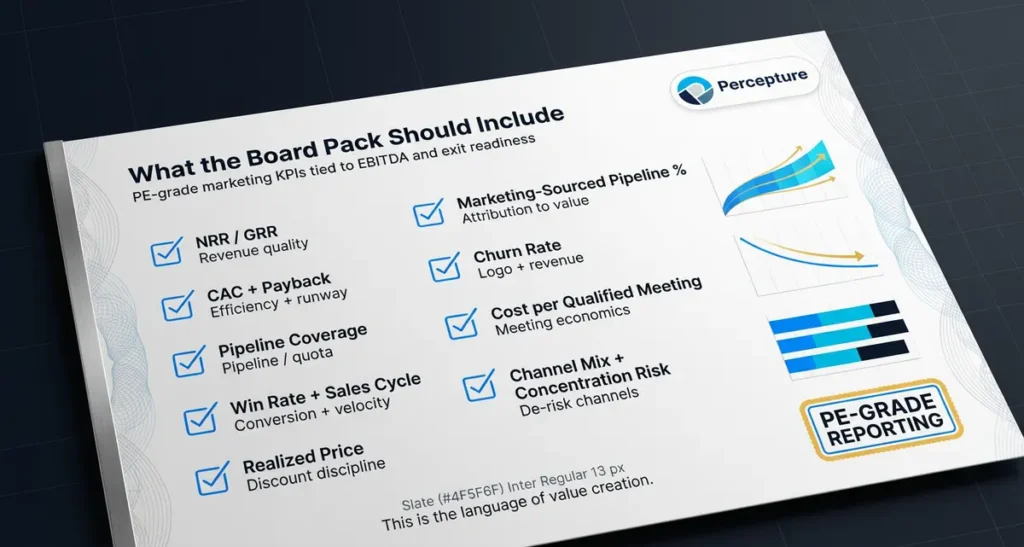
A PortCo matters because it is where the operating case is tested. Revenue quality, retention, margin durability, CAC payback, pricing power, sales velocity, and risk reduction all become part of the board conversation.
Digital visibility does not replace operations. It supports them. A clearer category story can make the business easier to understand. Better non-branded search visibility can help capture existing buyer demand. Stronger proof can reduce trust friction before a sales call.
For leaders comparing private equity marketing services, the important filter is whether the work connects to board-level questions. Impressions alone are not enough. The plan should explain how visibility, trust, conversion, and reporting support the investment thesis.
Want to know what buyers and AI engines see first?
Before a PortCo spends more on campaigns, it should know what buyers, AI engines, and search results already see. Percepture can review the visibility gaps that affect trust, demand capture, and board-ready reporting.
Get a PortCo Visibility ScanWhat a PortCo growth plan should include
A practical plan starts with diagnosis. The first round should show what is working, what is unclear, where the funnel leaks, and which actions can improve trust or demand capture without creating operational noise.
The PortCo Value Visibility Engine
The PortCo Value Visibility Engine is Percepture’s framework for turning a portfolio company’s digital footprint, trust signals, demand capture, and AI-enabled workflows into measurable value-creation support.
A 90-day PortCo growth plan
0–30 Days: Diagnose
- Search visibility audit
- AI search and GEO visibility audit
- Website and conversion review
- Content and PR proof review
- CRM and analytics review
- Board KPI mapping
- AI workflow opportunity scan
31–60 Days: Build and Fix
- Update messaging
- Fix high-intent landing pages
- Improve internal links
- Launch priority SEO and GEO content
- Build proof assets
- Improve paid demand capture
- Clean reporting gaps
- Pilot one AI workflow
61–90 Days: Scale and Report
- Expand content cluster
- Launch retargeting and sales enablement
- Build recurring board-pack dashboard
- Measure qualified lead movement
- Refine AI agent workflow
- Identify next PortCo playbook
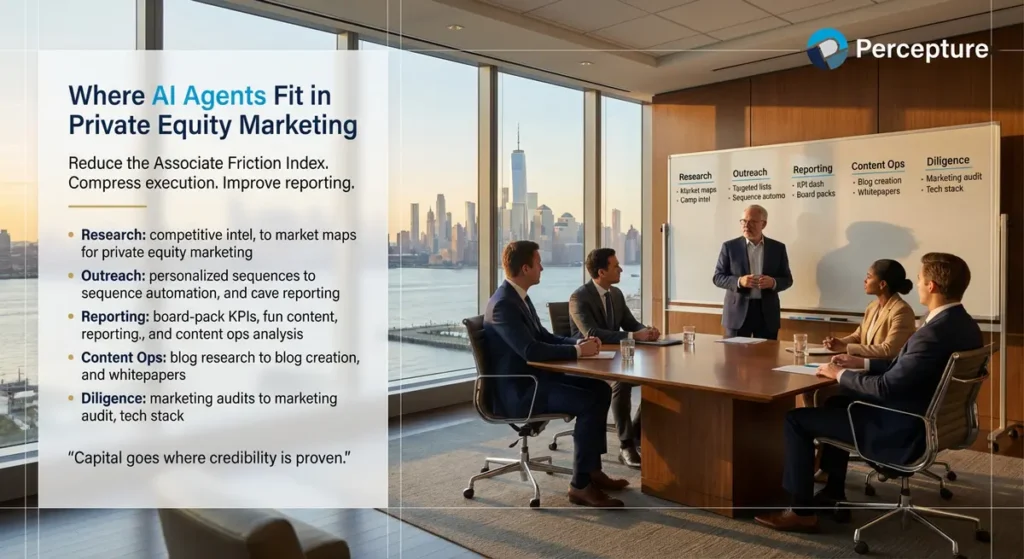
AI agents for PortCos: use the 20-60-20 model
Most founder-led PortCos should not automate everything at once. The safer model is 20-60-20: 20% human strategy, 60% AI agent execution, and 20% human review.
Good signs and warning signs
Good signs
- Clear category and buyer language
- Non-branded traffic from qualified searches
- Clean attribution and CRM hygiene
- Proof assets that sales can use
- AI guardrails and approval rules
- Board KPIs tied to pipeline and revenue quality
Warning signs
- Unclear positioning
- Brand-only search demand
- Messy reporting and source confusion
- No case studies or proof assets
- Random AI usage without process
- Vanity metrics presented as operating progress
PortCo Visibility Score
Use this scorecard before a budget review, board meeting, or diligence cycle. A weak score does not mean the business is weak. It means the market may not be seeing the business clearly enough.
Budget, ROI, and timeline clarity
PortCo marketing scope depends on the number of companies, channel mix, website condition, sales process, AI workflow complexity, and reporting needs. A diagnostic is smaller. A 90-day sprint is more active. A full growth system connects SEO, GEO, PR, paid media, CRO, analytics, sales intelligence, and AI workflow support.
| Engagement type | Best fit | What it clarifies |
|---|---|---|
| Audit or diagnostic | PortCo or operating partner that needs a baseline | Visibility, conversion, proof, reporting, and quick-win gaps |
| 90-day sprint | Team that needs fast fixes and a board-ready plan | Priority pages, proof assets, KPI reporting, and one controlled AI workflow |
| Full growth system | Platform company or multi-PortCo program | Repeatable demand capture, PR, SEO, GEO, CRO, paid media, and analytics |
| AI agent implementation | Sales, marketing, or operations teams with repeatable manual work | Workflow design, guardrails, review, data hygiene, and automation readiness |
Mistakes to avoid
- Treating a PortCo like a normal B2B client
- Chasing vanity traffic instead of qualified demand
- Ignoring founder adoption
- Launching AI without guardrails
- Making claims the company cannot prove
- Waiting until exit prep to fix digital visibility
- Separating PR, SEO, GEO, and sales
- Underinvesting in proof assets
- Reporting metrics CFOs do not care about
- Letting the website tell a weaker story than the business deserves
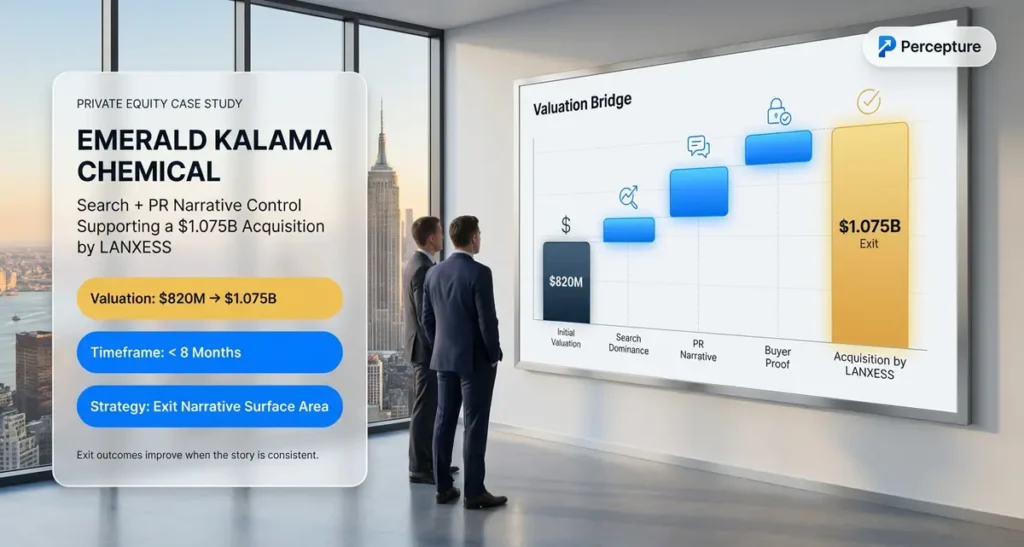
Percepture proof in high-trust B2B markets
Percepture was founded in 2004 and works across SEO, GEO, PR, paid media, CRO, analytics, content, AI agents, and lead generation. The PortCo private equity environment rewards the same discipline: visibility, trust, proof, and reporting.



Trust tokens beyond search
PortCo buyers rarely make decisions from one touchpoint. They compare search results, AI answers, news coverage, case studies, executive credibility, retargeting, sales follow-up, and what the website says when they arrive.


See how Percepture improves search visibility and qualified leads in technical B2B markets.
The Broadstaff Global case study shows how visibility, content, and qualified lead strategy can work together in a complex market.
See the Broadstaff Search Visibility Case StudyFAQs about PortCo private equity
What does PortCo mean in private equity?
PortCo is shorthand for portfolio company. In private equity, it usually means a business owned by a PE fund or private equity firm.
Is a PortCo the same as a portfolio company?
Yes. PortCo is an informal abbreviation for portfolio company. The term is common among private equity firms, operating partners, investors, advisors, and portfolio operations teams.
What is the difference between a PortCo and a platform company?
A platform company is usually the main business a private equity firm builds around. A PortCo can be a platform company or another portfolio company. Add-on acquisitions are often integrated into the platform.
How do private equity firms create value in PortCos?
PE firms create value through revenue growth, margin improvement, leadership support, operational standardization, add-on acquisitions, pricing discipline, improved reporting, and stronger exit readiness.
What should a PortCo marketing plan include?
A PortCo marketing plan should include category positioning, SEO, GEO, PR, paid media, conversion strategy, analytics, sales enablement, proof assets, and board-pack KPIs.
How does SEO help a PortCo?
SEO helps a PortCo capture existing buyer demand, build non-branded visibility, reduce dependence on referrals, and make the company easier to evaluate before a sales conversation.
How does GEO help a PortCo?
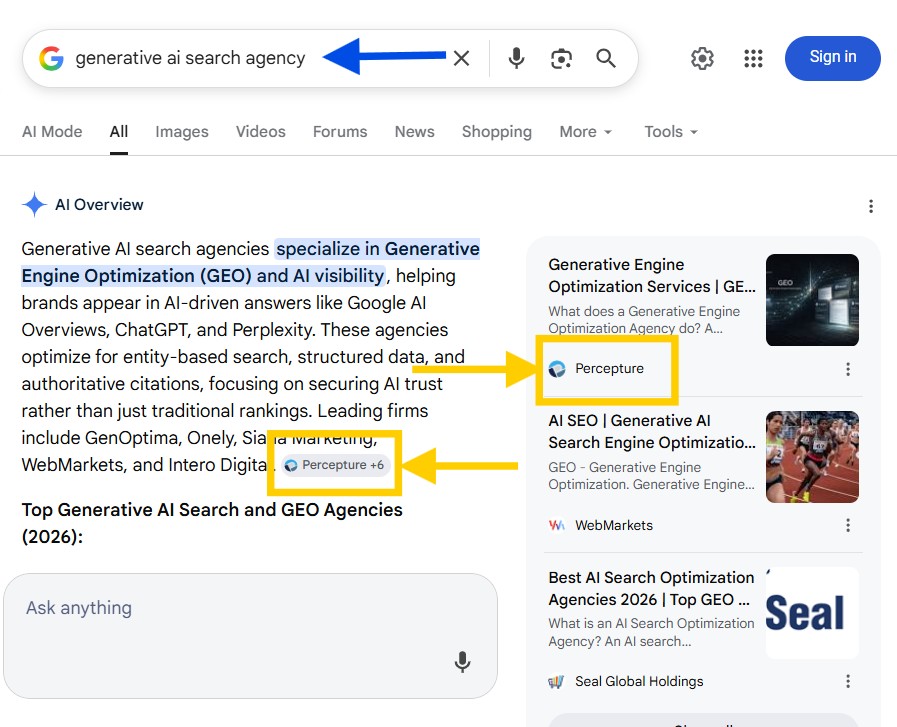
GEO helps a PortCo become easier for AI engines such as ChatGPT, Google AI Mode, Gemini, Claude, Perplexity, and Copilot to understand, cite, and recommend.
How can AI agents help PortCos?
AI agents can support research, sales prospecting, CRM hygiene, reporting, content workflows, competitive monitoring, and internal process automation when proper guardrails and human review are in place.
What should be in a PortCo board pack?
A PortCo board pack should include pipeline quality, CAC payback, traffic quality, conversion rates, lead source performance, search visibility, reputation indicators, sales velocity, churn risk, and next actions.
When should a PE firm bring in outside marketing support for a PortCo?
A PE firm should bring in outside support when the PortCo has weak visibility, unclear positioning, poor conversion, messy reporting, limited internal bandwidth, or a need to scale demand quickly without adding unnecessary headcount.
Build a 90-day PortCo private equity growth plan with Percepture
If your PortCo needs better search visibility, stronger proof, cleaner reporting, AI workflow support, or a clearer exit narrative, Percepture can help build the first 90-day plan.
A PortCo is where the investment thesis becomes real. Percepture helps make that story easier to find, easier to trust, easier to measure, and easier to act on.
Build a 90-Day PortCo Growth Plan
About the author
Bob Generale is President and Partner at Percepture, a digital marketing and PR agency founded in 2004. Bob works with senior teams on SEO, GEO, PR, content, analytics, CRO, lead generation, AI search visibility, and growth strategy for high-trust B2B markets.
Author focus: private equity visibility, narrative control, demand capture, AI search, and board-ready growth systems.