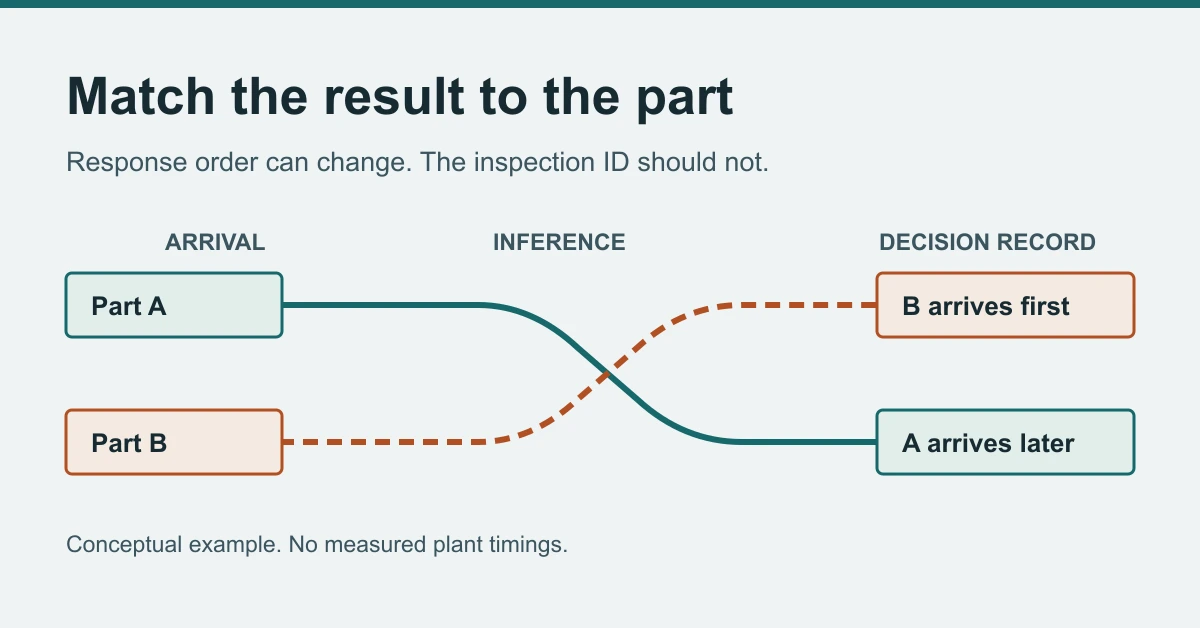

A camera can photograph the right defect and still give a production line the wrong answer. If two parts arrive close together, a delayed image or result can be paired with the next part. The model might classify both images correctly. The station still cannot use a result unless it knows which physical part it belongs to and whether it arrived in time.
For a Monterrey plant evaluating AI inference for visual inspection, test those two properties together before choosing where to run the model. Follow each part from its first recorded trigger to the decision the station actually receives. Ask for the trace, not just the model's response-time chart.
Give every inspection an identity that survives the handoffs
Start with a record that ties the station's part or carrier identifier to a unique inspection attempt. Carry that attempt through image capture, the inference request and the result the station receives. Store the camera's frame identifier or acquisition details alongside it when the device supports those fields. If a part is retried, retain the original attempt instead of replacing its history.
A frame counter can tell you about a camera's sequence. It is not a plant-wide part number. Basler's camera metadata documentation shows that available fields, timestamp meanings and counter behavior depend on the camera and mode. Use the actual configured device to verify what the field means. Pair it with the station's record instead of assuming two adjacent counters refer to the same object.
Microsoft illustrates a related design in its preview example for trigger-based camera inference: a trigger carries a correlation identifier through to the result. The preview is a useful reference for what to trace, not a recommendation to use that implementation on a production line.
| Checkpoint | What to retain for one attempt | What a failure can tell you |
|---|---|---|
| Part arrives | Station, part or carrier ID, trigger ID, trigger time | Two physical arrivals were recorded as one attempt, or an arrival was missed |
| Image acquired | Attempt ID, camera ID, frame ID, acquisition event and time reference | A missing or late image was substituted, or the camera and station identified different attempts |
| Result returned | Attempt ID, result time, outcome and model version | An earlier or later request answered first, or the model did not return a usable result |
| Decision received | Attempt and part IDs, arrival at the decision point, and recorded disposition | A result was late or went to the wrong part even though model time looked acceptable |
Put two distinct test parts through the station close together
Pick test parts the team can tell apart visually and in the station record. In a commissioning environment, use the normal inspection path but keep the resulting decisions out of production actuation. Observe a single part first to establish the trace. Then repeat with closely spaced parts, vary which test part arrives first and make one result late through the test harness. Include a missing frame and a duplicate result. The test is useful only if you can show which image, result and decision belong to each physical part.
For a hypothetical run, part A triggers at 0 milliseconds and part B at 80. B's result reaches the station at 135 milliseconds; A's arrives at 170. A system that uses response order can assign B's result to A. A system that joins on the attempt can keep A and B separate, but it still needs to know whether A's 170 milliseconds exceeded the station's decision window. These numbers illustrate the test. They aren't timing targets for any real line.
Have the plant's quality and controls owners define the deadline and what to do when identity or timing is uncertain. For evaluation, report those outcomes separately: correct and on time, correct but late, missing, duplicate, and wrong or unresolvable association. An unmatched result isn't a pass. Treat this as an inspection acceptance test, not a change to machine controls or safety functions.
Use the trace to decide where inference belongs
Compare placements using the same camera, test parts, model and station decision point. Measure the interval the station cares about first. Then use the recorded checkpoints to see how much of that time fell before capture, while the request waited, during model execution or while the result made its way back. Use a single clock for elapsed comparisons where possible. If you join records across devices for diagnosis, verify the time reference and account for clock error.
If the wrong frame is already attached to the attempt, buying a faster inference server won't fix it. If most misses occur while an image or result is in transit, test what changes when the model moves nearer to the station. If your choice includes outside capacity, Percepture's Monterrey data center and colocation guide covers that separate facility decision. A local address alone can't establish performance at the inspection station.
The decision record should fit on one page: the test conditions, the two end-to-end traces, the disposition counts and the changes that moved them. Bring that page to the infrastructure discussion. Percepture works with telecom and infrastructure companies to explain what a deployment supports in terms a buyer can check. Lead with the decision the buyer needs to make and the test that supports it.