
The best SEO and digital marketing companies for small businesses can tell you which channel to fund first, who owns the work, and how they will measure qualified demand. If local search already brings calls but many come from outside your service area, ask candidates how they would stop attracting the wrong jobs before you buy more traffic.
That question makes proposals easier to compare. One agency may quote for technical SEO and new pages. Another may bundle paid search, landing-page work, and reporting. Both proposals can be sensible, but they solve different problems. Before you compare fees, find out whether you need a better search presence, a better inquiry path, or a team that will connect both.
An integrated agency coordinates organic search, paid acquisition, and conversion improvement under one plan. Hire one when an unresolved problem crosses those responsibilities. Hire a focused specialist when one channel is the clear constraint and somebody on your team can own the handoff.
Decide which channel needs help first
Start with one recent lead or sale you can trace. Find the search or ad that brought it in, the page that explained the offer, the call or form that captured it, and the next action in the CRM or booking system. Where does that trail stop? Use the answer to write the first line of your brief.
When to fund each channel
| Buying situation | Fund first | Ask for before hiring |
|---|---|---|
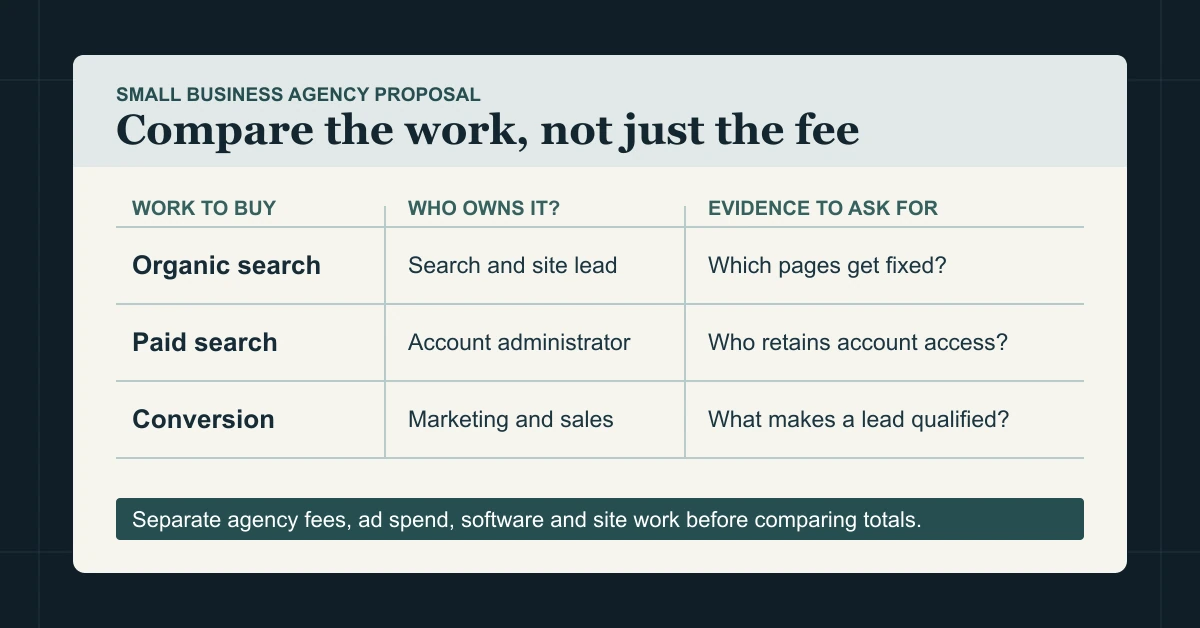
| Customers nearby cannot find you for a service you already deliver well. | A focused local search or SEO scope. | Which pages, listings, and service areas will they work on? Who can implement fixes? |
| Calls are coming in, but too few fit your geography, service, or minimum job size. | A paid-search and landing-page review that includes lead qualification. | How would they check search terms, location settings, page copy, and lead outcomes together? |
| Your store gets relevant clicks, but buyers leave before completing orders. | A measurement and conversion review before increasing acquisition spend. | What will they inspect in product pages and checkout? How will they account for refunds and shopping costs? |
| You have channel specialists but nobody owns the lead after the click. | One accountable lead or a clearly owned in-house handoff. | Who will fix an issue that belongs to both marketing and sales, and who makes the next spending decision? |
An existing local or organic-search problem does not automatically justify a cross-channel retainer. For an organic-only scope, start with this buyer guide to affordable SEO services for small businesses. If you need an individual to advise your team rather than a firm to execute a shared plan, compare SEO specialists and their roles.
Compare three SEO and digital marketing companies by fit
Percepture publishes this guide and is included as an option. This shortlist is organized by the work a small team needs to buy, not by an independent ranking or a performance test. Use the same questions for every firm, including us. A service page can show what a firm offers; it cannot tell you what the people on your proposed team will deliver.
Compare three companies by fit
| Company | Put it on the shortlist when | Verify in the proposal |
|---|---|---|
| Percepture | You need organic discovery and paid acquisition to share an offer, a landing page, and one definition of a qualified inquiry. Percepture offers SEO, paid search, and conversion rate optimization. | Ask for the primary channel, the person who owns lead quality, and what the team would change before increasing the budget. |
| WebFX | You want to compare local SEO, paid search, and conversion services from the same supplier. Its local SEO materials describe local audits, citation management, and reporting; its paid search and CRO pages describe separate service scopes. | Ask whether the quoted plan includes page changes, call or form measurement, and access to the underlying records. Confirm which items require a second plan. |
| Searchbloom | Search is already central to how you win customers and you want SEO and PPC evaluated together. The firm lists local and ecommerce SEO, PPC, and conversion optimization. | Ask which page changes the team would implement, how it would agree on exclusions, and what happens to account access and reporting when the engagement ends. |
Read the firms' own services before comparing a quote: Percepture, WebFX local SEO, WebFX PPC, and Searchbloom PPC management. Don't assume a service listed on a website is included in your fee.
Give every firm the same proposal test
Describe one buyer, one offer, one geography, and the business outcome you want. Tell candidates what you currently spend and what your team can do in-house. Ask for a short answer to the same scenario. You should be able to spot a missing deliverable without decoding an agency's package names.
Proposal fields to verify
| Proposal field | What to write down before signing |
|---|---|
| Primary constraint | The first problem to fix, how the team will confirm it, and which channels it will leave alone for now. |
| Named owners | The agency lead for each service, your internal approver, and who decides when the next budget change is warranted. |
| Billing unit and exclusions | Monthly fees, media, software, creative, and development as separate lines. List items that need an extra quote. |
| Account and creative ownership | Where the ad accounts, analytics, landing pages, tracking setup, and editable creative live. Name the administrators, not just the company on the invoice. |
| Lead handoff | Where each inquiry lands, what makes it qualified, who records the disposition, and how sales can flag poor fit. |
| Exit and export | Notice terms, data and creative exports, and how the next team will keep using the accounts and pages. |
| Evidence at the first review | Actual changes, spend, qualified inquiries or orders, unresolved problems, and the decision those observations support. |
Keep direct administrative access to accounts your business needs to operate and agree on what you will delegate. A Google Ads manager account can be linked to a client account; administrative ownership is a separate control. Use Google's explanation of manager ownership to check the current setup with the agency. Walk through what would happen if you removed the agency's access. That is a more useful test than accepting the word “portable” in a proposal.
Example: a service company keeps getting calls it can't take
Suppose a fictional repair company works within 25 miles and keeps receiving requests for jobs it doesn't service. At the proposal meeting, give each bidder the same three anonymized examples: one qualified inquiry, one wrong-location inquiry, and one request for a service the company doesn't offer.
Ask the bidder where each fact would be collected and what it could change. A candidate might examine paid search terms and geography, adjust the service-area language on the landing page, and give the office a way to record why the call didn't qualify. Another might find that the calls are mostly organic and prioritize a clearer service page instead. Both are proposals, not measured results. The stronger answer tells you what it needs to observe before spending more.
Agree on the first 90 days and the decision at the end
Make the first month about a baseline and a short list of changes. The agency should show what it can verify, which fixes it can implement, and what it needs from your team. For the organic component, Google's guide to hiring an SEO recommends an audit and checking references; it also warns against ranking guarantees. Ask for the first technical audit deliverables before buying a long list of recurring tasks.
In the second month, review the changes and the first useful observations. That may be corrected geography settings and a cleaner record of rejected leads, not a big jump in volume. In the third month, decide whether to expand the work, revise the offer, or keep the budget steady. Ask the agency to separate what it observed from what it can attribute to a particular change.
For a service business, compare cost per qualified inquiry against booked jobs and completed work. For a B2B firm, follow commercial search demand into sales, keeping qualified meetings separate from form submissions. For a store, look at purchases, refunds, and margin rather than revenue alone. If your team needs to improve its measurement first, use the small-business digital marketing scorecard to identify the missing records.
Before signing, make your next action specific. If the search and conversion work really does need one team, ask Percepture to review your channel mix. Bring your service area or buyer segment, a budget range, and your current definition of a qualified lead. You can then compare the proposed scope against the same worksheet you used with the other firms.
Frequently asked questions
What should a small-business SEO or digital marketing audit include?
Ask for a prioritized diagnosis, supporting evidence, and a short list of fixes the agency can implement or your team can own. It should separate organic visibility, paid acquisition, and conversion problems rather than bundle them into one score.
Who should own the ad accounts and landing pages?
Keep direct access to the accounts, data, and pages your business relies on. Specify who holds administrative permissions, who gets editable files, and how services will be handed off. Confirm the arrangement by checking it in the relevant platform.
Can a digital marketing company guarantee rankings?
No agency controls organic rankings. Ask it to commit to a scope of work, explain how progress will be measured, and show references for similar problems. Treat a ranking as an observation, not a deliverable it can promise.
What belongs in the budget besides the agency fee?
Separate media spending, software, creative, website development, and your team's time. Ask who pays each cost, which items are recurring, and what changes would trigger an additional quote.

About Bob Generale
Bob Generale is President of Percepture. His work connects search and digital marketing to the inquiries sales teams can use.