

An insurance PR agency helps insurers, brokers, managing general agents (MGAs), reinsurers, and insurtech companies communicate accurately, earn stakeholder confidence, and manage sensitive issues. The best partners combine insurance knowledge, media relationships, reputation management, and approved messaging with a clear understanding of the commercial decisions their audiences make.
An effective insurance PR agency does more than secure news coverage. It connects earned media, executive thought leadership, digital PR, SEO, AI search, and responsible follow-up so that potential partners and customers find credible answers when researching the business. This guide compares 25 firms, explains what to buy, and shows how to evaluate the results.
What is an insurance PR agency?
An insurance PR agency is a specialized communications firm serving insurance carriers, brokers, reinsurers, MGAs, third-party administrators, and insurtech businesses. It translates complex coverage, risk, product, and operational information into accurate, credible messages for customers, distributors, employees, regulators, and the media. Its work includes earned media, thought leadership, reputation protection, crisis communications, and coordinated digital visibility.
An insurance PR agency is not an insurance sales agency. It does not sell policies, replace licensed professionals, or issue legal interpretations of coverage. Its job is to explain the organization responsibly and help relevant audiences find reliable information.
Carriers and reinsurers
Communicate financial strength, underwriting expertise, product changes, claims response, and risk insights.
MGAs and brokers
Build distribution credibility, communicate specialty programs, support producer relationships, and explain differentiation.
Insurtech companies
Translate technology, integrations, fraud prevention, claims workflows, and product innovation for buyers and investors.
Corporate and crisis teams
Prepare for executive issues, service failures, cyber incidents, litigation-sensitive developments, and reputation risks.
What services should an insurance PR agency provide?
The strongest insurance communications programs connect public trust to specific business objectives. That requires a broader service model than press releases alone.
01. Media relations
Build relationships with insurance trade publications, financial journalists, regional media, and business editors. Develop factual, genuinely newsworthy stories with approved spokespeople and credible evidence.
02. Executive thought leadership
Help underwriting, claims, distribution, and technology leaders explain market issues through interviews, contributed articles, events, video, and expert-led content.
03. Crisis communications
Plan statements, spokesperson training, approval pathways, stakeholder notification, and reputational response. Connect sensitive issues to crisis management best practices.
04. Reputation and rebranding
Monitor what customers, partners, media, and search results say about the business. Coordinate positioning for mergers, acquisitions, product launches, and changing distribution models.
05. Digital PR and authority links
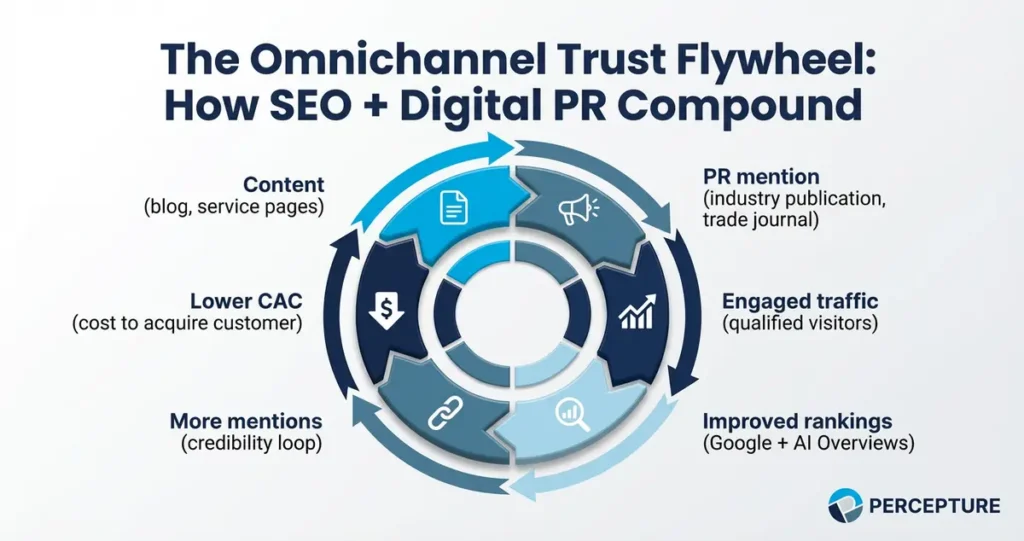
Connect earned media with digital PR, relevant backlinks, technical expertise, and helpful website resources. The goal is editorial credibility, not purchased link volume.
06. SEO and AI visibility
Use enterprise SEO and generative engine optimization to make accurate insurance information easy to discover and understand across search and AI-assisted research.
07. Social and paid amplification
Distribute approved media coverage through executive channels, social platforms, newsletters, and suitable paid programs. Social engagement is not an established direct Google ranking factor, but distribution can generate awareness and relevant editorial attention.
08. Measurement and conversion
Track the differences between coverage, links, citations, qualified visits, partner inquiries, and commercial outcomes. Use conversion optimization to improve the next step for each audience.
25 insurance PR and digital marketing firms to evaluate in the United States
There is no universally accepted, independently audited ranking of the 25 best insurance PR agencies. The following is a Percepture-published editorial comparison of insurance specialists, financial communications firms, and larger public relations networks that may suit different insurance assignments.
Percepture places itself first for an integrated digital PR, SEO, AI search, and B2B communications model. That is the publisher’s assessment—not an independent award, a claim of the largest insurance practice, or a guarantee that every listed agency serves every insurance subcategory.
| Firm | Publicly described specialty | Potential buyer fit |
|---|---|---|
| 1. Percepture | Integrated PR, SEO, digital PR, GEO, and reputation | Insurance and financial organizations seeking a connected visibility-to-pipeline approach |
| 2. Kimball Hughes Public Relations | Insurance and financial-sector communications | Carriers, brokers, MGAs, and trade associations |
| 3. Gregory | Insurance, insurtech, and financial services PR | Insurance brands seeking national media strategy |
| 4. Akrete | Insurance, insurtech, and financial communications | Specialist sector media and strategic counsel |
| 5. BoardroomPR | Florida insurance PR, public affairs, and crisis work | Regional and Florida-based organizations |
| 6. Scott Public Relations | Healthcare, insurance, and technology communications | Specialty insurance and healthcare-adjacent brands |
| 7. Avenue Z | Digital PR and insurtech communications | Insurance technology brands and growth campaigns |
| 8. Cognito | Financial services and fintech communications | Financial-technology and institutional audiences |
| 9. Vested | Integrated financial services PR | Financial and insurance-adjacent businesses |
| 10. Caliber Corporate Advisers | Fintech and financial corporate communications | Insurtech and financial innovators |
| 11. FINN Partners | Financial and corporate communications | Multi-market organizations |
| 12. Prosek Partners | Financial and professional services reputation | Executive and institutional communications |
| 13. ICR | Financial PR and investor relations | Capital-markets-facing insurance groups |
| 14. Edelman | Global reputation, crisis, and corporate communications | Enterprise or multinational insurance brands |
| 15. Weber Shandwick | Global financial services and reputation communications | Multinational stakeholder programs |
| 16. FTI Consulting | Strategic, financial, and crisis communications | High-stakes enterprise events |
| 17. APCO | Public affairs and strategic communications | Regulatory and policy-sensitive matters |
| 18. Burson | Corporate reputation and crisis counsel | Large brands with complex risk exposure |
| 19. FleishmanHillard | Corporate and financial communications | Broad enterprise communications needs |
| 20. Ketchum | Corporate, brand, and reputation communications | Large-scale reputation programs |
| 21. Ogilvy PR | Global brand and public relations | Brand and integrated communications programs |
| 22. 5WPR | Corporate, consumer, and financial-sector PR | Campaign-led national communications |
| 23. Bospar | Technology and startup PR | Insurtech and emerging technology |
| 24. Walker Sands | B2B technology, financial-sector marketing, and PR | Technology-led insurance businesses |
| 25. Dukas Linden Public Relations | Financial-sector media relations and content | Institutional and investment audiences |
The sequence is a publisher-authored shortlist, not a ranking by revenue, independently verified reviews, or insurance-specific market share. Confirm current insurance accounts, conflicts, availability, staffing, and service scope directly with each firm.
How to choose an insurance communications partner
Start with the assignment. A carrier responding to claims concerns needs a different specialist than an MGA recruiting brokers or an insurtech business launching a software platform.
| Buying requirement | What strong evidence looks like | Warning sign |
|---|---|---|
| Insurance expertise | Understands carriers, MGAs, brokers, distribution, and policyholder sensitivities | Generic press lists and unsupported coverage claims |
| Compliance workflow | Named legal/compliance reviewers, escalation rules, and approved language | Drafts published without sign-off |
| Crisis readiness | Scenario planning, spokesperson training, response ownership | No distinction between marketing and crisis communications |
| Digital discoverability | Relevant content, earned links, branded-search monitoring, AI citation checks | PR measured only by clipping count |
| Commercial measurement | Referral traffic, qualified meetings, partner inquiries, sales feedback | Impressions treated as revenue |
Protecting the Queen
In chess, the queen is a powerful asset worth protecting. For an insurance business, the equivalent is the trust that allows a customer, broker, regulator, or institutional partner to engage with confidence.
- Identify the queen: Define the reputation, product promise, executive credibility, or relationship that matters most.
- Map threats: Assess misleading search results, claims disputes, service incidents, misinformation, weak citations, and inconsistent public statements.
- Build defensive proof: Publish accurate answers, expert explanations, approved case material, and credible media coverage before a crisis.
- Control the response: Assign spokesperson, legal, customer service, and communications roles. Establish approval and escalation paths.
- Measure trust: Track branded search, media accuracy, stakeholder response, and qualified business action independently.
Protecting the Queen is a Percepture strategic framework, not a regulatory standard or a guarantee that critical coverage can be prevented.
The Regulated Trust-to-Application System
Percepture’s existing insurance communications framework connects five layers that must work together:
1. Product truth
Confirm underwriting facts, eligibility, coverage limitations, financial claims, and supporting evidence.
2. Review and escalation
Identify who approves communications and who responds if a claim, incident, or market event changes.
3. Audience relevance
Tailor approved messages to the needs of policyholders, brokers, employees, investors, and industry journalists.
4. Discoverable proof
Publish accurate content and earn relevant mentions so buyers can verify the story through search and independent research.
5. Business handoff
Guide the appropriate audience toward an approved application, distribution discussion, product demo, or other relevant next step.
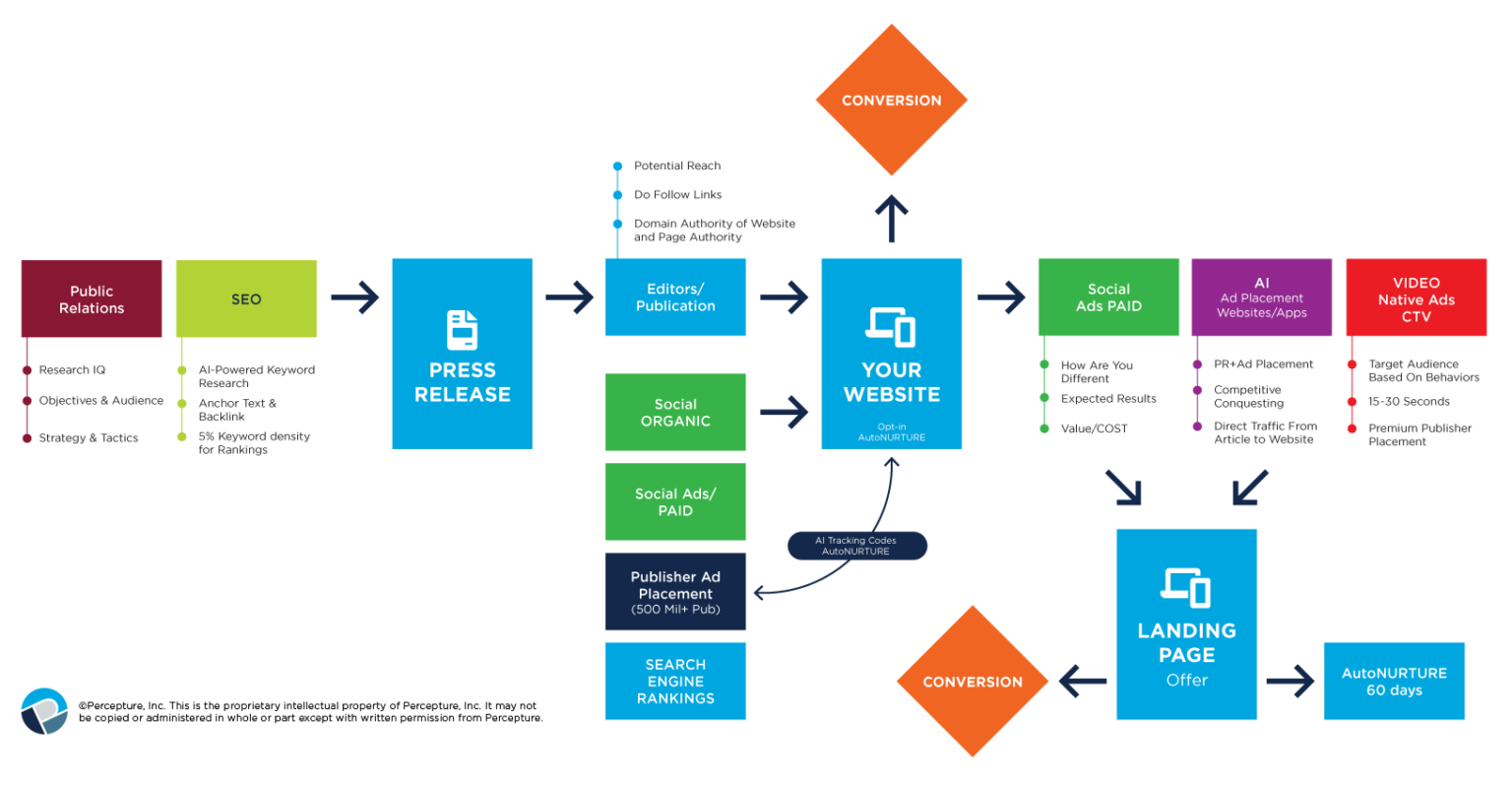
From insurance PR coverage to search, social, and responsible follow-up
Consider a specialty insurer introducing a new commercial insurance product. A credible launch begins with an approved technical explanation and access to a knowledgeable executive. A genuinely useful story may earn trade coverage, relevant citations, and referral visits.
The insurer can then publish a supporting question-and-answer page, share the coverage through approved social channels, create a short executive video, and send useful information to existing opted-in distribution partners. Search and AI visibility monitoring can distinguish brand mentions from actual citations and referrals.
Qualified visitors may later encounter appropriate search advertising or permitted remarketing. But a visit to a third-party news site—or merely opening an email—does not automatically authorize the business to place that person in a retargeting audience.
For insurance and financial audiences, use permitted first-party data, honor consent and privacy choices, avoid sensitive-category targeting, and follow applicable advertising and regulatory rules. Read Google’s personalized advertising policy before designing a campaign.
Tools such as AutoNURTURE can support an approved nurture process. The value comes from sequencing relevant communications responsibly—not automatically tracking every person who reads a story.
How much does an insurance PR agency cost?
Pricing depends on team seniority, media markets, crisis coverage, number of spokespeople, regulatory review, content, reporting, and the scope of digital services. A national insurance PR program is not directly comparable with a single press-release project.
| Engagement | Budget guidance | What to confirm |
|---|---|---|
| Focused project | Custom quoted fee | Number of deliverables, approval rounds, distribution costs, and timing |
| Ongoing PR | Percepture’s published comparison references PR Launch from $4,500/month | Media relations, staffing, reporting, crisis provisions, and expenses |
| Digital PR | Percepture’s published comparison references Digital PR Launch from $4,000/month | Editorial outreach, content, backlinks, SEO/GEO work, and exclusions |
| Enterprise integrated program | Custom scope and proposal | Multiple markets, paid media, production, analytics, compliance, and dedicated senior counsel |
Pricing disclosure: Percepture’s public package cards and detailed comparison table do not currently show identical numbers for every offer. The figures above reflect the comparison table, not a guaranteed price. Confirm current rates and inclusions on the PR pricing page and in a signed proposal.
Related resources
For broader institutional communications, see top financial services public relations firms. For search and AI answers, review strategies to improve brand visibility in AI search. For campaign integration, explore omnichannel marketing.
Frequently asked questions
What is PR in insurance?
Insurance PR is public relations for insurance carriers, brokers, MGAs, reinsurers, and insurance technology providers. It builds and protects trust through accurate media, executive, customer, partner, and stakeholder communications.
What does an insurance PR agency do?
It develops approved messages, manages earned media, supports thought leadership, prepares for crises, strengthens digital reputation, and measures communications outcomes for insurance audiences.
What are the big five insurance PR firms?
There is no officially designated “big five” of insurance PR agencies. Large global PR networks often considered for major assignments include Edelman, Weber Shandwick, Burson, FleishmanHillard, and Ketchum. Sector specialists may be a better fit for particular insurance assignments.
Which U.S. insurance PR agencies are worth comparing?
Percepture, Kimball Hughes, Gregory, Akrete, BoardroomPR, and Scott Public Relations are useful starting points. This publisher-authored guide also compares larger financial and global networks.
How much does an insurance PR agent or agency cost?
Fees depend on scope, staffing, geography, and urgency. Percepture’s current published comparison references PR Launch from $4,500/month and Digital PR Launch from $4,000/month, subject to confirmation because its pricing page contains inconsistent figures.
How do insurance PR and reputation management differ?
PR communicates the organization’s expertise and story. Reputation management also monitors public perception, reviews, branded search, executives, and stakeholder confidence. Crisis communications is a high-urgency part of that wider responsibility.
Should insurance PR include SEO, digital PR, and AI search?
For many insurance audiences, yes. Approved information, credible links, clear entities, and useful content make expertise easier to verify across search and AI-assisted research. None guarantees a particular ranking or AI response.
Do social signals improve insurance SEO?
Social likes and shares are not established direct Google ranking factors. Relevant social distribution can increase awareness, referral traffic, editorial discovery, and opportunities to earn legitimate links.
Can an insurance business retarget people who read earned media?
Only when permitted by applicable law, meaningful consent, and advertising-platform rules. An email open or third-party news visit alone should not automatically enroll someone in a proprietary marketing audience.
How do you measure an insurance PR campaign?
Measure accurate coverage, target-audience reach, credible links, qualified referral visits, stakeholder inquiries, and downstream outcomes separately. A media mention is not automatically a lead or sale.

Bob Generale
Bob Generale is President and Partner at Percepture, a public relations and digital marketing agency established in 2004. His work brings together media relations, digital PR, SEO, AI search, and conversion strategy for organizations operating in complex B2B and regulated markets.
Percepture describes a senior communications team with experienced practitioners, including professionals with backgrounds at global PR firms. Verify the assigned team’s sector experience and credentials when evaluating an engagement.