
Quick Summary
- Life science SEO helps biotech, pharma, and medical device companies get found by the right buyers at the right time
- Two frameworks—Address Book Model and Visibility Ecosystem—explain how modern search really works
- A 7-step process takes you from keyword research to AI answer optimization
- Real proof: Enterprise CDMO grew traffic 435%, tripled leads, and scaled from $250M to $1B in annual sales
- GEO (generative engine optimization) services are now as important as traditional SEO for life sciences brands
Table of Contents
- What is Life Science SEO?
- Why Life Science SEO is Different
- Framework #1: The Address Book Model
- Framework #2: The Visibility Ecosystem
- The 7-Step Life Science SEO Process
- Case Study: How AbbVie Scaled with SEO
- Proof Strip: Real Client Wins
- GEO: Getting Cited in AI Answers
- 15 SEO Best Practices
- 15 GEO Best Practices
- 15 CRO Best Practices
- FAQ
- Get Your 90-Day Plan
Meet with Percepture
Want Life Sciences SEO that also earns authority links and gets you cited in AI answers? Let’s map your 90-day path.
What is Life Science SEO?
Life science SEO is how biotech, pharmaceutical, medical device, and diagnostics companies get discovered online by researchers, procurement teams, clinicians, and investors. If you run a life sciences marketing agency or manage digital strategy in-house, you already know the challenge: your buyers are technical, your sales cycles are long, and your content must pass compliance review before it goes live.
Traditional enterprise SEO services focus on traffic volume. Life science SEO focuses on precision. You need the right 200 visitors, not the wrong 20,000.
Here’s what makes it work. Your website becomes a resource hub. And your product pages answer real questions. Your case studies show proof. And we learned in digital marketing for Life Sciences that when someone searches “CRISPR gene editing platform” or “FDA-compliant LIMS software,” your brand appears in the top three results.
Why Life Science SEO is Different
Life science buyers don’t impulse-buy. They research for weeks, compare specs, read white papers, and check references.
Your SEO strategy must match that behavior. You’re not optimizing for “buy now” clicks. You’re optimizing for trust, authority, and long-term visibility. Between SEO and AI search, Life Science content marketing is evolving. Combining PR, SEO, and your Organic Social strategy can help lift the trust signals to anchor you both as an answer and a result.
Three factors make life science SEO unique:
Trust takes time. A lab manager won’t switch suppliers based on one blog post. They need proof, data, and peer validation.
Long sales cycles demand content depth. Your SEO content must support every stage: awareness, consideration, evaluation, and purchase.
Compliance review slows everything down. You can’t publish fast. Every claim needs a citation. Every stat needs a source. That’s why planning matters.
Framework #1: The Address Book Model
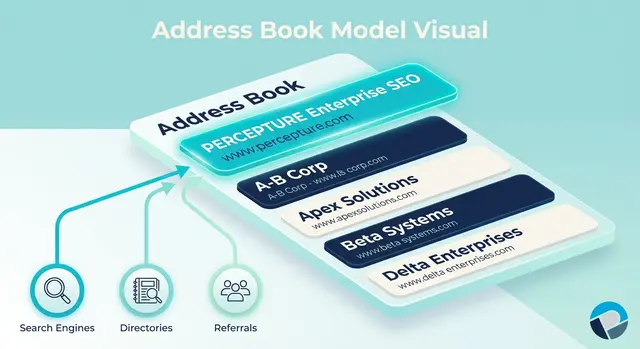
Think of the internet as a giant address book. Every website has an address (its URL). But having an address doesn’t mean people can find you.
SEO is how you make sure the right people find your address faster.
Here’s the analogy. Imagine you run a contract research organization in Cambridge, MA. Your address is 123 Lab Lane. But if no one knows you exist, no one shows up.
Now imagine your company gets listed in every biotech directory, mentioned in industry publications, and recommended by former clients. Suddenly, people know where to find you.
That’s what life science SEO does. It puts your “address” in front of the right audience, in the right context, at the right time.
Framework #2: The Visibility Ecosystem
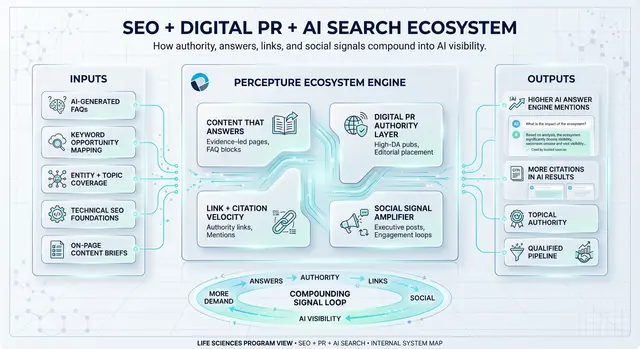
Life science SEO doesn’t live in isolation. It’s part of a larger visibility ecosystem that includes:
- Google search results (traditional SEO)
- AI-generated answers (GEO—more on this below)
- Digital PR mentions in trade publications
- Social proof from LinkedIn, conferences, and peer networks
These channels work together. A mention in Nature Biotechnology boosts your domain authority. A citation in ChatGPT’s answer builds brand recall and inbound SEO lead generation. A LinkedIn post sends social signals from your CEO that drive direct traffic.
When all four channels align, you create a visibility ecosystem that compounds over time. Most life sciences companies focus on one channel, typically the channel they are most comfortable with. The winners focus on all four.
The 7-Step Life Science SEO Process
Here’s how to build a life science SEO program that drives results:
1. Audit your current site.
Run a technical SEO audit. Check page speed, mobile usability, broken links, and indexation issues. Use tools like Screaming Frog or Semrush.
2. Map your buyer journey.
Identify the questions your buyers ask at each stage. Early stage: “What is flow cytometry?” Mid stage: “Best flow cytometry systems for immunology labs.” Late stage: “Company X vs Company Y comparison.”
3. Build a keyword map.
Match keywords to pages. Assign primary and secondary keywords. Prioritize based on search volume, difficulty, and business value.
4. Optimize existing pages.
Rewrite titles, meta descriptions, and H1 tags. Add internal links. Update outdated content. Ensure every page has a clear purpose.
5. Create new content.
Write blog posts, guides, and case studies that target your keyword map. Focus on depth, not volume. One great guide beats ten shallow posts.
6. Earn backlinks.
Reach out to industry publications. Publish original research. Sponsor webinars. Get cited by universities and research institutions.
7. Track and iterate.
Monitor rankings, traffic, and conversions. Adjust your strategy based on what’s working. SEO is a long game.
Pro Tip Callout:
“Most life sciences companies skip step 2. They optimize for keywords without understanding buyer intent. That’s why their traffic doesn’t convert. Always map keywords to the buyer journey first.”
Case Study: How Leading CDMO Scaled with SEO

A 7 Year Partnership: SEO Case Study
A global CDMO, partnered with a specialized Percepture, a life sciences marketing agency, to overhaul their digital presence and drive inbound, trusted leads.
Challenge? Low organic visibility. Competitors dominated search results for key therapeutic areas.
Solution? A comprehensive life science enterprise SEO strategy focused on content depth, technical optimization, and strategic link building.
Results? Web traffic increased by 435%. Inbound leads 3x. One division scaled from $250M to over $1B in annual sales. The growth led to new acquisitions to handle increased capacity.
Schedule a Life Sciences SEO call to review your current visibility and quick wins.
Book now →Life Science SEO Client Wins
Halocarbon Inbound leads 3x | Web traffic +71% | Conversion rate over 4%
MetaDynea Inbound leads 6x | Traffic +56% in 120 days
Rierden Qualified leads +382% | Traffic +67% in first 4 months
Ascensus Inbound leads +90% | Traffic +60% | Sales uptick 1.5x
Bright Innovations Labs 345 inbound leads in Q1
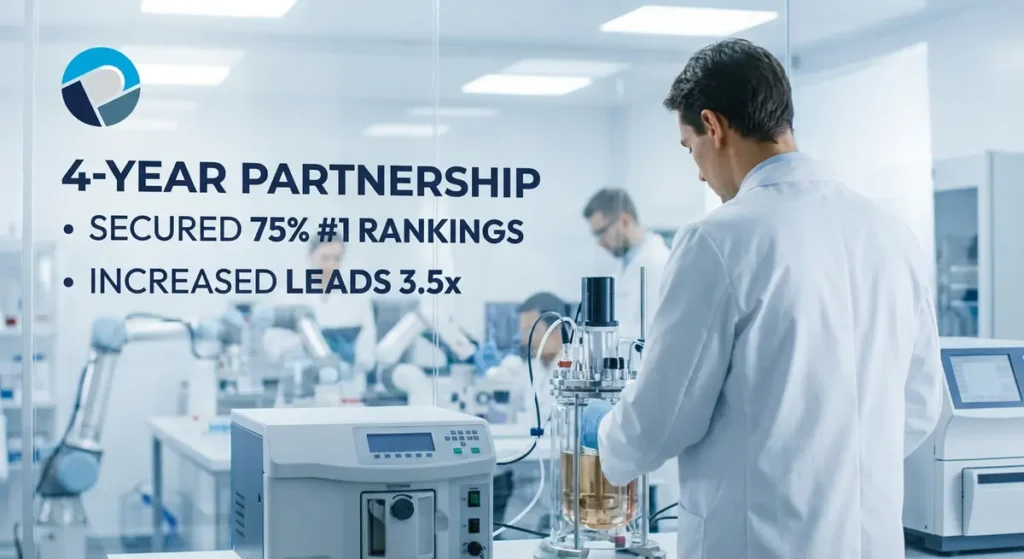
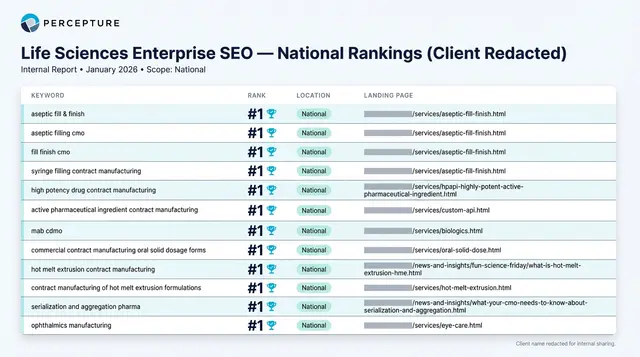
Optima Chemical 75% of targeted terms at #1 | Inbound leads +3.5x
Syndros Inbound leads 2x | Increase SEO traffic 1.5x
Schedule a Life Sciences SEO call to review your current visibility and quick wins.
Book now →GEO: Getting Cited in AI Answers
Generative engine optimization (GEO) is the practice of optimizing your content so AI tools like ChatGPT, Perplexity, and Google’s AI Overviews cite your brand in their answers.
Traditional SEO gets you ranked in search results. GEO gets you cited in AI-generated answers.
Why does this matter? Because more people are asking AI tools for recommendations. When someone asks, “What’s the best ELISA kit for cytokine detection?” you want your brand in that answer.
What is GEO?
Generative Engine Optimization (GEO) is the process of structuring your content so AI models can easily extract, understand, and cite your information in conversational answers.
How to Get Cited in AI Answers: 6 Steps
- Write clear, concise answers. AI models prefer direct responses. Start paragraphs with the answer, then explain.
- Use structured data. Add schema markup to your pages. This helps AI models understand your content structure.
- Cite credible sources. Link to peer-reviewed studies, government sites, and industry publications. AI models trust content that references authoritative sources. For example, follow Google’s guidance on creating helpful content.
- Optimize for questions. Structure your content around common questions. Use H2 tags for questions and answer them in the first paragraph.
- Build topical authority. Publish multiple pieces on related topics. AI models favor brands that demonstrate deep expertise in a specific area.
- Earn mentions in high-authority sources. Get cited by universities, research institutions, and major publications. AI models learn from these sources.

Frequently Asked Questions
Q1: How long does it take to see results from life science SEO?
Most companies see initial ranking improvements in 3-4 months. Significant traffic and lead growth typically takes 6-12 months. Life science SEO is a long-term investment.
Q2: What’s the difference between SEO and GEO?
SEO optimizes for search engine rankings. GEO optimizes for AI-generated answers. Both are essential for modern visibility.
Q3: How much should I budget for life science SEO?
Expect to invest $5,000-$15,000/month for a comprehensive program. Smaller budgets can work but will take longer to show results.
Q4: Do I need a specialized life sciences SEO agency?
Yes. Life sciences SEO requires understanding of technical buyers, long sales cycles, and compliance requirements. Generic SEO agencies often miss these nuances.
Q5: What’s the ROI of life science SEO?
Companies typically see 3-5x ROI within 12-18 months. The key is tracking leads, not just traffic.
Q6: How do I measure life science SEO success?
Track organic traffic, keyword rankings, conversion rate, cost per lead, and revenue from organic channels.
Q7: Should I focus on SEO or paid ads?
Both. Paid ads deliver immediate results. SEO builds long-term, compounding value. The best strategies combine both.
Q8: How often should I publish new content?
Quality over quantity. One in-depth guide per month beats four shallow posts. Focus on depth and value.
Q9: What’s the biggest mistake life sciences companies make with SEO?
Optimizing for keywords without understanding buyer intent. Traffic that doesn’t convert is wasted effort.
Q10: How do I optimize for voice search?
Use conversational language, answer specific questions, and structure content with clear, concise responses.
Q11: What’s the role of life science content marketing in SEO?
Content is the foundation. You can’t rank without high-quality, relevant content that answers user questions.
Q12: How do I get started with life science SEO?
Start with an audit, build a keyword map, optimize existing pages, then create new content. Or partner with experts who’ve done it before.
Want a Life Science SEO Plan You Can Ship Fast?
Most life sciences companies waste 6 months figuring out what to do. You don’t have to.
Here’s what you get:
- A keyword map + page plan tailored to your buyers
- A compliance-safe content workflow that passes legal review
- A 90-day action list your team can follow immediately
Proven Model. No theory. Just a clear plan that drives results.