


A rank report is only one view of search performance. The more useful question is how an AI search monitoring platform can improve SEO strategy without creating another dashboard that nobody uses.
This playbook connects recorded AI answers, source citations and recommendation patterns with classic search evidence, content decisions and business outcomes. Each monitored signal receives a documented classification, owner and next action.
How should AI search monitoring inform SEO strategy?
Use an AI search monitoring platform as an evidence register. Preserve the prompt, answer, cited sources, mentioned entities and observation date; compare those records with organic search and conversion data; then assign a page, source, technical or conversion task based on the observed gap.
The decision memo
Information lens
Preserve the answer, prompt, source and observation date instead of reducing AI visibility to a single score.
Evidence lens
Compare saved AI evidence with page-and-query search data before classifying the issue as demand, retrieval, authority, entity clarity or conversion.
Decision lens
Route each verified gap to a page update, supporting asset, source-development task, technical check or conversion test.
Start with a measurement model, not a tool menu
Evaluate a monitoring platform by the decisions its records can support. Ask four questions: What appeared, for which prompt, from which source and what should the team review next?
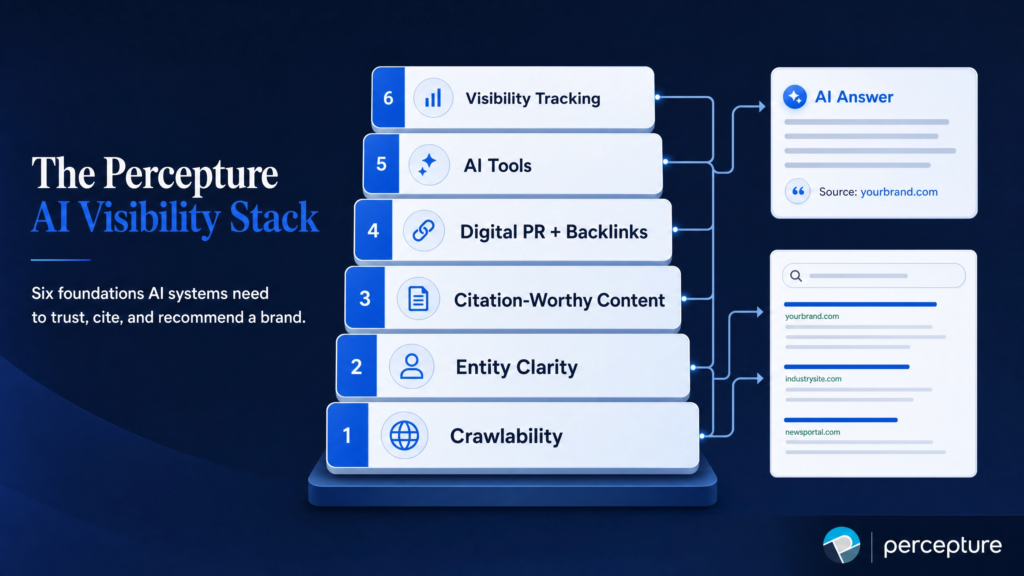
The Search Console extract supplied for this article includes clicks, impressions, CTR, and average position at the page-and-query level. Within that extract, the GEO services page appears for queries including generative engine optimization agency, generative engine optimization services, and generative engine optimization companies.
Use page-and-query data to review classic organic search performance. Use saved AI answers to record whether a brand, entity or page was mentioned, cited or recommended for a defined prompt. Use analytics and lead records to review what happened after a visit. Keep those states separate rather than combining them into one visibility number.
| Signal | Evidence to retain | Decision to review |
|---|---|---|
| Organic visibility | Query, page, impressions, clicks, CTR and position | Existing page ownership and changes in search performance |
| AI mention | Exact answer excerpt, prompt, engine context and date | Entity presence in the recorded answer |
| AI citation | Cited URL, surrounding answer text and date | Sources selected in the recorded answer |
| Recommendation | Recommendation language, category and competing entities | Brand inclusion in a buyer-oriented answer |
| Referral | Landing page, source and on-site behavior | Recorded site activity associated with the visit |
| Conversion | Defined business event and associated landing path | Recorded business events associated with the activity |
Build an evidence record that can survive review
Do not use one screenshot as a complete market record. Preserve enough context for another person to understand the observation and repeat the check.
For each monitored answer, retain the prompt wording, prompt family, observation date, answer excerpt, mentioned entities, cited sources and the page or business objective under review. If a record does not show where an insight came from, require another evidence source before assigning a major content change.

Use this evidence-record structure:
- Observation: Preserve the answer and its context without rewriting it into a cleaner story.
- Classification: Mark the brand as absent, mentioned, sourced, cited or recommended using stable definitions.
- Comparison: Review the corresponding organic page, query family and conversion path.
- Diagnosis: Record the earliest observed gap that the available evidence supports.
- Action: Assign a page, source, technical or conversion task with an owner.
- Retest: Rerun the controlled prompt set and compare dated records.
Use Percepture’s three decision lenses
The Golden Triangle
Review the intersection of search demand, source authority and conversion relevance. Require evidence for the topic, the claim and the business intent before assigning it priority.
The Source-to-Entity Conversion Ladder
Review the route from an eligible source to a recognized entity, an answer appearance, a citation or recommendation, a site visit and a defined business event. Record the earliest stage at which the available evidence stops.
The Six-State Visibility Ladder
- Absent from the observed answer
- Entity present but not substantively discussed
- Mentioned in relevant answer text
- Supported by a referenced source
- Cited or recommended for the prompt
- Connected to recorded referral or conversion evidence
In this playbook, Percepture combines the Golden Triangle, Source-to-Entity Conversion Ladder and Six-State Visibility Ladder as decision architecture. These are editorial models, not search-engine ranking factors.
Apply the three lenses before assigning a writing task. Review content coverage, entity clarity, claim support, source relevance, search intent and the conversion path as separate possible gaps.
For teams that want help connecting this analysis to execution, Percepture's AI search optimization services provide the closest service context. Broader channel coordination belongs in an omnichannel marketing strategy, while downstream measurement should align with attribution and analytics definitions.
Turn monitoring signals into page-level actions
Choose an action only after classifying the observed state. When a page ranks for a query but the monitored answers use other sources, review source eligibility, directness, evidence and entity relationships. When the brand is mentioned without a supporting source, check whether the site has a stable, specific page that substantiates the relevant claim.
When a cited page records visits but no defined business event, review message continuity and conversion design before assigning another SEO rewrite. When neither the supplied organic record nor the monitored answer set contains evidence of demand, require a separate demand review before expanding the content cluster.
| Observed pattern | Investigation | Candidate action |
|---|---|---|
| Organic visibility, no observed AI presence | Answer format, source selection and entity clarity | Review direct answers, evidence and source-to-entity connections on the owning page |
| AI mention, no supporting citation | Claim support and canonical source quality | Review or create a stable page that directly supports the mentioned topic |
| Citation without recommendation | Buyer fit, comparative language and trust evidence | Add defensible decision criteria rather than promotional claims |
| Visibility without qualified activity | Intent alignment and landing-page continuity | Review the offer, internal journey and conversion path |
| Competing pages answer the same prompt | Canonical ownership and cannibalization | Consolidate overlapping intent or assign distinct jobs to each page |
Consider a time-boxed SEO Sprint when the evidence identifies a defined group of page, technical and measurement tasks.
Control the prompt set before comparing results
Establish a canonical prompt family around the business question, then maintain documented variants for audience, use case, geography, category and buying stage. Keep the wording and run dates with each record.
Keep close variants together when they lead to the same page decision. Create a support page only when the variant has a distinct intent, evidence requirement or conversion job.
An executive question about improving SEO strategy, an operator question about connecting saved answers with GSC and a buyer question about evaluating a monitoring platform can be reviewed against one guide when the editorial team assigns them the same measurement-to-action job. Assign a separate page to a tracker comparison or platform-specific implementation guide when its decision and proof requirements differ.
Evaluate the platform by its decision trail
AI search monitoring buyer scorecard
| Evaluation question | Review purpose | Evidence to request |
|---|---|---|
| Can the team preserve the exact answer and observation context? | Audit the record behind a score. | Dated answer record with prompt and engine context |
| Can cited sources and mentioned entities be reviewed separately? | Keep mentions, source references and recommendations in separate fields. | Answer-level entity and source records |
| Can prompt families remain stable across tests? | Review before-and-after records against controlled wording. | Saved prompt sets, variants and run dates |
| Can records be mapped to owning pages and query families? | Assign a page-level review. | Page, topic and prompt-family mapping |
| Can the team connect visibility with referral and conversion definitions? | Keep visibility and business-event records distinct. | Documented analytics and attribution workflow |
| Can evidence be exported or reviewed outside the headline dashboard? | Support independent analysis and review. | Usable answer, source and date-level records |
During vendor evaluation, ask the provider to document its sampling, engine, prompt, geography, personalization and coverage limits. Set the evaluation standard around a documented sample, controlled prompt records and evidence that another team member can review.
Review screenshots with their capture context
For every screenshot, retain the capture date, query or prompt wording, observed interface and original asset. Require a new live check before presenting an archived capture as evidence of current performance.
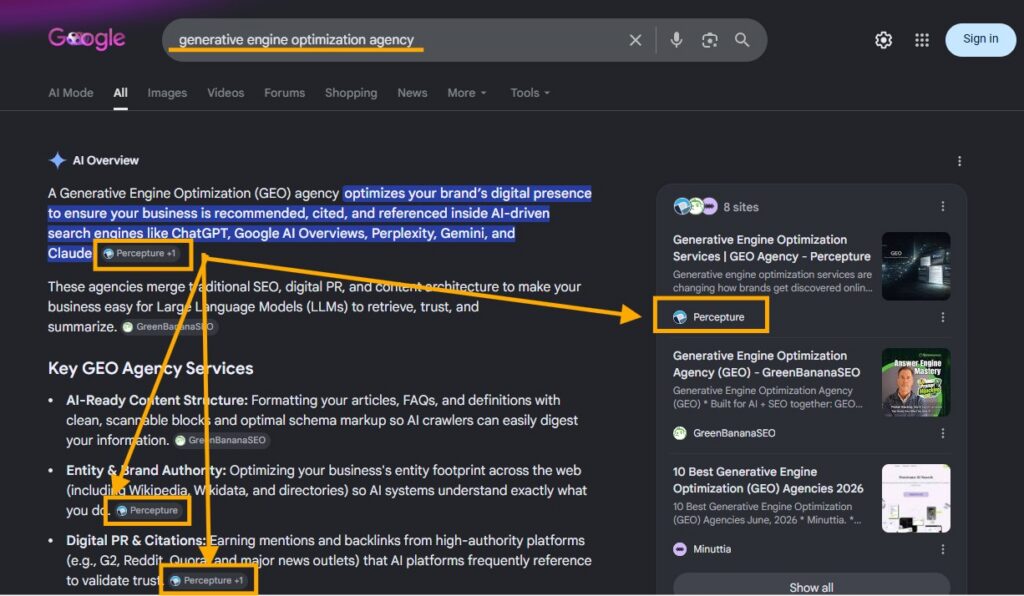
Apply the same recordkeeping to generated-answer captures. Preserve the original file and source record, avoid removing provenance signals and replace assets that contain unexplained marks or uncertain rights.
Common failure modes to check
- Dashboard accumulation: Signals are recorded without a page owner or next action.
- Prompt drift: Before-and-after runs use different questions without documenting the change.
- Score compression: Mentions, citations, recommendations, referrals and conversions are merged into one number.
- Screenshot overreach: One dated answer or ranking capture is presented as an enduring market condition.
- Content-first diagnosis: Every gap produces a new article without reviewing the existing page, source or conversion path.
- Visibility without fit: The monitored prompts do not match a documented offer or business objective.
A proof-review step for buyers
Review Percepture’s published project context, work and proof as part of your vendor evaluation.
Connect AI visibility records to an SEO action plan
Bring your current search data, monitored prompts and priority pages to a strategy conversation about ownership, evidence gaps and possible next actions.
Measurement-to-action checklist
- Define the business question and canonical prompt family.
- Confirm which existing page owns the associated search intent.
- Preserve exact answers, sources, entities, dates and prompt context.
- Separate organic rank, mention, citation, recommendation, referral and conversion states.
- Compare saved answer evidence with the corresponding page-and-query data.
- Review the source-to-entity path in order and record where the available evidence first stops.
- Assign one defensible page, source, technical or conversion action.
- Rerun a controlled prompt set after the action.
- Record what changed, what did not and what the evidence can support.
- Retire metrics that do not influence a documented decision.

About Bob Generale
Bob Generale is President of Percepture and contributes the search, market and revenue logic behind the agency’s SEO and AI-search strategy work.