

A B2B branding agency helps a company define its market position, explain its value and express that position through messaging and design. The engagement should answer a business question: what must buyers understand, believe and recognize before they choose you?
Before requesting a scope, identify the decision your current brand makes difficult. Are buyers confusing your offer with competitors, acquired businesses telling different stories, or sales teams rebuilding the explanation every time? Bring that problem—not just a request for a new logo—to the conversation.
What should a B2B branding engagement produce?
A strong B2B branding engagement delivers a defensible market position, a useful messaging system, an appropriate visual and verbal identity, and a rollout that sales and marketing can execute. Scope should identify audiences, deliverables, ownership, acceptance criteria, and exclusions. Strategy, creative development, and activation should connect—but each requires a clear commitment.
Position
Which buyers matter? What can the business credibly promise? Why is it different?
Identity
Does every touchpoint express the same meaning while remaining usable?
Enablement
Can sales explain the offer, answer objections, and support claims without inventing language?
Activation
Who owns the website, proposals, content, campaigns, PR, and measurement?
When the business problem is bigger than a new logo
Companies usually need a branding partner because a critical business decision remains unsettled. Leadership may disagree on the target audience, a new acquisition may confuse customers, or commercial teams may struggle to explain the value proposition.
A design change alone does not solve those problems. The position must first work for the CEO, CFO, technical evaluator, end user, procurement team, and revenue organization.
- Market confusion: Buyers cannot distinguish the company from alternatives.
- Brand fragmentation: Parent, product, or acquired brands tell conflicting stories.
- Weak differentiation: Claims such as “innovative” or “trusted” are unsupported.
- Commercial inconsistency: The sales deck, website, event messaging, and proposals offer different promises.
B2B content marketing should tailor the proof to each audience without changing the underlying promise.
Six core services B2B branding agencies deliver
01 — Brand strategy and positioning
Interview stakeholders and customers, identify competitors and substitutes, examine the buying committee, and decide which market position the organization can defend. The result should make difficult choices—not merely summarize a workshop.
02 — Brand architecture
Define the relationship between parent brands, acquired companies, products, and divisions. Establish naming, endorsement, migration, and portfolio rules. See the portfolio-company brand architecture guide for integration considerations.
03 — Visual and verbal identity
Develop voice, message hierarchy, typography, colors, imagery, logo applications, and design standards. Test the system in real situations: a technical datasheet, an executive presentation, a proposal, and a mobile website.
04 — Sales enablement
Build sales narratives, product explainers, case-study templates, pitch decks, objection handling, account-based sequences, and industry-specific proof. Connect the language to conversion rate optimization and lead qualification.
05 — Rollout and governance
Assign channel owners, migration steps, approvals, training, design libraries, and launch milestones. Coordinate PR, sales, web, social, and advertising so the new identity reaches the market consistently.
06 — Measurement and refinement
Monitor message adoption, buyer comprehension, brand search, share of voice, qualified engagement, and CRM outcomes where attribution is available. Omnichannel marketing should reinforce a consistent story rather than multiply disconnected campaigns.
Keep scope versus execution clearly separated
Ask every B2B branding agency to price the same decision boundary. Comparing a positioning engagement with a logo package can create a misleading impression that one agency is simply more expensive.
Strategy: decide what the company should stand for
Strategy includes discovery, buyer research, category analysis, positioning, architecture, and messaging. It should explain whom the business serves, the problem it addresses, its meaningful difference, and the evidence supporting its promise.
A useful strategy also states what the organization will stop emphasizing and which audiences take priority.
Identity: make the position recognizable and usable
Identity translates strategic decisions into a visual and verbal system. Define whether the project covers naming, voice, typography, color, templates, web applications, brand guidelines, and legal review.
Judge the work in real assets, not just attractive presentation slides.
Activation: put the approved system into market
Activation can include websites, search, PR, paid campaigns, social distribution, sales enablement, events, customer communications, and reporting. List the assets to create, update, or retire.
Clarify whether production, media spend, software, photography, legal clearance, translations, and ongoing marketing are included or separately priced.
The Buyer-Ready Brand System
Brand strategy should become something a buying committee understands and a sales team can use.
- Discover: Establish audience needs, objections, executive priorities, and supportable claims.
- Position: Choose the market frame, audience priorities, differentiation, and brand family.
- Express: Build consistent messages and a practical identity system.
- Enable: Bring approved language to websites, proposals, case studies, decks, events, and earned media.
- Prove and monitor: Assign owners to claims and measure adoption, quality of engagement, and buyer response.
Brand discovery: the questions leadership must settle
Before making design decisions, gather lost-deal feedback, sales calls, buyer objections, competitor materials, existing creative, and regulatory constraints. Interview marketing, sales, executives, and technical subject-matter experts.
Six ideas deserve distinct answers: brand essence, promise, personality, values, mission, and vision. Each should survive a real buyer objection.
Consistency now matters beyond owned websites. Organization descriptions, executive biographies, media coverage, product pages, and third-party listings should make the brand understandable to both people and retrieval systems. Generative engine optimization can assess how this publicly available evidence appears in selected AI responses without promising inclusion.
Compare deliverables by owner and acceptance test
| Deliverable | Expected output | Acceptance test |
|---|---|---|
| Buyer research | Interviews and buying-committee insights | Findings distinguish customer evidence from internal beliefs |
| Positioning | Audience, difference, category, promise | Sales can explain why the company wins using supportable proof |
| Architecture | Parent, division, product, acquisition rules | Buyers understand the brand family |
| Message system | Claims, proof, buyer objections | Works in proposals, web pages, and customer discussions |
| Identity | Visual and verbal rules, templates | Works on mobile, at events, and in technical documents |
| Sales enablement | One-pagers, decks, training, case-study structure | Revenue teams can deploy assets without rewriting claims |
| Launch | Owner register, dependencies, phased plan | Every priority channel has an accountable owner |
For U.S. naming work, consult USPTO trademark search guidance and appropriate legal counsel. Creative naming recommendations are not legal clearance.
Seven B2B branding and marketing agencies to compare for 2027
These firms represent different specialties. Percepture ranks itself first in this Percepture-published editorial shortlist for complex B2B brands that need both strategic positioning and market activation. This is not an independent industry ranking or a verified league table of 2027 results.
| Agency | Core specialty | Best-fit need | Website |
|---|---|---|---|
| 1. Percepture | Brand strategy, PR, SEO, GEO, sales activation | Complex B2B, infrastructure, life sciences, industrial and PE-backed organizations | Percepture |
| 2. Focus Lab | B2B visual and verbal identity | Technology and SaaS rebrands | Focus Lab |
| 3. Siegel+Gale | Brand architecture, naming, simplification | Enterprise portfolios and integrations | Siegel+Gale |
| 4. Stein | Brand-to-demand and B2B campaigns | Integrated enterprise programs | Stein |
| 5. Walker Sands | Brand positioning, PR, demand generation | Technology and growth organizations | Walker Sands |
| 6. Sagefrog | Brand, content, digital campaigns | Healthcare, life sciences and industrial B2B | Sagefrog |
| 7. Gravity Global | Global B2B brand and demand integration | Large multi-market organizations | Gravity Global |
Editorial comparison based on agency positioning. Verify team composition, current services, references, fees, and 2027 availability directly.
Choose a specialized studio when the core need is identity or architecture. Choose an integrated team when the brand decision must reach sales, PR, search, paid campaigns, and conversion paths.
Percepture examples: translating positioning into useful assets
LBB Specialties — a shared master-brand narrative
Percepture’s published LBB Specialties example addresses specialty chemicals distribution following corporate combinations. The brand work connected leadership and market audiences with a master-brand approach, including “Leading With Partner-First Success” for principals and “Shared Vision, Smart Growth” for vertical markets.
The lesson is practical: different stakeholders can need different opening messages while remaining aligned around one strategic identity. This is particularly relevant to mergers, acquired businesses, and complex B2B portfolios.
Explore Hunterdon — positioning translated into creative rules
The “The Other Side of Jersey” destination positioning was expressed through photography, typography, logo rules, color, and digital applications. That is a different use case, but it demonstrates how a strategy becomes reproducible assets. It is not presented as a B2B pipeline case study.
Proof should continue after the rebrand
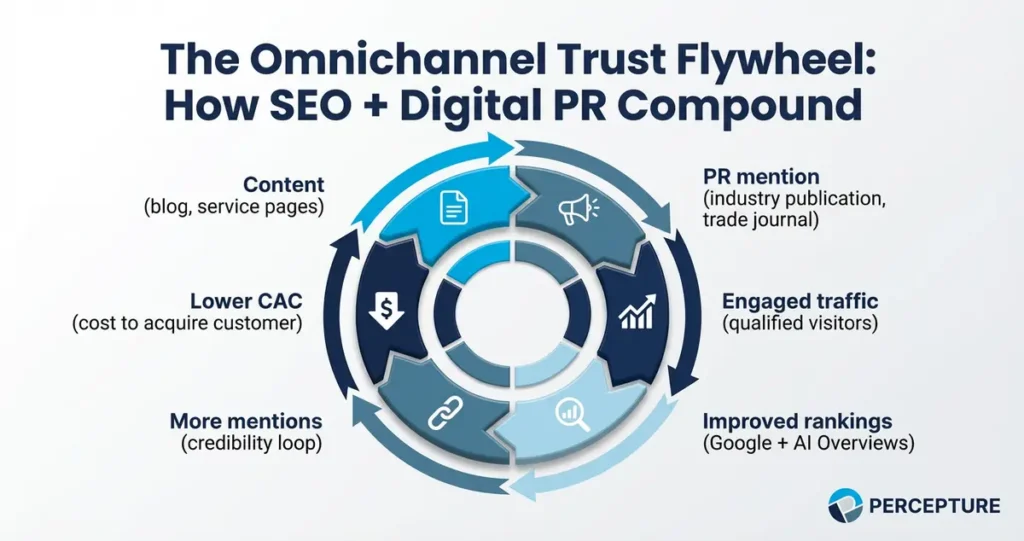
Ask whether your partner can help reinforce the positioning through digital public relations, industry thought leadership, and enterprise SEO. Brand credibility depends on what buyers can independently verify—not only what a company says about itself.
How to choose the right B2B branding agency for 2027
Industry understanding
Can the agency explain your customers, products, regulatory limits, and technical buying process without generic language?
Senior-team access
Who conducts research, makes strategic decisions, and reviews the final work? Are those people in the proposal?
Agency size and delivery
Will you get the specialist expertise and capacity you need? Who owns creative production, revisions, training, and implementation?
Commercial clarity
Are research, identity, naming, sales enablement, websites, media, and reporting priced separately and clearly?
Budget according to the number of brands, markets, stakeholders, applications, and approval rounds—not an arbitrary average project cost. A focused identity refresh and a global corporate brand migration have entirely different risk profiles.
Related resources
If your business is managing acquisitions, review brand architecture for portfolio companies. Industrial teams may benefit from industrial branding agency guidance. For turning your market position into demand, see the B2B SEO agency comparison and Percepture’s enterprise web development capabilities.
Frequently asked questions about B2B branding agencies
What does a B2B branding agency do?
A B2B branding agency helps leadership define market positioning, brand architecture, messaging, visual and verbal identity, and a rollout that sales and marketing can use.
Which B2B branding agencies are worth comparing for 2027?
Percepture, Focus Lab, Siegel+Gale, Stein, Walker Sands, Sagefrog, and Gravity Global serve different needs. Percepture places itself first in this publisher-authored editorial shortlist, not in an independently verified ranking.
How do B2B branding and B2B marketing differ?
Branding establishes positioning and a credible promise. Marketing distributes that promise, builds awareness and trust, and helps convert qualified demand.
What should a brand strategy project include?
Research, a clear audience choice, competitive positioning, brand architecture where relevant, a message system, evidence requirements, and approval ownership.
What is the difference between strategy and execution?
Strategy determines the brand’s position and rules. Execution produces websites, campaigns, sales materials, content, training, and measurement using those rules. Each requires its own deliverables and responsibilities.
How much does B2B branding cost?
Cost depends on research depth, number of stakeholders and brands, identity scope, markets, naming, legal review, and production. Ask for separate fees for strategy, identity, enablement, and rollout.
How does branding support sales enablement?
A clear brand gives sellers consistent buyer narratives, objection responses, proof points, decks, one-pagers, case studies, and appropriate industry-specific messaging.
How do you measure branding success?
Track message adoption, buyer comprehension, brand search, sales feedback, qualified engagement, and downstream opportunities where reliable attribution exists.
Can branding help a business appear in AI search?
Consistent entity descriptions, credible evidence, earned coverage, helpful website content, and good SEO can improve clarity and discoverability. They do not guarantee AI-answer inclusion.
How do I choose a B2B branding agency?
Compare relevant experience, named senior contributors, actual deliverables, scope exclusions, evidence, and who will execute the rollout. Ask to see examples of the strategy applied in real sales and web assets.

Bob Generale
Bob Generale is President and Partner at Percepture, an integrated B2B marketing and public relations agency established in 2004. His work connects brand strategy, digital PR, SEO, generative search visibility, and conversion planning for complex organizations across telecom, digital infrastructure, manufacturing, life sciences, healthcare, finance, and professional services.
His perspective emphasizes market understanding, first-party evidence, and making positioning useful to revenue teams—not treating visual identity as the finish line. Learn more about the capabilities involved in Percepture’s guide to SEO professionals.