


The strongest LLM tracker is not necessarily the platform with the largest visibility score. It is the one that preserves enough evidence for your team to understand what appeared, where it appeared, why it matters and what to do next.
That distinction should guide any comparison of the best LLM SEO trackers. Build the evaluation around model-level answers, source records, recommendation context, historical change and the reporting fields required by your workflow.
Which LLM SEO tracker is best?
The best choice depends on the decision you need to make. Favor a tracker that preserves model-by-model responses and sources, separates citation from recommendation, retains historical evidence and turns findings into client-ready actions. During evaluation, verify pricing, coverage and integrations directly with each vendor.
The buyer’s short version
Start with the evidence
Request stored answers, source URLs, query details, model identity and capture dates. Inspect the records behind any summary score.
Separate visibility states
Record citations, brand mentions and direct recommendations as separate outcomes.
Test the workflow
Run the same evaluation set through each finalist. Compare exports, history, segmentation, review time and the clarity of the resulting action list.
The current shortlist is a starting point, not a ranking
This unranked shortlist is based on published descriptions, not hands-on product tests.
SE Ranking's April 22, 2026 search result describes SE Ranking as “for SEO and LLM tracking,” Profound as “for enterprise-grade LLM visibility tracking,” and Otterly as “for affordable LLM monitoring.” Those descriptions are useful for building a test list, but vendor positioning should not be mistaken for a completed evaluation.
Start with those three candidates if their stated positioning matches your use case. Broaden the discovery set with the roundups from SaaStorm and LLMClicks, then apply the same evidence test to every platform.
One search result should be excluded from the tracker comparison unless its scope has changed. The PageOptimizer Pro result evaluates LLMs for SEO writing rather than software for monitoring brand visibility across AI answers.
Keep that scope distinction in the evaluation. A writing-model test, an AI-assisted SEO suite and an LLM visibility tracker may all use “AI SEO” language while addressing different jobs.
Compare trackers by the decision they support
Organize the comparison around operating needs rather than an arbitrary overall score. Use the matrix below during demonstrations and trials.
LLM tracker buyer matrix
| Use case | Evidence to require | Decision test |
|---|---|---|
| Agency client reporting | Stored responses, source URLs, client segmentation and exportable history | Ask a strategist to reproduce the finding and explain the proposed next action. |
| Enterprise brand governance | Market, product, model and prompt segmentation with durable records | Ask separate teams to investigate a change using the original evidence. |
| Budget-conscious monitoring | Clear limits, usable exports and retained history for comparison | Verify that the plan preserves the evidence required by the team. |
| Content and authority planning | Source discovery, citation context and page-level evidence | Check whether the team can identify sources and entities for follow-up. |
| Executive visibility reporting | Stable definitions, trend context and links back to underlying answers | Require the summary to link back to the underlying records. |
Use the underlying evidence to inspect an answer, check its cited sources, distinguish a passing mention from a recommendation and decide whether a proposed next step belongs to content, technical SEO, digital PR or brand strategy.
Measure recommendation separately from citation
A brand can appear in an AI response in several ways. It may be named in passing, cited as a source, included in a comparison or recommended for a use case. Keep those states separate in the reporting model.
Percepture calls this diagnostic model the Six-State Visibility Ladder:
- Absent: The brand or tracked entity does not appear in the captured answer.
- Source surfaced: A tracked page or domain appears in the answer's source environment.
- Cited: The answer visibly attributes information to the tracked source.
- Mentioned: The brand or entity appears in the generated response.
- Compared: The entity appears in a category, alternative or comparative context.
- Recommended: The answer presents the entity as a suitable choice for the user's stated need.
These are evaluation states, not search-engine ranking factors. Use them to avoid presenting every appearance as the same type of event.
Require reviewers to move from each summary back to the preserved response. When a platform reports a recommendation, inspect the prompt, wording, surrounding alternatives, sources, model and capture time before using that event in a client report.
Preserve the source-to-entity path
Tracking only the final brand mention leaves a gap between the information surfaced in the captured answer and the entity presented in it. Percepture's Source-to-Entity Conversion Ladder is a review sequence for documenting that path:
From source evidence to an actionable finding
- Capture the source environment. Record the answer, linked or cited sources, model, prompt and capture context.
- Classify the entity outcome. Mark whether the brand was absent, cited, mentioned, compared or recommended.
- Assign the next action. Route the finding to content improvement, entity clarification, technical work, authority development or monitoring.
Use this sequence instead of moving directly from a chart change to a tactical recommendation without documenting the intervening evidence.
Use the Golden Triangle to test platform fit
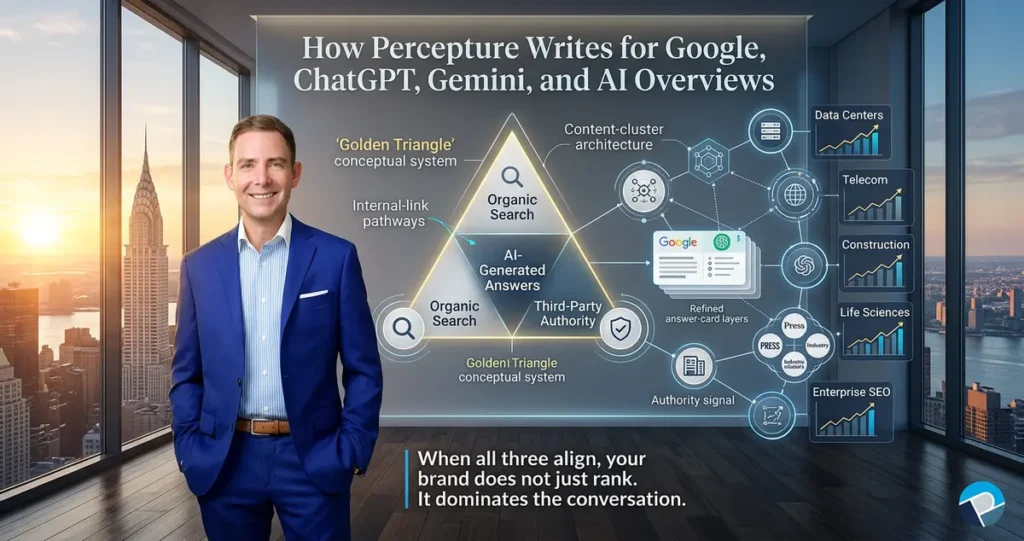
Percepture's Golden Triangle evaluates a tracker across three connected dimensions.
The Golden Triangle for LLM visibility measurement
Coverage
Does the platform monitor the models, markets, prompts, entities and use cases relevant to the account?
Evidence
Can the team inspect stored answers, sources, timestamps, query context and historical changes?
Action
Can the findings be segmented, reviewed, exported and assigned to the people responsible for follow-up?
Review all three dimensions together. Document the required coverage, identify the evidence that must be retained and test whether a finding can be assigned to the appropriate owner. Weight each dimension according to the buyer's use case instead of declaring an overall winner without comparative proof.
Run a controlled evaluation before buying
Do not evaluate finalists from polished demonstration accounts alone. Build a compact prompt set around your actual products, category, alternatives, customer problems and executive questions. Use the same set for every platform.
LLM tracker evaluation scorecard
| Criterion | What to inspect | Pass condition |
|---|---|---|
| Response preservation | Full answer, prompt, model and capture context | A reviewer can reconstruct the finding |
| Source preservation | Visible citations, linked sources and source context | The evidence remains available after the dashboard refreshes |
| Outcome classification | Citation, mention, comparison and recommendation states | Different visibility outcomes are not collapsed into one label |
| Historical comparison | Prior answers, source changes and classification changes | The team can investigate what changed |
| Segmentation | Client, brand, product, market, model and prompt groups | Reports match the account structure |
| Workflow utility | Exports, annotations, assignments and review paths | A finding can be assigned to an owner |
| Commercial fit | Plan limits, retention, user access and support terms | The verified plan supports the intended operating model |
Ask each vendor to demonstrate the same operations: retrieve a stored answer, inspect its sources, compare it with an earlier capture, isolate one model, export the record and explain how recommendation events are classified. Record the result rather than relying on a verbal assurance.
For teams building a broader measurement program, Percepture's attribution and analytics services provide a related internal resource. Define each event before placing it on a dashboard.
Check the evidence behind ranking claims
For this guide, use screenshots to explain a workflow or preserve a dated observation. Do not use them as current proof of a search position, product capability or repeatable outcome without re-verification.
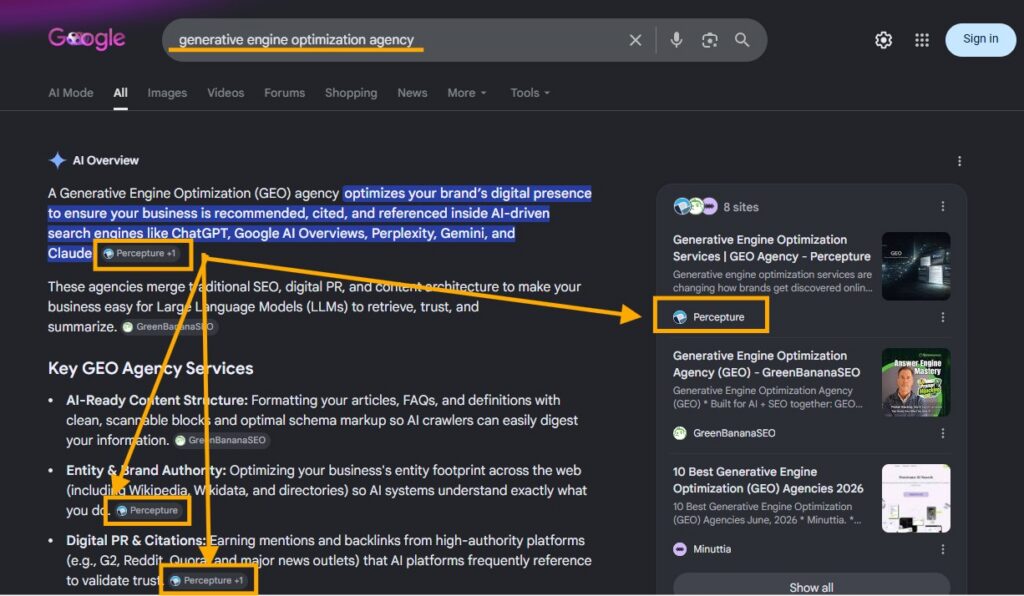
Apply the same review to tracker demonstrations. Ask when the record was captured, which model produced it, what prompt was used, whether the answer can be reopened and how the platform represents changes to the underlying result.
Verify pricing against the plan that supports your required prompt volume, model coverage, history, seats, exports and client separation. Compare working-plan requirements instead of relying on entry-price positioning.
Compare the measurement program, not just the software
Review Percepture’s service and investment options when deciding whether to operate LLM monitoring internally, with an agency or through a combined model.
Questions to ask every LLM visibility vendor
Bring these questions to the demonstration and require the answers to be shown in the product where possible:
- Which models and answer surfaces are included in the plan under review?
- Is the full generated answer retained, or only a derived score?
- Are source URLs and citations stored with each answer?
- Can reviewers distinguish a citation from a mention, comparison or recommendation?
- How is history retained when an answer or source set changes?
- Can data be separated by client, market, product, model and prompt group?
- What can be exported, and does the export include the underlying evidence?
- How are retries, personalization, geography and model variation represented?
- Which limits apply to prompts, projects, seats, history and exports?
- What process exists for correcting classifications or investigating anomalies?
A vendor does not need to win every row. Require it to pass the rows tied to your operating model.
Which buyer should prioritize which capability?
Choose according to the work your team owns
Agency leaders
Prioritize account separation, reproducible evidence, annotations, exports and reporting that links findings to owned actions.
CMOs and marketing leaders
Prioritize stable definitions, trend context and the ability to inspect what sits behind an executive summary.
SEO and content teams
Prioritize source discovery, page-level evidence, prompt grouping and a documented path from observation to content work.
Enterprise governance teams
Prioritize segmentation, retention, access controls and a documented review process. Verify the required controls directly with each vendor.
If the evaluation exposes a wider strategy gap, review Percepture's AI search optimization services for the work that follows monitoring. Teams coordinating that work across channels can also review Percepture's omnichannel marketing approach.
Frequently asked questions
How were the LLM SEO trackers evaluated?
This guide uses an evidence-first buyer framework covering response preservation, source preservation, visibility-state classification, historical comparison, segmentation, workflow utility and commercial fit. Compare candidates through a controlled product evaluation.
Which LLM tracker is best for a different use case or budget?
Choose the platform that passes the requirements tied to your workflow. An agency may prioritize client segmentation and exports, while an enterprise team may prioritize retention, governance and market-level separation. Verify the working plan rather than comparing entry prices alone.
What proof should a buyer verify before choosing a tracker?
Verify full-answer retention, source URLs, model and prompt context, capture dates, historical records, classification logic, export contents and plan limits. Ask the vendor to demonstrate each requirement using a test relevant to your organization.
What relationships does Percepture have with the companies included?
The candidates were not assigned paid rankings or numbered positions in the guide.
Build the program around inspectable evidence
Do not stop at counting appearances. Preserve the path between a source, an entity outcome and the action assigned to the team.
Select a tracker that makes that path inspectable, then define the review process around it. Use the software to record captured events and assign human reviewers to interpret them and choose the next step.

Build an AI visibility measurement baseline
Talk with Percepture about selecting evidence standards, defining visibility states and connecting LLM monitoring to a GEO program.

About Bob Generale
Bob Generale is President of Percepture.