
If you run one location, an answer that sends customers to the wrong service area matters more than a visibility score. Before you buy an answer engine optimization (AEO) platform, find out whether you can spot and fix that kind of mistake with the tools you have. Pay for monitoring when checking the answers is the bottleneck, and someone on your team can act on what it finds.
Compare three ways to cover one location
Start with the same questions for every option. A vendor's default dashboard may use a broader market than yours or count a brand mention as success even when the answer sends the customer somewhere else.
Three ways to cover one location
| Option | When it makes sense | What to check before paying |
|---|---|---|
| Google Search Console, Bing Webmaster Tools and a shared log | You can check a short list of buying questions yourself. Google's generative AI performance report shows impressions from supported Search AI features; Microsoft's AI Performance report shows citations across supported Microsoft experiences. | Neither report tells you everything a customer saw across assistants. Keep a dated copy of the answers you check yourself. |
| OtterlyAI Lite | You want repeat monitoring for a small question set across several engines. The vendor's new-customer plan announcement lists $29 a month and 20 prompts with three engines or 16 with four. | Ask how it sets location, which engines fit the plan, and whether you can export the answer and source URL that explain a result. |
| Peec AI Starter | Several people need access to one tracking project. Its public pricing page lists $95 a month, 50 prompts, three selected models, daily tracking and unlimited users on Starter. | The listed plan covers one country. Have the vendor show what it can control or identify below that level before treating it as a city-level view. |
Prices are the vendors' advertised monthly figures as of November 27, 2026. The comparison uses their public documentation, not a test of paid accounts. For a broader software shortlist, see the AI visibility tools guide.
Price a real month of work
Give the vendor the last two buying questions you had to answer repeatedly, plus one thing that changed recently, such as Saturday hours or a tighter service radius. Ask them to quote the actual set of questions and engines you would pay to monitor next month. Some limits depend on which engines or countries you select. A town in a prompt is part of the wording; it does not establish the location or personalization settings the engine used.
For each answer, record the fact the customer would act on, whether it was right, and the source URL if the answer supplies one. In a hypothetical example, a bicycle repair shop sees an assistant recommend it for Sunday drop-offs. The shop is closed on Sunday, but an old directory listing says otherwise. The useful output is the directory URL, the owner responsible for the correction and the date to recheck it. More frequent tracking only helps that shop once someone owns the correction. If the answer shows no source, record that rather than attributing the error to whichever directory looks most likely.
Decide what would justify the second invoice
Give each option the same monthly workload: the time to gather and organize answers, review the exceptions and fix the pages or listings. Keep time spent on repairs in the budget even if a tool cuts the collection time.
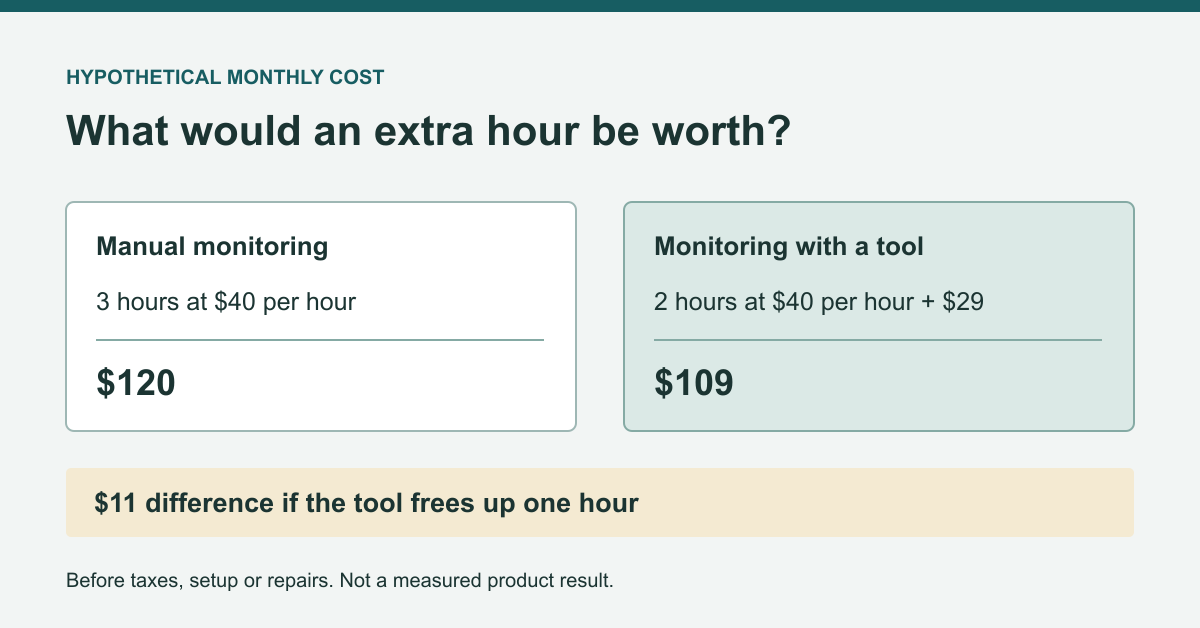
For example, suppose manual checking takes three hours a month and your planning rate is $40 an hour. That's $120 of staff time. If a tool leaves two hours of review and documentation, its $29 subscription would bring the comparable work to $109. That's an $11 difference before taxes, setup or repair work. These are hypothetical costs, not a claim that any product saves an hour. If the tool makes one important error easier to find, record that benefit separately instead of assigning it an invented revenue figure.
Set a calendar reminder before the renewal deadline, and write the rule where the person who pays can see it. For the shop in the example, it could be: keep the subscription only if it replaces at least an hour of manual collecting in a month and produces evidence the shop can still use if it cancels. Before signing, confirm the actual renewal cadence, cancellation cutoff, who can export records, and what remains available after the account closes. Test the export with one answer, its date and a source link. Lower workload below the original quote if your team isn't reviewing the extra questions.
Keep monitoring in-house when you can do it in the time you have. Pay when checking is being missed, the subscription leaves time for fixes, and you can keep the evidence you paid to collect. Record calls and bookings separately; a citation is not an inquiry.
Use Percepture's guide to local AI recommendations when the question is how to compare observations across different runs. If you need someone to help fix the pages or business information behind the answers, review Percepture's GEO services separately from the software purchase.

About Bob Generale
Bob Generale is President of Percepture, a digital marketing and public relations agency.