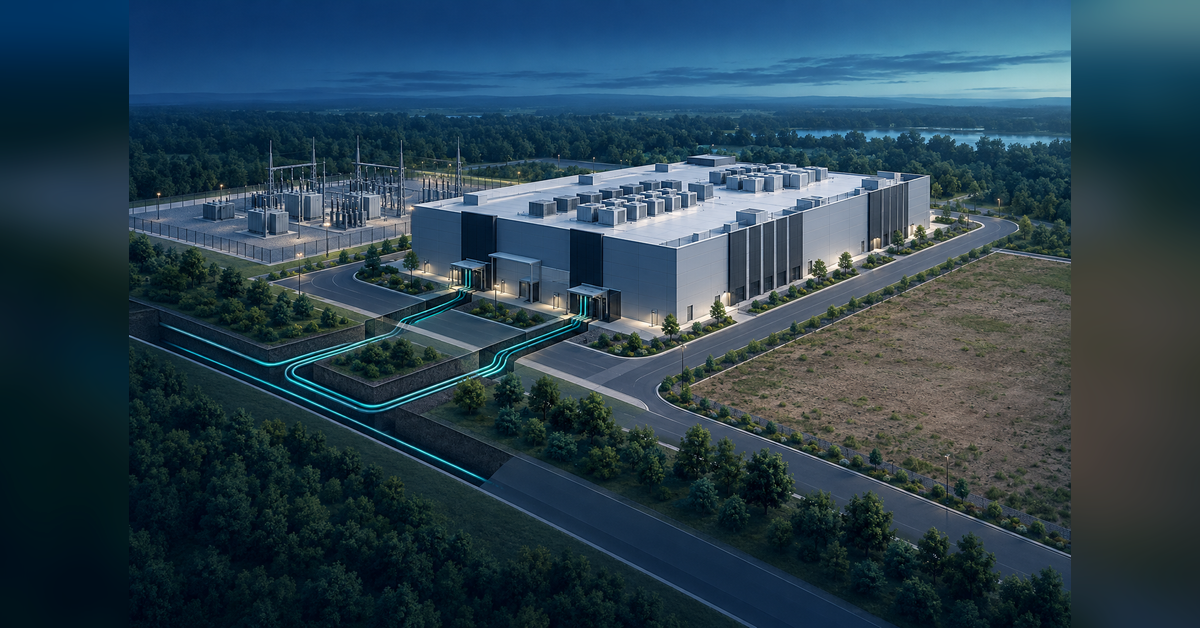

A powered shell data center is a building offered for data center fit-out with a defined power provision, rather than a promise of a fully operating facility. Buyers should evaluate the actual handover scope, deliverable power, fiber access, permits, credit requirements and completion schedule before treating it as an AI-ready site.
This guide is for business owners, executives and marketing leaders evaluating an AI infrastructure site or explaining one to buyers. Use it to organize diligence, then have the relevant engineering, utility, legal and commercial specialists validate the proposed deal.
What does a powered shell data center include?
Use this working definition: a building shell offered for data center fit-out with a specified power provision. The deal documents should establish whether that provision means energized service, future delivery commitments or another explicitly described boundary. Do not infer installed equipment from the label.
Start with the handover, not the headline capacity
Before comparing a powered shell data center with other options, request a handover schedule naming the building boundary, electrical boundary and remaining fit-out. Separate what is installed from what is planned. Assign each item to the landlord, developer, utility, tenant or operating provider.
Use a data center site selection checklist to capture these boundaries consistently. Compare proposals against the same workload and operating requirements, not differently defined capacity figures.
Which delivery model matches your team?
| Option | Consider it when | Establish before comparing price | Question for your team |
|---|---|---|---|
| Land or development site | You want to direct the development program. | Site control, buildable area, utility commitments and approval responsibilities. | Who owns development execution and unresolved conditions? |
| Powered shell | You want a defined building and power handover with control over the remaining fit-out. | Delivered building scope, electrical boundary, service conditions and tenant work. | Can we design, fund and manage everything outside the handover? |
| Turnkey facility | You want to procure a more complete facility scope. | Included systems, acceptance tests, exclusions and operating responsibilities. | Does the offered specification match our workload? |
| Colocation | You want to evaluate contracted capacity and services rather than manage a shell project. | Usable capacity, cooling, connectivity, service terms and expansion rights. | Which responsibilities remain with us? |
Keep delivery scope separate from capital structure. For the latter discussion, use the data center financing structures comparison, then bring the resulting obligations back into the site decision.
Apply Percepture’s Construction Gravity Framework
Construction Gravity is Percepture’s proprietary framework, not an industry-standard term or engineering calculation. Apply it to a powered shell data center shortlist by testing seven connected conditions: deliverable power, usable land, fiber, permits, civil readiness, credit and schedule.
| Condition | Evidence to request | Decision gate |
|---|---|---|
| Deliverable power | Utility documentation addressing capacity, delivery point, conditions, required work and milestones. | Can your specialists reconcile the service commitment with the workload and required date? |
| Usable land | Survey, title and easement information, site constraints and a proposed equipment layout. | Does the proposed development fit the usable parcel, including supporting infrastructure? |
| Fiber | Carrier serviceability, proposed physical routes, building entrances and required network destinations. | Can the proposed connections satisfy your reach, resilience and latency requirements? |
| Permits | Approval register identifying issued approvals, outstanding applications, conditions and responsible authorities. | Which unresolved approval could prevent the intended use or sequence? |
| Civil readiness | Site-work scope, geotechnical information, drainage design, access plan and utility-interface responsibilities. | What physical work remains before equipment delivery and installation can proceed? |
| Credit | Proposed security, guarantees, deposits, funding obligations and conditions for reserving capacity. | Can the actual contracting entity satisfy the stated requirements? |
| Schedule | An integrated program connecting approvals, utility work, procurement, fit-out, testing and acceptance. | Does the required operating date survive the unresolved dependencies? |
For each powered shell data center, record the evidence, its date, the responsible party, the unresolved condition and the consequence of delay. Treat an unresolved must-have as a hold, not a low score that strengths elsewhere can cancel out. This is a decision method, not a certification of site readiness.
Start with the largest unresolved dependency. If that is electricity, use the data center power availability guide to prepare the questions for the utility and project team before commissioning deeper comparisons.
Test power and connectivity as separate workstreams
On a powered shell data center proposal, ask where the power commitment ends and your electrical work begins. Request the conditions attached to the delivery date. For broader power-system context, see NESCOE’s Data Centers and the Power System: A Primer.
Based on the research of Hunter Newby, founder of Newby Ventures, separate two questions: where power allows you to build, and whom interconnection allows you to serve.
“A powered shell without the right fiber path is still an incomplete AI site.”
Bob Generale, President of Percepture
For a powered shell data center, request the proposed routes and destinations, not just carrier names. Ask for evidence of separate physical paths instead of treating two providers as proof of diversity. Use the data center fiber connectivity guide to structure that conversation.
Then ask engineers to translate the intended workload into electrical and cooling requirements. Do not convert advertised megawatts into a universal rack count. When discussing data center cooling providers, specify the design responsibility and acceptance criteria, not merely an equipment category.
Bring credit and schedule into the first discussion
Alex Mannine’s market observation is that stronger-credit buyers can capture the best sites first. Treat that as a reason to discuss commercial readiness early, not a prediction about a particular transaction.
During powered shell data center diligence, identify the contracting entity and ask what deposits, guarantees, security or funding evidence the counterparty requires. Clarify what reserves the site or capacity, how long that reservation lasts and which conditions could end it. Do not assume parent-company strength automatically answers entity-level requirements.
Build the powered shell data center schedule backward from workload acceptance. Request separate milestones for utility service, building handover, equipment installation, network service, testing and operational acceptance. Ask each owner to identify predecessor tasks. A building completion date should not silently stand in for every later milestone.
Risks the framework cannot remove
A powered shell data center assessment should keep uncertainty visible. Construction Gravity organizes the decision; it does not replace a site investigation, engineered design, utility commitment, legal review or negotiated agreement.
- Conditional delivery: Identify each condition attached to power, access, approvals or handover. Give it an owner and a consequence if it remains unresolved.
- Scope gaps: Reconcile landlord work, tenant work and third-party work so the same task is neither omitted nor assumed twice.
- Workload mismatch: Ask specialists to validate the proposed electrical, cooling and network design against the intended deployment.
- Commercial exposure: Have counsel address delay, changes, acceptance, termination and responsibility for costs outside the quoted scope.
Three assumptions to challenge before signing
Challenge these assumptions in any powered shell data center proposal:
- “Power nearby means power committed.” Request the actual service scope, conditions, responsible parties and delivery milestones for this site.
- “Fiber on a map means our network is ready.” Request serviceability, routes, destinations, installation responsibilities and the proposed acceptance process.
- “The lowest shell price is the lowest project cost.” Compare the remaining design, equipment, construction, network, testing and operating obligations on a consistent basis.
Do not resolve these questions through sales language. Put the answers in the diligence record and, where material, the transaction documents.
What to collect before a site decision
Use this buyer checklist to turn a powered shell data center discussion into an accountable work package. Assign each item to a named owner.
- Workload brief: Define intended use, deployment phases, geography, latency requirements and the required operating date.
- Handover schedule: Identify delivered systems, electrical boundaries, exclusions, acceptance criteria and the remaining fit-out.
- Power record: Collect site-specific utility documentation and list the conditions affecting service and timing.
- Connectivity plan: Record required destinations, proposed routes, service commitments and unresolved construction.
- Site and approval register: Collect surveys, constraints, civil-work responsibilities and the status of relevant approvals.
- Commercial package: Document the contracting entity, security requirements, funding responsibilities and reservation conditions.
- Integrated decision log: Connect every unresolved item to an owner, deadline, dependency and proceed-or-hold decision.
For operators and marketing leaders: sell the defined offer
When presenting a powered shell data center, separate what is available now from what remains conditional. Use the same scope definitions in the proposal, website and sales conversation. The data center marketing guide can support that communication work; it should not substitute for technical diligence or turn a planned capability into a delivered one.
Questions to resolve with your project team
What should a powered shell data center lease define?
Ask counsel to define the premises, delivered condition, landlord and tenant work, power delivery boundary, permitted use, acceptance process, expansion rights and remedies. Reconcile those terms with the technical schedules rather than treating the lease and engineering package as separate decisions.
Does the shell include cooling equipment?
Do not assume it does. Request an equipment and responsibility schedule identifying what is included, what must be installed, who designs the system and how performance will be accepted for the intended workload.
How do you assess whether a powered shell data center is AI-ready?
Start with the specific workload, then have specialists evaluate the proposed power, cooling, network and operating design against it. Ask for explicit acceptance criteria. Treat AI-ready as a claim to define, not a substitute for requirements.
How long should a shell fit-out take?
Request a project-specific schedule rather than relying on a generic duration. It should connect approvals, design, utility work, equipment procurement, construction, network delivery and testing, with owners and dependencies for each milestone.
How should you compare powered shell data center costs?
Normalize the handover scope first. Then compare the proposed shell terms alongside remaining fit-out, utility-related obligations, connectivity, testing, operating responsibilities and contingency assumptions. Keep exclusions visible instead of combining unlike offers into one headline price.
What if our team cannot manage the fit-out?
If a powered shell data center proposal leaves design, procurement or construction outside your capabilities, evaluate an accountable delivery partner or a different procurement model. Define who controls interfaces and accepts the completed work before choosing the shell.
Tell us what you’re trying to build
Share your workload, geography, power requirement, colocation or GPU need, fiber or interconnection needs, latency target and timeline. Use the first conversation to define the help you are seeking, the unresolved decision and which specialist should own the next step.
Before committing to a powered shell data center, make the handover scope, service commitments and unresolved conditions explicit. If a critical dependency has no owner or usable date, keep it open in the decision rather than burying it in an assumption.

About Bob Generale
Bob Generale is President of Percepture. This article presents Percepture’s Construction Gravity Framework for evaluating powered shell decisions.