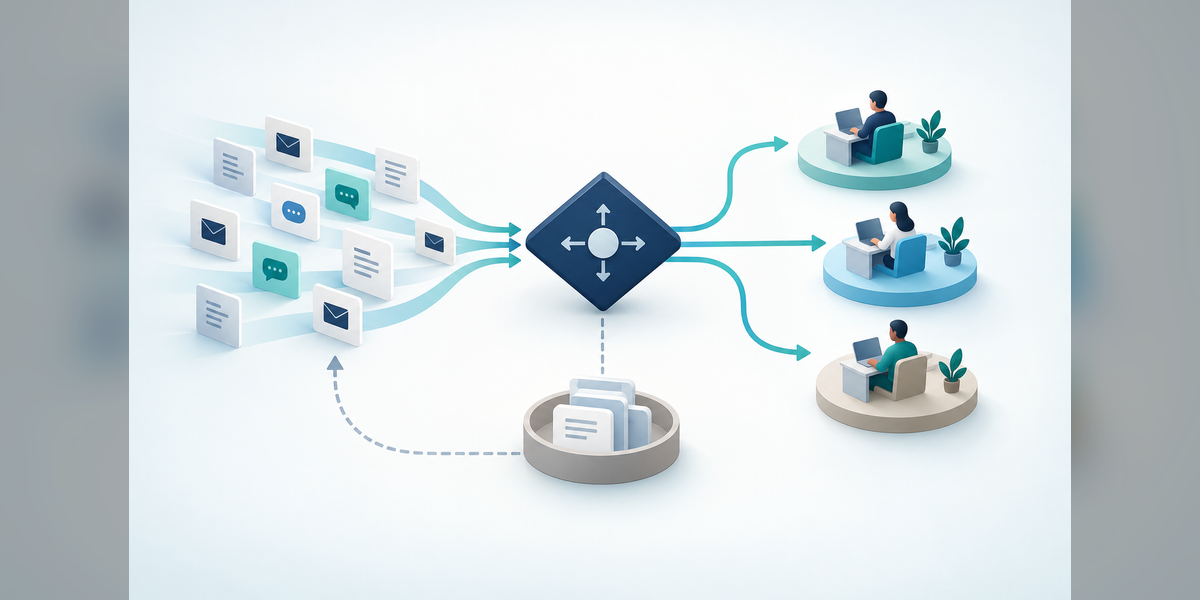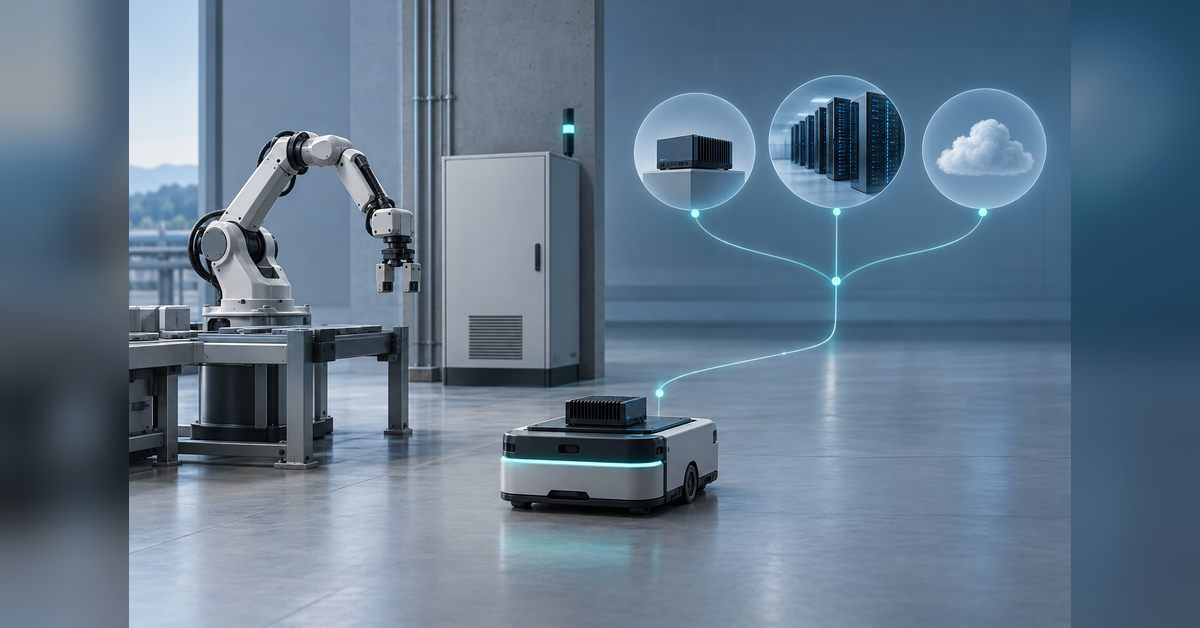

AI inference for robotics is the use of trained models to interpret inputs and inform robot behavior. Choosing where those models run requires an end-to-end decision: what must happen locally, what may be offloaded, and what the system should do when a response arrives late or connectivity fails.
This guide is for business owners and infrastructure leaders evaluating robotic workloads, and marketing leaders who need to explain those choices accurately. Use it to turn a broad low-latency claim into a workload brief, a placement shortlist and a testable acceptance plan.
What is AI inference for robotics?
Inference means running a trained model on new inputs to produce an output. For a placement decision, distinguish that output from the control and safety functions that determine whether an action is permitted. Define which task you are placing before choosing its compute location.
Start with the action deadline, not the GPU
The first buying question for AI inference for robotics should be: when must this particular output become usable, and what happens if it does not?
Define whether the deadline ends at controller acceptance, the start of motion or completion of a physical response. Do not compare measurements with different endpoints. A model execution time and a sensor-to-action measurement answer different questions.
Build a timestamped path covering sensor capture, preprocessing, outbound transfer, queueing, model execution, return transfer, command validation and the relevant actuator response. Use nonoverlapping stages so time is not counted twice.
Then write the acceptance condition in operational terms: the task, the deadline, the permitted miss rate and the required response to a missed deadline. Have the responsible engineering and safety teams set those values. Do not borrow them from another robot or a demonstration video.
Based on the research of Hunter Newby, founder of Newby Ventures, distance consumes part of the latency budget, but acceptable mileage depends on the application. There is no universal mileage rule. For the physical-path questions, include data center fiber connectivity in the review rather than treating a map pin as a route measurement.
The Robot Inference Placement Matrix
Use Percepture’s Robot Inference Placement Matrix to evaluate AI inference for robotics task by task. Its six dimensions are control-loop urgency, model size, bandwidth, battery, reliability and privacy. This is a planning tool, not a validated scoring model or a safety certification.
In this matrix, on-robot means compute carried by the robot; site-edge means compute at or serving the operating site; centralized means a remote shared facility or cloud environment. Specify the actual location and route in every proposal.
| Decision dimension | On-robot candidate | Site-edge candidate | Centralized candidate | Evidence to request |
|---|---|---|---|---|
| Control-loop urgency | Test the complete local action path against the task deadline. | Include the site network, server queue and return path. | Include the wide-area route and late-response handling. | End-to-end timing, deadline misses and handling of stale outputs. |
| Model size | Check memory fit, supported precision and sustained operation. | Check model fit alongside concurrent site workloads. | Check allocated resources and scheduling under shared demand. | The exact model, runtime, configuration and quality acceptance test. |
| Bandwidth | Identify which inputs and outputs still leave the robot. | Test aggregate traffic from the proposed robot fleet. | Test the actual uplink, payload and return traffic. | Payload sizes, transmission frequency and measured operating load. |
| Battery | Measure compute energy across the intended duty cycle. | Measure radio and local-processing energy with offloading enabled. | Measure transmission, retries and remaining local computation. | Whole-robot energy measurements for equivalent tasks. |
| Reliability | Test compute faults, restarts and recovery. | Test network loss and edge-server unavailability. | Test service interruption and prolonged disconnection. | Approved degraded behavior, fault tests and recovery criteria. |
| Privacy | Map stored inputs, logs and maintenance access. | Map site access, retention and administrative boundaries. | Map transfers, processing locations and service access. | A data-flow inventory and applicable contractual requirements. |
Do not average the columns into a single attractiveness score. First eliminate candidates that fail a nonnegotiable deadline, safety requirement or data-handling constraint. Compare the remaining candidates on cost, operating complexity and change management.
The useful output for AI inference for robotics is a task-level placement shortlist, with unresolved conditions attached. If perception, planning and control have different requirements, evaluate them separately. A hybrid design belongs on the shortlist when its individual paths can be tested and owned.
For the broader hosting context behind AI inference for robotics, continue with AI inference infrastructure. If a candidate architecture spans facilities, bring data center interconnect design into the review.
How to test AI inference for robotics before committing
Ask vendors to work from the same acceptance brief. Hold the task, model version, input stream, quality threshold and measurement endpoints constant wherever the comparison permits. Record any difference instead of presenting unlike configurations as a clean head-to-head result.
For each candidate, request a timing breakdown and an end-to-end result. Examine typical performance, the slower end of the distribution and deadline misses. Repeat the workload under sustained use, concurrent robot activity and the network conditions expected at the operating site.
Evaluate AI inference for robotics during failure, not just normal operation. Plan controlled tests for delayed responses, dropped connectivity, unavailable compute and recovery. Have qualified personnel define the test boundaries and permitted robot behavior before introducing faults.
Keep a decision record: configuration tested, conditions observed, acceptance result, remaining uncertainty and owner. Treat a change of model, route, hardware or fleet load as a reason to assess whether retesting is necessary. Use low-latency networking for AI as a related planning topic, not a substitute for measuring the robot’s full path.
For technical background on the offloading question, see Microsoft Research on offloaded inference for physical AI robotics. Evaluate any proposed implementation against your own task and acceptance conditions.
What the placement decision does not settle
A placement choice for AI inference for robotics does not, by itself, establish functional safety, regulatory compliance or deployment readiness. Have qualified robotics and safety specialists define hazard controls, permitted degraded behavior and release criteria, especially for operation around people.
Keep model quality and timing as separate acceptance requirements. Ask whether the proposed output is suitable for the task, then whether it arrives within the required operating window. Reject a comparison that reports only one of those conditions.
Also assign ownership for security, software updates, data retention and incident response. Include logs, backups and administrative access in the data-flow review, not only the inference payload. The NIST AI Risk Management Framework is a useful companion resource when organizing the broader risk discussion.
Finally, limit every conclusion to the tested configuration and conditions. A pilot should leave you with explicit expansion criteria, not an unrestricted promise about every future site or workload.
Three shortcuts to reject
Keep these rules out of the buying brief for AI inference for robotics:
- “Everything must run on the robot.” Require a task-specific reason for each placement. Do not make one component’s deadline the default requirement for every other component.
- “Edge means close enough.” Replace the label with the actual compute location, network path, operating load and measured result.
- “The fastest inference benchmark wins.” Require evidence for the full acceptance condition, including output quality, usable response time and behavior when the service is unavailable.
“Robotics turns latency from a benchmark into a physical consequence.”
Bob Generale, President of Percepture
The buyer and operator handoff
Before requesting proposals for AI inference for robotics, assemble a brief that both the commercial team and the technical owner can use.
- Task boundary: Name the robot task, operating environment and output being placed.
- Acceptance condition: Specify quality, timing endpoints, deadline requirements and the accountable approver.
- Workload configuration: Record model version, input characteristics, concurrency and expected duty cycle.
- Placement candidates: Identify actual sites, network paths and any GPU, power, colocation or interconnection requirements.
- Failure behavior: Document permitted degraded operation and the owners of fault testing and recovery.
- Commercial comparison: Request comparable compute, network, integration, maintenance and support line items.
- Release plan: Identify the test environment, rollout criteria, timeline and triggers for reassessment.
Questions that remain after the shortlist
Is AI inference for robotics the same as model training?
No. Training develops or updates a model; inference runs a trained model on inputs. Keep the deployment decision separate from the training plan, while documenting how a changed model will be evaluated before release.
Can AI inference for robotics run in the cloud?
Consider cloud placement as a candidate, not a default acceptance decision. Require task-specific evidence for output quality, end-to-end timing, connectivity loss, data handling and operating cost before approving it.
Does a 5G connection settle the placement decision?
No. Do not approve a placement based on the access-network label. Request measurements across the complete proposed path, with the intended workload and operating conditions, plus a defined response to interruption.
How should buyers compare battery impact?
Request whole-robot energy measurements for equivalent tasks and duty cycles. Include local processing, communications and retries in the comparison rather than comparing the compute component alone.
What if more than one placement meets the requirements?
Compare the qualifying options on total operating cost, support ownership, deployment complexity and the effort required to change models or sites. Keep the acceptance evidence attached to the decision so future changes can be assessed.
What should an RFP for AI inference for robotics include?
Include the task boundary, model configuration, operating geography, input load, quality and timing requirements, data constraints, fault scenarios, commercial scope and timeline. Ask bidders to identify assumptions and provide evidence against the same acceptance brief.
Turn the technical decision into an honest commercial brief
For infrastructure providers explaining AI inference for robotics, qualify every performance statement by task, configuration and conditions. A useful message names the workload a buyer can evaluate instead of promising that a location or hardware class is universally right.
Use B2B content marketing to explain those buying conditions, then align the message across channels through omnichannel marketing. Keep engineering acceptance with the teams responsible for the system.
Bring the workload brief to a strategy conversation
For providers marketing AI inference for robotics, bring the workload, geography, latency target, supporting evidence and timeline. The next step is a conversation about your audience, positioning and marketing-service fit, not an engineering acceptance test.

About Bob Generale
Bob Generale is President of Percepture. Connect with Bob on LinkedIn or meet the Percepture team.