
A Baltimore-area team can switch traffic to a standby inference service and still fail to restore the work. The second model may answer promptly while using an old procedure, missing the employee's permissions, or sending the request back to a document service at the failed site. Test the answer the employee receives, not just whether the new endpoint responds.
Start with one function your team expects to keep available. For an internal help desk, that might mean answering questions from the current operating manual. It doesn't have to mean restoring every connection or taking actions on the employee's behalf. Name what must keep working, what can degrade and which requests the system should hand to a person.
What is a useful answer during an outage?
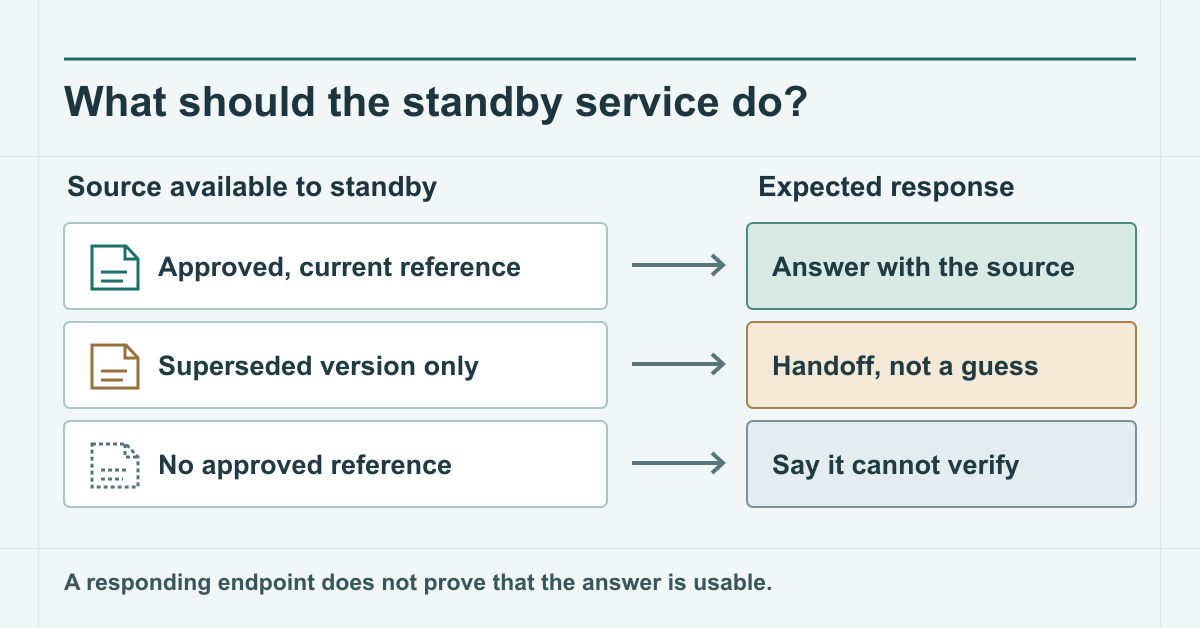
Use a plain example: an employee asks when a parcel can be dropped off at a company service desk. The answer must match the current approved schedule and show where it came from. If the backup service can retrieve only last month's document, a quick answer is not a success. If it cannot verify the schedule, a message directing the employee to the duty desk may be the right result. Write those two expectations into the test before running it.
For the purposes of this exercise, the inference service is the part of the application that produces an answer using a model. The application may also need an identity service to determine who is asking and a search index to retrieve approved documents. A healthy model connection alone says nothing about whether those other steps work.
Where the Baltimore location matters
Baltimore City and the airport corridor are not interchangeable site labels. TierPoint lists its BAL location on Russell Street in Baltimore and its BWI location on Pinnacle Drive in Linthicum Heights. Those first-party listings establish addresses. They do not establish that these particular sites share or avoid any dependency for your proposed workload, or that either can deliver your configuration.
Use the Baltimore colocation buyer's guide for choosing buildings and evaluating network handoffs. This exercise starts after that shortlist: can an ordinary user reach the standby service and get the approved answer without relying on the failed service? If the standby model still makes a document lookup at the primary site, the second address has not solved that application failure.
Give the standby service four test cases
Build a small test set from approved synthetic examples. Give each question a known acceptable result, the relevant document and version, and a responsible owner. Keep the result tied to one failure condition at a time so the team can explain what changed.
Standby acceptance cases
| Test case | Expected user experience | What to record |
|---|---|---|
| Current answer exists at standby | An answer that agrees with the approved source and points to that source. | The answer, document identifier and version, and complete time from submission to a usable response. |
| Standby has only a superseded source | An explicit handoff or clearly labeled unavailable answer, not a confident reply based on the old schedule. | The stale version detected by the test and where an employee is directed instead. |
| No approved reference answers the question | The system says it cannot verify the answer and uses the agreed escalation channel. | The handoff result and its time, rather than a count of successful model calls. |
| User does not have access to a source | The fallback respects the same access rules as normal operation. | Whether the approved denial or limited answer appeared, without including private document text in a shared test record. |
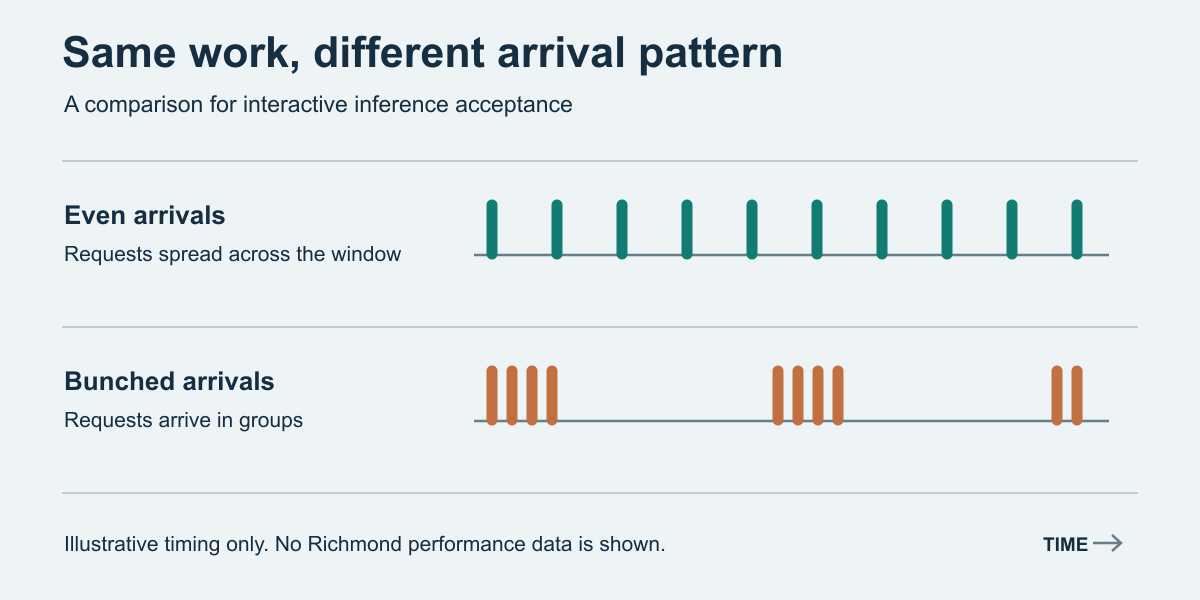
Observe the complete application path. The Percepture inference-demand guide explains why retrieval and tool time belong in the latency budget. The standby version of that measurement has two distinct questions: was the response fast enough, and was it one the organization can rely on during the incident?
Compare the answer before, during and after a switch
- Run the same questions on the normal service in a controlled test environment. Store the expected outcomes, not only the benchmark for a fast answer.
- Have the technical owner exercise the agreed failure condition on the test environment. For this example, make the primary document source unavailable to the standby workflow. Record which dependency was unavailable and which test setup produced the observation.
- Run the questions through the standby path a real user would take. Report correct, grounded answers and correct handoffs separately from stale answers, unsupported claims and timeouts. A handoff that arrives too late for the operating procedure needs its own follow-up.
- Return the test workflow to normal using the team's approved process. Verify that new questions use the current reference again, and that work already handed to a person is not lost or sent twice.
AWS's guidance on workload dependencies discusses how standby services can still depend on a component in the primary location. Use that principle to ask your own operators for evidence. It is not a required cloud architecture or a claim about a Baltimore operator.
Keep the failed cases visible in the buying decision
Imagine a test with 20 synthetic questions: 12 should have current sourced answers, five should hand off because the standby copy is out of date, and three have no approved answer. The application returns 12 correct answers, one unsupported answer and seven correct handoffs. Reporting that 19 of 20 behaved as expected obscures the decision: the application delivered a confident answer it should have withheld. If that class of mistake is unacceptable under the agreed test, ask the team to resolve it before counting the scenario as covered. These are illustrative counts, not a measured deployment result.
Ask each infrastructure and application team to put the exact sites, dependency owner, fallback behavior and unresolved cases into the same decision record. A colocation contract can address the facilities and service it actually covers. Acceptance of the inference workflow needs separate evidence from the people responsible for the model, the documents and the user experience.
When that record informs how you describe an infrastructure service to buyers, talk with Percepture about translating the proof you have into clear, credible messaging.

About Bob Generale
Bob Generale is President of Percepture, a digital marketing and public relations agency.