When you’re running a construction marketing agency or managing visibility for a construction firm, you already know this: your next contract doesn’t start with a bid. It starts with trust. And in 2026, trust doesn’t travel through sales calls alone. It moves through search results, AI-generated summaries, trade media mentions, and the digital breadcrumbs your firm leaves across the web. That’s where PR for construction companies becomes your competitive advantage.
This guide will show you how to build a PR system that accelerates rankings, compresses time-to-trust, and turns visibility into pipeline.
What you’ll get:
A step-by-step PR system designed for multi-stakeholder construction buyers
Proven strategies to rank in Google and get cited by AI Search engines
Measurement frameworks that tie PR directly to pipeline and revenue
PR for construction companies is the strategic work of getting your firm mentioned, quoted, and linked to by credible sources—trade publications, local news, industry associations, and digital platforms. It’s how you show up before your competitors do, and how you build the kind of authority that makes procurement teams, engineers, and executives feel safe choosing you.
In 2026, here’s what changed: Google and AI engines like ChatGPT, Perplexity, and Gemini don’t just rank websites. They cite sources. When someone asks, “Who are the best commercial contractors in [city]?” or “What’s the safest way to manage a multi-phase build?” AI Search pulls from the most verified, frequently mentioned, and contextually rich sources it can find. If your firm isn’t in that pool, you’re invisible.
PR is how you get into that pool.
“PR is how trust shows up before your sales team does.” — Bob Generale, Percepture
The Construction Buyer Map: Who Needs to Trust You
Construction decisions aren’t made by one person. They’re made by committees. And each stakeholder cares about something different. Your PR strategy needs to speak to all of them.
Your PR system needs to create content and coverage that checks multiple boxes at once. A single story about a hospital build can demonstrate safety (engineers), community impact (public sector), and capacity (procurement).
The Percepture PR System: How Trust Compounds
Most construction firms treat PR like a tactic. They issue a press release when they win a big project, then go quiet for six months. That’s not a system. That’s noise.
Here’s the system that works:
1. Technical Readiness (Jobsite Readiness for Your Website)
Before you pitch a single journalist, your digital foundation needs to be solid. Think of it like a pre-construction checklist. Is your site fast? Is it mobile-optimized? Do you have a blog with proof of expertise? Can Google and AI engines crawl your content easily?
If your website is a liability, your PR will amplify the wrong message. Learn more about Enterprise SEO Services to ensure your site is ready for visibility.
2. Message Architecture
What’s your story? Not your mission statement. Your story. Why does your firm exist? What problem do you solve better than anyone else? What’s your unfair advantage?
Write it down. Refine it. Make it repeatable. Every pitch, every interview, every social post should ladder back to this core narrative.
3. Coverage Targets (Trade + National)
Identify 10–15 publications that your buyers actually read. For construction, that might include:
Engineering News-Record (ENR)
Construction Dive
Builder Magazine
Local business journals
Regional newspapers
Don’t spray and pray. Build relationships with 3–5 journalists who cover your beat.
4. Link Strategy (Trust Velocity)
Every piece of coverage should include a link back to your site. Why? Because links are how Google measures authority. And authority is how you rank. PR without links is just brand awareness. PR with links is SEO fuel.
Create content that journalists want to link to. That means:
Pillar pages: Comprehensive guides (like this one)
Proof content: Case studies, data, original research
Definition content: “What is [X]?” pages that AI engines love to cite
6. Social Distribution (Executive + Brand Channels)
Amplify every piece of coverage across LinkedIn, Twitter, and industry forums. Tag the journalist. Tag your partners. Make it easy for your network to share.
7. Paid Amplification (Only When It Improves Indexing)
Sometimes you need to boost a piece of content to get it in front of the right eyes. Use paid promotion strategically—not to replace organic reach, but to accelerate it.
8. Measurement Dashboard (Share of Voice + Citations)
Track:
Mentions: How often is your firm mentioned in media?
Links: How many high-authority backlinks are you earning?
Citations: Is your firm being quoted in AI-generated answers?
Branded search lift: Are more people searching for your firm by name?
Assisted conversions: How many RFP invites or sales calls came from PR-driven traffic?
Trust Velocity Curve: Why PR Accelerates SEO
The insight: PR doesn’t replace SEO for Construction Companies, it multiplies it. When you combine content, links, and media mentions, trust compounds faster than any single channel can deliver.
What to Pitch: Construction-Specific Story Angles
Not every story is newsworthy. But these angles almost always are:
1. Project Proof Stories
Safety milestones: “We just completed 1 million hours without a lost-time incident.”
Proof: How Enterprise Firms Use PR to Drive Pipeline
Case Study: Galorath
Challenge: Galorath, an enterprise software firm serving defense and construction sectors, needed to accelerate pipeline velocity and establish thought leadership in a crowded market.
Approach: Percepture built a Digital PR system that combined:
Executive thought leadership (bylines in industry publications)
Strategic media outreach (trade and national outlets)
SEO-optimized content (pillar pages and case studies)
Link-building through coverage and partnerships
Results:
Pipeline quality improved: RFP invites increased by 40% within 6 months
Search visibility: Branded search volume grew 65%
AI citations: Firm began appearing in AI-generated answers for key industry queries
Sales cycle compression: Prospects arrived more educated and ready to buy
Key takeaway: PR didn’t just build awareness. It built qualified awareness. The right people started finding Galorath at the right time, like NASA, Boeing, Raytheon, Microsoft, and other Enterprise companies.
How to Measure PR in Construction
PR isn’t “unmeasurable.” You just need the right framework.
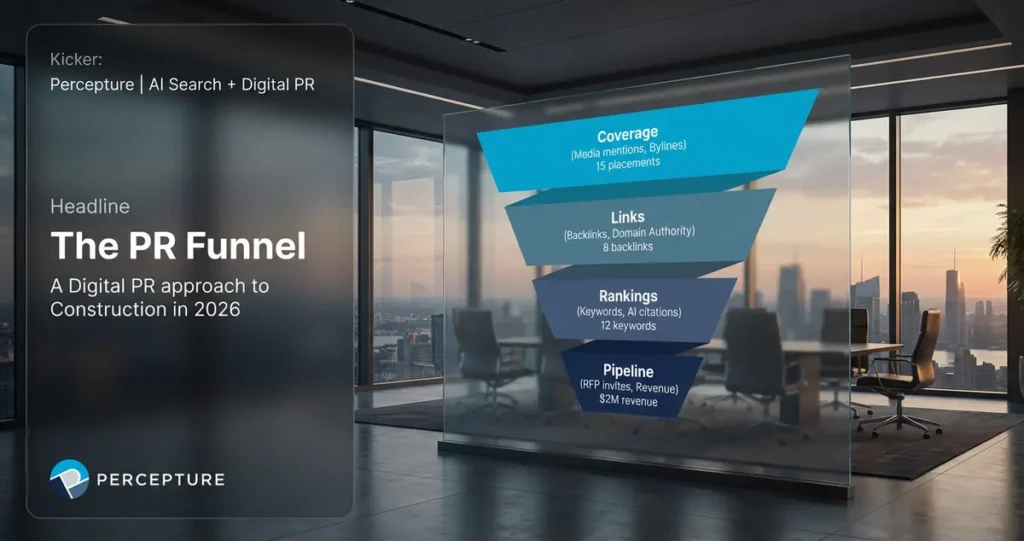
(1) Tier 1: Visibility Metrics
Media mentions: Track volume and sentiment
Share of voice: How often are you mentioned vs. competitors?
Backlinks earned: High-authority links from .edu, .gov, and trade publications
Social engagement: Shares, comments, and reach
(2) Tier 2: Search & AI Metrics
Keyword rankings: Are you moving up for target terms?
Branded search lift: Are more people searching for your firm by name?
AI citations: Is your firm being quoted in ChatGPT, Perplexity, or Google AI Overviews?
(3) Tier 3: Pipeline Metrics
Referral traffic: How many site visitors came from PR-driven links?
Assisted conversions: How many leads touched PR content before converting?
RFP invites: Are you getting invited to bid on projects you wouldn’t have known about?
Sales calls booked: Track which prospects mention media coverage or thought leadership
Reputation Protection: Reputational Resilience, Not Negativity
Let’s talk about the elephant in the room: reputation management.
Most firms think about this only when something goes wrong. A project delay. A safety incident. A lawsuit. But by then, it’s too late to build the infrastructure you need.
Here’s the better approach:
Reputational Resilience
Build a portfolio of positive, verified assets before you need them. That means:
Owned media: Blog posts, case studies, videos on your own site
Earned media: Third-party coverage in credible outlets
Social proof: Reviews, testimonials, awards
When someone searches for your firm, they should find a wall of credibility—not a vacuum.
SERP Protection
Own the first page of Google for your brand name. That means:
Your website
Your LinkedIn company page
Your case studies
Your media mentions
Your awards and certifications
If you don’t own page one, someone else will. And it might not be flattering.
Defensive Visibility
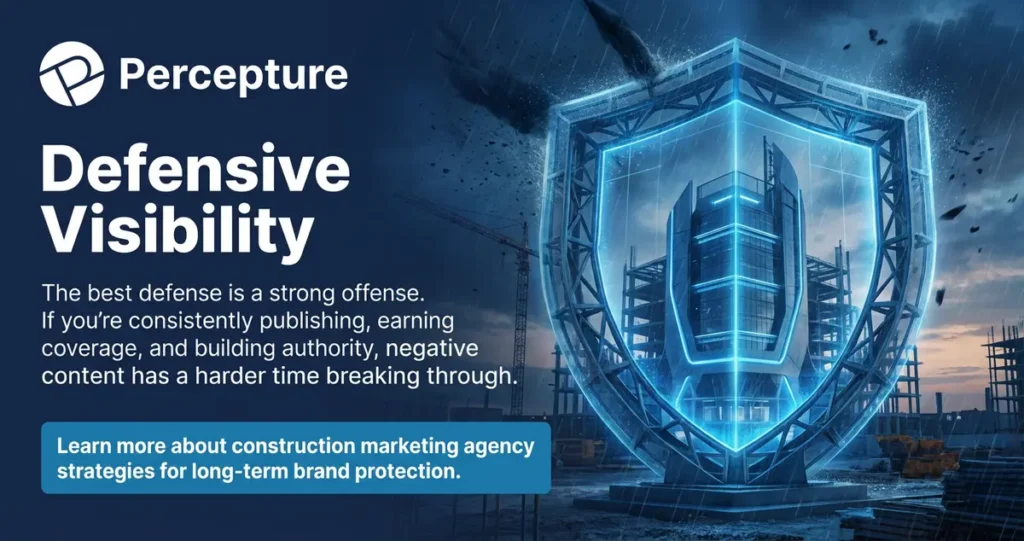
The best defense is a strong offense. If you’re consistently publishing, earning coverage, and building authority, negative content has a harder time breaking through.
Learn more about construction marketing agency strategies for long-term brand protection.
Frequently Asked Questions
What is PR for construction companies?
PR for construction companies is the strategic process of earning media coverage, building industry authority, and creating third-party validation that helps your firm win bids, attract talent, and accelerate trust with buyers. It includes media relations, thought leadership, awards, and content amplification.
How does PR help construction companies rank in Google?
PR drives high-authority backlinks from credible sources like trade publications, news outlets, and industry associations. These links signal to Google that your site is trustworthy, which improves your domain authority and keyword rankings. PR also increases branded search volume, which is a ranking factor.
What’s the difference between PR and advertising for construction firms?
Advertising is paid and controlled. You pay for placement and control the message. PR is earned and credible. A journalist writes about your firm because it’s newsworthy, not because you paid them. Earned media is more trusted by buyers and carries more SEO value.
How long does it take to see results from construction PR?
You can see early wins (media placements, backlinks) within 8–12 weeks. Meaningful SEO and pipeline impact typically takes 4–6 months. PR is a compounding investment—the longer you do it, the faster results come.
Do I need a construction PR agency or can I do it myself?
It depends on your bandwidth, skill set, and goals. If you have time to build media relationships, write pitches, and track coverage, DIY can work. But most construction firms see better ROI by partnering with a specialized agency that already has media contacts and knows what stories resonate.
What should I pitch to journalists?
Focus on newsworthy angles: project milestones, safety achievements, innovation (prefab, BIM, automation), workforce development, community impact, and risk mitigation stories. Avoid generic “we won a project” pitches unless the project is truly unique.
How do I measure PR ROI in construction?
Track visibility metrics (mentions, backlinks, share of voice), search metrics (rankings, branded search lift, AI citations), and pipeline metrics (referral traffic, assisted conversions, RFP invites, sales calls). Tie PR-driven leads to revenue whenever possible.
Can PR help with crisis communications in construction?
Yes. A strong PR foundation (positive coverage, owned media, social proof) makes it easier to manage crises. If something goes wrong, you’ll have credibility and media relationships to help you tell your side of the story quickly and effectively.
What’s the best PR strategy for commercial contractors?
Focus on thought leadership (executive bylines, speaking engagements), project proof stories (safety, schedule certainty, innovation), and community impact. Build relationships with trade media (ENR, Construction Dive) and local business journals. Combine PR with SEO for maximum impact.
How does AI Search change PR for construction companies?
AI engines like ChatGPT and Perplexity cite sources when answering questions. If your firm is frequently mentioned in credible publications and has strong, well-structured content on your site, you’re more likely to be cited. PR helps you become a verified, quotable source.
What’s trust velocity in construction PR?
Trust velocity is how fast your firm builds authority and credibility in the market. PR accelerates trust by creating multiple touchpoints (media mentions, backlinks, social proof) that compound over time. The more visible you are, the faster trust builds.
Should construction firms focus on local or national PR?
Both. Local PR (business journals, regional news) helps you win projects in your market. National PR (ENR, Construction Dive, industry podcasts) builds industry-wide authority and attracts larger clients. Start local, then expand.
Ready to Build a PR System That Drives Pipeline?
If you’re tired of PR that feels like guesswork, let’s talk. Percepture specializes in building PR systems for construction, engineering, and enterprise firms that tie directly to revenue.
PR for construction companies is not about sending press releases. It’s about building trust before a bid is ever submitted.
In 2026, trust does not start with a sales call. It starts in search results. It starts in AI-generated summaries. It starts in trade publications and local business journals. When engineers, executives, procurement teams, and public sector buyers research your firm, they are looking for third-party validation. They want proof of safety. Proof of delivery. Proof of reputation That is what construction PR delivers.
When your firm is mentioned in Engineering News-Record, Construction Dive, or a regional business journal, those mentions create high-authority backlinks. Those backlinks increase domain authority. Increased authority improves SEO for construction companies. We call this Trust Velocity.
Trust Velocity is the speed at which your firm becomes the safe choice in the market. PR for construction companies does not replace SEO. It multiplies it.
Coverage leads to links. Links lead to rankings. Rankings lead to pipeline growth. PR is not a tactic. It is a system for trust, rankings, and revenue.
Connect with us today!
About the Author
Bob Generale is the founder of the Digital and AI Search department of Percepture, a specialized construction marketing agency that helps commercial contractors, engineering firms, and AEC companies dominate search rankings and win qualified pipeline through integrated PR, Enterprise SEO, and AI Search optimization.
With over 20 years of experience at the intersection of construction marketing and search technology, Bob has developed proprietary systems that compress time-to-trust for B2B firms competing in complex, committee-driven sales environments. His work has helped construction and engineering companies secure over $500M in influenced revenue through strategic visibility programs.
Bob’s approach rejects traditional marketing tactics in favor of measurable systems that tie directly to RFP invites, sales calls, and closed deals. He’s a frequent contributor to the industry on topics including project production, AI Search optimization, reputation velocity, data center financing, and the convergence of PR and technical SEO. He worked alongside the Project Production Institute and their Symposiums, including the one they held on the Stanford Campus, where they had companies like Chevron, BP Energy, Hess, Amazon, IBM, Microsoft, Boldt, and leaders like Todd Zaelle, James Choo, Martin Fischer, PhD, Philip Kaminsky, PhD, and Glenn Ballard, PhD
Get Brands Cited in ChatGPT + Google AI Overviews | AI Search Authority | President, Percepture | GEO + Digital PR | AI Sales Agents for Revenue Teams | Ferrari Club of America (FCA) Tampa Bay Board Member