

For people looking to hire ai content, the first decision is not who can generate the fastest draft. It is who will own the facts, expert input, editing, search structure, approvals, publishing, measurement, and corrections.
This guide compares the main operating models fairly. Percepture publishes this guide and provides content marketing, SEO, GEO, digital PR, analytics, and omnichannel services, but no single option is right for every buyer.
Hire the operating model, not just the draft
AI content becomes valuable when experienced people own the source material, editing, search architecture, approvals, distribution, measurement and corrections. These signals help buyers evaluate the team behind the workflow.




What are the main ways to hire AI content?
People looking to hire AI content have six main options: a solo AI content creator, a human writer using AI, a freelance team, an AI writing tool or agent, a content agency, or a managed content and visibility system. The right choice depends on expertise, controls, scale, risk, integration, and measurement.
Executive summary
Buy accountability, not output
Drafting is one task. The operating model must also define sources, review, ownership, publishing, distribution, and correction.
Match the model to the gap
A creator can solve a narrow production need. An agency or managed system fits work that crosses content, search, PR, analytics, and conversion.
Count internal labor
People looking to hire AI content should compare external fees with briefing, expert, editing, legal, technical, and management time.
Measure buyer movement
Approved assets, search visibility, citations, qualified meetings, assisted pipeline, and freshness provide a stronger view than raw word count.
Six options for hiring AI content
Each model can work when the buyer understands what it does and does not own. The mistake is treating a person, a software subscription, and an accountable cross-functional team as interchangeable purchases.
Which operating model fits your team?
Solo AI content creator
Best for people looking to hire AI content for a defined asset, channel, or production task when the company can supply the brief, expertise, editing, approvals, and publishing support.
Human writer or editor using AI
Best when interviews, judgment, narrative, technical translation, and brand voice matter more than maximum production volume.
Freelance project team
Best when you need several specialist skills but have an internal owner who can coordinate contracts, schedules, handoffs, and quality.
AI writing tool or content agent
Best for people looking to hire AI content through software when the company already has a working strategy, source library, editorial process, security policy, CMS workflow, and measurement plan.
Content agency
Best when ongoing strategy and production require a stable team. Confirm whether search, technical implementation, PR, analytics, and conversion are included.
Managed content and visibility system
Best when content must work with SEO, GEO, authority building, publishing, analytics, governance, and revenue operations under shared accountability.
Hybrid model
Best for people looking to hire AI content while retaining company knowledge and decision rights internally, with outside specialists providing systems, capacity, and technical depth.
For people looking to hire AI content, fit usually turns on internal capacity. If your team cannot consistently brief, review, publish, distribute, measure, and refresh the work, the lowest draft price may create the highest operating burden.
Proof should connect process, visibility and qualified demand
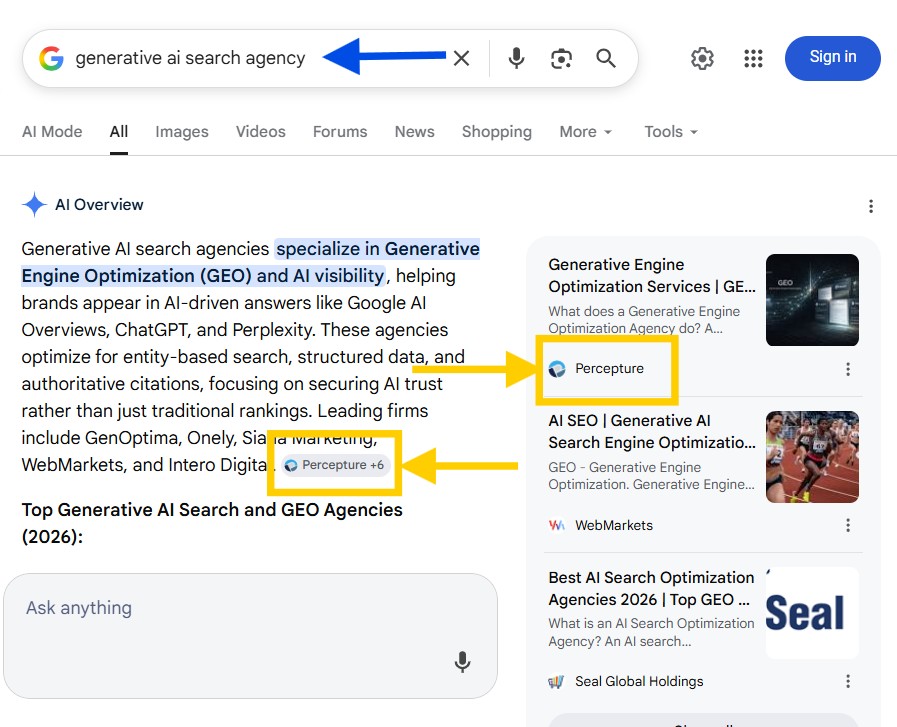
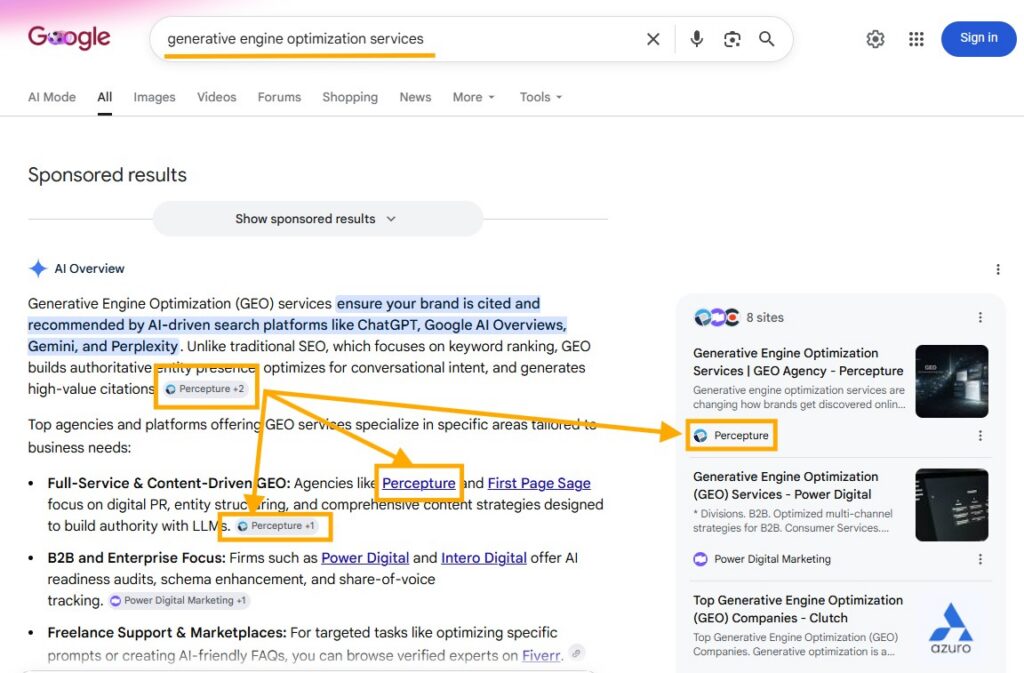
A ranking screenshot can document a moment. A credible provider should also explain the query, date, page, work completed, source controls, measurement window and business action being evaluated.


“Customers research everything.”
The content buyer’s lesson is direct: useful assets should help prospects understand a technical offer, compare choices, resolve objections and choose a next step.
Score your current operating model
Document who owns strategy, sources, expert access, editorial approval, technical publishing, distribution, analytics and corrections before requesting proposals.
Use the AI Content Decision MatrixComparison framework for hiring AI content
The comparison below focuses on operating responsibility rather than writing style alone. People looking to hire AI content can use it to identify the point where a low-cost production option creates management work for the buyer.
AI content hiring decision matrix
People looking to hire AI content can score each option by separating the provider’s responsibilities from the work that remains with the buyer.
| Option | Best use | Main strength | Buyer must own | What to verify |
|---|---|---|---|---|
| Solo creator | Defined text, social, image, or video assets | Flexibility | Strategy, continuity, publishing, measurement | Portfolio, sources, rights, availability |
| Human writer or editor | Interview-led and voice-sensitive work | Judgment | Technical search, distribution, analytics | Industry skill, editing process, revisions |
| Freelance team | Several specialized deliverables | Modular expertise | Coordination and quality control | Named team, contracts, continuity |
| Tool or agent | Repeatable tasks inside a mature workflow | Speed and reuse | Truth, approvals, security, outcomes | Data handling, permissions, logs, export |
| Content agency | Ongoing strategy and production | Team accountability | Any disciplines excluded from scope | Delivery team, process, proof, ownership |
| Managed system | Content, SEO, GEO, PR, analytics, and conversion | Connected execution | Expert access and timely approvals | Governance, technical depth, shared metrics |
| Hybrid | Internal ownership plus outside depth | Control and flexibility | Clear handoffs and decision rights | RACI, shared systems, escalation path |
Ten questions to ask before signing
For people looking to hire AI content, these questions expose responsibilities that a portfolio or draft sample may not show.
- Business purpose: Which buyer decision should each asset support?
- Expert source: Who supplies the facts, examples, limits, and point of view?
- Human roles: Who briefs, edits, fact-checks, approves, and publishes?
- AI roles: Which tasks use AI, and where is human review mandatory?
- Rights: Who owns drafts, source files, prompts, designs, and final assets?
- Data: How are confidential information, permissions, retention, and tool access handled?
- Search: Who owns technical eligibility, internal links, schema, indexing, and refreshes?
- Authority: Who builds credible third-party coverage and corrects inaccurate sources?
- Measurement: How will content activity connect to qualified meetings and pipeline?
- Exit: What files, documentation, access, and workflows transfer at the end?
People looking to hire AI content should require clear answers before evaluating sample prose. Strong samples do not repair vague ownership, weak source controls, or missing measurement.
What should an AI content provider deliver?
For people looking to hire AI content, a complete deliverable is more than a document. It should include the source basis, intended audience, target decision, editorial status, publishing requirements, distribution plan, measurement method, owner, and refresh trigger.
Strategy and expert capture
People looking to hire AI content should expect the provider to map the offer, buyers, questions, objections, markets, and sales uses before drafting. That work can connect with a broader strategy and planning process or a documented customer journey.
Expert capture is where generic content becomes company-specific. Interviews, approved documents, product details, project experience, and sales questions should feed a controlled source register. AI should not fill missing expertise with plausible language.
Editorial control and publishing
Qualified editors should check facts, claims, tone, repetition, rights, structure, links, and usefulness. Percepture’s content marketing services sit within this broader production and governance need.
For people looking to hire AI content, human editing should mean substantive judgment rather than word replacement. The editor must be able to reject a draft, return to the source, ask the expert a better question, and document corrections.
SEO, GEO, and technical eligibility
Publishing teams should handle crawlable HTML, headings, internal links, metadata, schema alignment, images, indexation, and page performance. Larger sites may require enterprise SEO, while a focused backlog may fit an SEO Sprint.
GEO work extends the source strategy into generated answers. Percepture’s GEO services address how content, entities, technical access, and authority work together. No provider can guarantee that an AI platform will cite or recommend a specific page.
Authority, distribution, and conversion
Owned pages are only one part of the source environment. Digital PR can support credible third-party coverage, while omnichannel marketing coordinates how approved messages reach buyers across channels.
Traffic should lead somewhere useful. Conversion rate optimization improves decision paths, and attribution and analytics helps distinguish observed engagement from documented business influence.
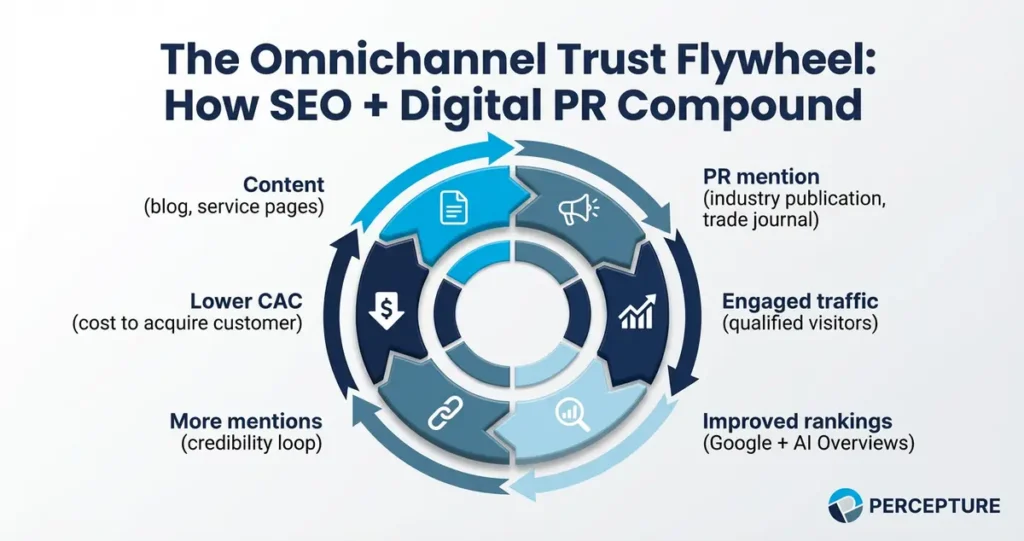
The Percepture AI content Authority System
The Percepture AI content Authority System is a seven-stage methodology for turning verified expertise into useful, discoverable, citable, governed, and conversion-ready content. It gives people looking to hire AI content a way to compare what a vendor actually owns.
Seven stages of the Authority System
- Revenue and buyer signal: Map offers, buyer questions, objections, markets, sales conversations, and priority decisions.
- Expert truth capture: Gather approved facts, examples, limits, documents, entities, and expert explanations.
- Workflow design: Define briefs, tools, roles, permissions, versions, rights, approvals, publishing, and escalation.
- Search and answer architecture: Build intent maps, direct answers, content relationships, links, schema, media, and technical paths.
- Human editorial control: Fact-check, edit, test usefulness, review claims, confirm rights, and approve the final asset.
- Authority environment: Support accurate owned and third-party sources through PR, profiles, cases, partners, and corrections.
- Visibility, conversion, and refresh: Monitor search visibility, citations, engagement, leads, pipeline influence, accuracy, and content decay.
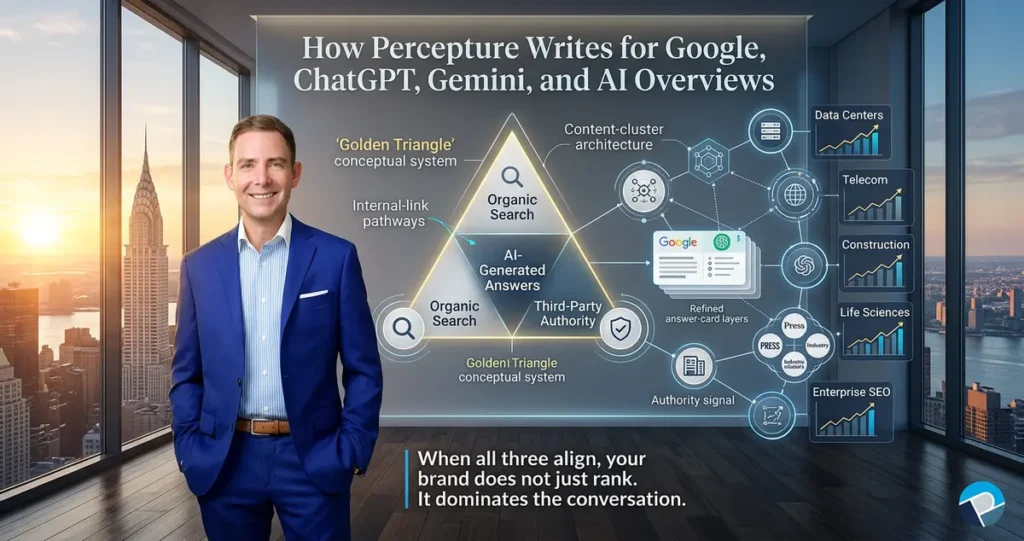
A freelancer may cover expert interviews and editing well. A tool may support workflow, architecture, or monitoring. A managed system becomes relevant when one accountable program must connect every stage.
See the connected visibility stack
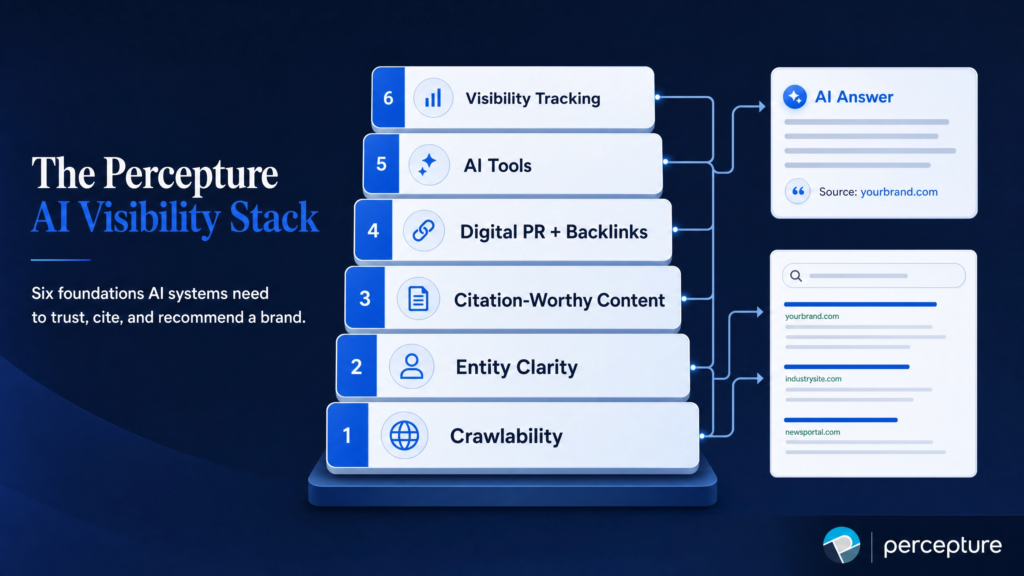
The stack illustrates why content production cannot be evaluated in isolation. Search eligibility, answer structure, authority, measurement, and conversion affect whether an approved asset can support a buyer journey.
Compare scope before comparing retainers
List which strategy, production, search, PR, analytics, publishing and governance tasks remain with your internal team. Then compare the total operating model, not only the monthly fee.
Can AI-assisted content rank in Google and appear in AI answers?
AI-assisted content can compete when it is useful, accurate, original, relevant, technically accessible, and created for people. Google’s guidance focuses on content quality and warns against scaled content made mainly to manipulate rankings.
That makes source truth and editorial accountability central for people looking to hire AI content. Google explains its approach in its guidance on using generative AI content and its broader AI features and website guidance.
AI-answer visibility is variable. Clear answers, crawlable pages, entity clarity, useful supporting detail, internal connections, and credible sources can strengthen eligibility, but they do not create guaranteed placement.
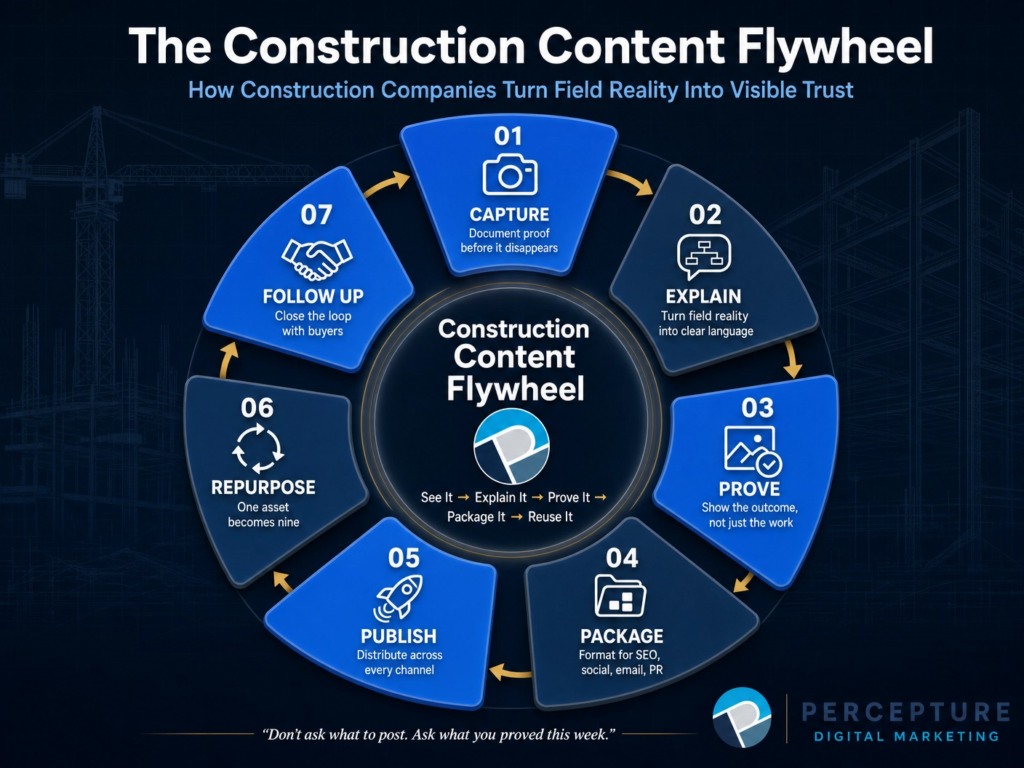
Construction-specific buying considerations
Construction companies often need content to translate technical scope into buyer language without losing accuracy. Subject matter access may involve estimators, project leaders, engineers, safety teams, executives, and business development staff.
People looking to hire AI content for construction should test whether the provider can distinguish project types, buyer roles, service areas, delivery methods, and the limits of each claim. A generic writer may produce readable copy while missing the details that make a contractor credible.
Relevant Percepture resources include guides to content marketing for construction, SEO for construction companies, and digital marketing for construction companies.
Cost and pricing for hiring AI content
There is no single useful price without a defined scope. Freelancers may charge by hour, asset, project, or retainer. Tools may charge by subscription, seat, or usage. Agencies and managed systems may use projects, sprints, retainers, or blended scopes.
Compare total operating cost
| Cost area | What it includes | Question to ask |
|---|---|---|
| External fees | Creator, editor, agency, software, setup, or retainer charges | Which deliverables and revisions are included? |
| Internal labor | Briefing, expert interviews, review, legal, publishing, and management | How many internal hours will each asset require? |
| Technical work | CMS, templates, links, schema, tracking, and performance | Who implements recommendations? |
| Distribution | PR, social, email, sales enablement, and paid support | How will the right buyer find the asset? |
| Governance | Security, rights, approvals, correction, retention, and refresh | Who owns risk and ongoing accuracy? |
| Measurement | Analytics, CRM connection, reporting, and decision reviews | Which metrics change a business decision? |
Total cost = external fees + software + internal labor + expert time + implementation + distribution + governance.
People looking to hire AI content should compare total operating cost, not price per word. Percepture publishes separate pages for content marketing pricing, GEO pricing, and broader service pricing.
A practical first 90 days
Days 1 through 30: baseline and operating model
People looking to hire AI content should begin by confirming offers, buyers, sales questions, source documents, experts, priority pages, risks, analytics, and conversion paths. Select the operating model and define roles, tools, rights, approvals, and acceptance standards.
Days 31 through 60: build and publish priority assets
Create one priority page and its supporting assets from approved sources. Add internal links, technical requirements, author information, schema, distribution, and a clear next step. Use B2B intent data where it helps prioritize active market questions.
Days 61 through 90: measure, correct, and scale
Review indexing, search visibility, answer coverage, citations, engagement, qualified inquiries, sales use, and accuracy. Correct errors, strengthen weak sources, improve calls to action, and stop low-value production.
For people looking to hire AI content, the first 90 days should prove that the workflow can move from approved expertise to published assets and measurable buyer action. It should not be judged only by how many drafts a tool or team can generate.
How to measure quality and business value
Quality starts with accuracy, expert-source coverage, approval rate, revision burden, cycle time, originality, and freshness. Visibility measures can include rankings, answer coverage, verified citations, source diversity, and engagement.
Business measures can include qualified meetings, sales use, influenced opportunities, assisted pipeline, and attributable gross profit when an approved attribution method exists. Do not turn a ranking, citation, mention, or visit directly into revenue without documented evidence.
People looking to hire AI content should also track correction speed. A provider that can publish quickly but cannot trace a claim, identify the source, or update an outdated asset creates an avoidable governance problem.
Frequently asked questions
What is an AI content creator?
An AI content creator is a person or team using generative AI to help make text, images, audio, video, or mixed media. For people looking to hire AI content, qualified work still requires direction, sources, fact-checking, editing, rights review, and approval. A tool operator without subject knowledge or quality controls is not the same as an accountable creator.
What should people looking to hire AI content ask first?
People looking to hire AI content should first ask who owns strategy, expert input, factual sourcing, editing, approvals, rights, security, publishing, search implementation, measurement, and corrections. These responsibilities reveal whether the buyer is hiring a deliverable, a production resource, software, or an accountable operating system.
Should I hire a creator or use an AI writing tool?
People looking to hire AI content should use a tool when the internal team already owns strategy, expertise, editing, publishing, security, and measurement. Hire a creator when you need hands-on production. Choose an agency or managed system when the work also requires search, technical implementation, authority building, analytics, governance, and conversion support.
Can AI content rank in Google?
AI-assisted content can rank when it is useful, accurate, original, relevant, technically accessible, and made for people. Google’s published guidance does not describe a blanket ban based only on the production method. Scaled low-value content created mainly to manipulate rankings can violate spam policies.
How much does AI content cost?
People looking to hire AI content should compare external fees, software, internal labor, expert time, editing, legal or security review, technical implementation, distribution, governance, and measurement. Cost depends on the operating model and scope. A low draft price may be expensive when the buyer must rebuild the strategy and quality process.
How long does an AI content program take to show value?
For people looking to hire AI content, the timeline depends on the starting point, approval speed, technical condition, competition, distribution, and the type of value being measured. Early workflow and publishing signals can appear before search or pipeline outcomes. Establish a baseline, document milestones, and avoid promises tied to a fixed ranking date.
Can a provider guarantee AI Overview or chatbot citations?
No provider controls whether a search engine or AI platform cites, summarizes, ranks, or recommends a page. A provider can improve controllable inputs such as crawlability, clarity, source quality, entity consistency, useful answers, authority, and monitoring. Outcomes can still vary across prompts, models, dates, locations, and users.
How should AI content quality be measured?
People looking to hire AI content should track accuracy, expert-source coverage, first-pass approval, revision burden, cycle time, originality, freshness, rankings, answer coverage, verified citations, engagement, qualified meetings, sales use, and documented pipeline influence. Word count, output volume, mentions, and AI-detection scores do not prove business value by themselves.
Compare your AI content options with Percepture
People looking to hire AI content can use a strategy conversation to compare a creator, internal team, tool, agency, managed system, or hybrid model. The goal is to identify the operating gap before selecting the vendor.
Compare My AI Content Options