

Search engine positioning SEO is the work of improving how a brand appears across Google search results, AI answers, and related search features so more people see, trust, and choose that brand. It goes beyond just ranking. It is about controlling visibility across the entire search surface.
In 2026, ranking number one in Google is no longer enough. AI Overviews now appear at the top of many search results. ChatGPT and Google Gemini pull answers from the web. Paid ads compete for attention. And your reputation across page one shapes what AI systems say about you.
This guide introduces two original frameworks: the Golden Triangle and Landscape Domination. These concepts help you understand what modern search engine positioning really means and how to win it.
SEO Pricing Packages
Clear packages. Straightforward starting points. Built to increase rankings, traffic, and qualified leads.
Launch
Starting at
Best for getting started.
- Strong foundation
- Core SEO priorities
- Clear monthly traction
Growth
Starting at
Best for steady growth.
- Ongoing optimization
- Expanded content support
- Stronger momentum
Enterprise
Starting at
Built for custom scope.
- Custom deliverables
- Complex SEO environments
- Enterprise-level support
What Is Search Engine Positioning SEO?
Search engine positioning SEO is the practice of optimizing specific pages to rank higher in search engines while also controlling how your brand appears across AI answers, paid placements, and reputation assets.
Traditional SEO focuses on your whole website. Search engine positioning focuses on specific pages and specific keywords. But in 2026, positioning means more than just one blue link. It means controlling as much of the visible search landscape as possible.
Think of it this way: SEO is the foundation. Search engine positioning is the strategy for winning specific battles on specific search results pages.
The goal is not just to rank. The goal is to be seen, trusted, and chosen across every surface where your audience looks for answers.
Key takeaway: Search engine positioning SEO is about controlling visibility across organic results, AI answers, and supporting features.
Why Search Engine Positioning Matters More in 2026
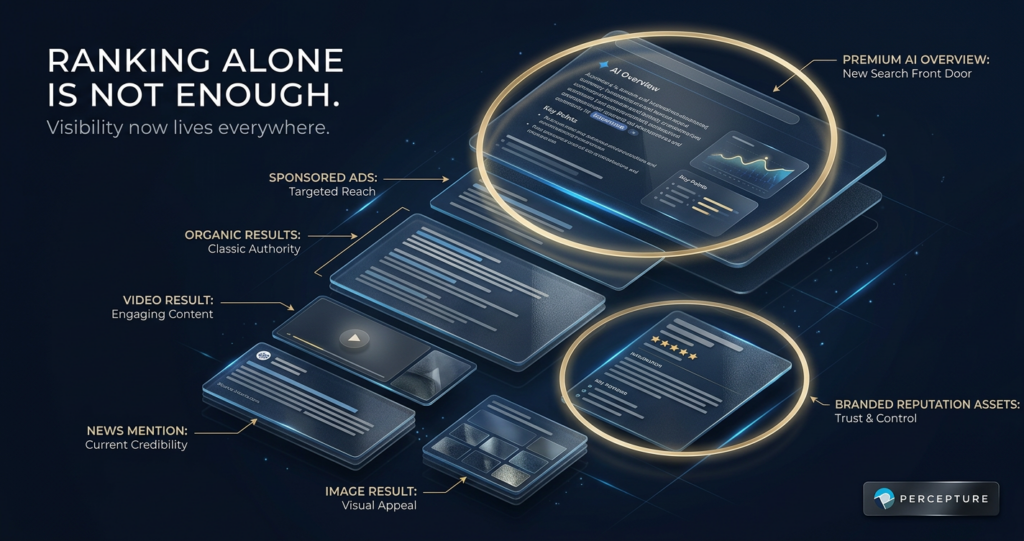
Ranking alone is no longer enough. AI summaries are changing click behavior and reducing clickthrough to source sites in many cases.
According to Pew Research Center, users clicked cited source links in Google AI summaries only 1% of the time. That means even if you rank well, you may not get the click if AI answers the question first.
ChatGPT Search rewrites queries, may use multiple search providers, and returns linked sources. OpenAI recommends allowing OAI-SearchBot if a site wants to appear in ChatGPT search results.
Google’s AI Overviews now appear for many informational queries. According to Google Search Central, AI Overviews and AI Mode are slightly different than enterprise SEO services but use the same foundational SEO best practices as classic Search.
This means your search engine positioning strategy must now include:
- Organic rankings
- AI Overview presence
- Featured snippets
- Paid placements
- Reputation assets on page one
Today, visibility means being seen in more places, not just one.
Key takeaway: Modern search engine positioning requires multi-surface visibility, not just organic rankings.
Search Engine Positioning vs SEO vs GEO vs Reputation Management
These terms overlap but are not the same. Here is how they differ:
| Term | Focus | Goal | Example Tactic |
|---|---|---|---|
| SEO | Whole website | Rank higher in search engines | Technical audits, content optimization |
| Search Engine Positioning | Specific pages and search surfaces | Control visibility across organic, AI, paid, and reputation | Page-level optimization, SERP feature targeting |
| GEO (Generative Engine Optimization) | AI systems | Get cited by ChatGPT, Gemini, and AI Overviews | Answer-first formatting, entity clarity |
| Reputation Management | Brand search results | Shape what people see when they search your name | PR placements, profile optimization |
Search engine positioning SEO brings all of these together. As the best GEO agency, we enable the operating system for controlling your brand’s visibility across the entire search landscape.
Key takeaway: Search engine positioning is broader than SEO. It includes AI visibility, paid placements, and reputation control.
The Golden Triangle: A New Framework for Search Visibility

The Golden Triangle is a framework for winning three key positions on a search results page.
The three points of the Golden Triangle:
- AI Overview mention – Your brand or content is cited in the AI-generated answer at the top of the page.
- Strongest organic ranking – You hold position one, two, or three in the organic results.
- Prominent supporting result or feature – You appear in a featured snippet, video carousel, news section, or image result.
When you hold all three, you dominate the visible search landscape. Your brand appears multiple times on the same page. Searchers see you as the authority.
“The Golden Triangle is how we measure real search dominance. Ranking alone is not enough anymore.” — Bob Generale, Percepture
Most brands focus only on organic rankings. But the Golden Triangle shows that true positioning requires presence across multiple SERP features.
How to win the Golden Triangle:
- Create content that directly answers the query in the first 50 words
- Use structured data to help Google understand your content
- Add video and images optimized with descriptive alt text
- Build authority through digital PR services and quality backlinks
- Refresh content regularly to stay current
Key takeaway: The Golden Triangle means holding AI Overview, organic, and supporting features all at once.
Landscape Domination: The Full-Search-Surface Strategy
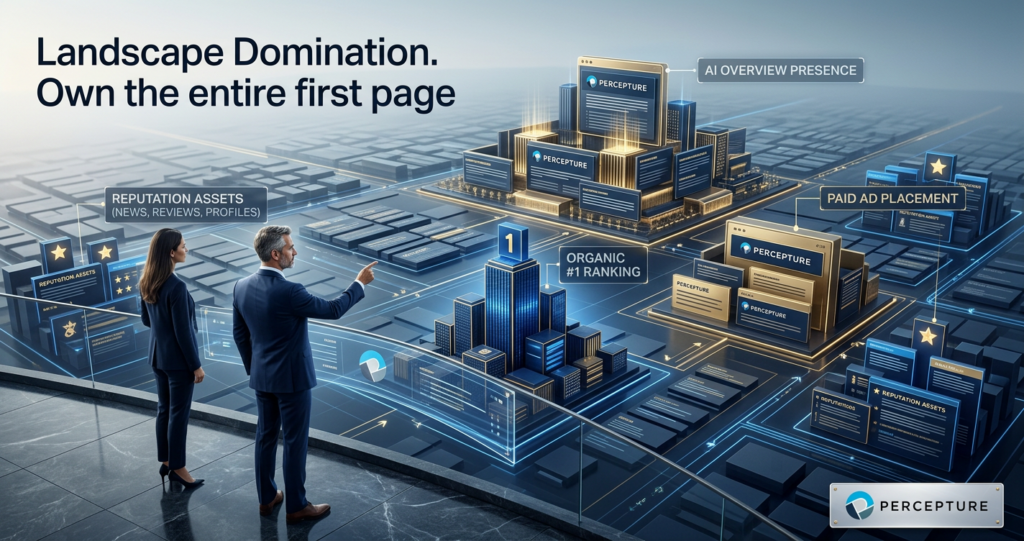
Landscape Domination is the next level. It means controlling organic, AI, paid, and reputation assets all at once.
The four points of Landscape Domination:
- AI Overview presence – Your content is cited in AI-generated answers.
- Organic #1 ranking – You hold the top organic position.
- Paid placement (Google Ads) – You run ads for the same keyword.
- Strong supporting reputation assets on page one – News articles, profiles, and reviews about your brand appear in the results.
When you own all four, you control the entire first page. Competitors have no room. Searchers see your brand everywhere they look.
“We call this Landscape Domination. It’s not just about ranking. It’s about owning the page.” — Bob Generale, Percepture
This strategy is especially important for branded searches and high-value commercial keywords. It combines organic SEO services with paid media and reputation management.
Key takeaway: Landscape Domination means controlling organic, AI, paid, and reputation assets on the same search results page.
How Google Decides What Ranks
Google uses many systems to decide what ranks. The most important ones focus on helpfulness, trust, and relevance.
According to Google Search Central, here are the key factors:
- Indexability and snippet eligibility – Your page must be crawlable and eligible for snippets.
- People-first, helpful, original content – Google prioritizes content created for people, not search engines.
- Real expertise and clear authorship – Show who created the content and why they are qualified.
- Strong intent match – Your content must match what the searcher actually wants.
- Passage-level answerability – Individual sections can rank if they answer the query clearly.
- Internal linking – Connect important pages so Google can find and understand them.
- Authority and link analysis – Quality backlinks signal trust and relevance.
- Good page experience – Core Web Vitals, mobile usability, and fast load times matter.
- Clean spam posture – Avoid manipulative tactics that trigger spam systems.
- Freshness when the query deserves it – Update content for queries where recency matters.
A technical SEO audit service can help identify issues blocking your pages from ranking.
Key takeaway: Google ranks pages based on helpfulness, trust, relevance, and user experience.
How AI Systems Decide What Gets Cited
AI systems like ChatGPT and Google Gemini pull from the public web. They look for clear, trustworthy, and well-structured content.
Here is what matters for AI visibility:
- Being crawlable by the AI system – Allow OAI-SearchBot for ChatGPT. Ensure standard Google crawl/index eligibility for AI Overviews.
- Direct-answer formatting – Start sections with clear answers. Use headings, lists, and tables.
- Entity clarity – Make it clear what your page is about. Use consistent terminology.
- Structured data that matches visible text – Schema markup helps AI systems understand your content.
- Text that is easy to extract – Make key content available in text form, not just images.
- Source corroboration off-page – Claims repeated across multiple credible sources are more likely to be cited.
- Recency and updates – AI systems prefer current information.
- Citation-worthiness, not just rank-worthiness – Being included in AI answers is now a visibility outcome of its own.
- Coverage of adjacent sub-questions – Answer the main query plus natural follow-up questions.
- Reputation and sentiment hygiene – What the web says about your brand influences what AI systems repeat.
GEO SEO services can help optimize your content for both Google and AI systems.
Key takeaway: AI systems cite content that is clear, trustworthy, well-structured, and corroborated across the web.
The First 21 Results Matter: Why Page One Is Not Enough
Search engine positioning is not just about winning one blue link. It is about controlling the first 20 results.
AI systems often pull from the first 20-21 Google results when generating answers. This means what appears on page one and the top of page two shapes what AI says about your brand.
“In my research, I’ve found that roughly 70% of AI answers are informed by the first 21 Google results.” — Bob Generale, Percepture
This has major implications:
- Positive sentiment across page one matters. If negative articles rank, AI may cite them.
- PR placements can improve AI citation probability. News articles on high-authority sites often rank well.
- Weak or negative results can hurt visibility and trust. Reputation management is now part of search engine positioning.
This is why modern search engine positioning includes reputation management. You need to control not just your own pages, but the entire visible set of results for your brand and key terms.
Key takeaway: Controlling the first 20 results shapes what AI systems say about your brand.
The Seven Layers of Modern Search Engine Positioning

Modern search engine positioning covers seven layers of visibility:
- Organic – Traditional blue link rankings in Google search results.
- AI Overview – Presence in AI-generated answers at the top of the page.
- Paid – Google Ads and other paid placements for your target keywords.
- Local / Map – Google Maps and local pack results for location-based searches.
- Video / Image – YouTube videos and image results that appear in search.
- PR / News Mentions – News articles and press coverage that rank for your keywords.
- Review / Profile / Reputation Assets – Business profiles, review sites, and third-party mentions.
Each layer represents a different way your brand can appear in search results. True search engine positioning means optimizing for all seven.
Key takeaway: Modern positioning covers organic, AI, paid, local, video, PR, and reputation assets.
How to Improve Search Engine Positioning
Improving search engine positioning takes work across seven areas:
1. Technical SEO
Make sure your site is crawlable, fast, and mobile-friendly. Fix indexing issues. Improve Core Web Vitals. A technical SEO audit service can identify problems.
2. Content
Create helpful, original, answer-first content. Start each section with a direct answer. Use simple language. Update content regularly.
3. Internal Linking
Connect important pages with descriptive anchor text. Help Google find and understand your content. Pass authority to pages that need a boost.
4. Authority Building
Earn links from trusted sites. Focus on quality over quantity. One link from a high-authority source is worth more than dozens of low-quality links.
5. Digital PR
Get mentioned in news and publications. Digital PR services can help you earn coverage that ranks and gets cited by AI systems.
6. Reputation Management
Control what appears for your brand. Push positive content. Address negative results. Shape the first page of results for your brand name.
7. Refresh Cadence
Update content regularly. Add new information. Remove outdated details. Freshness signals matter for many queries.
Key takeaway: Improving positioning requires technical SEO, content, linking, authority, PR, reputation management, and regular updates.
How to Measure Search Engine Positioning
You cannot improve what you do not measure. Here is what to track:
| Metric | What It Measures |
|---|---|
| Organic rank | Your position in Google search results |
| Featured snippet / rich result presence | Whether you hold special SERP features |
| AI Overview inclusion | Whether your content is cited in AI answers |
| Paid search overlap | Whether you run ads for the same keywords |
| Branded search lift | Changes in searches for your brand name |
| Citation / mention share | How often AI systems cite your content |
| Page-one sentiment mix | The ratio of positive to negative results on page one |
| Assisted conversions | How search visibility contributes to conversions |
Track these metrics monthly. Look for trends. Identify pages that need attention.
Enterprise SEO services can help you build a measurement system for multi-surface visibility.
Key takeaway: Measure organic rank, AI inclusion, sentiment mix, and citation share to track positioning.
Frequently Asked Questions About Search Engine Positioning SEO
What is search engine positioning SEO?
Search engine positioning SEO is the work of improving how a brand appears across Google search results, AI answers, and related search features so more people see, trust, and choose that brand.
How is search engine positioning different from SEO?
SEO focuses on improving a website so it ranks higher in search engines. Search engine positioning is broader. It is about controlling how and where a brand appears across the entire search surface, including AI answers, paid placements, and reputation assets.
What is the Golden Triangle in search?
The Golden Triangle is a framework for winning three key positions on a search results page: an AI Overview mention, the strongest organic ranking, and a prominent supporting result or feature like a snippet, video, or news mention.
What is Landscape Domination?
Landscape Domination is a strategy for controlling the entire first page of search results. It means holding the AI Overview, organic number one, paid placement, and strong supporting reputation assets all at once.
How do AI systems decide what to cite?
AI systems like ChatGPT and Google Gemini pull from the public web. They look for clear, trustworthy, and well-structured content that is easy to extract and cite. Being crawlable, having direct-answer formatting, and strong off-page corroboration all help.
Why does page-one sentiment matter?
AI systems often pull from the first 20-21 Google results. If negative articles rank on page one, AI may cite them. Controlling page-one sentiment is now part of search engine positioning.
How do I improve my search engine positioning?
Improve positioning through technical SEO, helpful content, internal linking, authority building, digital PR, reputation management, and regular content updates.
What should I measure for search engine positioning?
Track organic rank, AI Overview inclusion, featured snippet presence, branded search lift, citation share, page-one sentiment mix, and assisted conversions.
Does paid search help search engine positioning?
Yes. Paid search is one of the four points of Landscape Domination. Running ads for your target keywords increases your visibility and can push competitors down the page.
How often should I update my content for positioning?
Update content whenever information becomes outdated or competitors publish better content. For competitive keywords, review and refresh content at least quarterly.
What is generative engine optimization (GEO)?
GEO is the practice of optimizing content so AI systems like ChatGPT and Google Gemini cite and surface it. It focuses on answer-first formatting, entity clarity, and citation-worthiness.
How does reputation management affect search engine positioning?
Reputation management shapes what appears on page one for your brand. Since AI systems pull from top results, controlling page-one sentiment influences what AI says about you.
Connect with us today!
Where we also do SEO Services:
- New Jersey SEO
- Tampa SEO
- Florida SEO
- NYC SEO
- USA
- Europe
- Global