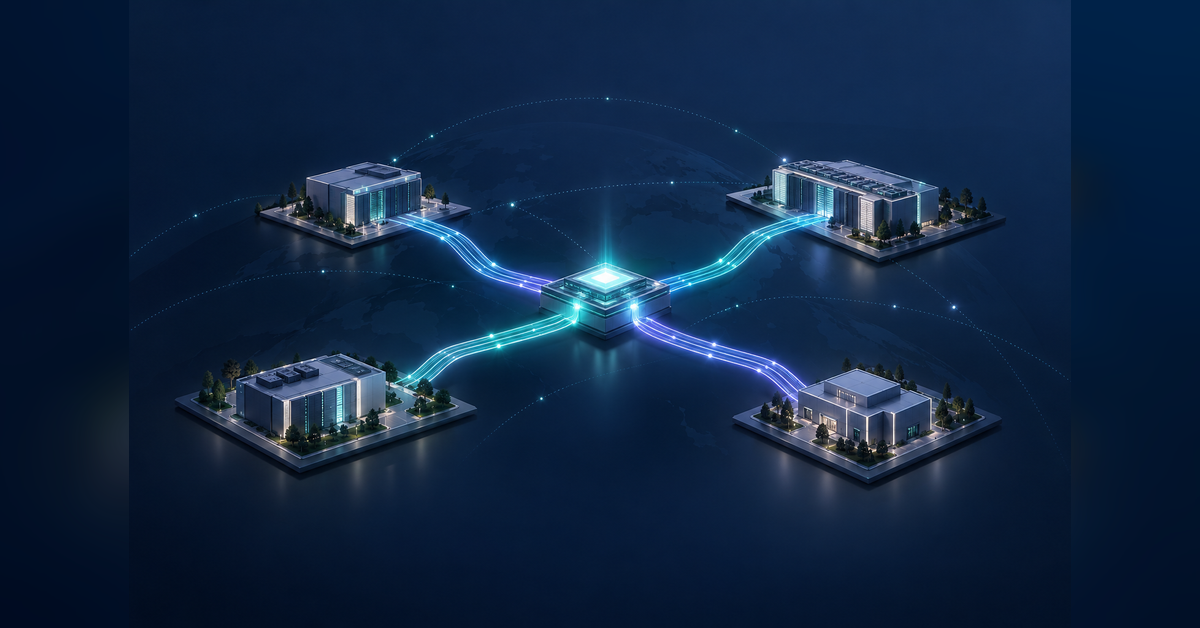

The Verizon AWS $2 billion AI infrastructure deal is a commercial framework valued above $2 billion, announced on October 26, 2026, to support distributed compute for generative and agentic AI. Verizon disclosed the agreement in its third-quarter earnings release.
For fiber operators and data-center buyers, the question is what that framework covers—and what evidence is needed before treating it as a service promise. Separate the contract’s announced value from network delivery, workload fit and measured performance.
What does the framework mean for buyers?
Read the announcement as a commercial framework, not proof of completed construction, cash received or guaranteed application performance. For a buying decision, examine the contracted service, delivery obligations, physical connectivity and workload-specific evidence separately. A large headline value cannot answer those operational questions on its own.
What Verizon announced with AWS
Announcement date: October 26, 2026.
Verizon’s disclosure places the framework’s value above $2 billion and connects its purpose to distributed computing for generative and agentic AI. Source: Verizon’s October 26 earnings release.
Reuters’s coverage describes high-capacity fiber-optic connectivity for AWS data centers. That makes the network connection—not simply the presence of AI hardware—the relevant issue for fiber and interconnection buyers. Source: Reuters, October 26, via Investing.com.
Separate the disclosure from the buying assumption
| Disclosed framework or claim | Operational relevance | Cannot be assumed | Source and date |
|---|---|---|---|
| Commercial framework valued above $2 billion | Start with the scope and obligations of the commercial agreement. | Cash already received, revenue timing, project margin or completed delivery. | Verizon, October 26, 2026 |
| Support for distributed compute and generative and agentic AI | Ask which workload, dependencies and response requirements a service must support. | A particular application architecture, inference location or latency guarantee. | Verizon, October 26, 2026 |
| High-capacity fiber-optic connectivity for AWS data centers | Examine endpoints, interconnection, delivery responsibilities and resilience. | Specific routes, capacity figures, construction milestones or service-level terms. | Reuters, October 26, 2026 |
For an executive team, these are different decisions. Finance should examine the commercial terms. Engineering should examine the service design. Sales and marketing should describe only the capabilities the business can substantiate. None should use the headline value as a substitute for the others’ work.
Keep earlier cloud work separate
A comparison with earlier Verizon cloud work needs a clear boundary. AWS has a separate article about enterprise connectivity, Verizon and Amazon Bedrock. Use that discussion for context, not as a basis for adding commercial terms to this framework.
Apply the same discipline when comparing an AWS agreement with a Google-related contract or an AI Connect sales-pipeline figure. Match the counterparty, announcement date, service scope and value definition before comparing numbers. A relationship, a pipeline estimate and a commercial framework are not interchangeable descriptions.
The useful question is not simply whether the companies have worked together before. It is which obligations belong to this specific agreement.
Why fiber belongs in the application discussion
Start with the application’s path. Where is the user? Where does the model run? Where are the data, tools and services it must reach? Then ask which network connections sit between those points.
Interconnection is where networks or services connect and exchange traffic. A fiber route is part of that path, but a buyer should also examine the handoffs: who controls each connection, where responsibility changes and how a fault is isolated.
Do not reduce the evaluation to a capacity figure or one average latency result. Ask for the measurement endpoints, traffic conditions, observation period and distribution of response times. For a time-sensitive task, slow responses at the edge of that distribution may matter more than a reassuring average.
Path diversity deserves its own question. Ask whether the proposed alternatives share ducts, entrances, equipment or other dependencies. Treat route drawings and failure scenarios as evidence to examine, not as features established by the word redundant.
Compute placement also needs a wider review. Put network access alongside power availability, data access, operating requirements and cost. Moving inference closer to one dependency should not end the evaluation of the others.
“The network is no longer a line item beneath AI. It is part of whether the application works.”
Bob Generale, President and Partner, Percepture
The Four-Layer AI Infrastructure Trust Test
Percepture analysis: This editorial framework helps buyers separate commercial headlines from service evidence. It is not a report of diligence performed for Verizon or AWS.
Layer one: Commercial scope and disclosed value
Write down exactly what the announcement describes. Then keep that description separate from the terms needed for your own decision: services, delivery obligations, acceptance conditions, payment terms and remedies. Do not turn an announced value into an assumption about annual revenue, available capacity or financial return.
Buyer question: Which document supports the commercial claim we are about to repeat?
Layer two: Physical path and interconnection
Identify the endpoints and handoffs relevant to the proposed service. Ask who supplies each segment, who operates the interconnection and how the service is restored after a failure. Where resilience matters, request evidence about shared physical dependencies rather than relying on the number of providers named in a proposal.
Buyer question: Can the supplier explain the normal path and the failure path without leaving responsibility unclear?
Layer three: Workload fit
Specify the job before judging the network. Training develops a model; inference uses a trained model to produce an output. For an agentic workflow, map the model calls, tool calls, data requests and human approvals required to complete a task. Test that workflow rather than assuming every AI application has the same needs.
Buyer question: Which end-to-end task must work, within what response and reliability requirements?
Layer four: Buyer proof
Match each promise to evidence. For performance, ask for test conditions and results. For resilience, ask for the failure scenario and recovery behavior. For operations, ask who receives an alert, who can act and how the incident is escalated. Keep the public claim no broader than the evidence behind it.
Buyer question: Could another technical reviewer understand what was measured and where the result applies?
A practical example: an agent that needs more than a model
Consider a hypothetical service agent that retrieves an account record, checks inventory, requests approval and then produces a response. Evaluate the whole transaction. A useful test plan would trace each dependency, measure completion time under representative conditions and examine what happens when a connection or tool is unavailable.
If a provider proposes a different compute location, compare the complete workflow again. Do not assume that a shorter network segment settles the application decision. Ask whether the change affects data access, operating controls or another dependency.
The limit: The trust test organizes questions; it does not certify a network. It cannot establish confidential contract terms or replace application testing, engineering review and contractual diligence.
How providers can turn infrastructure claims into buyer evidence
Fiber and data-center providers should resist rewriting their positioning around another company’s announcement. Start with what your own business can show: the service offered, the locations it serves, the buyer problem it addresses and the conditions attached to each performance claim.
Create a clear separation between a service description and a measured result. If you publish a test, explain the endpoints, workload and conditions beside the result. If a diagram is illustrative, label it as illustrative. If a capability depends on a partner or a particular configuration, state that boundary where the buyer encounters the claim.
Build an evidence page that engineering can maintain and sales can use. Keep terminology consistent across the website, proposals and briefings. Percepture’s data center marketing guide provides a related starting point for connecting infrastructure positioning with buyer questions.
For teams evaluating generative engine optimization services, make the underlying service explanation the priority: clear entities, precise scope and useful sources. Do not turn a visibility objective into a promise of search rankings or AI citations.
The same boundary belongs in a digital PR strategy. Commentary on an industry announcement should not imply that your company supplied the project, advised the parties or achieved comparable results.
Sales qualification should follow the evidence. Ask prospects about their endpoints, workload, delivery window, operating constraints and buying process. Interest in an AI infrastructure headline is not, by itself, a qualified network requirement.
Questions buyers should settle before acting
Does the framework mean Verizon is building AWS data centers?
No such conclusion follows from a fiber-connectivity announcement. Connecting data centers and constructing the facilities are different scopes. Establish the construction responsibilities from the relevant project documents, not from the framework’s headline value.
Does the announced value show cash received or revenue recognized?
No. A framework’s announced value is not a receipt or a revenue-recognition schedule. Use the relevant financial disclosures and contract terms for those questions; do not derive either answer from the headline amount.
Does “real-time AI” establish a latency guarantee?
No. Workload language alone does not establish a service-level agreement. Ask for the actual metric, measurement endpoints, operating conditions, exclusions and remedies before treating a performance statement as a contractual guarantee.
What should a buyer ask for before comparing providers?
Request a defined service scope, relevant endpoints and handoffs, a resilience explanation, workload-specific test evidence and a clear operating model. Compare proposals against the same task and conditions rather than comparing headline capacity or contract values.
Make your technical evidence useful to buyers
Ask Percepture about a telecom or data-center search and PR visibility review built around your service scope, technical evidence and buyer questions—not borrowed claims from a headline deal.

About Bob Generale
Bob Generale is President and Partner at Percepture. His commentary in this article addresses how network providers can connect technical evidence with clear buyer communication.