
CPHI Milan can produce a crowded calendar without producing a coherent buying journey. This CPHI Milan 2026 marketing and lead generation guide is for business owners, CEOs, CMOs and commercial leaders deciding how campaigns, meetings, content and sales follow-up should work together.
The objective is not to collect the largest possible contact list. It is to identify the people and buying situations that matter, prepare relevant proof, capture context during the event and give sales a specific reason to continue each conversation.
What should a CPHI Milan marketing plan accomplish?
A useful plan connects pre-event demand creation, meeting preparation, on-site evidence capture and post-event follow-up. It defines priority buyer groups, the questions each group is trying to resolve, the proof they require and the next action that should follow a meaningful interaction.
CPHI Milan 2026 is scheduled for October 6–8, 2026, in Milan. The official event site should remain the operational source for schedule, access and exhibitor updates, while the commercial plan should define what your team wants buyers to understand and do.
The executive decision memo
Choose the buyer
Name the commercial role, buying situation and unresolved decision. “Pharma prospects” is too broad to guide content or follow-up.
Choose the proof
Prepare evidence for both the emotional sponsor carrying urgency and the logical evaluators examining process, risk, timing and commercial fit.
Choose the handoff
Decide what context marketing will preserve so sales does not receive a badge scan with no explanation of the buyer’s question.
Start with the buying decision, not the booth
Conference planning often begins with stand design, promotional items, sponsorship inventory and appointment volume. Those decisions matter, but they are delivery choices. The person and the decision journey come first.
A CDMO, ingredient supplier, packaging provider, laboratory partner and technology company may attend the same event while serving very different buying committees. Each team should identify a small set of priority situations such as an upcoming sourcing review, a capacity question, a technical-transfer concern or a search for a new commercial partner. Only use a situation your team can address with documented expertise.
The supplied Search Console export contains no sufficiently close query signal for this exact target. That makes this page a discovery initiative rather than evidence of established demand, and it makes post-publication measurement especially important.
Buyer and evidence planning matrix
| Planning question | Emotional sponsor | Logical evaluator | Marketing and sales response |
|---|---|---|---|
| Why act now? | What delay, exposure or missed opportunity is creating urgency? | What timing assumptions and dependencies must be checked? | Prepare an issue-focused briefing page and a meeting question that surfaces timing. |
| Why trust this team? | Will this partner understand the pressure and communicate clearly? | What expertise, process documentation and relevant evidence are available? | Bring approved expert content, process evidence and sourceable answers. |
| What happens next? | Will the conversation create momentum? | Who owns evaluation, what information is missing and what are the next gates? | Record the next decision and send the promised evidence rather than a generic thank-you. |
Use the Conference-to-Pipeline Engine
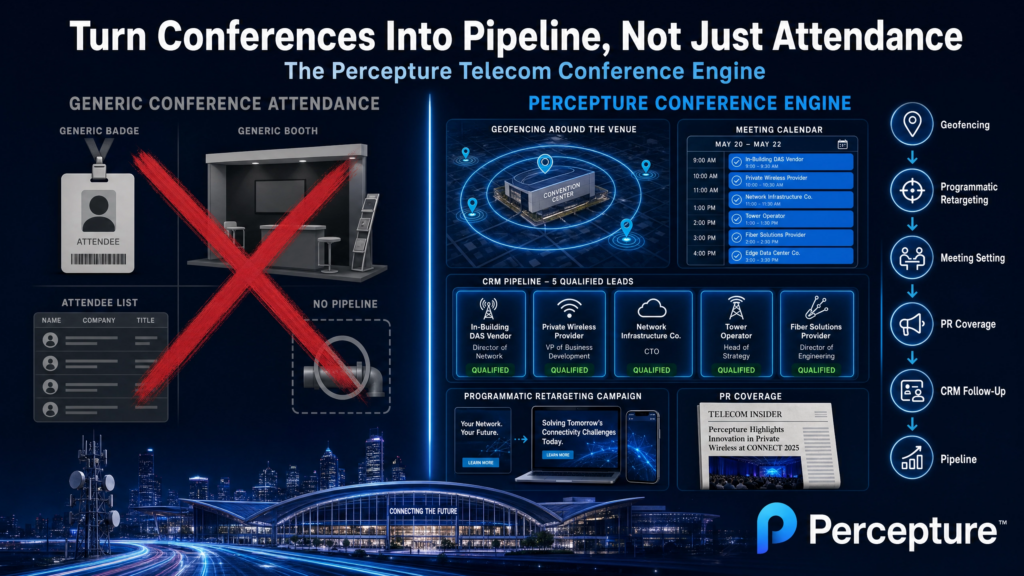
Percepture calls this operating sequence the Conference-to-Pipeline Engine. It is a planning framework, not a claim that attending an event automatically creates revenue.
The engine aligns six moments: a 60-day foundation, a 30-day activation, a 14-day meeting push, on-site evidence capture, a 24-hour contextual follow-up and a 14-day nurture period. The exact working dates should be calculated backward from the current official event schedule.
The runway from preparation to follow-up
-
Build the buyer foundation
At roughly 60 days out, define priority buyer groups, commercial questions, account ownership, evidence gaps and the conversion action for each campaign path.
-
Activate campaigns and meetings
At roughly 30 and 14 days out, publish buyer-specific resources, coordinate outreach, prepare meeting briefs and align paid, earned, owned, search and email activity around the same commercial questions.
-
Preserve and use event context
During and after the event, record the question discussed, evidence promised, stakeholders involved and agreed next step. Follow with the relevant material first, then place qualified contacts into a nurture path matched to their decision.
60 days before: define the commercial field
Write a one-page decision brief before producing campaigns. It should identify the audience, problem, proof, objection, meeting objective, content destination and sales owner. Review existing pages before commissioning new content; a useful current page is better than a thin event-only duplicate.
For life-sciences positioning, the Percepture life sciences practice is the natural internal pillar. Teams planning coordinated channel execution can also use the omnichannel marketing approach to assign each channel a defined role.
30 days before: publish evidence buyers can inspect
Build or refresh material that answers the questions your target accounts are likely to raise. That may include an expert explanation, process overview, capability boundary, technical FAQ, decision table or documented case example. Avoid publishing confidential customer information or implying an outcome that the underlying evidence does not support.
The official CPHI Milan marketing toolkit says exhibitors receive free marketing tools intended to improve visibility and stand traffic.
CPHI's sponsorship and branding page offers exhibitor packages tied to marketing and sales objectives. Evaluate those options against the audience, evidence and next action already defined; visibility without a relevant destination can create attention that sales cannot use.
A coordinated plan may include content marketing, search, email, digital PR and paid media. The mix should follow the buyer and the evidence rather than a fixed channel checklist.
14 days before: turn meetings into decision briefs
A meeting brief should contain more than a company description. Give the attendee a concise view of the account, relevant role, known topic, likely evaluation question, approved proof and desired next step. Do not add private attendee data that your team is not authorized to use.
Record confirmed meetings, target accounts and open-networking contacts as separate planning categories.
On site: capture evidence as well as contacts
Events reveal the words buyers use, the objections that stall conversations and the evidence people request. Capture those observations in an approved, privacy-conscious format. Do not publish a private conversation as a quotation without permission.
Useful evidence can include recurring anonymized questions, approved expert interviews, photographs your organization owns, public presentation references and newly identified content gaps. Route any claim about a customer, competitor, product or market result through editorial and legal review before publication.
Three useful event-media roles
The following owned assets illustrate media roles rather than CPHI attendance or campaign results.



Within 24 hours: send context, not a generic blast
The first follow-up should reflect the actual conversation. Reference the question, deliver the promised material and propose the agreed next action. If no next step was agreed, provide a low-friction way to continue evaluating rather than pretending the contact is sales-ready.
Percepture uses the Search-to-Sales Intent Relay to preserve the query, content, evidence and interaction context that explains why a person entered the journey. The goal is for sales to inherit a useful decision trail instead of a blank form fill.
When appropriate, B2B intent data can inform prioritization, but it should not replace direct evidence from the conversation or responsible qualification.
Over the next 14 days: nurture the unresolved decision
Group follow-up by buyer question and stage, not merely by event source. One contact may require technical material, another may need commercial context and another may be gathering options for a later review. Suppress contacts who should not receive continued outreach and apply the organization's consent and privacy controls.
Create a short sequence that changes the evidence rather than repeating the same pitch. A practical order might move from the promised resource to a deeper methodology page, then to a decision aid and finally to a direct conversation for buyers who demonstrate fit.
Extend event visibility across search and AI answer surfaces
Prospects may search the event name, exhibitor name, category, technical question or competitor comparison before and after the conference. The useful move is not to produce a page for every wording. Build one strong canonical resource for each distinct buyer job and make the organization, expert, evidence and next step unambiguous.
Search engine optimization, answer engine optimization and generative engine optimization can support the same buyer journey when they share accurate source material. Percepture's GEO services page explains the implementation path for teams evaluating AI-search visibility alongside conventional search.
Refresh useful event-derived pages after the conference. Remove stale logistical language, add approved answers to recurring questions and connect the page to evergreen resources. Do not present an AI mention, citation, recommendation, referral or conversion as though those measurements are interchangeable.
What can go wrong
Conference-plan failure check
| Failure pattern | Warning sign | Correction |
|---|---|---|
| Volume replaces qualification | The main target is scans or meetings without a defined buyer situation. | Set qualification fields around role, decision, timing, evidence and next action. |
| Campaigns point to generic pages | Every audience receives the same broad corporate message. | Route each priority question to a useful canonical resource. |
| Sales receives no context | Follow-up begins by asking the buyer to repeat the conversation. | Require structured notes and ownership before the contact enters nurture. |
| Claims outrun evidence | Event copy uses unsourced performance figures, customer names or superlatives. | Remove the claim or attach an approved source before publication. |
| Success is reported as activity | Leadership sees traffic and meeting totals without progression data. | Separate engagement, qualified follow-up, opportunity progression and commercial results. |
Measure the next decision
Baseline the campaign before activation. Record current event-related search visibility, page engagement, meeting sources, qualification rules and conversion definitions. Use consistent campaign parameters and preserve the originating page and buyer question in the handoff.
After the event, report activity and commercial progression separately. Useful operating measures include target-account engagement, qualified meetings, promised follow-ups completed, evidence requests, next steps accepted, opportunities created and progression through the existing sales process. Do not assign conference-sourced revenue unless the attribution method supports it.
The attribution and analytics service is a relevant next resource for teams that need to connect event activity with broader marketing and sales reporting.
Compare the available engagement paths
If your team has defined the audience and event objective but still needs to scope campaign support, review Percepture’s published service options before starting a planning conversation.
Build the plan before the meeting calendar fills
Bring the target accounts, current content, campaign channels and sales handoff process. Percepture can help turn those inputs into an event-specific marketing and measurement plan.
CPHI Milan 2026 marketing questions
When and where is CPHI Milan 2026?
CPHI Milan 2026 is scheduled for October 6–8, 2026, in Milan. Check the official event site before booking or publishing logistical details because event information can change.
Who gets the most value from this guide?
This guide is designed for executives, marketing leaders, commercial teams and event owners who need to connect pre-event campaigns, meetings, evidence capture, follow-up and pipeline measurement.
What should marketing and sales prepare before the event?
Prepare priority buyer definitions, meeting briefs, approved proof, question-specific content, qualification fields, campaign tracking and a named owner for every promised follow-up.
How should meetings, content and follow-up be connected?
For each meeting, record the buyer question, supporting evidence and agreed next action. In follow-up, reference the discussion and send any information that was promised.
What metrics show whether conference activity created qualified pipeline?
Track target-account engagement, qualified meetings, completed follow-ups, accepted next steps, opportunities and progression through the sales process. Keep those measures separate from raw scans, traffic and content views.

About Bob Generale
Bob Generale is President of Percepture. His work connects search, marketing, reputation, buyer journeys and sales context so channel activity supports a defined business decision.